


- 1. Key Takeaways
- 2. What Is MVP in Software Development?
- 3. Why Software Teams Build an MVP Before the Full Product
- 4. MVP vs Prototype vs Proof of Concept
- 5. MVP vs MMP vs MLP vs Beta: Sorting Out the Terms
- 6. Types of MVP in Software Development
- 7. Real MVP Examples Worth Learning From
- 8. How an MVP Gets Built, Step by Step
- 9. How to Tell If Your MVP Actually Worked
- 10. When an MVP Is the Wrong Call
- 11. Common MVP Mistakes That Burn Runway
- 12. How Boomdevs Solves the Overbuilt MVP Problem
- 13. Frequently Asked Questions
Summarize with
You have a product idea and a budget that can’t survive a wrong guess. Everyone keeps telling you to “start with an MVP,” but nobody agrees on what that means.
An MVP in software development is a first working release that does one core job for real users, so you can test demand before funding the full build. It’s not a demo or a rough draft. Here’s what goes into one, and how to tell if yours worked.
Key Takeaways
- MVP means minimum viable product: the smallest release that real users can actually use, built to test one business assumption.
- It exists to stop you building the wrong thing. Poor product-market fit shows up in 43% of recent venture-backed shutdowns.
- In MVP vs prototype terms, a prototype tests the design, a PoC tests feasibility, and an MVP tests demand with people who could become paying customers.
- An MVP “worked” when users come back or pay, not when it launches. Set your success and stop criteria before you build.
What Is MVP in Software Development?
An MVP in software development is the version of your product that answers your riskiest question with real users and the least possible build. That question is usually some form of “will enough people use this, and pay for it?”
The idea comes from the Lean Startup movement. Eric Ries describes the minimum viable product as the version of a new product that lets a team collect the most validated learning about customers with the least effort. That lets a team collect the most validated learning about customers with the least effort. The same source notes that Frank Robinson coined the term in 2001, before Steve Blank and Ries made it mainstream.
Notice what that definition leaves out: a feature count. Your MVP might be a single-screen web app, or a manual service with a simple form in front of it.
What makes it an MVP is the learning it buys you, not its size. If you’re scoping one now, our MVP development services page shows how that scoping works in practice.
What “Minimum,” “Viable,” and “Product” Actually Mean
Each word in minimum viable product pulls against the others, and that tension is the whole point:
- Minimum: you include only what’s needed to test your main assumption. Every extra feature delays the answer and muddies the feedback.
- Viable: what you do ship has to work well enough for someone to rely on it for a real task. A broken flow teaches you about bugs, not demand.
- Product: real users get their hands on it. A slide deck or a mockup that nobody can use doesn’t count.
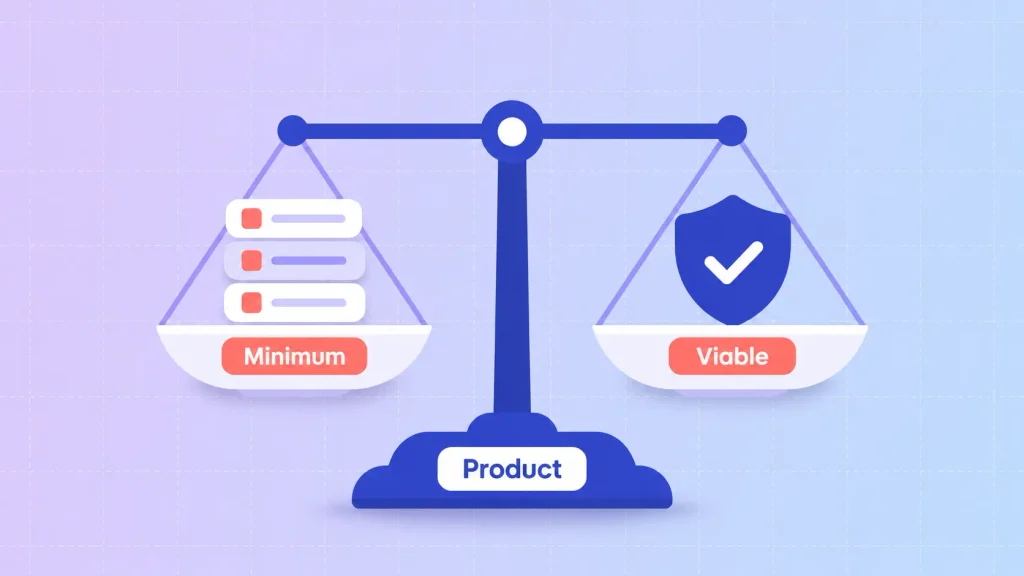
Most failed MVPs lean too hard on one word. Teams that obsess over “minimum” ship something nobody can use. Teams that obsess over “product” spend a year on version one.
What an MVP Is Not
Part of answering what is MVP in software development is knowing what it isn’t. The term gets stretched in every direction, so it helps to rule a few things out:
- Not a demo: a demo shows an idea to an audience. An MVP lets people use it while you watch what happens.
- Not a buggy draft: the scope is small, but the quality bar for what’s in scope stays high.
- Not version 1.0 with random features cut: every feature that makes it in should serve the test you’re running.
- Not only for startups: established companies use MVPs to test new products, internal tools, or new markets before a full rollout.
If your plan fails any of these, you’re probably building a prototype or a small full product, and that’s worth knowing before the budget goes out.
Why Software Teams Build an MVP Before the Full Product
You build a minimum viable product because the most expensive mistake in software is building something people don’t want. in software is building something people don’t want. The data on startup failure makes that painfully clear.
In its March 2026 analysis of 431 venture-backed companies that shut down since 2023, CB Insights found that 43% cited poor product-market fit as a cause. Running out of cash was more common, but it’s usually the symptom. The money tends to vanish after the market has already said no.
An MVP moves that “no” to the start of the project instead of the end. Here’s what you get from building one first:
- Evidence instead of opinions: sign-ups, repeat use, and payments tell you more than any survey or focus group.
- A smaller bet: you spend a fraction of the full budget to find out whether the rest is worth spending.
- A sharper roadmap: you learn which features people actually use, so the next sprint goes where demand is.
- A stronger fundraising story: investors take real usage data far more seriously than a projection in a pitch deck.
The catch is that an MVP only pays off if you’re willing to act on what it tells you, including bad news.
MVP vs Prototype vs Proof of Concept
These three get confused because they all happen early and they’re all small. The difference is the question each one answers, and who gets to see it:
| Artifact | Question it answers | Who sees it | What you get back |
| Proof of concept (PoC) | Can this be built? | Your internal team | A yes or no on technical feasibility |
| Prototype | Will people understand it? | Testers and stakeholders | Feedback on flows, screens, and usability |
| MVP | Will people use it, and pay? | Real early users | Usage, retention, and revenue signals |
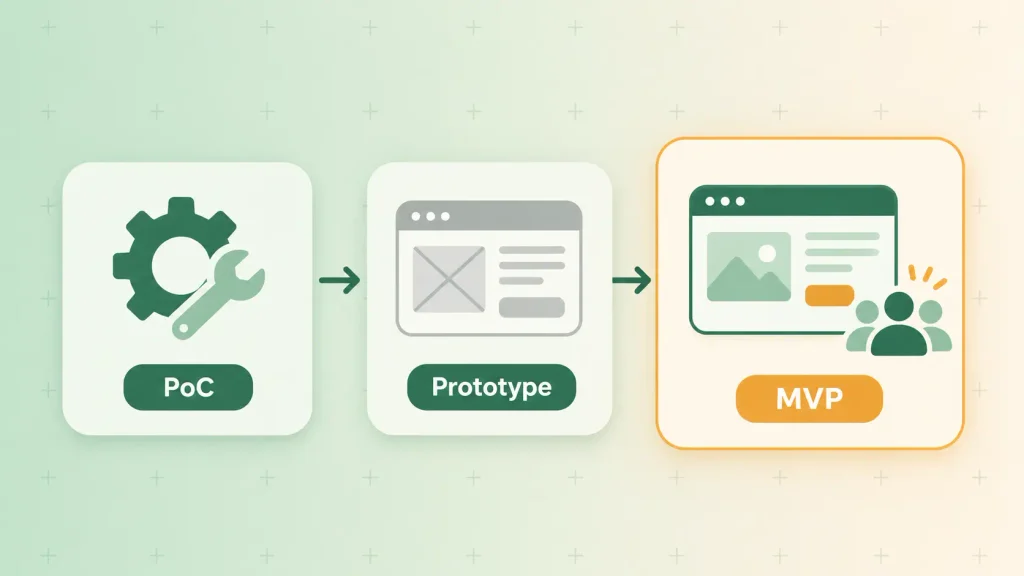
Not every project needs all three. If your idea relies on familiar technology, you can usually skip the PoC. If the interface is simple, a short round of prototype testing in your design process may be all you need before you build.
The one you can’t skip, if demand is uncertain, is the MVP. That’s the real difference in MVP vs prototype: a prototype can tell you people like the look of something. Only real usage tells you they’ll keep using it.
MVP vs MMP vs MLP vs Beta: Sorting Out the Terms
You’ll hear several cousins of the MVP in planning meetings, and they’re not interchangeable. Each one sits at a different point on the road from idea to full launch:
| Term | What it means | When it shows up |
| MVP (minimum viable product) | The smallest usable release that tests your core assumption | First, before you’ve proven demand |
| MLP (minimum lovable product) | A first release designed to delight, not just function | Instead of an MVP, in crowded markets where “good enough” won’t stand out |
| MMP (minimum marketable product) | The smallest version you can sell and market broadly | After the MVP has validated demand |
| Beta | A nearly finished product released to a limited group to find bugs | Just before full launch |
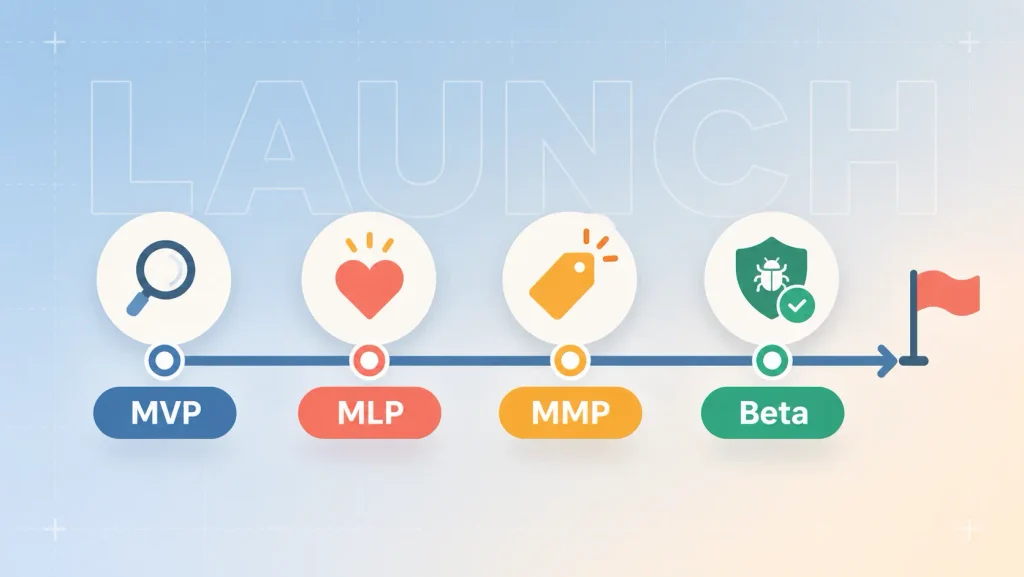
The practical difference is intent. An MVP asks “should we build this?” A beta asks “is this ready to ship?” If your team is calling a near-final build an MVP, you’ve already skipped the validation step.
Types of MVP in Software Development
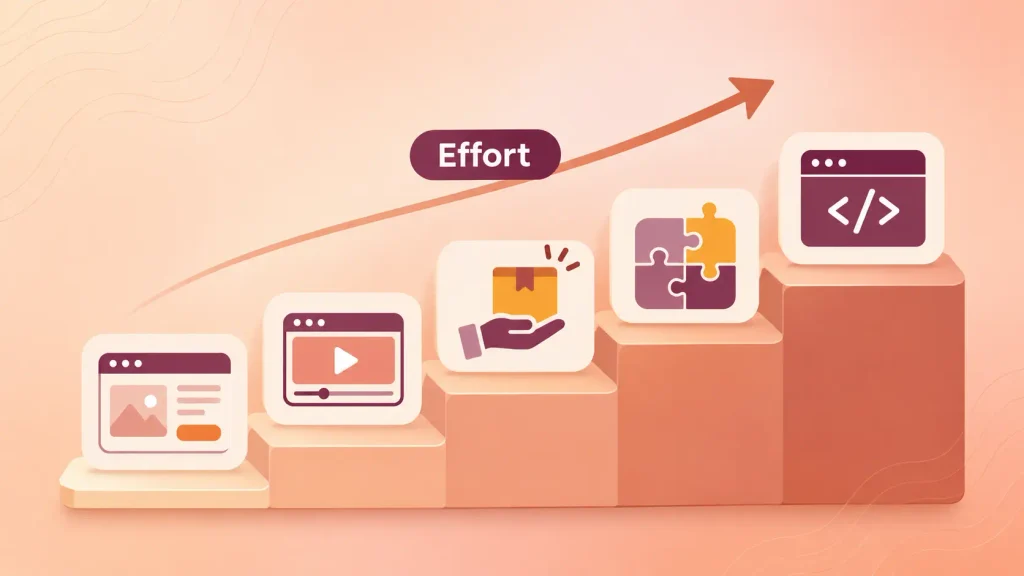
An MVP doesn’t have to be a coded app. The right type of MVP in software development depends on what you need to learn and how much you can spend learning it. Here’s how the common types compare:
| MVP type | What users get | What it tests best | Build effort |
| Landing page (fake door) | A page describing the product with a sign-up or pre-order button | Interest | Lowest |
| Explainer video | A short video showing how the product would work | Interest in a hard-to-explain idea | Low |
| Concierge | The service delivered by hand, by your team | Whether the outcome is worth paying for | Low code, high time |
| Wizard of Oz | A real-looking interface with humans doing the work behind it | Whether users accept the experience | Low to medium |
| Single-feature | Working software that does one job | Whether the core feature solves the problem | Medium |
| No-code | A working product assembled from existing tools | Whether people keep using it | Low to medium |
| Custom-code | A focused custom build designed to grow | Demand, plus whether it can scale | Highest |
The lighter types of MVP are cheap, but they measure intent rather than behavior. A sign-up tells you someone is curious. Repeat use tells you they need it.
So a good rule is to start with the cheapest type that can still answer your real question. If you need recurring revenue to prove the model, a landing page won’t get you there.
In that case, a SaaS MVP with real billing will. If the product needs unique business logic or handles sensitive data, a focused web MVP build is usually the safer starting point. AI products add their own wrinkles, which we cover in our guide to building an AI SaaS MVP.
Not sure which of these types of MVP fits your idea? A short scoping session with the Boomdevs MVP team can usually narrow it down to one or two options.
Real MVP Examples Worth Learning From

The best-known MVP examples share one trait: each tested a single “leap of faith” before the founders committed to the full build. Two stories show the range:
| Company | The question | The MVP | What it proved |
| Dropbox | Will people try file syncing if it just works? | A three-minute demo video aimed at early adopters | Demand was real, before the hard engineering was finished |
| Airbnb | Will strangers pay to sleep in someone’s home? | Air mattresses in the founders’ apartment and a basic website | People would pay for the stay |
Dropbox is the classic case. The product was too technically complex to demo as a rough prototype, so Drew Houston recorded a video instead. In Ries’s account of the Dropbox MVP, Houston says the beta waiting list jumped from 5,000 to 75,000 people overnight.
Airbnb went even more manual. During a sold-out design conference in San Francisco, the founders set up air mattresses and a simple site, and three guests paid $80 each to stay. No booking engine, no reviews, no payment system.
What you can take from both MVP examples: neither one looked anything like the final product. They looked exactly like the cheapest test of the riskiest assumption.
How an MVP Gets Built, Step by Step
Building an MVP follows a short loop: decide what to prove, build only that, then measure. The specifics vary, but the sequence holds for most software products:
- Name the assumption. Write the one belief your plan depends on, such as “small clinics will pay monthly for online booking.”
- Pick your first users. Choose a narrow group who feel the problem most and who you can actually reach.
- Define success and failure up front. Decide which result means “keep going” and which means “stop,” before anyone writes code.
- Cut the feature list. Keep only what the test needs. Everything else goes on a roadmap, not in the build.
- Choose the type and build it. Use the lightest MVP type that can answer the question, and build in short cycles.
- Launch, measure, and decide. Put it in front of real users, compare results against step three, and act on them.
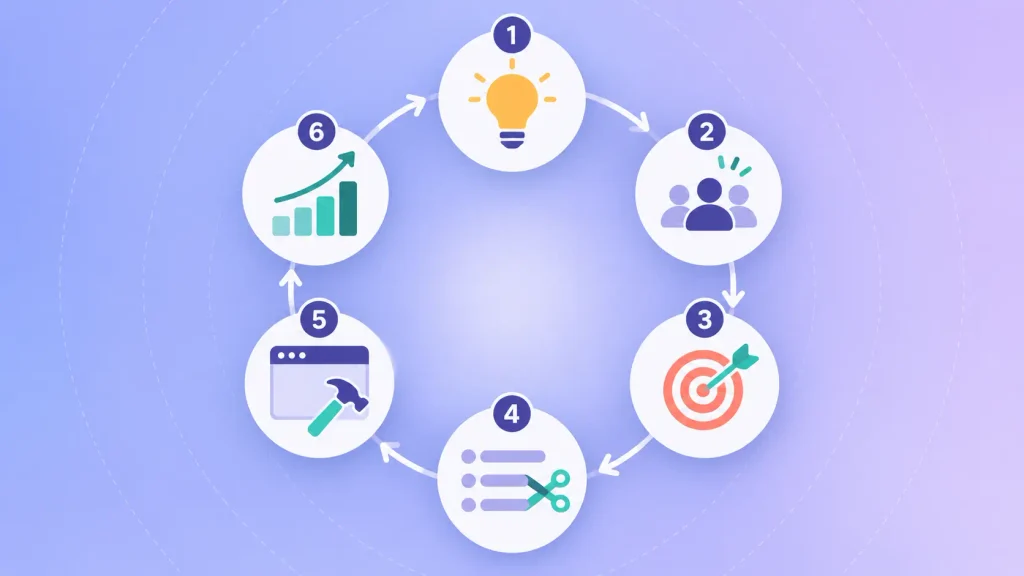
Steps one and three are where most teams cut corners, and they’re the two that make the rest meaningful. Once the MVP validates demand, the work shifts into a fuller SaaS development process with a wider roadmap.
How to Tell If Your MVP Actually Worked
Your MVP worked if real users behaved the way your assumption predicted. Launching on time doesn’t count, and neither do compliments. The useful signals look like this:
- Activation: new users reach the core action, such as sending their first invoice or booking their first slot.
- Repeat use: people come back without being reminded. This is the strongest early sign of real value.
- Willingness to pay: users pay, pre-order, or agree to a price. Saying “I’d pay for that” is not the same thing.
- Organic pull: users invite others or ask for features, which tells you the problem is real to them.
Vanity numbers like total downloads or page views feel good but rarely change a decision. You’ll want to pick the two or three signals that map directly to your assumption.
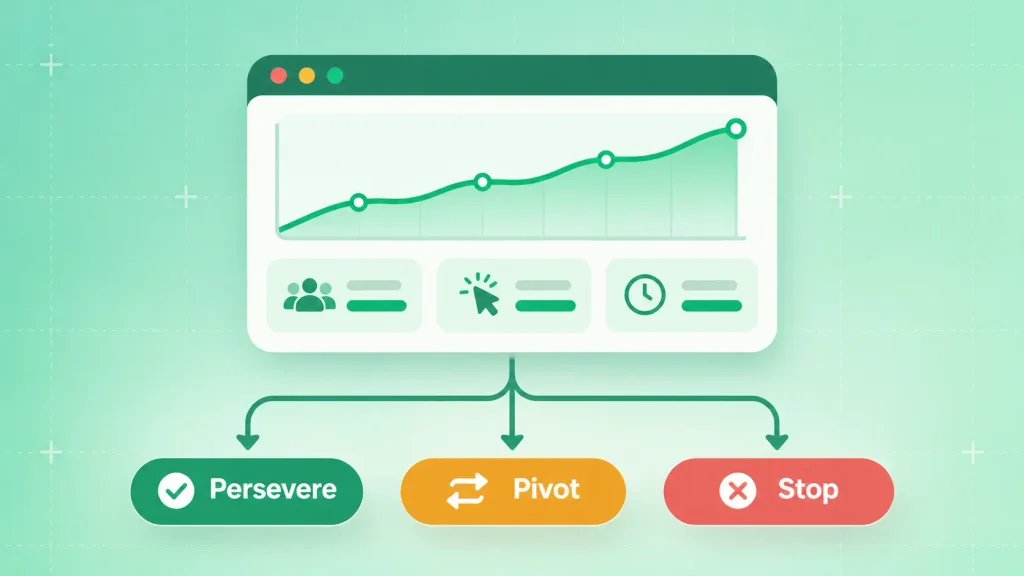
Then hold yourself to the criteria you set before launch. The results should push you toward one of three moves:
- Persevere: the signals match your assumption, so you invest in the next stage.
- Pivot: something is working, but not what you expected. You change the user, the problem, or the solution.
- Stop: the core assumption didn’t hold. You’ve lost a little money instead of a lot.
Stopping is the outcome founders resist most. It’s also the one that saves the most runway.
When an MVP Is the Wrong Call
A minimum viable product is a tool for uncertain demand. When demand isn’t the open question, a stripped-down release can cost you more than it saves. You may want a different approach in these situations:
- Regulated products: in healthcare, fintech, or anything handling sensitive data, “minimum” can’t mean skipping compliance, security, or audit trails.
- Validated markets: if you’re rebuilding a proven internal tool or replacing software your team already depends on, you know the demand. The risk is execution, not interest.
- Trust-critical experiences: if a half-finished first impression would damage a brand your existing customers already trust, a limited pilot with a polished scope may serve you better.
- Technical-risk-first ideas: if the real question is “can this even be built?”, start with a proof of concept before you test the market.
None of this means skipping validation entirely. It means picking the test that matches your actual risk.
Common MVP Mistakes That Burn Runway
Most MVP failures aren’t caused by bad ideas. They come from a handful of process mistakes that show up again and again:
- Scope creep: every stakeholder adds one “small” feature until the MVP becomes a full product with a delayed launch.
- Testing on the wrong people: friends, family, and colleagues are kind. Their feedback rarely predicts what strangers will pay for.
- No success metric: without a defined target, every result looks like a partial win, and nothing gets decided.
- Treating “minimum” as low quality: a buggy release teaches you about bugs. Users who hit errors leave before they show you anything about demand.
- Ignoring the data: teams sometimes launch, see weak numbers, and keep building anyway because the plan was already approved.
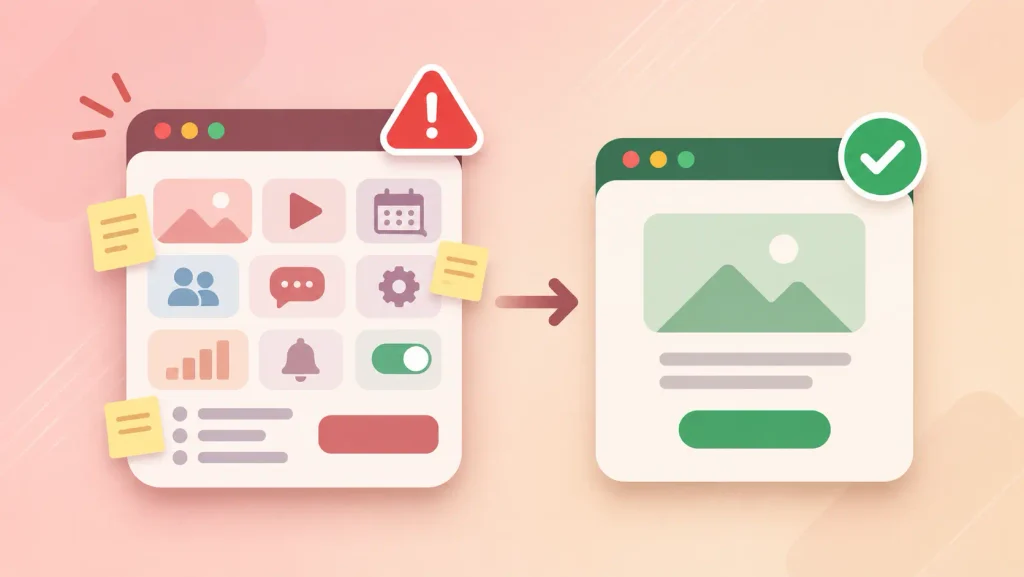
Many of these show up in why mobile apps fail more broadly, too. The fix is the same: decide what you’re testing, then let the result change your plan.
How Boomdevs Solves the Overbuilt MVP Problem
The most common problem with a minimum viable product isn’t building too little. It’s building too much, too slowly, and without a way to measure the result. Boomdevs’ MVP process is designed around preventing exactly that.
Before anyone writes code, the team tests every proposed feature against your core assumption. Features that serve the test make it into the build, and the rest move to the roadmap. Development runs in two-week sprints with a working build at the end of each one, so you see progress instead of status reports.
Analytics and event tracking go in before launch, so your first users generate the signals you’ll need for the persevere, pivot, or stop decision. Most Boomdevs MVPs ship in eight to 12 weeks, depending on platform, scope, and integrations. If you’re a founder at pre-seed or seed stage, the startup MVP development track handles strategy, design, and engineering end to end.
Want to see what a tightly scoped MVP looks like before you commit a budget? See how Boomdevs scopes and ships MVPs, a process shaped by work with 350+ startup founders.
Frequently Asked Questions
What does MVP stand for in software development?
MVP stands for minimum viable product. In software, it’s the smallest working release that real users can use, built to test whether your core idea has enough demand to justify the full build.
How long does it take to build an MVP?
It depends on which of the types of MVP you pick. A landing page or concierge test can go live in days, while a coded MVP usually takes a few months. At Boomdevs, most MVPs ship in eight to 12 weeks, and simpler products can launch in as little as six weeks.
How much does an MVP cost?
Cost depends on the MVP type, the platform, your feature scope, and the integrations you need. A no-code or landing page test costs far less than a custom build. For a detailed breakdown of a common case, see our guide to SaaS MVP development cost.
Is an MVP only for startups?
No. Established companies use MVPs too. Many well-known MVP examples come from teams testing new products, entering new markets, or validating internal tools before a wider rollout., enter new markets, or validate internal tools before a wider rollout. A small working release gives leadership real usage data to judge, rather than a forecast.
Can you build an MVP with no-code tools?
Yes, and for many ideas a no-code minimum viable product is a smart first step. No-code works well for testing demand and basic workflows. Once you need unique business logic, deeper integrations, or room to scale, it’s worth weighing the trade-offs covered in custom software vs off-the-shelf tools.