


- 1. Key Takeaways
- 2. MVP vs MMP: The Head-to-Head Comparison
- 3. What Is an MVP?
- 4. What Is a Minimum Marketable Product (MMP)?
- 5. When Should You Build an MVP vs an MMP?
- 6. How Do You Know Your MVP Is Ready to Become an MMP?
- 7. How to Move from MVP to MMP Without Starting Over
- 8. Common MVP vs MMP Mistakes That Waste a Runway
- 9. Where MLP, MMF, and Prototypes Fit
- 10. How Boomdevs Solves the MVP-to-MMP Jump
- 11. Frequently Asked Questions
Summarize with
You have an idea, some runway, and a decision to make. You can build a minimum viable product (MVP) to test it, or a minimum marketable product (MMP) you can start selling.
Both sides have smart advocates, and both cost real months.
The honest answer to MVP vs MMP depends on your situation, not on which release is better. It comes down to two things: whether demand is proven, and what a rough first impression would cost you. Here’s how to tell where you stand.
Key Takeaways
- An MVP buys learning. It’s the smallest release that tells you whether anyone wants this.
- An MMP buys revenue. It’s the smallest release a stranger will pay for, use alone, and keep using.
- Build an MVP when demand is the open question. Build an MMP when demand is proven and your risk is selling, supporting, and keeping customers.
- A minimum marketable product is defined by table stakes more than features: billing, permissions, self-serve onboarding, support, and security basics.
- Decide what comes after an MVP on evidence: users who’d miss the product, retention that flattens, and people trying to pay.
MVP vs MMP: The Head-to-Head Comparison
The real difference in MVP vs MMP is the question you’re asking. With an MVP, you’re asking whether anyone wants this. With an MMP, you’re asking whether strangers will pay for it, use it without hand-holding, and stay.
That one shift changes who sees the release, what you build, and how you judge it. Here’s how MVP vs MMP compare on the criteria that actually drive your budget:
| Criteria | MVP | MMP |
| Core question | Does anyone want this? | Will people pay for it and stay? |
| Audience | A few tolerant early adopters | Paying customers with alternatives |
| Feature scope | One core workflow, must-haves only | Core workflow plus buyer table stakes |
| What can be missing | Polish, automation, billing, most settings | Depth and breadth, not the basics |
| What can’t be missing | A real user finishing a real task | Billing, permissions, support, security |
| Success metric | Clear evidence, even a “no” | Revenue, retention, repeatable sales |
| Main risk | Building something nobody wants | Launching something nobody trusts |
| Marketing spend | Minimal, often founder-led outreach | A real go-to-market budget |
Notice that most rows describe intent, not feature count. Two teams can ship nearly the same code, and one is running an MVP while the other is running an MMP.
That’s why scoping should start from the question, not the feature list. It’s also how Boomdevs approaches MVP development services: name the release first, then decide what goes in it.
What Is an MVP?
An MVP is the cheapest experiment that gives you a trustworthy answer about demand. The word “viable” describes the test, not the product. It has to be good enough that the result means something.
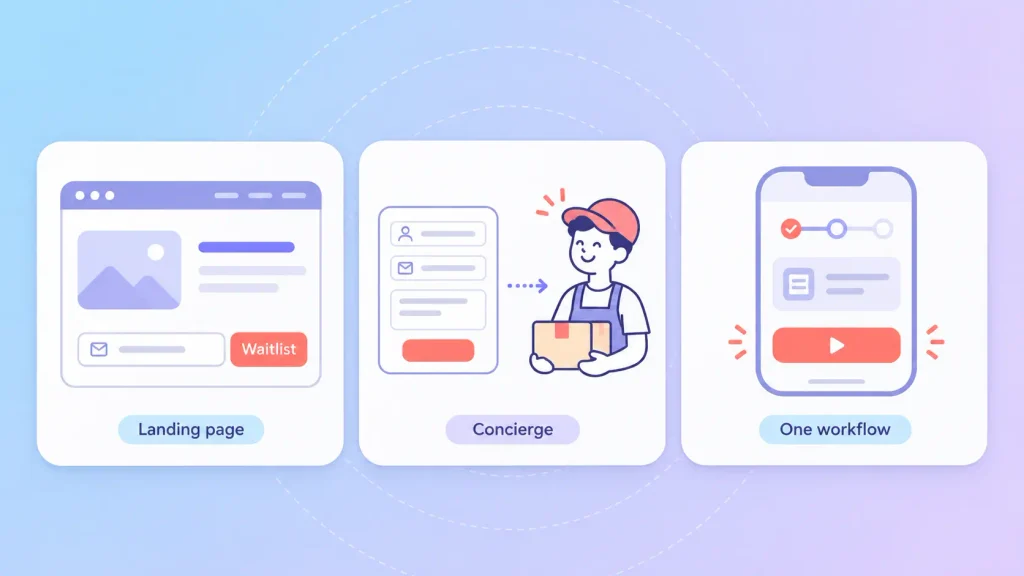
That leaves you more room than most founders expect. Any of these can count as an MVP:
- Landing page or waitlist: tests whether your pitch earns signups before you write any product code.
- Concierge MVP: you deliver the outcome by hand, behind a simple form, to see if people value it.
- Single-workflow product: one real feature, built properly, used by a small group.
What an MVP can’t be is a broken demo. If users can’t finish the one task you’re testing, the data tells you nothing.
We cover the fundamentals in our guide to what an MVP is in software development. For the minimum viable product vs minimum marketable product comparison, one point matters most: an MVP that proves nobody wants your product has still done its job.
What Is a Minimum Marketable Product (MMP)?
A minimum marketable product is the smallest version of your product a stranger would buy without a founder on the call. It’s narrower than your full roadmap, but it’s complete for the job it does. Nothing in it should feel like a test.
The idea grew out of the minimum marketable feature, which Mark Denne and Jane Cleland-Huang introduced in Software by Numbers. Their aim was to ship small units of real value so each release could earn while the team kept building.
The MMP stretches that logic across your whole first product. The Agile Alliance also notes that MMF often gets wrongly equated with MVP, which explains a lot of the MVP vs MMP confusion you’ll hear in planning meetings.
The Unglamorous Must-Haves an MMP Can’t Ship Without
Your MMP earns its name through the parts buyers assume rather than admire. Nobody signs up because your invoices look tidy. Plenty of buyers walk away when there’s no way to get one.
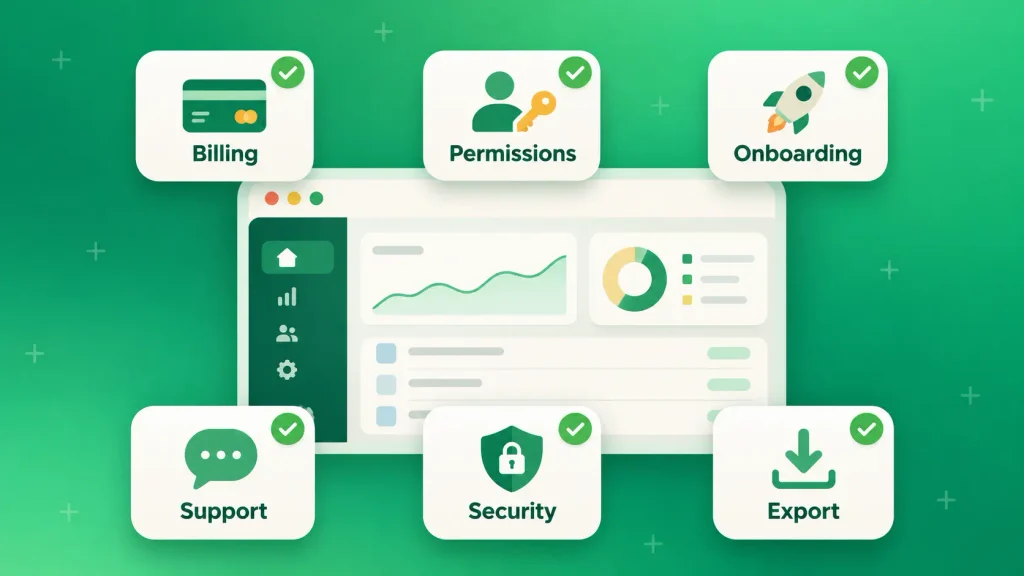
Before you call a release marketable, it’s worth checking that it covers these:
- Billing and plans: a way to pay, upgrade, cancel, and get a receipt without emailing you.
- Accounts and permissions: secure login, password recovery, and roles if several people per customer will use it.
- Self-serve onboarding: a new user reaches first value alone. Thoughtful UI/UX design usually pays off most right here.
- A support path: a help channel, clear response expectations, and someone who owns it.
- Security and privacy basics: protected data, a privacy policy, and whatever your buyers’ industry checks first.
- Data export: customers want to know they can leave with their data, even if they never do.
- Product analytics: you can see where new users drop off, so you fix the right screen.
None of this is exciting to build. Skip it, though, and your sales calls turn into apologies.
When Should You Build an MVP vs an MMP?
You should build an MVP when you don’t yet know whether people want the product. You should build an MMP when demand is already proven and your real risk is selling and keeping customers.
Most founders know which camp they’re in once they look honestly at the evidence they have. The harder part is admitting it in front of the team.
Build an MVP When Demand Is Still the Unknown
An MVP earns its keep when a wrong guess is cheap and the lesson is valuable. That usually looks like this:
- You’re creating a new category or an unproven workflow.
- You’ve never sold to this customer segment before.
- Early users will tolerate rough edges because the problem hurts.
- You’d genuinely stop or pivot if the answer came back negative.
That last point is the honest test. If the roadmap continues no matter what users say, you’re not running an experiment. You’re shipping a first release, and it deserves MMP standards.
Still at the idea stage? Our guide on how to validate an app idea covers cheaper checks you can run before building anything.
Go Straight to an MMP When the Market Is Already Proven
Sometimes the market has already settled the MVP vs MMP question for you. In that case, an MVP mostly confirms what you know. You can usually skip ahead when:
- The category is crowded: buyers compare you to established tools, and a bare-bones release gets ignored.
- You sell to businesses: procurement and security reviews expect permissions, audit trails, and support from day one.
- Trust is the product: in fintech, healthcare, or anything touching money or health data, one visible failure can stall growth for months.
- You already have proof: a waitlist that converts, pre-orders, or an earlier product serving the same buyers.
Skipping the MVP doesn’t mean skipping learning. You still test with design partners or a controlled beta. You just hold that beta to marketable standards.
A Five-Question Check You Can Run in One Meeting
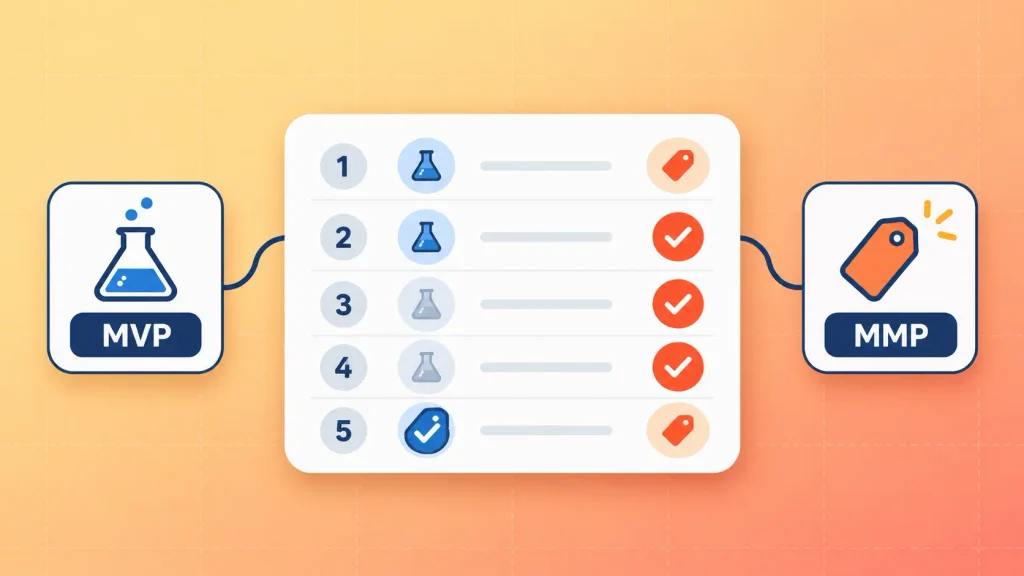
When your team can’t agree on MVP vs MMP, I’d suggest working through these in order. Answer each one with evidence, not opinion:
- Do we know people want this? If the honest answer is “we think so,” lean toward an MVP.
- Who sees the first release? A handful of design partners will forgive a lot. The open market won’t.
- What happens if it breaks? Mild confusion points to an MVP. Lost deals, churn, or compliance trouble point to an MMP.
- Can we fix mistakes quietly? Reversible problems suit an MVP. Public, sticky ones need MMP care.
- What does the category treat as table stakes? If every competitor offers something, buyers will read its absence as a dealbreaker.
If most answers point one way, you have your decision. If they split, start with a tightly scoped beta held to marketable standards. And if you’re clearly in MVP territory, a focused startup MVP development team can help you get to real evidence quickly.
How Do You Know Your MVP Is Ready to Become an MMP?
Your MVP is ready to graduate when users show they’d miss it, keep coming back, and try to pay. Opinions in interviews don’t count for much here. Behavior does.
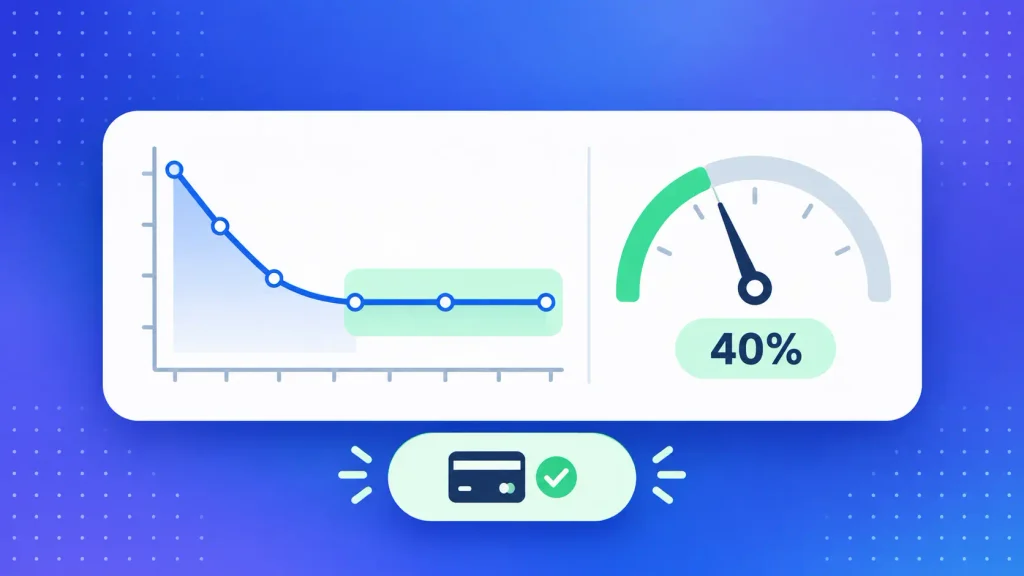
One widely used yardstick is the Sean Ellis test. You ask active users how they’d feel if they could no longer use the product. Ellis benchmarked nearly a hundred startups and found the line at 40% answering “very disappointed”.
No single number settles it, though. You’ll want several of these signals showing up together:
| Signal | What it tells you | Where to measure it |
| 40%+ “very disappointed” | Users depend on the product | Short survey of active users |
| Retention curve flattens | A core group keeps returning | Weekly or monthly cohorts |
| People try to pay | The value is worth money | Pre-orders, paid pilots, pricing clicks |
| Repeated requests for basics | You’re hitting table stakes | Support tickets, sales notes |
| Objections move from “why” to “how” | Demand is settled, readiness isn’t | Sales call notes |
That last signal is easy to miss. When prospects stop asking why they’d need you and start asking about permissions or invoicing, your MVP has done its job.
How to Move from MVP to MMP Without Starting Over
What comes after an MVP is the work of turning a learning tool into something you can sell and support. You keep what the evidence proved and harden it. A full rebuild shouldn’t be your default.
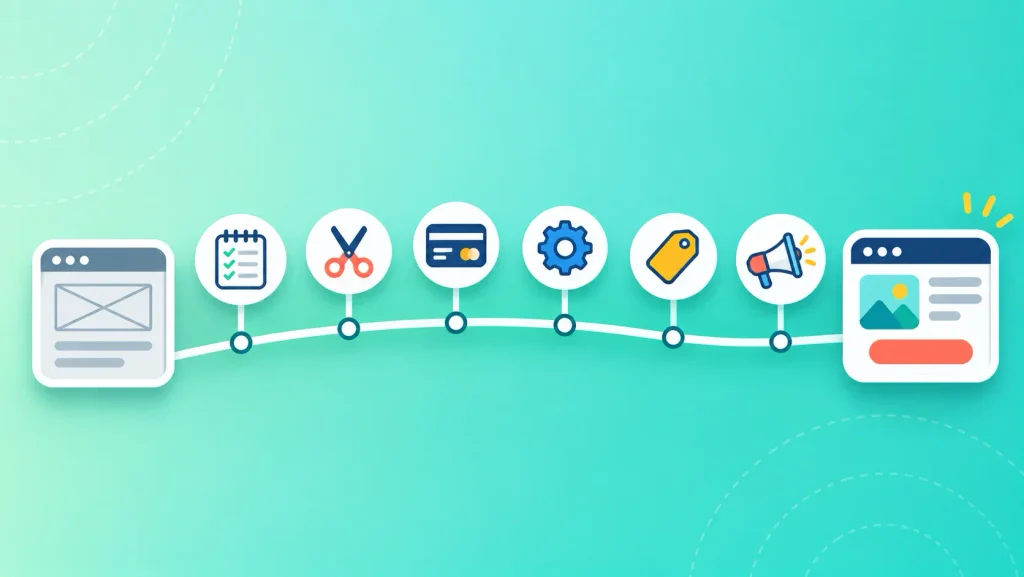
Here’s the sequence that tends to work:
- Lock in what you learned. Write down which assumptions the MVP confirmed and which it killed. That list becomes your scope filter.
- Cut the features users ignored. Usage data usually shows screens nobody touches. Remove them before you polish anything.
- Add the table stakes. Work through billing, permissions, onboarding, and support before any new headline feature.
- Replace the manual work. Anything a founder did by hand behind the scenes needs to become reliable software or a staffed process.
- Set pricing and packaging. Decide what’s free, what’s paid, and how customers upgrade.
- Prepare go-to-market. Positioning, launch plans, and sales materials should be ready the day the product is.
Expect this stage to cost more than the MVP did, because the scope is wider and the quality bar is higher. Our breakdown of SaaS MVP development cost is a useful starting point for budgeting it.
If you’re building SaaS, it pays to plan billing and multi-tenant accounts early. A SaaS MVP development team that designs for them from the start can spare you a painful rewrite at this step.
Rebuild or Refactor? What to Do with Your MVP Shortcuts
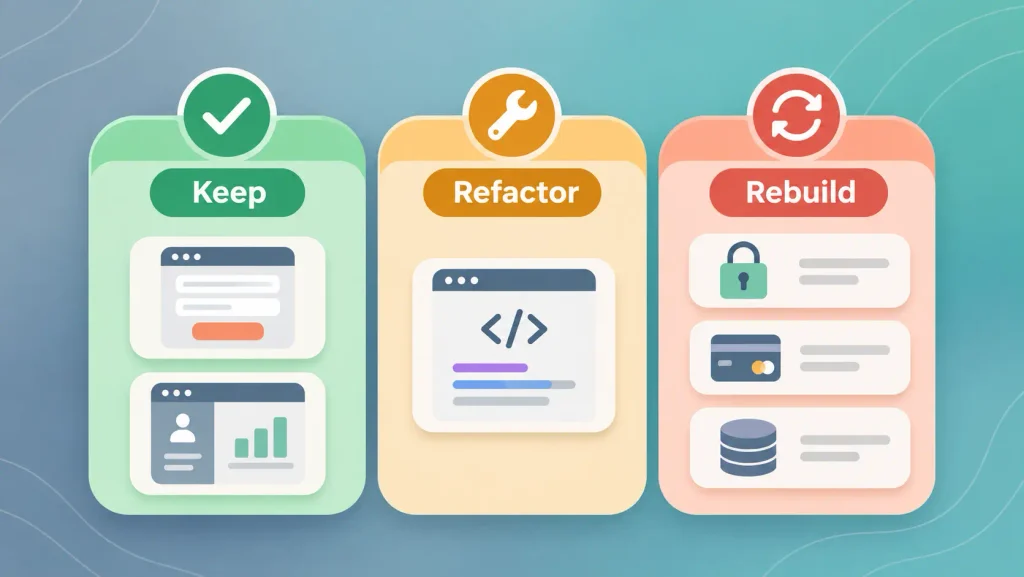
Every good MVP cuts corners on purpose. At this stage, your job is deciding which shortcuts can stay and which will hurt paying customers.
You can sort them into three groups:
- Keep: simple tools that work at low volume, like a hosted form, a basic admin panel, or a manual approval step.
- Refactor: code that works but has no tests, hardcoded settings, or a data model straining under real use.
- Rebuild: anything touching payments, authentication, or customer data that was built without security in mind.
A full rebuild resets your timeline and can reintroduce bugs you already fixed. Rebuild the risky parts, refactor the rest, and ship.
Common MVP vs MMP Mistakes That Waste a Runway
You can trace most MVP and MMP failures back to judging a release by the wrong yardstick. The stakes are real. In CB Insights‘ analysis of 431 venture-backed shutdowns since 2023, poor product-market fit was a cause in 43% of them.
Two-thirds of those fit failures were early-stage companies that never found a market at all. These MVP vs MMP mistakes are how teams end up in that group:
- Calling a first release an MVP: you get the low-quality bar of an experiment without the freedom to walk away.
- Measuring an MVP by revenue: a validation release with weak sales may still have answered its question clearly.
- Skipping the MVP in an unproven market: you polish features built on guesses, then learn nobody needed them.
- Bloating the MMP: “marketable” means the basics are covered, not that every wishlist item ships.
- Launching the MMP too late: strong signals sit unused while you chase perfect, and competitors move first.
If you build mobile products, several of these patterns show up again in our look at why mobile apps fail.
Where MLP, MMF, and Prototypes Fit
You’ll hear more labels than MVP and MMP in planning meetings. A prototype, an MMF, and an MLP each answer a different question, and mixing them up causes the same scope arguments.
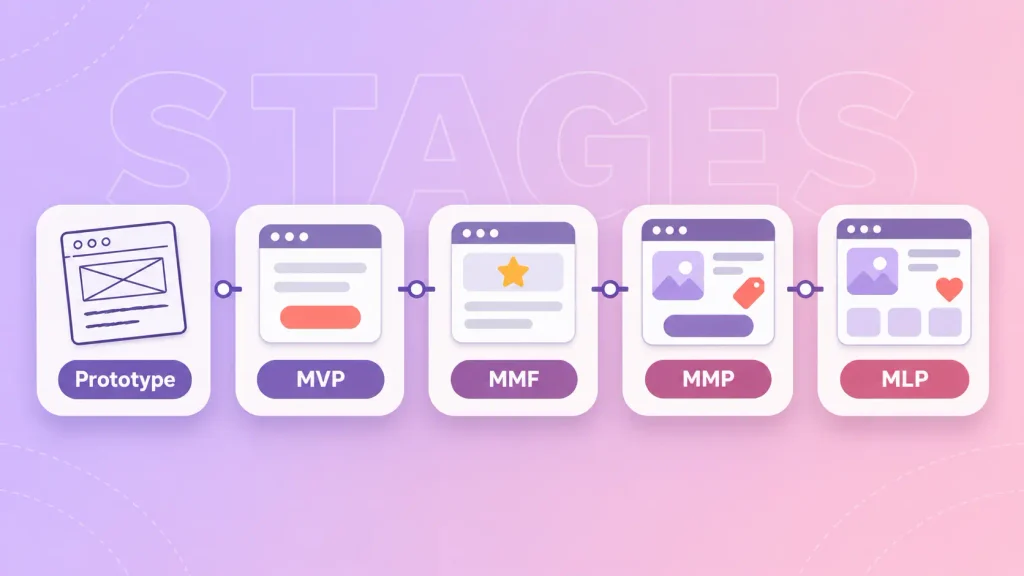
Here’s how all five line up:
| Term | Question it answers | Typical audience |
| Prototype | Does the flow make sense? | Internal team, test users |
| MVP | Does anyone want this? | Early adopters |
| MMF | Is this one feature worth shipping? | Existing customers |
| MMP | Will people pay and stay? | The paying market |
| MLP | Would people pick us over alternatives? | Users in a crowded category |
A prototype rarely runs on real data, which is the main line between it and an MVP. For AI products, an AI proof of concept often comes even earlier, to check the technology works before you test demand.
In the MVP vs MMP vs MLP choice, the MLP matters most in crowded markets. When adequate tools already exist, being merely usable won’t get you noticed.
How Boomdevs Solves the MVP-to-MMP Jump
The hardest part of the minimum viable product vs minimum marketable product decision is being honest about your evidence. Boomdevs starts each engagement by naming which release you’re actually building, then scopes everything to that goal.
After 3.5K+ projects and work with 350+ startup founders, the team has seen both failure modes: overbuilt experiments and underbuilt launches. Here’s what the work looks like in practice:
- Release scoping: a clear line between must-haves and table stakes, tied to the evidence you already have.
- MVP builds: one workflow, built properly and instrumented, so you can trust what the data says.
- MVP-to-MMP upgrades: billing, permissions, onboarding, and the refactoring needed to support paying customers.
If you’re weighing MVP vs MMP for your next release, talk to Boomdevs about scoping it. You’ll leave the call knowing which one you’re building, and why.
Frequently Asked Questions
Can You Skip the MVP and Launch an MMP?
Yes, when demand is already proven. Crowded categories, B2B sales with security reviews, and products where trust is the offer often justify it. You still learn through a controlled beta, but you hold it to marketable standards.
Can an MVP Make Money?
It can, and charging early is a strong demand signal. Just don’t judge an MVP by revenue alone. Its job is to tell you whether people want the product, and a clear “no” is still a useful result.
Is an MMP the Same as an MLP?
No. In MVP vs MMP vs MLP terms, an MMP is the smallest version people will pay for, with the basics covered. An MLP is the smallest version people would choose over alternatives, usually because it does one thing noticeably better.
Is an MVP the Same as a Prototype?
No. A prototype shows how a product might work, often with mock data. An MVP is a working release that real users rely on for a real task, so it produces behavior you can measure.
How Long Does It Take to Go from MVP to MMP?
It depends on how many table stakes your MVP skipped and how much manual work needs automating. The factors that shape how long it takes to build an MVP apply here too, plus pricing and launch prep. Scope it first, and the timeline follows.