


- 1. Key Takeaways
- 2. Prototype vs MVP: The Head-to-Head Comparison
- 3. What a Prototype Is (and What It Can't Tell You)
- 4. What an MVP Is (and Why "Minimum" Doesn't Mean Unfinished)
- 5. Where a Proof of Concept Fits
- 6. Prototype or MVP First? Choose by Your Riskiest Assumption
- 7. What Investors Expect at Each Stage
- 8. Can a Prototype Become Your MVP?
- 9. Common Prototype and MVP Mistakes
- 10. How Boomdevs Takes You from Prototype to MVP
- 11. Frequently Asked Questions
Summarize with
You have an idea, some runway, and two people giving you opposite advice. One says build a prototype first, the other says ship an MVP. Both camps have real founders behind them.
The honest answer in the prototype vs MVP debate depends on your situation, not on which one is better. It comes down to your riskiest assumption and the evidence you need next. Here’s how to tell whether your idea needs a prototype or MVP first.
Key Takeaways
- A prototype tests the experience. It shows whether people understand your product and can move through it. Nothing behind the screens has to work.
- An MVP tests demand. It’s a working product that real users can sign up for, use, and ideally pay for.
- Pick your riskiest assumption. If the big unknown is “will they get it,” prototype. If it’s “will they use it and pay,” build the MVP.
- You don’t always need both. A simple product with a clear workflow can often skip straight to an MVP.
- A prototype is rarely your MVP’s foundation. Treat it as a blueprint, not as code you’ll ship.
Prototype vs MVP: The Head-to-Head Comparison
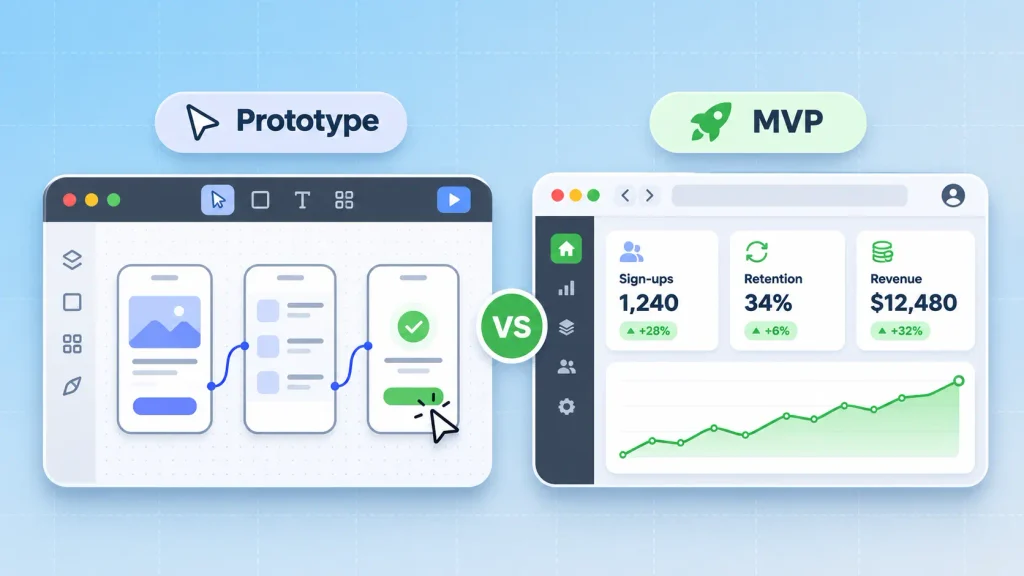
The core difference between prototype and MVP is simple: a prototype shows how your product would look and flow, while an MVP is a stripped-down product that actually works for real users. One answers “do people understand this?” The other answers “do people want this enough to use it?”
That single difference drives everything else. Here’s the prototype vs MVP breakdown on the criteria you’ll actually decide with:
| Criteria | Prototype | MVP |
| Question it answers | Does the flow make sense? | Will people use it and pay? |
| Does it work? | Simulated, nothing real behind it | Core features fully functional |
| Who uses it | Your team, test users, investors | Real early adopters |
| Feedback you get | Observations and opinions | Behavior: sign-ups, retention, revenue |
| Relative time and cost | Low, mostly design hours | Higher, design plus engineering |
| What you’re handed | A clickable design file | A live product with analytics |
| What it can’t prove | Demand or willingness to pay | Whether a better flow existed |
Read the last row twice. Each artifact is blind to exactly what the other one sees, so in prototype vs MVP, the order you build them in matters a lot.
What a Prototype Is (and What It Can’t Tell You)
A prototype is your product with the engine removed. Screens link together, buttons go somewhere, and a test user can tap through a full task, yet no data is saved and no payment ever goes through.
Its job is cheap learning. You can throw away a prototype in an afternoon, which is exactly the freedom you lose once code exists.
Low, Mid, and High-Fidelity Prototypes
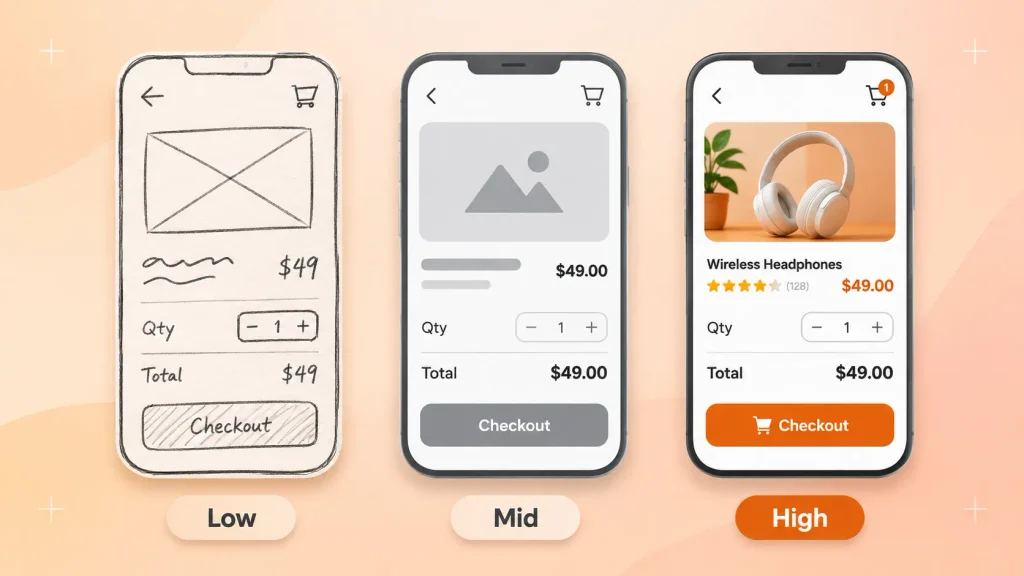
Fidelity is how close the prototype looks and feels to the finished product. You’ll want to match it to the question you’re asking, not to how impressive you want the demo to be:
- Low fidelity: paper sketches or rough wireframes. Good for testing whether the core idea and screen order make sense.
- Mid fidelity: clickable wireframes in a tool like Figma. Good for testing navigation, labels, and where people get stuck.
- High fidelity: polished, interactive screens that look nearly real. Good for usability testing, trust signals, and investor demos.
Higher fidelity isn’t automatically better. A polished prototype can make testers comment on colors when you needed them to struggle with the checkout. If you’re planning this stage, our UI/UX design process for startups walks through where each level fits.
What a Prototype Proves, and What It Doesn’t
A prototype is strong evidence about usability and weak evidence about demand. You can learn a lot from very few sessions. Research from Nielsen Norman Group found that testing with five users uncovers roughly 85% of usability problems, and that three small rounds beat one big study.
What it can’t do is tell you whether people will come back next week. Here’s where the evidence line sits:
- It can show: whether users understand the value, complete the main task, and find the flow intuitive.
- It can’t show: whether they’ll sign up unprompted, return on their own, or pay.
- Watch out for: polite feedback. Someone saying “I’d use this” in a test session costs them nothing.
That gap is the whole reason MVPs exist, and it’s where most prototype vs MVP confusion clears up. When the open question shifts from “can they use it” to “will they,” a prototype has done its job.
What an MVP Is (and Why “Minimum” Doesn’t Mean Unfinished)
An MVP is the smallest real product that lets you learn from actual customer behavior. Eric Ries, who popularized the term, describes it as the version of a product that gets the most validated learning about customers for the least effort. Note what’s missing from that definition: a feature count.
So an MVP isn’t a cheap version of your full roadmap. It’s one core job done well enough that early adopters will use it for real. If you want the longer explainer, see our guide on what an MVP is in software development.
Four Common MVP Types
Not every MVP needs a full codebase on day one. The right type depends on what you’re testing:
| Type | How it works | Best for |
| Concierge | You deliver the service by hand | Testing whether people want the outcome |
| Wizard of Oz | Looks automated, people work behind it | Testing a product before building the automation |
| No-code | Built on tools like Bubble or Webflow | Simple workflows and fast market tests |
| Coded | Custom software with core features only | Complex logic, integrations, or scale |
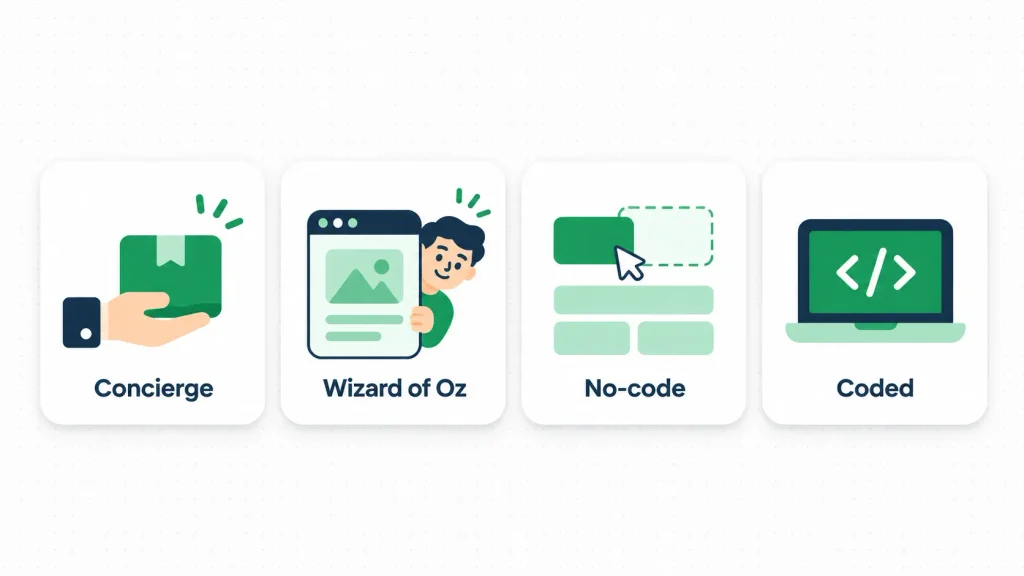
Manual MVPs are underrated. They test demand without engineering, though they can’t prove your automation will work later. For SaaS ideas that need real software from the start, a focused SaaS MVP development build is usually the coded route.
What Your MVP Still Has to Get Right
Real users mean real responsibility. Your MVP can skip features, but it can’t skip the basics that keep people and their data safe:
- Reliable core flow: the one main task has to work every time, or you’ll measure frustration instead of demand.
- Secure accounts and data: sign-in, permissions, and data handling need production standards.
- A way to measure: analytics on activation, return visits, and conversions, decided before launch.
A buggy MVP doesn’t test your idea. It tests your users’ patience, and the data you get back is useless.
Where a Proof of Concept Fits
A proof of concept checks whether something can be built at all, before you design or sell it. It usually comes up when your idea depends on uncertain technology, like a new AI model or a tricky integration.
Here’s how the three stages split the work when you’re weighing proof of concept vs prototype vs MVP:
| Stage | Question it answers | Who sees it |
| Proof of concept | Can this be built? | Engineers and technical stakeholders |
| Prototype | Does the experience make sense? | Test users, team, investors |
| MVP | Will people use and pay for it? | Real early customers |
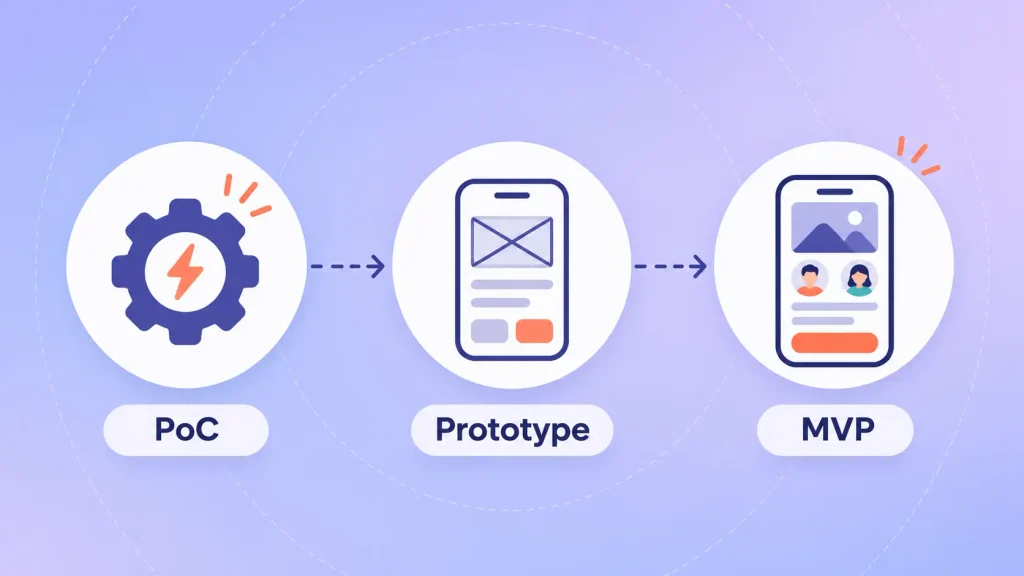
The order PoC, prototype, MVP is common but not mandatory. If your technology is proven, you can skip the PoC entirely and start where your real uncertainty sits.
Prototype or MVP First? Choose by Your Riskiest Assumption
In the prototype vs MVP decision, build whichever one tests the assumption most likely to kill your idea. Every product rests on a few guesses, and the most dangerous one should get tested first, with the cheapest tool that can actually answer it.
If you haven’t pinned that assumption down yet, our guide on how to validate an app idea is a good place to start.
Start with a Prototype If…
A prototype makes sense when the experience is the open question:
- Your workflow is new or complex, like multi-step onboarding, approvals, or a marketplace with two user types.
- You’re torn between directions and want to test two or three concepts before committing.
- Your team or co-founders disagree about what the product should look like.
- You need something to show in early investor or partner conversations.
Go Straight to an MVP If…
An MVP makes sense when the experience is clear and demand isn’t:
- The workflow is familiar, like a booking flow or a simple dashboard users already understand.
- You need behavioral proof, such as sign-ups, retention, or payments, for your next decision.
- A manual or no-code version is cheap, so a prototype would cost nearly as much as the real thing.
A Three-Question Decision Test
When you’re stuck on prototype or MVP first, run your idea through these questions in order. Stop at the first “no”:
- Can it be built? If you’re unsure about the core technology, run a proof of concept first.
- Will users understand it? If you can’t say yes with evidence, build a prototype and test it.
- Will they use it and pay? This is the question only an MVP can answer, so build one.
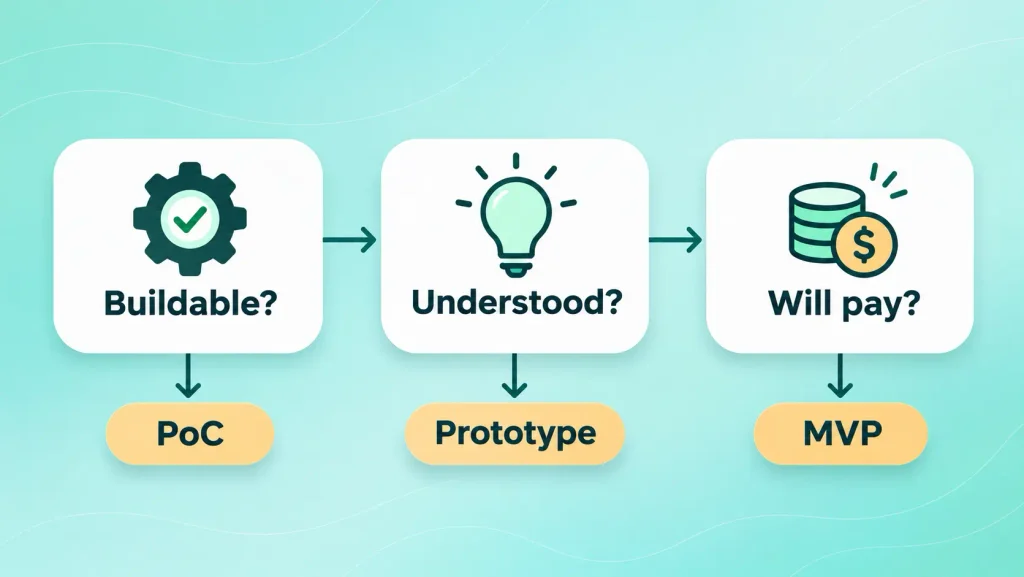
In our work with founders, the sticking point is usually question two or three. It’s worth being honest about which, because building for the wrong question is how months disappear.
Not sure which question you’re stuck on? Boomdevs is trusted by 350+ startup founders. Talk through your idea with our startup MVP team and leave with a clear first build.
What Investors Expect at Each Stage
A prototype shows investors you understand the problem; an MVP shows them people care. To investors, MVP vs prototype isn’t a matter of polish. The two answer different questions in the room, so you’ll want to bring the one that matches what you’re being asked.
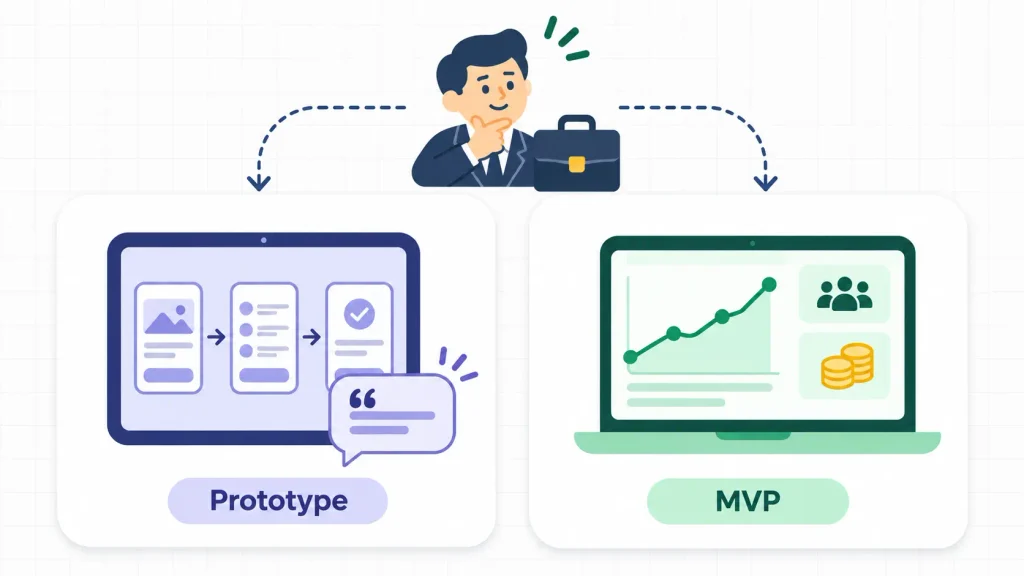
Here’s how each artifact holds up against the questions you’re likely to face:
| Investor question | A prototype can show | An MVP can show |
| Do you understand the user? | Yes, through a clear flow | Yes, through usage data |
| Can your team ship? | Partly, design skill only | Yes, a live product |
| Does anyone want this? | Only interview quotes | Sign-ups, retention, revenue |
| How will you make money? | A pricing assumption | Real payment behavior |
A strong prototype can carry an early, idea-stage conversation. Once the questions turn to traction, though, nothing replaces real usage. Pair either one with a story investors can follow, which is where a sharp pitch deck design earns its keep.
Can a Prototype Become Your MVP?
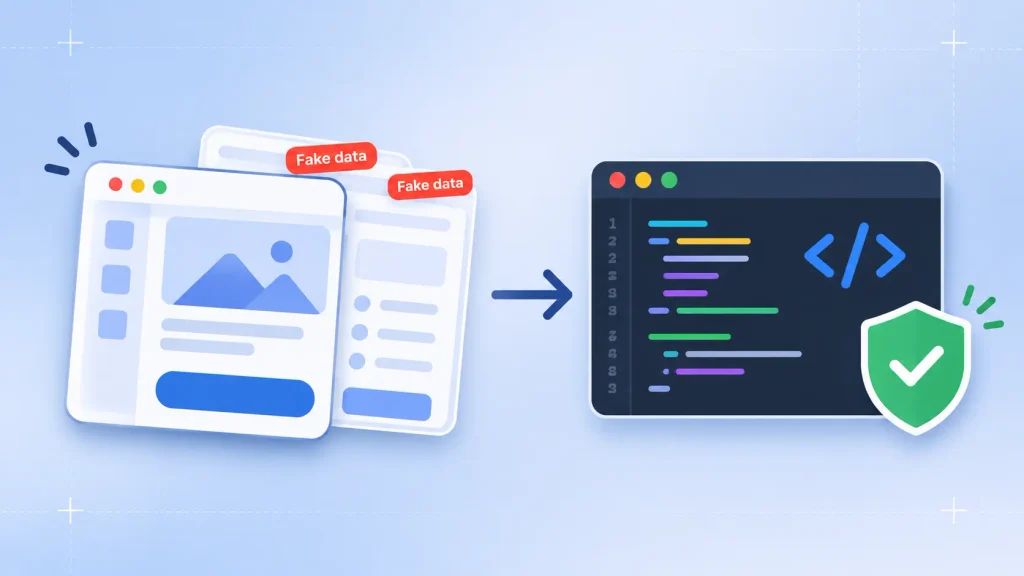
Sometimes, but usually it shouldn’t, and this is where the difference between prototype and MVP matters most. A prototype is built to change fast, not to run safely, so its shortcuts become liabilities the moment real users arrive.
Even well-built prototyping tools are clear about this. The UK government’s service manual notes that its prototype kit lacks the security and performance features a live service needs. That holds for most prototypes, including code-based ones.
The design work carries over, and that’s the valuable part. Before you start the MVP build, check that your prototype has earned it:
- Your target user and core task are stable enough to name in one sentence.
- Test users complete the main flow without you explaining it.
- You’ve listed every fake piece, like hardcoded data or simulated payments, so engineering knows what to build for real.
- Your next question needs real behavior, not more opinions.
If all four hold, hand the screens and findings to your build team. Timelines vary a lot by scope, and our breakdown of how long it takes to build an MVP covers each phase.
Common Prototype and MVP Mistakes
Most prototype vs MVP mistakes come from building the right thing at the wrong time. The stakes are real: CB Insights reviewed 431 VC-backed startups that shut down since 2023 and found poor product-market fit behind 43% of them.
These are the traps worth watching for:
- Treating prototype praise as demand. Test users being nice isn’t the same as customers paying. Only an MVP measures the second.
- Polishing the prototype forever. One more version feels like progress, but it’s often a way to avoid real-world feedback.
- Overbuilding the MVP. If you’re adding a fifth “must-have” feature, you’re building version two before learning from version one.
- Mislabeling what you have. Blurring the difference between prototype and MVP, like calling a clickable demo an MVP, sets investor and user expectations you can’t meet.
- Launching without metrics. An MVP you don’t measure is just a smaller product, not an experiment.
Notice the pattern. Each mistake swaps the question you should be testing for one that feels safer to answer. A simple fix is to write down, before you build anything, the one result that would change your plan. If the outcome can’t change your next decision, you’re not testing anything yet.
How Boomdevs Takes You from Prototype to MVP
You get the most from a prototype when the people who test it also build the MVP, so nothing gets lost between the design file and the codebase. At Boomdevs, our UI/UX design team builds prototypes you can put in front of users, and the same project carries straight into engineering.
Here’s what that looks like in practice:
- Discovery first: we pin down your riskiest assumption, so the prototype vs MVP call is based on evidence, not guesswork.
- Prototypes built to test: clickable flows aimed at one clear question, not a decorative demo.
- A lean MVP build: one core flow, production-grade security, and analytics set up before launch.
After 3.5K+ delivered projects, the pattern we see most is founders building more than their next decision needs. We’ll help you build less, and learn faster.
Ready to turn your idea into a product people can use? Plan your MVP with Boomdevs and get a scoped first release built around the question that matters most.
Frequently Asked Questions
Is a Prototype the Same as an MVP?
No, and that’s the heart of prototype vs MVP. A prototype simulates how your product would look and flow, with nothing working behind it. An MVP is a functional product that real users can sign up for and use. Prototypes test usability; MVPs test demand.
Can I Skip the Prototype and Build an MVP Directly?
Yes. When you’re deciding prototype or MVP first, skip the prototype if your workflow is familiar and your biggest unknown is demand. A booking tool or simple dashboard often doesn’t need a prototype. If your flow is new or complex, skipping it usually means finding UX problems after they’re already in code.
How Long Does a Prototype Take Compared to an MVP?
On timing, MVP vs prototype isn’t close. A prototype is much faster because it’s design work only, with no backend, data, or testing. An MVP takes longer since it needs real engineering, security, and deployment. For phase-by-phase estimates, see our guide to MVP timelines, and for budgets, our SaaS MVP cost breakdown.
Can I Raise Funding with Just a Prototype?
It’s possible at the idea stage, when investors are mainly judging the team and the problem. A prototype shows you understand your users. Once conversations turn to traction, you’ll need an MVP with real usage data.
Is an MVP the Same as a Beta?
Not quite. An MVP is the smallest product built to test whether people want your core offer. A beta is a release stage where a near-complete product is tested before wider launch. An MVP can be released as a beta, but the two labels answer different questions.