


- 1. Key Takeaways
- 2. How Much Does SaaS MVP Development Cost in 2026?
- 3. Where Your SaaS MVP Budget Actually Goes
- 4. 7 Factors That Drive SaaS MVP Development Cost
- 5. SaaS MVP Cost by Team Model and Region
- 6. How Long Does It Take to Build a SaaS MVP?
- 7. No-Code vs Custom: When a Cheaper MVP Makes Sense
- 8. What AI Changes About SaaS MVP Cost in 2026
- 9. Your Year-One Budget: Build, Run, and Iterate
- 10. How to Reduce SaaS MVP Cost Without Building a Weaker Product
- 11. Red Flags in a SaaS MVP Quote
- 12. How Boomdevs Solves the SaaS MVP Budget Problem
- 13. Frequently Asked Questions
Summarize with
SaaS MVP development cost usually lands between $15,000 and $120,000 in 2026, and that spread won’t help you budget much on its own. Your number depends on a few concrete choices. How many user roles you need. Whether billing and multi-tenancy ship on day one. Where your team sits. This guide breaks each one down, so you can estimate your own build and spot a padded quote before you sign anything.
Key Takeaways
- Typical ranges: SaaS MVP development cost runs about $15,000 to $30,000 for a simple build, $40,000 to $80,000 for a market-ready one, and $70,000 to $120,000 or more for a complex one., a market-ready one $40,000 to $80,000, and a complex one $70,000 to $120,000 or more.
- Scope beats everything: user roles, subscription billing logic, multi-tenancy, and integrations move your price more than any hourly rate.
- Location still matters: the same build can cost several times more with a US team than with an offshore one.
- Timeline: a genuine MVP takes roughly 8 to 16 weeks. Much longer usually means scope creep.
- Year one costs more than the build: plan for maintenance, hosting, and payment fees on top of the quote.
How Much Does SaaS MVP Development Cost in 2026?
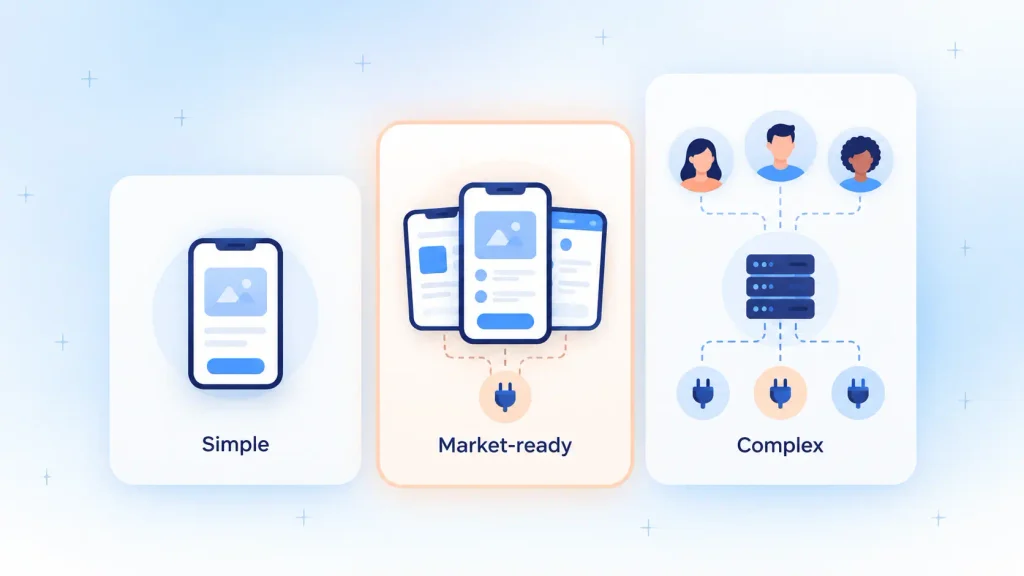
Most professionally built SaaS MVPs cost between $15,000 and $120,000, depending on how much product you need before your first customer pays. Classic Informatics’ 2026 SaaS MVP cost breakdown splits that range into three tiers.
Here’s what each tier typically buys you:
| Tier | What you get | Typical cost |
| Simple MVP | One core workflow, basic auth, a handful of screens | $15,000 to $30,000 |
| Market-ready MVP | Fuller feature set, integrations, polished UI | $40,000 to $80,000 |
| Complex MVP | Multiple user roles, many integrations, custom infrastructure | $70,000 to $120,000+ |
Most funded B2B founders end up in the middle tier. If your estimate drifts into the top one, it’s worth asking whether you’re still building an MVP or have quietly scoped a full product.
Why Published Ranges Disagree by 10x
You’ve probably seen SaaS MVP development cost numbers that don’t line up at all. Azilen puts an MVP SaaS at $60,000 to $120,000 for teams in North America and Europe. Meanwhile, a freelance developer’s guide on DEV starts small MVPs at $3,000.
Nobody is lying. They’re pricing different things:
- Who builds it: a senior engineer in Austin and one in Dhaka can write identical code on very different payrolls.
- What “done” means: one quote includes the admin panel, billing, and deployment pipeline. Another quietly leaves them out.
- Demo vs product: a single-customer demo costs far less than an architecture that isolates every customer’s data and survives real signups.
- Who carries the risk: fixed-price quotes bake in contingency, while hourly quotes push that risk back onto you.
So when you compare quotes, compare the scope line by line first. The price only means something once you know what it covers.
Where Your SaaS MVP Budget Actually Goes
Your SaaS MVP budget doesn’t all go to “coding.” A big share goes to work you never see on screen, and that’s usually where cheap quotes cut corners.
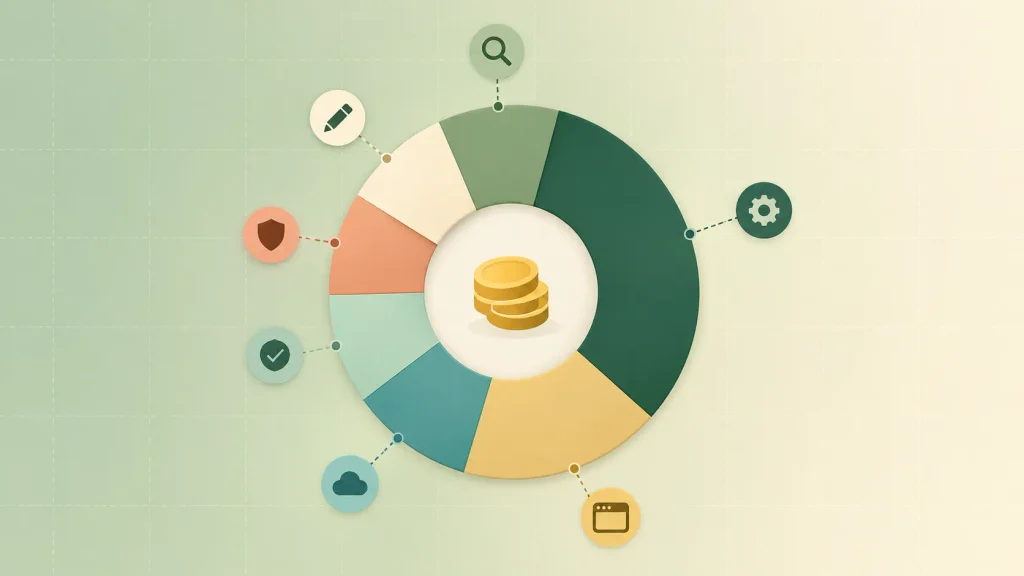
Azilen’s SaaS cost breakdown shows how effort typically spreads across a build:
| Area | Share of budget | What it covers |
| Discovery and architecture | 10 to 15% | Feature priorities, data model, tenancy strategy |
| UX/UI design | 10 to 15% | Wireframes, prototypes, onboarding flows |
| Backend development | 25 to 30% | Business logic, APIs, roles, integrations |
| Frontend development | 15 to 20% | Dashboards, interfaces, responsiveness |
| Cloud and DevOps | 10 to 15% | CI/CD, monitoring, backups |
| QA and automation | 10 to 15% | Manual and automated testing |
| Security and compliance | 5 to 10% | Auth, encryption, audit readiness |
If a quote shows almost nothing for discovery or QA, that money hasn’t disappeared. It’s just been moved to after launch, where fixes cost more.
One more line founders forget: the admin panel. Teamseven’s own breakdown gives internal tooling 12% of a typical B2B MVP budget, because someone has to manage users, plans, and refunds from week one.
7 Factors That Drive SaaS MVP Development Cost
Your SaaS MVP development cost comes down to the same seven decisions.
You control most of them, which is good news for your budget.
Feature Scope and User Roles
Feature count is the biggest lever on your SaaS MVP development cost. Each screen, flow, and edge case adds design, development, and testing time.
User roles multiply that effect. An app with one user type is one product. Add admins, team members, and clients, and you’re building permission logic into every screen.
Your tech stack plays in here too. A widely used stack is cheaper to staff and maintain, which is why choosing the right tech stack is a budget decision as much as a technical one.
Multi-Tenant vs Single-Tenant Architecture
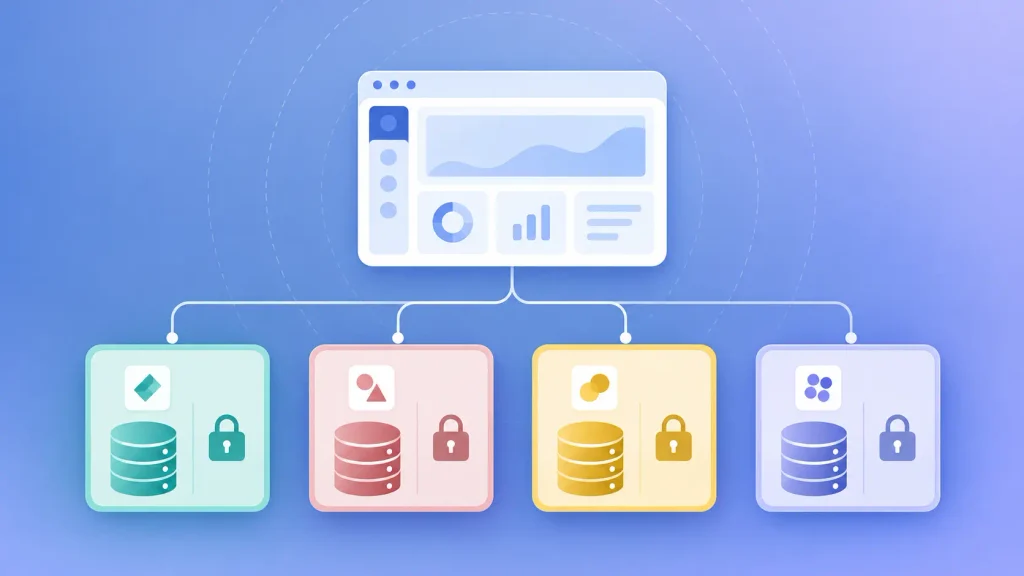
Multi-tenancy means one app serves many customers while keeping each one’s data separate. It costs more upfront.
Skipping it can cost far more later. If you plan to sell to many businesses, retrofitting tenancy after launch usually means rewriting your data layer under pressure.
Subscription Billing Logic
Taking a single payment is simple. Recurring billing is not, because every plan change creates an edge case your code has to handle.
The usual suspects include:
- Free trials and coupons
- Upgrades and downgrades mid-cycle
- Failed payments and retries
- Invoices and usage limits
Stripe or Paddle handles the payment itself. Your team still has to build the logic around it, so one plan at launch is far cheaper than four.
Third-Party Integrations
Each integration brings its own authentication, error handling, rate limits, and maintenance. Five integrations on day one can cost more than your core feature.
A simple test helps here. If the integration isn’t needed to prove someone will pay, it can probably wait until version two.
Design Depth
You don’t need award-winning animation for an MVP. You do need clear navigation, sensible empty states, and forms people can finish.
That gap between “polished” and “usable” is real money. Good UI/UX design for SaaS products focuses spend on the screens that drive activation, not on decoration.
Security and Compliance
If you handle health records, payments, or EU personal data, compliance work like HIPAA or GDPR enters the build. That means extra development, documentation, and sometimes legal review.
It’s far cheaper to design for compliance from sprint one than to bolt it on before an enterprise deal.
Team Location and Engagement Model
The same scope can be priced very differently depending on where and how your team works. It’s a big enough factor to get its own section next.
SaaS MVP Cost by Team Model and Region
Hourly rates vary widely by region, and the team model you pick changes your monthly burn even more. Classic Informatics publishes regional developer rates, and Azilen publishes monthly team costs by model.
Here’s how the main options compare:
| Model | Typical cost | Best for | Main risk |
| US/Canada developers | $100 to $200/hr | Local, high-touch builds | Highest cost per feature |
| Eastern Europe | $35 to $55/hr | Strong engineering on a mid budget | Time zone overlap with the US |
| India | $25 to $45/hr | Cost-sensitive builds | Quality varies by firm |
| US/Canada in-house team | $45k to $70k/month | Funded startups building core IP | Hiring time and overhead |
| Outsourced dedicated team | $18k to $30k/month | Fastest path to a scoped MVP | Depends on partner quality |
| Freelancer | Lowest, varies widely | Thin, single-workflow MVPs | One person is your whole team |

The cheapest hourly rate rarely produces the cheapest product. Rework, communication gaps, and missed requirements eat savings quickly, so I’d suggest weighing a team’s track record on SaaS builds above its rate card.
How Long Does It Take to Build a SaaS MVP?
A genuine SaaS MVP usually takes 8 to 16 weeks, according to Classic Informatics. Timeline matters for your SaaS MVP budget because most teams bill by time, directly or indirectly.
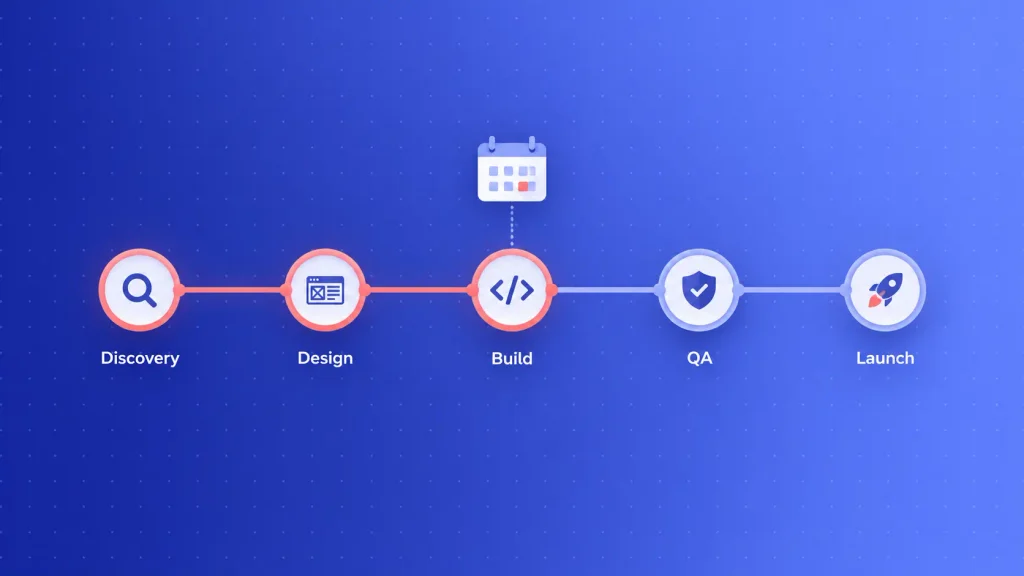
Most builds move through the same phases:
- Discovery: you agree on the core workflow, user roles, and what stays out of scope.
- Design: wireframes become a clickable prototype you can test with real users.
- Build sprints: features ship in small increments, with demos you can react to.
- QA and hardening: testing, security checks, and performance fixes.
- Launch: deployment, monitoring, and the first round of real feedback.
You can do the math yourself. A dedicated outsourced team at $18,000 to $30,000 a month, running for three months, lands at roughly $54,000 to $90,000. For a deeper look at each phase, our SaaS development process guide walks through them in order.
No-Code vs Custom: When a Cheaper MVP Makes Sense
No-code tools like Bubble can get you in front of users for a fraction of a custom build’s cost. The catch shows up later, if the product works.
Here’s the honest trade-off:
| Factor | No-code | Custom build |
| Upfront cost | Lower | Higher |
| Speed to first users | Faster | Slower |
| Custom billing and tenancy | Limited by the platform | Fully yours |
| Cost if it succeeds | Often a full rebuild | Extend what exists |

A good rule of thumb: no-code wins for validation, and custom wins once the software is the business.
There’s also a middle path. Eleken estimates a design-first clickable prototype at about $16,000, based on one designer at $50 an hour for eight weeks. You get user feedback before paying for a single backend.
What AI Changes About SaaS MVP Cost in 2026
AI shows up in your budget in two separate ways. It changes how your team builds, and it may become a feature you’re paying to run.
Where AI-Assisted Development Cuts Cost (and Where It Doesn’t)
The evidence is mixed, and that matters when someone promises an “AI-cheap” quote. In GitHub’s controlled study, developers using Copilot finished a JavaScript server task 55% faster than those without it.
But METR’s randomized trial found the opposite on real work. Experienced developers on large codebases took 19% longer with AI tools, even though they expected a speedup.
In practice, that splits roughly like this:
- Where AI helps: boilerplate, standard CRUD screens, tests, and well-trodden patterns.
- Where it doesn’t: architecture, tenancy design, billing edge cases, and product decisions.
So AI tends to shorten timelines a little more than it shrinks invoices. If a quote is dramatically cheaper because “AI writes the code,” it’s worth asking who’s making the architecture calls.
Budgeting for AI Features Inside Your MVP
An AI feature has two costs: building it, and running it. The second one is usage-based, so it grows with every user and every request.
Before you commit, you’ll want answers to three questions:
- How often will each user trigger the AI? Daily use and monthly use are very different bills.
- Which model tier do you need? Smaller models cost less per request and are often good enough.
- Can you cap or cache usage? Limits per plan protect your margins early on.
If you’re exploring this path, our guide to what AI SaaS actually is and the breakdown of AI consulting costs are useful next reads. When you’re ready to build, AI SaaS development covers both the product and the cost controls around it.
Your Year-One Budget: Build, Run, and Iterate

Your SaaS MVP development cost doesn’t stop at the build quote. Founders who budget for the build alone often run short just as real users start asking for changes.
Here’s a worked example for a $50,000 market-ready MVP, using the published percentages covered below:
| Line | Basis | Year-one cost |
| Build | Your quote | $50,000 |
| Mid-build scope buffer | 20 to 30% of build | $10,000 to $15,000 |
| Maintenance and iteration | 20 to 40% of build per year | $10,000 to $20,000 |
| Payment processing | 2.9% + 30¢ per charge | About $2,100 (see below) |
| Hosting and tooling | €300 to €1,200/month | €3,600 to €14,400 |
Before hosting, that’s roughly $72,000 to $87,000 on a $50,000 build. That gap is exactly why I’d suggest raising or reserving against the full year, not the quote.
Hosting and Tooling
Kolonell prices launch-stage running costs for a typical SaaS stack at €300 to €1,200 a month. That covers hosting, a managed database, monitoring, and similar services.
These costs start small and climb with usage. Your architecture choices decide how steeply.
Payment Processing Fees
Stripe’s standard US rate is 2.9% plus 30 cents per successful card charge. International cards add more on top.
The example above assumes 100 customers paying $50 a month. That’s $145 in percentage fees plus $30 in fixed fees each month, or about $2,100 a year.
Maintenance and Iteration
Classic Informatics puts post-launch maintenance at 20 to 40% of the build cost per year, and recommends a 20 to 30% buffer during the build itself. Azilen’s estimate is lower, at 15 to 25%.
Either way, this is the money that finds product-market fit. Treat it as part of the product, not overhead. If you want to plan the stages after launch, our SaaS development services cover growth-stage builds as well.
How to Reduce SaaS MVP Cost Without Building a Weaker Product
The smartest way to cut SaaS MVP development cost is to build less, not worse. A cheaper MVP should be smaller, never flimsier.
Validation is the first saving. In CB Insights’ analysis of 111 startup post-mortems, 35% of founders cited no market need as a reason they failed. A prototype test costs far less than a product nobody buys.
Cuts that usually pay off:
- One user type and one core workflow at launch
- One pricing plan, with more added once you see demand
- Proven UI components instead of custom design for every screen
- Managed services for auth, email, and payments
- A written “not now” list, agreed before the build starts
Cuts that tend to backfire:
- Skipping discovery to “start faster”
- Skipping QA and automated tests
- Weak database design to save a week
- Ignoring security until a customer asks
The first list shrinks your MVP. The second shrinks your margin for error, and you’ll usually pay it back with interest.
Red Flags in a SaaS MVP Quote
A low quote can be the most expensive one you accept. These signs suggest the number won’t hold:
- No discovery phase. A fixed price without understanding your workflows is a guess.
- Vague deliverables. “A working SaaS platform” is not a scope. Named features and integrations are.
- No admin panel, billing, or deployment line. If it’s missing, you’ll pay for it later as a change request.
- No rationale for the tech stack. “Whatever you want” means nobody has thought about your product.
- Unclear code ownership. If the contract doesn’t give you the repo, database, and cloud accounts, walk away.
- No post-launch support terms. Every product ships with bugs. The contract should say who fixes them, and for how long.
Any one of these is worth a direct question before you sign. Two or more, and it’s worth getting another quote.
How Boomdevs Solves the SaaS MVP Budget Problem
Most SaaS MVP development cost overruns start before any code gets written, with a scope nobody pinned down. That’s where Boomdevs starts too.
Every SaaS MVP development engagement begins with discovery: one core workflow, a clear “not now” list, and an architecture that won’t need a rebuild at your first 50 customers. You get milestone-based delivery, demos every sprint, and full ownership of your code and infrastructure.
That process comes from 3.5K+ delivered projects and work with 350+ startup founders. The goal is simple: a number you can plan around, and an MVP that answers the question you’re actually trying to test.
Frequently Asked Questions
How Much Does a Simple SaaS MVP Cost?
Most SaaS MVPs take 8 to 16 weeks from discovery to launch. Simpler single-workflow builds sit at the shorter end. If a plan stretches well past four months, the scope has probably grown beyond an MVP.
How Long Does It Take to Build a SaaS MVP?
Most SaaS MVPs take 8 to 16 weeks from discovery to launch. Simpler single-workflow builds sit at the shorter end. If a plan stretches well past four months, the scope has probably grown beyond an MVP.
Is It Cheaper to Build a SaaS MVP With an Offshore Team?
Usually, yes. Developer rates in India and Eastern Europe run roughly $25 to $55 an hour, compared with $100 to $200 in the US and Canada. The savings hold up when the partner has real SaaS experience and a clear process, since rework can erase a lower rate quickly.
How Much Should I Budget After My SaaS MVP Launches?
Plan for 20 to 40% of your build cost per year in maintenance and iteration, plus hosting and payment fees. On a $50,000 build, that’s $10,000 to $20,000 a year before running costs. This budget is what funds the changes real users ask for.
Can I Build a SaaS MVP for Under $10,000?
It’s possible with a freelancer or a no-code tool, if you keep to one user type and one workflow. Expect trade-offs in security, scalability, and support. For validating demand, that can be fine. For a product you plan to sell at scale, it often means a rebuild later.
Ready to see what your SaaS MVP will actually cost?
Share your core workflow and target users, and get a scoped, milestone-based estimate from a team that has delivered 3.5K+ projects. You’ll know your number before you commit a dollar.