


- 1. Key Takeaways
- 2. What Is AI SaaS? A Plain-English Definition
- 3. AI SaaS vs Traditional SaaS: What Actually Changes
- 4. How AI SaaS Works Under the Hood
- 5. Benefits of AI SaaS
- 6. What Are the Types of AI SaaS?
- 7. Top AI SaaS Examples to Know in 2026
- 8. Agentic SaaS: From Assistant to Autonomous Agent
- 9. How to Choose the Right AI SaaS Tool
- 10. How AI SaaS Pricing Works in 2026
- 11. The Security and Governance Risks Unique to AI SaaS
- 12. Build vs Buy: Should You License AI SaaS or Build Your Own?
- 13. Frequently Asked Questions
Summarize with
AI SaaS is cloud software that does the work for you instead of just storing your data. Where a traditional tool waits for a click, an AI SaaS product reads your context, predicts what you need, and can act on it, all delivered through the same subscription model you already know. No servers to run, no models to train, no data-science team to hire.
That shift is happening fast. Enterprise spending on generative AI nearly tripled year-over-year, from $11.5 billion in 2024 to $37 billion in 2025, according to Menlo Ventures’ 2025 State of Generative AI in the Enterprise report (Dec. 9, 2025). More than half of that, $19 billion, went straight to the application layer: the AI-native tools people actually use. This guide breaks down what AI SaaS is, how it differs from the software you grew up on, how it works, what it costs, how to choose the right tool, and how to buy it without getting burned.
Key Takeaways
- AI SaaS embeds machine learning into a subscription product, so you get prediction and automation without building infrastructure.
- The real break from traditional SaaS is the inference layer: probabilistic, context-aware output instead of fixed, rule-based logic.
- AI SaaS pricing increasingly includes consumption-based and outcome-based models alongside traditional per-seat pricing, which can save money or blow up your bill depending on how you cap it.
- Agentic SaaS, software that acts on its own, is the fastest-moving trend: Gartner predicts that 40% of enterprise applications will include task-specific AI agents by the end of 2026, up from less than 5% today. Separately, Gartner forecasts that more than 40% of agentic AI projects could be cancelled by 2027 because of escalating costs, unclear business value, and inadequate risk controls.
- The main risks are new, not familiar: prompt injection, data leakage in shared systems, and unpredictable model behavior. Vet vendors before you sign.
What Is AI SaaS? A Plain-English Definition
Picture your CRM not just logging a deal, but reading the email thread, scoring the lead, and drafting the follow-up before you ask. That is AI SaaS: cloud-delivered software with machine learning built into the core, so it can analyze patterns, make predictions, and take action on your behalf.
The subscription and cloud delivery are the same as classic SaaS. What changes is the engine. A rules-based app follows instructions a developer wrote in advance. An AI SaaS product runs your request through a model that reasons over your data and produces an answer shaped by context, not a script.
There is a spectrum here, and it matters. Bolting a chatbot onto an old dashboard is not the same as rebuilding the product around a model. The genuinely AI-native tools treat intelligence as the product, not a feature in the corner.
AI SaaS vs Traditional SaaS: What Actually Changes
Traditional SaaS runs on deterministic logic. It stores your data and returns exactly what its rules tell it to. AI SaaS adds a probabilistic inference layer that interprets, predicts, and sometimes decides, which makes the output variable and context-driven rather than fixed.
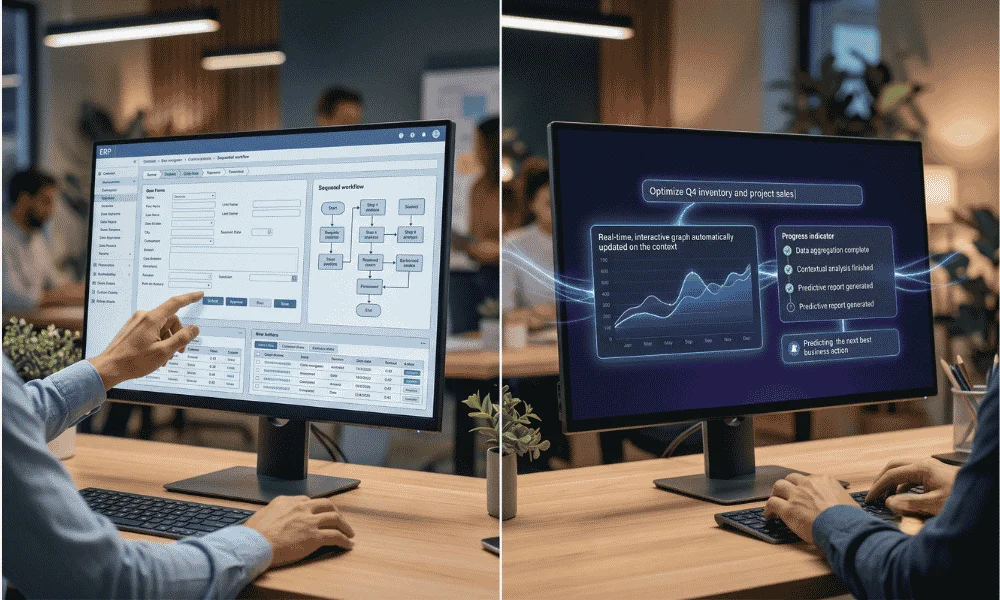
Here is the practical breakdown.
| Dimension | Traditional SaaS | AI SaaS |
| Core execution | Rule engines and stored procedures | Inference layer (LLMs, embeddings) |
| Output type | Deterministic and fixed | Probabilistic, variable, and contextual |
| User interaction | Click-based menus and forms | Intent-driven, conversational input |
| Pricing model | Predictable per-seat fees | Often consumption or outcome-based |
| Design logic | Feature-first | Outcome-first |
The trade-off is real. Deterministic software is predictable, which is exactly what you want for payroll or invoicing. Probabilistic software is flexible and powerful, but it can also be wrong in ways a rule engine never could, so the best of these tools keep a human in the loop for anything high-stakes.
How AI SaaS Works Under the Hood
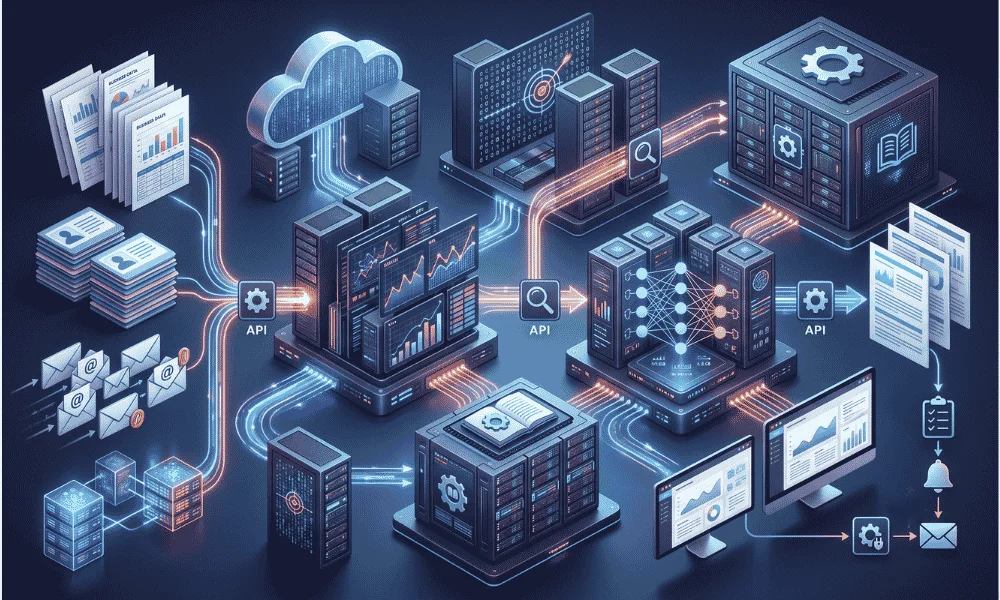
Most AI SaaS products route your request through four stages: they prepare your data, retrieve the relevant pieces, run those through a model, then deliver the result back to you or to another system. The clever part is what sits in the middle.
- Data ingestion. Raw records get split into small chunks and converted into vectors, numeric representations a model can compare and search.
- Context retrieval. Using retrieval-augmented generation (RAG), the system pulls the most relevant chunks so the model answers from your current facts, not just its training data.
- Inference. The prompt and retrieved context hit a model runtime, such as a Claude, GPT, or Gemini model, which generates the output.
- Delivery. The result streams back into the interface, or it kicks off a downstream workflow that another agent completes.
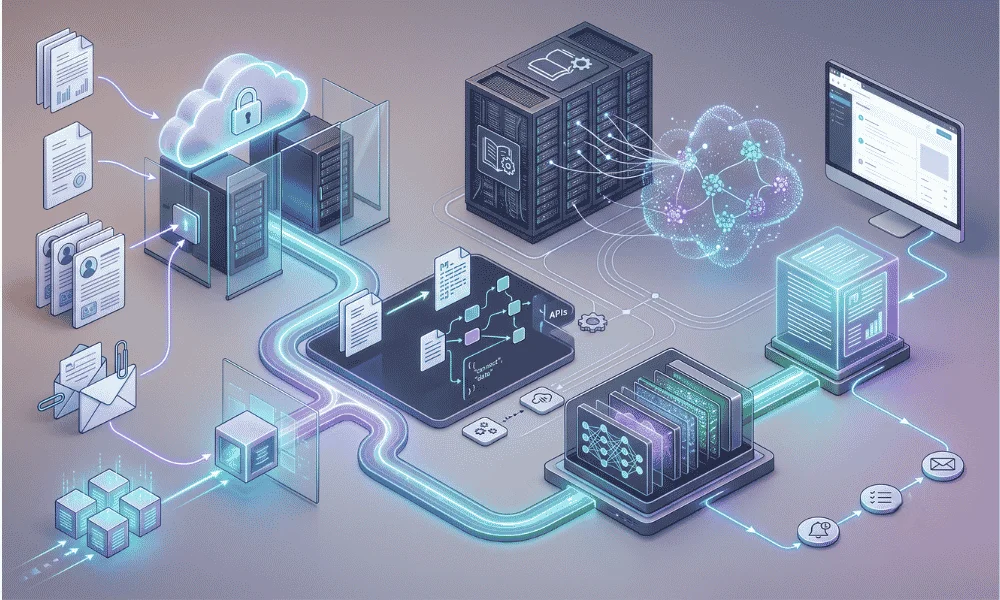
That retrieval step is why RAG matters so much. It is the difference between a model guessing and a model answering from your own knowledge base. RAG can improve grounding by giving a model access to relevant, up-to-date information from a company’s knowledge base, although it does not eliminate hallucinations on its own a model can still misread or misapply the retrieved context.
Benefits of AI SaaS
The appeal of AI SaaS isn’t the novelty of the technology, it’s what it removes from a team’s plate. A few benefits show up consistently across adopters:
- Faster time-to-value than building in-house. Vertical vendors can shorten time-to-value by providing domain-specific workflows, integrations, and model capabilities that teams would otherwise need to build and maintain themselves. That’s a big reason Menlo Ventures found 76% of enterprise AI use cases are now purchased rather than built internally, up from a 53%/47% split just a year earlier.
- Lower up-front investment. No dedicated data-science hires, no model training pipeline, no GPU procurement, the vendor absorbs that cost and amortizes it across customers. This is also where an outside AI and generative AI consulting engagement tends to pay for itself: getting the build-vs-buy call right the first time is cheaper than re-platforming later.
- Faster deals, faster wins. Menlo’s same report found AI deals reach production at nearly twice the rate of traditional software (47% vs. 25%), suggesting that buyers are moving AI solutions into production faster than they historically have with traditional SaaS.
- Updates without infrastructure maintenance. Vendor-managed updates can improve the product over time without requiring your team to maintain the underlying AI infrastructure, although those changes also introduce governance and consistency risks, a model, prompt, or retrieval change on the vendor’s side can shift output quality in either direction without warning (more on this below).
- Scales with usage, not headcount. Outcome- and consumption-based pricing means costs can track the actual work done rather than the number of seats you’ve bought – useful for spiky or seasonal workloads, if you cap it properly.
The flip side: these are gains realized when the tool is a genuine fit for the workflow. A mismatched vertical tool, or a horizontal tool stretched to do specialized work, erodes most of this advantage.
What Are the Types of AI SaaS?
Horizontal vs Vertical AI SaaS
The quickest way to categorize any of these tools is to ask whether it works everywhere or works deeply in one place. Horizontal tools are general-purpose and industry-agnostic. Vertical AI SaaS products are designed for a specific industry or workflow, often combining general-purpose models with domain-specific data, retrieval, workflows, and integrations.
- Horizontal AI SaaS: Salesforce Einstein for CRM, Microsoft Copilot for productivity, and Notion AI for general knowledge work. Broad reach, shallow specialization.
- Vertical AI SaaS: Harvey AI for legal reasoning, Veeva for life sciences and clinical data, and Gong for revenue intelligence. Narrow focus, deep expertise.
Vertical AI SaaS can offer faster time-to-value when the product is closely aligned with a specialized workflow, because more of the domain context and workflow logic is already built in. Healthcare has been the clearest proof of that appetite: Menlo Ventures reports it captured 43% of all vertical AI spend in 2025 about $1.5 billion of the $3.5 billion total, more than the next four verticals combined even though healthcare’s long procurement cycles and regulatory requirements typically slow enterprise software adoption (Menlo Ventures, “2025: The State of Generative AI in the Enterprise”, Dec. 9, 2025).
Top AI SaaS Examples to Know in 2026
If you want to see where the category is heading, watch the tools that are already generating real revenue rather than demos. A few stand out.
- GitHub Copilot for developer productivity. In a controlled 2023 GitHub study of 95 professional developers, those using Copilot completed a JavaScript coding task 55.8% faster than the control group (1h11m vs. 2h41m average) a single, bounded task, and real-world gains vary by team and codebase.
- Salesforce Einstein for sales, using agentic features to build pipeline forecasts and draft outreach sequences.
- Intercom Fin for customer support, an agent that resolves a large share of tickets on its own (more on its pricing below). Fin, formerly Intercom’s AI customer-agent business, is also undergoing a major ownership change: Salesforce announced a definitive agreement on June 15, 2026, to acquire Fin for approximately $3.6 billion, with the deal expected to close in Q4 of Salesforce’s fiscal year 2027 and Fin folding into Agentforce (Salesforce official press release) worth watching if you’re evaluating it for a long-term contract.
- Glean for enterprise search, stitching answers together across the fragmented apps where your company’s knowledge actually lives.
- Harvey AI for legal work, reasoning over contracts and case material in a way general chatbots cannot.
Notice the pattern: the winners are not chatbots pasted onto old products. They resolve a task, they specialize, and they earn their keep on outcomes.
Agentic SaaS: From Assistant to Autonomous Agent
An assistant helps you complete a task; an agent can execute multiple steps toward completing it for you. Agentic SaaS is software that chains its own reasoning steps, calls other tools through APIs, and completes multi-stage work across systems with little or no human input.
Concretely, that looks like a support agent that reads a ticket, checks the customer’s account in the CRM, resets a password, and emails confirmation, all without a person touching it. The reach of this shift is hard to overstate. Gartner predicts that 40% of enterprise apps will embed task-specific AI agents by the end of 2026, up from less than 5% in 2025 (Gartner, Aug. 26, 2025).

That is only half the picture, though. Gartner also forecasts that more than 40% of agentic AI projects will be cancelled by 2027, citing escalating costs, unclear business value, and inadequate risk controls. Fast adoption and a high failure rate are both true at once, which is exactly why picking the right tool, and scoping it correctly, matters more than picking any agentic tool at all.
A word of caution, too. Gartner has separately warned about “agentwashing,” where vendors slap the word “agent” on a glorified chatbot. Before you believe the label, ask what the tool can actually do without a person clicking the next button.
How to Choose the Right AI SaaS Tool
With adoption this fast, the harder problem isn’t finding an AI SaaS tool, it’s picking the right one. (If the honest answer is that you need outside help scoping it rather than a checklist, that’s its own decision see how to choose an AI consultancy for that side of the question.) A short evaluation framework:
- Match specialization to the task. If the workflow is genuinely industry-specific (legal review, clinical documentation, financial compliance), a vertical tool with domain training will usually outperform a horizontal tool stretched to cover it. If the task is general (drafting, search, summarization), horizontal tools are often cheaper and more flexible.
- Pressure-test the “agent” claim. Ask the vendor exactly which steps the tool completes without a human clicking “approve,” and ask to see it fail every agent has edge cases, and how a vendor talks about failure modes tells you a lot.
- Model your worst-case bill, not your average. For consumption- or outcome-based pricing, forecast peak usage and set hard caps, especially on any workflow that can trigger itself in a loop.
- Require the governance basics up front. SOC 2 Type II, written data-use guarantees, tenant isolation, and a model-versioning SLA (see the checklist below) — treat a vendor’s inability to produce these as your answer.
- Pilot with a reversible decision. Because AI SaaS deals convert to production almost twice as fast as traditional software, it’s tempting to commit fast. Structure the first contract so you can exit or downgrade if the tool underperforms once real volume hits it.
- Keep a human in the loop on anything high-stakes. Lending, hiring, clinical, or safety-relevant decisions should have a defined human checkpoint regardless of how confident the tool’s output looks.
How AI SaaS Pricing Works in 2026
AI SaaS pricing has drifted away from the tidy per-seat model, because a seat no longer maps cleanly to value when the software does the work. Three models now dominate, and each shifts risk differently between you and the vendor.
- Consumption-based. You pay per token or API call. Model API pricing is only one component of an AI SaaS vendor’s total cost, since the end-user price typically also bundles infrastructure, integrations, support, and product margin, but it’s a useful order-of-magnitude anchor. OpenAI’s GPT-4o, now an older model in its lineup, is listed at $2.50 per million input tokens and $10 per million output tokens; confirm current rates directly with your vendor, since token pricing across the industry keeps falling. Flexible, but usage can spike without warning.
- Per-seat. Still common for horizontal tools, usually bundled into a premium tier rather than sold as the whole product.
- Outcome-based. The emerging standard, where you pay only for a result. Intercom’s Fin uses outcome-based pricing: service resolutions, procedure handoffs, and disqualifications are currently documented at $0.99 each, while sales qualifications are $9.99, on top of a base plan with a monthly outcome minimum. So you’re billed for value delivered, but “outcome” is defined more broadly than “problem solved,” and it’s worth reading the vendor’s fine print on what counts as which.
Outcome pricing sounds like the safest deal, and often it is. But watch the fine print: a tool that resolves more also bills more, so success and cost rise together. Model your worst-case volume, not your average, and set hard caps on any agentic workflow that can call itself in a loop.
The Security and Governance Risks Unique to AI SaaS
The risks that should worry you here are not the familiar ones. Prompt injection remains the top-ranked risk in OWASP’s 2025 Top 10 for LLM Applications, because a model processes instructions and data in the same channel and can’t always tell a legitimate request from a malicious one hidden in a document or web page.
Two more deserve your attention. Data-use and isolation risks can expose sensitive information if a vendor handles customer data improperly or fails to enforce strong tenant isolation across models, retrieval systems, or vector stores. And the absence of model-versioning guarantees means a silent update can change your output quality overnight, with no changelog and no warning.

Governance is not just security, either. High-stakes decisions like lending, hiring, or clinical triage need a bias and fairness review, plus a human check on anything that materially affects a person. And because inference is energy-hungry, teams with ESG commitments are starting to weigh the carbon cost of always-on AI, not only the dollar cost.
Before you sign anything, run the vendor through this short checklist:
- SOC 2 Type II report, current and available on request.
- Explicit written guarantee that your data is not used to train shared models.
- Documented tenant isolation for data and vector storage.
- A model-versioning SLA, so updates are announced, not sprung on you.
- Data residency controls that match your compliance obligations.
- A clear bias-audit and human-oversight policy for any consequential decision.
Build vs Buy: Should You License AI SaaS or Build Your Own?
For most teams in 2026, buying beats building, and the market agrees. Menlo Ventures found that 76% of enterprise AI use cases are now bought rather than built in-house, up from 53% the year before. Vertical vendors ship pre-trained domain expertise you would otherwise spend months recreating.
Building makes sense when the capability is your core differentiator, when your data or workflow is genuinely unusual, or when compliance rules out sending data to a third party. For almost everything else, a licensed tool gets you to value faster and cheaper. When building is the right call, that’s typically a custom software development engagement rather than a DIY side project, the same engineering rigor that goes into any bespoke system applies just as much when the system happens to have a model inside it.
There is a messy middle worth naming, too. Lightweight internal tools are increasingly quick to assemble, so the honest question is rarely “build the whole platform or buy it.” It is “which specific pieces do we buy, which few do we build, and where does shadow AI already fill the gap?” That last point is not hypothetical: Menlo Ventures found that product-led growth now drives 27% of enterprise AI spend about four times the rate of traditional software with unofficial, personal-account “shadow AI” usage pushing the real figure toward 40% once accounted for. That means your team may already be using AI SaaS whether IT approved it or not.
If you are weighing that decision now, map each use case against three axes: how core it is, how sensitive the data is, and how fast you need it live.
Frequently Asked Questions
What does AI SaaS mean for my business?
It means moving from software you operate to software that operates for you. Instead of reading a dashboard and deciding what to do, you get tools that score leads, resolve tickets, and draft work on their own. The practical payoff is time back and fewer manual, repetitive tasks.
Is SaaS dead because of AI?
No, but its value is relocating. Traditional software isn’t disappearing; it’s becoming the trusted “system of record” that gives AI reliable context to act on. The money is shifting from storing data to executing on it: Menlo Ventures reports AI applications now represent more than 6% of the entire software market, just three years after ChatGPT’s launch (Menlo Ventures, Dec. 9, 2025).
What is the difference between an AI agent and a chatbot?
A chatbot answers questions from a script and stops there. An agent takes actions: it calls APIs, moves between systems, and completes multi-step tasks like resetting a password or provisioning access. The line is autonomy whether the software waits for your click or acts without one.
Will AI SaaS increase my monthly costs?
It can go either way. AI SaaS cuts labor costs by automating work, but consumption-based pricing means an unmonitored agent can rack up token or API charges fast. Cap usage, model your peak volume rather than your average, and treat any self-triggering workflow as a budget risk until proven otherwise.
Can I trust an AI SaaS vendor with my proprietary data?
Only with the right contracts in place. You need a written guarantee that your data will not train shared models, documented tenant isolation, a SOC 2 Type II report, and explicit data residency controls. If a vendor cannot produce those, treat that as your answer.
How long does AI SaaS take to implement?
A vertical, pre-trained tool can often reach real value in weeks rather than the many months a custom build demands, because the domain knowledge already lives in the model. Timelines still depend on data cleanup, integrations, and change management, which is usually where projects actually stall.
What is the “shadow AI” threat?
Shadow AI is employees using unapproved tools a personal ChatGPT account, say for company work. It creates compliance and security gaps because sensitive data ends up in systems your policies never vetted. Given that it already drives a meaningful share of AI spending, the fix is a sanctioned tool and a clear policy, not a ban nobody follows.