


- 1. What Is AI Consulting?
- 2. AI Consultant vs. AI Developer vs. Fractional CAIO
- 3. Decision Flow: Which One Do You Actually Need?
- 4. Why Do Most Enterprise AI Projects Fail?
- 5. What Are the Different Types of AI Consulting Firms?
- 6. Which Firm Type Fits Your Business Size?
- 7. How to Evaluate and Choose an AI Consulting Partner
- 8. Common Mistakes Buyers Make When Hiring an AI Consultancy
- 9. AI Agent Consulting: What It Looks Like in Practice
- 10. The Platforms and Frameworks Behind Most Agent Builds
- 11. Case Study: Scoping a Support-Triage Agent for a Mid-Market SaaS Company
- 12. What to Expect at Each Project Phase
- 13. How Much Does AI Consulting Cost in 2026?
- 14. Red Flags to Watch For When Hiring an AI Firm
- 15. Frequently Asked Questions
- 16. The Bottom Line
Summarize with
Most “top AI firms” articles are directories wearing a guide’s clothing. They rank McKinsey next to a five-person ML shop, tell you to “check their portfolio,” and call it advice. None of that helps when you are the one signing the contract.
This guide skips the listicle. It walks through what AI consulting services actually cover (call it AI consultancy services, AI automation consulting, or AI agent consulting, it’s the same buying decision), which firm type fits your size and budget, what the engagement should cost, and the questions that separate a consultancy that ships working systems from one that ships a deck and disappears.
How do you choose an AI consultancy? Match firm type to your size and budget first: boutiques or a fractional CAIO for startups and SMBs, Big Four or MBB for multi-unit enterprises. Then vet every finalist on four things: a data-readiness audit before any price quote, a staged PoC → MVP → production path with priced milestones, a named MLOps plan for after launch, and mapped compliance to NIST AI RMF or the EU AI Act. Skip any firm that quotes one lump sum on day one.
Key takeaways:
- Firm type matters more than firm reputation. A Big Four logo and a five-person boutique solve different problems at wildly different prices.
- More than eighty percent of AI projects fail to reach production, and the cause is almost never the model itself.
- Insist on a staged path (proof of concept, then MVP, then production) with named milestones, not one lump quote for “the AI project.”
- Ask about model drift and MLOps before you sign, not after accuracy starts slipping six months into production.
- Budget $2,000 to $30,000 a month for fractional AI leadership, or $150 to over $1,000 an hour for project work, depending on the tier.
What Is AI Consulting?
AI consulting services help a company figure out where AI actually creates business value, then build and govern the system that captures it, blending strategy, engineering, and compliance instead of stopping at any one of the three.
AI consulting services exist to answer one question honestly: where does artificial intelligence actually move your numbers, and what does it take to get there. An AI consultant’s job is to answer that, then help you build the thing that does it, without leaving you holding a system nobody can maintain. That’s the trade behind AI consultant services: judgment plus delivery.
The work spans more ground than the name suggests. It can mean AI automation consulting services that remove manual steps from a business process, generative AI consulting for internal tools and content workflows, or, increasingly, AI agent consulting services for systems that act on your behalf instead of just answering questions. The good ones blend three skills no matter which of those you need. Strategy decides what’s worth building. Engineering builds it and gets it into production. Governance keeps it compliant and safe once it’s live. A firm that only offers one of the three will eventually hand you off to someone else, and that handoff is where a lot of AI budgets quietly disappear.
AI Consultant vs. AI Developer vs. Fractional CAIO
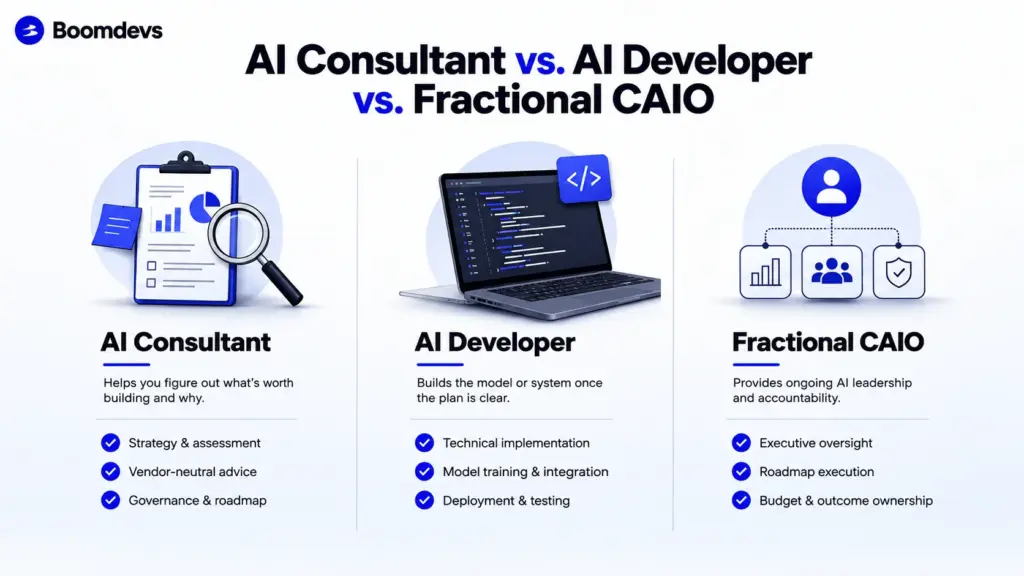
Hire a developer if the use case is already validated and scoped. Hire a consultant if you need to figure out what’s worth building. Hire a fractional CAIO if you need ongoing, senior-level ownership of the AI roadmap rather than a single project.
These three titles get used almost interchangeably in sales decks, and that’s exactly why the wrong one gets hired.
| Role | Best For | Watch Out For |
| AI Consultant / Firm | Strategy, vendor-neutral assessment, and governance before you commit budget | Firms that stop at the strategy deck and hand execution to a separate vendor |
| AI Development Company | Building a specific model or system once the strategy is already set | Teams that start coding before anyone has validated the use case |
| Fractional Chief AI Officer (CAIO) | Ongoing executive ownership, board reporting, and budget accountability, part-time | Advisors who set direction but have no authority over whether anything actually gets built |
If you already know exactly what to build, hire a developer. If you don’t, or if nobody senior owns the AI agenda internally, start with a consultant or a fractional CAIO instead.
Decision Flow: Which One Do You Actually Need?
Walk through these questions in order. Stop at the first one that fits.
- Do you already have a validated, well-specified use case and just need it built? → Hire an AI development company (or a nearshore/offshore team if the scope is large and stable).
- Do you know AI could help somewhere, but you’re not sure where, or nobody senior owns the decision? → Start with an AI consultant or boutique firm for a readiness audit and scoped strategy.
- Do you need ongoing, board-level accountability for AI outcomes, not just a single project? → Bring in a fractional CAIO who sits inside your leadership structure part-time.
- Are you running multiple AI initiatives across several business units with heavy compliance exposure? → Go straight to a global consultancy (Big Four or MBB) with the bench depth to run it as a program, not a project.
Most companies move through more than one of these over time: a fractional CAIO or consultant sets direction first, then hands validated use cases to a development team to build.
Why Do Most Enterprise AI Projects Fail?
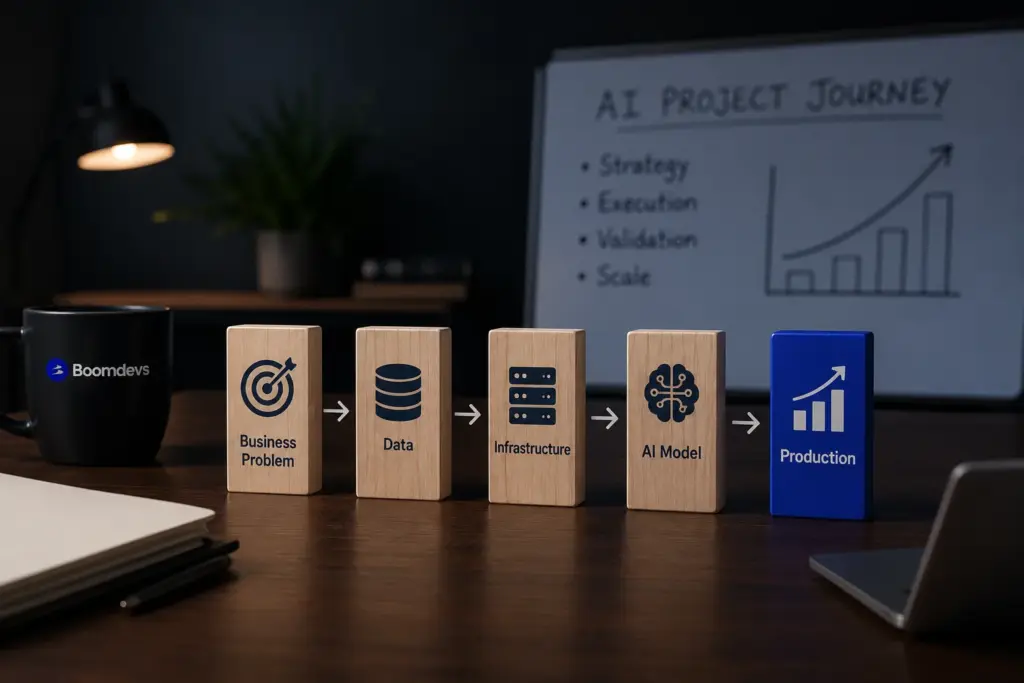
Over eighty percent of AI projects fail to reach production, and RAND’s research traces this mostly to leadership decisions, not model quality: misunderstood problems, chasing flashy technology over business outcomes, weak production infrastructure, and poor data readiness.
They fail at a much higher rate than ordinary software projects, and the reason is rarely the algorithm. RAND Corporation’s 2024 study on AI project failure, built on interviews with sixty-five experienced data scientists and machine learning engineers, found that more than eighty percent of AI projects fail, roughly twice the failure rate of non-AI IT projects.
RAND traced this back to five root causes, and only one of them is genuinely technical. The others sit squarely with leadership: misunderstanding the problem before scoping the solution, chasing flashy models instead of the business outcome, underinvesting in the infrastructure that gets a model into production, and applying AI to problems it isn’t actually ready to solve yet.
Poor data readiness runs through nearly every failure pattern researchers have documented since. A consultancy that quotes you a build price before looking hard at your data is quoting blind, and that number will move once they actually see what they’re working with.
What Are the Different Types of AI Consulting Firms?
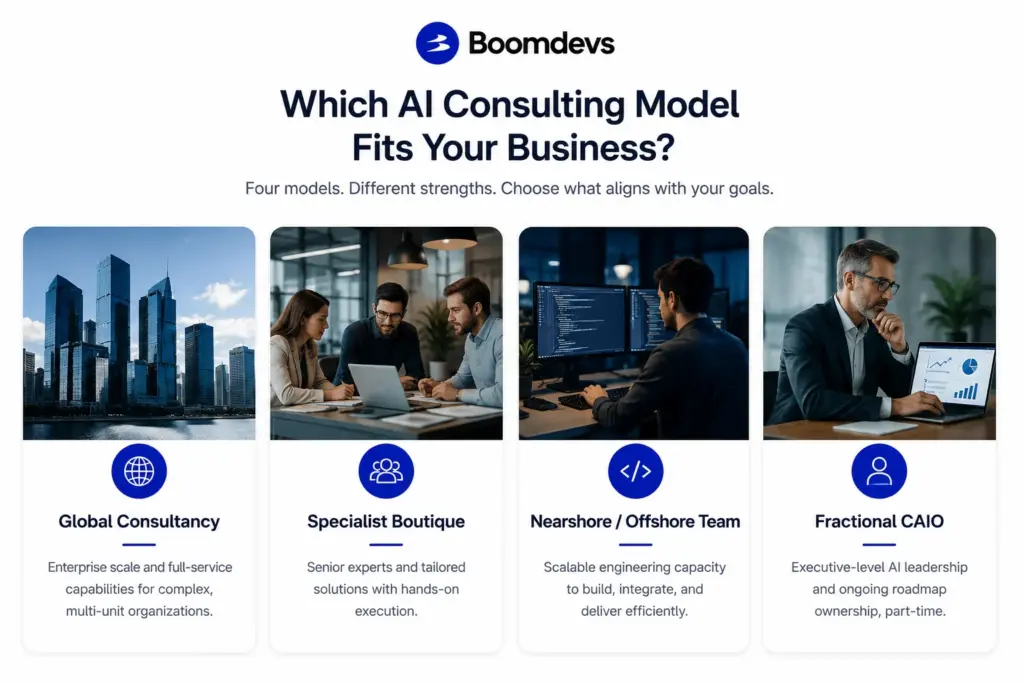
The market splits into four tiers: global consultancies (Big Four/MBB) for board-level, cross-unit rollouts; specialist boutiques for senior-led execution at startup and mid-market scale; nearshore/offshore teams for large validated builds; and fractional CAIOs or independent strategists for ongoing senior judgment without a full-firm price tag.
Firm size determines what you’re buying almost as much as expertise does. Here’s how the market actually breaks down.
Global Consultancies (Big Four and MBB)
McKinsey, Deloitte, BCG, and their peers bring board-level credibility and the kind of scale that matters for a multinational, cross-business-unit rollout. If your board needs to hear “we hired McKinsey” as part of the sign-off, this tier delivers that.
The tradeoff is structural. Senior partners sell the engagement and set the strategy, but junior analysts do most of the actual work, and the model itself rarely changes that dynamic even as AI tools compress delivery timelines industry-wide.
Specialist AI Boutiques
Boutique firms, usually five to fifty people, sell technical depth instead of brand weight. The person who scoped your project is often the same person who builds it, which matters when you need architecture decisions made by someone who has actually shipped a model to production.
Their pitch, and it’s a legitimate one, is “strategy that ships, not just strategy that sounds good in a boardroom.” Boomdevs is a fair example of how this looks in practice: its AI and generative AI consulting services are built specifically to close the strategy-to-execution gap, with senior product strategists and engineers owning a project from kickoff through delivery instead of handing it off to a separate build team once the deck is approved. That structure won’t suit a Fortune 500 transformation spanning a dozen business units, but for a startup or mid-market team that needs an AI use case actually running rather than another roadmap slide, it’s the kind of setup worth putting on a shortlist.
Nearshore and Offshore Firms
These teams are the right call for large, well-specified engineering work where the use case is already validated and you mainly need hands-on keyboard work. They’re a poor fit for open-ended strategy questions, since ambiguity is expensive when the team billing your project isn’t the team that gets to ask you clarifying questions in real time.
Fractional AI Teams and Independent Strategists
A fractional Chief AI Officer or an independent AI strategist gives a startup or SME senior-level judgment without the overhead of a full firm. This is often where AI consulting services for small businesses deliver the most value, since the pricing and scope are built for a team that can’t yet justify a full-time executive hire. This model has grown fast: one 2026 industry survey found CAIO adoption jumped from roughly a quarter to more than three-quarters of surveyed organizations in a single year, as AY Automate’s fractional CAIO guide reports, citing IBM research.
Boutique vs. Big Four vs. Fractional CAIO: Head-to-Head
| Specialist Boutique | Big Four / MBB | Fractional CAIO | |
| What you’re really buying | Senior execution at a fixed scope | Board-level credibility and scale | Ongoing accountability, not a project |
| Who does the work | The same senior people who scoped it | Partners scope it, analysts build it | The CAIO themselves, plus whoever they bring in |
| Typical engagement length | Weeks to a few months, sprint-based | Months to years, program-based | Ongoing, part-time, month-to-month |
| Cost profile | $150–$350/hour or fixed-scope project pricing | $300–$1,000+/hour, large program budgets | $2,000–$30,000/month retainer |
| Best fit | Startup or mid-market team that needs a working system, not a roadmap | Enterprise with multiple business units and heavy compliance exposure | Any company where nobody senior currently owns the AI agenda |
| Biggest risk | Can outgrow the team as needs scale | Slow handoff between strategy and delivery layers | No formal authority to force organizational change |
Which Firm Type Fits Your Business Size?
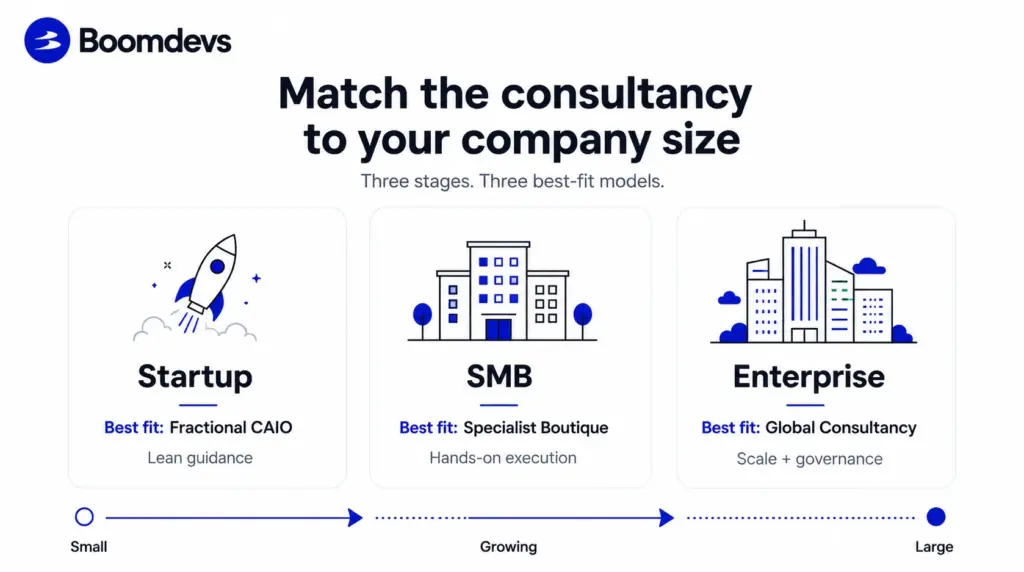
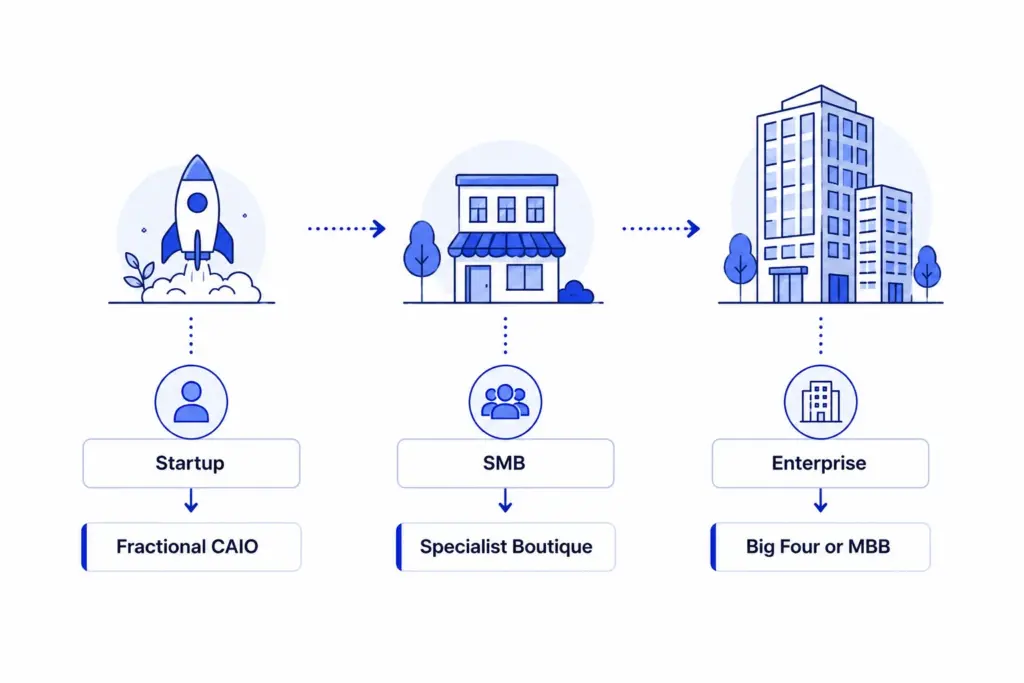
Startups generally do best with a fractional CAIO or independent strategist, SMBs with a specialist boutique, and enterprises with a global consultancy, mainly because budget, engagement style, and compliance exposure scale together.
| Startup | SMB | Enterprise | |
| Best-fit firm type | Fractional CAIO or independent strategist | Specialist boutique | Global consultancy (Big Four/MBB) |
| Typical budget | $2,000–$8,000/month retainer | $50,000–$250,000 per project | $250,000–$1M+ per program |
| Engagement style | Lean, senior-only, fast iteration | Fixed-scope, sprint-based, same team start to finish | Multi-workstream, partner-led strategy with analyst execution |
| Primary need | Direction and prioritization, not headcount | A working system that ships without a big internal team | Cross-business-unit coordination and board-level governance |
| Common risk | No authority to force internal change | Outgrowing the boutique before scaling | Slow handoffs between strategy and delivery teams |
How to Evaluate and Choose an AI Consulting Partner
Run every finalist through four checks before signing anything: a data-readiness audit ahead of any price, a staged PoC/MVP/production methodology, a concrete MLOps and post-launch support plan, and documented compliance with NIST AI RMF and, where relevant, the EU AI Act.
Once you know which tier fits your budget, run every finalist through the same four checks before you sign anything.
Step 1: Audit Your Data Readiness First
Your data, not the model, is almost always the bottleneck. A partner worth hiring insists on auditing your data infrastructure and its quality before quoting a firm build price.
If a firm skips this and jumps straight to a number, treat that number as fiction. It will move once real data readiness comes into view.
Step 2: Demand the PoC, MVP, Production Methodology
AI is not deterministic like traditional software, and it shouldn’t be scoped like it. Insist on three distinct stages: a proof of concept that tests whether the idea is technically feasible, a minimum viable product that tests whether it creates real business value, and only then a production build.
Each stage should have its own milestone, its own go or no-go decision, and its own price. A single fixed quote covering “the whole AI project” from day one is a sign the firm hasn’t scoped the risk honestly.
Step 3: Assess MLOps and Post-Launch Support
AI models degrade over time as the real world drifts away from the data they were trained on, a problem practitioners call model drift. Ask exactly how a firm handles automated monitoring, retraining, and knowledge transfer once the model is live, because a system nobody maintains starts failing quietly within months.
Post-launch support is where a lot of proposals go silent. If a firm’s pricing only covers “delivery” and stops there, budget separately for the ongoing MLOps work, since it doesn’t disappear just because it wasn’t quoted.
Step 4: Verify Compliance and Governance
Ask whether the firm maps its work to the NIST AI Risk Management Framework, a voluntary U.S. framework built around four functions: govern, map, measure, and manage. For anything touching the EU, ask specifically how they’re tracking the EU AI Act’s phased rollout.
That rollout is worth understanding on its own terms going into the back half of 2026. Prohibitions on unacceptable-risk AI and transparency rules for chatbots and generative content take effect from August 2, 2026, alongside most of the Act’s remaining provisions. High-risk systems under Annex III got more breathing room after the EU’s “Omnibus” simplification package, finalized in mid-2026: those obligations were pushed from August 2026 to December 2, 2027, according to Travers Smith’s summary of the deal. Penalties still scale with global turnover and can run into tens of millions of euros for serious violations, so this isn’t a box to leave for later if you operate anywhere in the EU.
AI Consultancy Evaluation Checklist
Use this before you sign with any finalist:
- They audited (or scoped an audit of) your data before quoting a firm price
- The proposal breaks the work into PoC, MVP, and production, each with its own price and go/no-go gate
- They can name their MLOps approach: monitoring cadence, retraining triggers, and who owns it post-launch
- They explain how they track NIST AI RMF and, if relevant, the EU AI Act’s phased deadlines
- Code and model ownership transfer to you, not to a proprietary platform you can’t leave
- Fixed-scope work is priced fixed, not billed time-and-materials with no ceiling
- You’ve met the actual people who will do the work, not just the people who sold the engagement
- References exist from a company at a similar stage and size to yours
- The contract states who maintains the system after launch and at what cost
- Pricing includes, or clearly excludes with a separate estimate, compute, API fees, and data labeling
The same vetting logic works outside AI too. If your product also needs a design partner, here’s a guide on choosing a UI/UX design agency that follows a similar checklist.
Common Mistakes Buyers Make When Hiring an AI Consultancy
In short: Most bad hires trace back to picking on brand name instead of fit, accepting a single all-in quote, skipping reference calls, and assuming the platform or model choice matters more than the team’s delivery discipline.
- Hiring for brand instead of fit. A Big Four name looks good on a board slide, but if you’re a 30-person startup, you’ll likely spend more on process overhead than on actual building, and you’ll be several layers removed from the people doing the work.
- Accepting one lump-sum quote for “the AI project.” This almost always means the firm hasn’t separated technical risk (will it work) from business risk (will it matter), and the price will move once they hit your real data.
- Skipping reference calls with a company at your stage. A boutique’s flagship case study is often an enterprise client, which tells you little about how they’ll handle a 15-person team with far less internal data infrastructure.
- Treating the model or platform as the differentiator. Whether a firm builds on OpenAI’s GPT models, Anthropic’s Claude, Google’s Vertex AI, or AWS Bedrock matters far less than whether they have a disciplined PoC-to-production process. Most competent firms are platform-agnostic and pick the model per use case, not per contract.
- Signing without a maintenance clause. If the contract is silent on who monitors for model drift after launch, assume the answer is “nobody,” and budget for that gap yourself.
- Ignoring compliance until the system is already live. Retrofitting NIST AI RMF or EU AI Act compliance onto a shipped system costs far more than designing for it from the start.
AI Agent Consulting: What It Looks Like in Practice
AI agent consulting scopes systems that take actions, not just answer questions, so the core deliverable is a clear boundary between what the agent decides autonomously and what routes to a human, backed by real monitoring once it’s live.
AI agent consulting has grown into its own category because agents don’t just answer questions, they take actions: filing tickets, updating records, routing approvals, or executing multi-step workflows without a human clicking “go” at every step. That makes the stakes different from a chatbot project, and it’s why this is usually where governance and MLOps questions matter most.
A few representative examples of where this shows up:
- Customer support triage. An agent reads incoming tickets, classifies urgency, pulls the relevant account history, and either resolves routine requests directly or escalates with a pre-filled summary for a human agent. This is usually where AI chatbot development and agent work overlap. The win isn’t replacing support staff, it’s cutting the time between “ticket lands” and “the right person has full context.”
- Sales operations. An agent monitors a CRM for deals going stale, drafts a follow-up email in the rep’s voice, and schedules it for review rather than sending it unsupervised. The consulting work here is mostly about where to put the human checkpoint, not the model itself.
- Internal knowledge retrieval. An agent sits across scattered documentation, wikis, and Slack history, and answers employee questions with citations back to the source document, a common shape for AI copilot development, reducing the time engineers or ops staff spend hunting for answers that already exist somewhere internally.
- Finance and procurement workflows. An agent reconciles invoices against purchase orders and flags mismatches for a human to approve, rather than auto-approving payments, an explicit design choice made because the cost of a false approval is much higher than the cost of a slower review.
In each case, the pattern is the same: agents get scoped with a clear boundary between what they decide autonomously and what still routes to a person, and that boundary is exactly what a competent AI agent consulting engagement should help you define before anything ships.
The Platforms and Frameworks Behind Most Agent Builds
A consultancy’s technical credibility shows up in whether it can explain, plainly, which underlying tools it’s proposing and why, not just that it “uses AI.” Most production agent and generative AI work in 2026 is assembled from a fairly small set of building blocks:
- Foundation models: OpenAI’s GPT models, Anthropic’s Claude models, and Google’s Gemini models cover most text and reasoning workloads; the right choice usually comes down to cost, latency, context length, and how the model handles your specific task, not brand preference.
- Cloud AI platforms: Microsoft Azure AI, Google Cloud’s Vertex AI, and AWS Bedrock are the three most common platforms for enterprises that want model access bundled with the security, identity, and compliance tooling their existing cloud contract already covers.
- Orchestration frameworks: Tools like LangChain (and similar orchestration layers) chain together model calls, retrieval steps, and tool use into a single workflow, which is usually the actual engineering work behind an “AI agent,” more plumbing than magic.
- Interoperability standards: The Model Context Protocol (MCP), an open standard for connecting AI models to external tools and data sources, has become a common way agents build plug-ins into a company’s existing systems (CRMs, ticketing tools, internal databases) without custom integration code for each one. A firm that already does this kind of AI integration work can usually connect a new agent to your existing stack faster than one building bespoke integrations from scratch.
A firm worth hiring should be able to explain, in one or two sentences, why it picked a given model and platform for your use case. If they can’t, or if the answer is just “we use the best AI,” that’s a sign the technical decision-making is thinner than the pitch suggests.
Case Study: Scoping a Support-Triage Agent for a Mid-Market SaaS Company
A useful way to see this framework in action is a hypothetical but representative engagement: a 120-person B2B SaaS company fielding roughly 400 support tickets a week, with three support staff spending most of their time on triage rather than resolution.
Audit. A two-week readiness audit found the company’s ticket history was usable but inconsistently tagged, and that roughly a third of tickets were routine, repeatable questions already answered in existing documentation. The audit recommended a triage-and-retrieval agent instead of a broader “AI support bot,” specifically because the data supported that narrower scope.
PoC (5 weeks). A prototype agent classified incoming tickets by urgency and category and matched routine questions to existing documentation with cited sources. It correctly triaged about 85% of tickets in testing, good enough to justify moving forward, but not good enough to remove a human from the loop entirely.
MVP (8 weeks). The agent went live for a subset of ticket categories, always routing to a human for final send rather than replying automatically. Over six weeks, average time-to-first-response dropped by roughly 40%, and the support team reported meaningfully less time spent on repetitive lookups.
Production (4 months). The system expanded to all ticket categories, with monitoring for classification drift, a monthly retraining cadence tied to newly tagged tickets, and a documented handoff so the company’s own ops lead could manage day-to-day operation without ongoing vendor dependency. This is the same production-hardening stage covered by AI SaaS development and AI product development work more broadly.
The throughline: the engagement never billed for “an AI support system” as a single line item. Each phase had its own price, its own pass/fail bar, and its own decision point to continue or stop, which is exactly the structure this guide recommends insisting on.
What to Expect at Each Project Phase
| Phase | Typical Duration | Core Deliverables |
| Readiness Audit | 1–4 weeks | Data quality assessment, infrastructure gap list, use-case shortlist ranked by feasibility and business impact, go/no-go recommendation |
| Proof of Concept (PoC) | 4–8 weeks | Working prototype against real (or representative) data, technical feasibility report, honest assessment of accuracy and limitations, recommendation to proceed or stop |
| Minimum Viable Product (MVP) | 6–12 weeks | Functional system tested with real users on a limited scope, measured business-value results (not just technical metrics), a scoped plan and price for production |
| Production Build | 3–6 months | Fully integrated, monitored system, MLOps plan (monitoring, retraining triggers, alerting), documentation and knowledge transfer to your internal team, compliance mapping (NIST AI RMF and, where relevant, EU AI Act) |
How Much Does AI Consulting Cost in 2026?
Expect $2,000–$75,000 for a readiness audit, $150–$350/hour for boutique work, $300–$1,000+/hour for Big Four or MBB, $50,000–$500,000+ for a fixed-scope build, and $2,000–$30,000/month for a fractional CAIO, plus 20–40% on top for costs proposals routinely omit.
Pricing varies more by firm tier than almost anything else, and most firms won’t volunteer where they sit until you ask directly.
| Engagement Type | Typical Range |
| Readiness or strategy audit | $2,000 to $75,000, depending on company size and data complexity |
| Boutique hourly rate | $150 to $350 per hour |
| Big Four or MBB hourly rate | $300 to over $1,000 per hour |
| Fixed-scope project build | $50,000 to $500,000 or more, depending on scope |
| Retainer or fractional CAIO | $2,000 to $30,000 per month |
These figures track with 2026 market data from Groovy Web’s AI consulting rate breakdown, AIDOLS’ cost guide by firm tier, and Iternal’s fractional CAIO pricing analysis.
The quoted number is rarely the final number, either. DCF Research’s 2026 pricing analysis flags five costs that routinely get left off proposals: cloud infrastructure and GPU compute, third-party API fees, post-launch support, internal staff time diverted to the project, and data labeling or licensing. Budget twenty to forty percent above any quoted fee to cover them.
Red Flags to Watch For When Hiring an AI Firm
A handful of warning signs show up again and again in failed engagements, and every one of them is checkable before you sign.
- A firm promising guaranteed ROI or near-perfect accuracy before it has seen your actual data.
- A proposal built around slide decks with no concrete path to a system that actually ships.
- Refusal to hand over code ownership, or a contract that quietly locks you into a proprietary platform.
- Time-and-materials pricing is offered for work that has a clear, fixed scope. That combination is how budgets balloon.
If you’re building a shortlist right now and the strategy-plus-build model described above sounds like what you actually need, it’s worth a few minutes on Boomdevs’ consulting page to see how that kind of engagement gets scoped in practice, fixed-price, sprint-based, or retainer, with the same senior team from the first workshop through the final handoff.
Explore the AI services this guide references:
- AI Consulting – the core service this whole guide is about
- AI Agent Development – for the agent-scoping work covered above
- Generative AI Development – for internal tools and content workflows
- AI Integration – for connecting a new build into your existing stack
- AI Chatbot Development – for support-triage style use cases
- AI Copilot Development – for internal knowledge-retrieval use cases
- AI SaaS Development and AI Product Development – for the production-build phase
- AI Development – the parent hub for all of the above
More from the Boomdevs blog on AI:
- Benefits of Hiring AI Consultants: Why It Matters for Your Business in 2026 – the closest sibling to this guide, focused on the ROI case for hiring rather than the vendor-selection process
- AI in Software Development: Benefits, Tools & Trends – for how AI is changing the build process itself, useful context once you’ve picked a partner
- Artificial Intelligence category hub – every AI post on the blog in one place
Frequently Asked Questions
How Long Does It Take to Implement AI in a Business?
Strategy workshops typically run one to four weeks. A proof of concept or MVP usually takes four to twelve weeks, and a production-ready system generally takes three to six months, with data readiness as the biggest swing factor.
Do I Need an In-House AI Team if I Hire a Consultant?
Not necessarily, but you do need an internal champion who understands your business processes well enough to hold the consultant accountable. Many companies use the initial engagement to build the first systems, then upskill their own team to take over maintenance over time.
What Is the Difference Between an AI Consultant and an AI Developer?
A developer builds exactly what you specify. A consultant helps you figure out what’s worth building in the first place, then designs the architecture, checks data readiness, and manages the organizational change that comes with it.
Who Provides the Best AI Consulting Services for Scaling a Business?
There’s no single best provider, since the right fit depends on your stage and budget, not on brand recognition. A fast-growing startup usually gets more value from a specialist boutique or a fractional CAIO that stays senior-led and moves quickly, while an enterprise with multiple business units and heavier compliance needs typically needs the bench depth of a global consultancy. Match the firm tier to your actual constraints first, then compare names within that tier.
Is a Fractional CAIO Better Than Hiring an AI Consultant?
They solve different problems. A consultant delivers a scoped project and exits; a fractional CAIO holds ongoing accountability for AI outcomes and sits inside your leadership structure. If you need a one-time build, hire a consultant. If nobody senior currently owns your AI roadmap, a fractional CAIO closes that gap for a fraction of a full-time executive’s cost.
The Bottom Line
Choosing an AI consultancy comes down to four decisions, in order: pick the firm tier that matches your size and budget, not the name with the most recognition; insist on a staged PoC → MVP → production path with priced, go/no-go milestones at each step; confirm who owns MLOps and compliance after launch, before you sign anything; and budget 20–40% above the quoted number for the costs proposals routinely leave out.
None of this requires you to become an AI expert yourself. It requires holding every finalist to the same checklist, asking the questions this guide walks through in the order it walks through them, and treating a firm’s reluctance to answer any one of them as your answer. RAND’s research shows that most AI projects fail well before the model is even built, in the decisions leadership makes about scope, data, and accountability, which means the buying decision you make now is doing more work than any technology choice that follows it. Get the firm tier, the staged path, the MLOps plan, and the compliance mapping right, and model choice, architecture, and vendor selection become a much smaller decision than most buyers treat them as.