


- 1. Key Takeaways
- 2. How Long Does It Take to Build an MVP? The Short Answer by Tier
- 3. MVP Development Timeline by Phase
- 4. How Long Different Types of MVPs Take
- 5. What Actually Decides Your MVP Timeline
- 6. Estimate Your Own MVP Timeline in Five Minutes
- 7. Why MVPs Run Late (and What It Costs You)
- 8. How to Build an MVP Faster Without Cutting Corners
- 9. How to Read an Agency's MVP Timeline Quote
- 10. How Boomdevs Fixes MVP Timeline Slippage
- 11. Frequently Asked Questions
Summarize with
How long does it take to build an MVP? For most founders, it takes two to four months, with lean builds shipping in four to eight weeks and complex ones taking up to eight months. That range alone won’t help you plan a launch or fundraise. Your number depends on your user roles, integrations, compliance needs, and how fast you sign off on sprints. Here’s how each one moves the calendar, so you can set a date you’ll hit.
Key Takeaways
- How long does it take to build an MVP? Most take two to four months. Lean builds can ship in four to eight weeks, and complex or regulated products run four to eight months.
- Development is the longest phase, but discovery is the phase that decides whether your estimate holds.
- A second user role, a long integration list, or regulated data will push you into a slower tier faster than extra screens will.
- AI coding tools trim the build, yet the savings across the whole project are smaller than the hype. AI features inside the product add their own testing time.
- If your MVP is already late, adding developers usually makes it later. Cutting scope is the fix.
How Long Does It Take to Build an MVP? The Short Answer by Tier
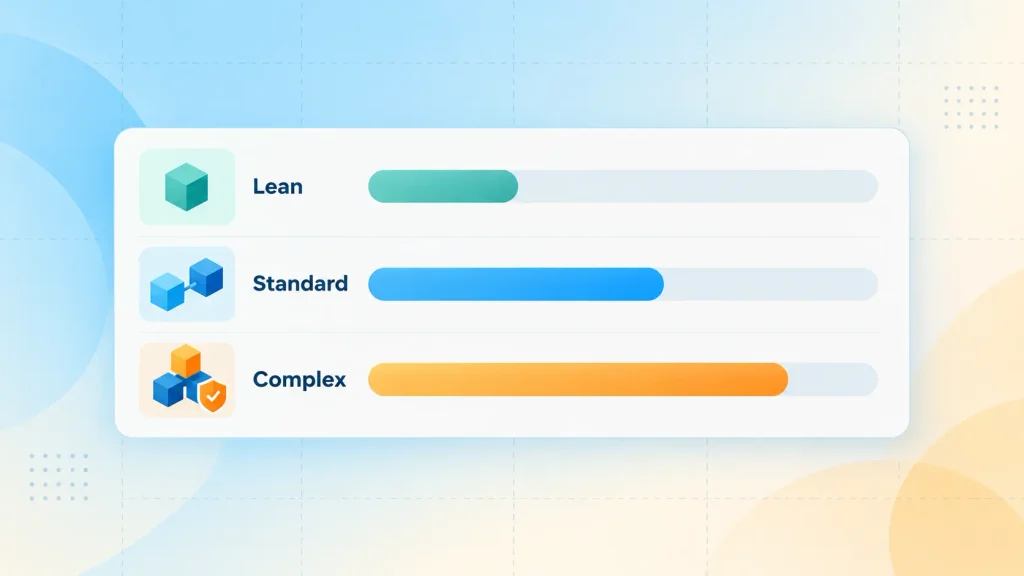
You can place almost any minimum viable product into one of three tiers, and the tier predicts your timeline better than a feature count does. Upsilon’s MVP timeline guide groups them as lean at four to eight weeks, standard at two to four months, and complex at four to eight months.
Independent numbers cluster around that middle tier. Altar.io’s build data put the average at four months, with three months the most common result. A 2026 benchmark of 30 MVP builds found a median of 12 calendar weeks from kickoff to first live release.
Here’s what typically sits inside each tier:
| Lean | One core user flow, template UI, 1 or 2 integrations | 4 to 8 weeks |
| Standard | A second user role, custom UI, 3 to 5 integrations | 2 to 4 months |
| Complex | Multiple roles, AI features, regulated data (HIPAA, PCI-DSS) | 4 to 8 months |
Most founders underestimate their tier. If your “simple” idea has both a customer view and an admin view, or a workflow with an approval step, you’re already in standard territory.
Which Clock Are You Measuring?

Two quotes for the same MVP can differ by months simply because they start the clock in different places. One counts from signed kickoff to first release. Another counts from your first idea to a product with paying users.
Altar makes the same point from the founder’s side: an idea on a napkin takes longer than a fully scoped product, because scoping is work too. These are the three clocks you’ll hear quoted:
- Idea to launch: includes validation, scoping, and finding a team. It’s the longest number, and the one your runway feels.
- Kickoff to first release: what most agency quotes and benchmarks measure, like the 12-week median above.
- Development only: some quotes cover just the coding sprints and leave out discovery, design, and QA.
Before you compare any two numbers, I’d suggest asking which clock each one uses. Ask three agencies “how long does it take to build an MVP?” and you can get three honest answers that are months apart, just because each starts the clock somewhere else. A six-week quote that excludes discovery can easily finish later than a 12-week quote that includes it.
MVP Development Timeline by Phase
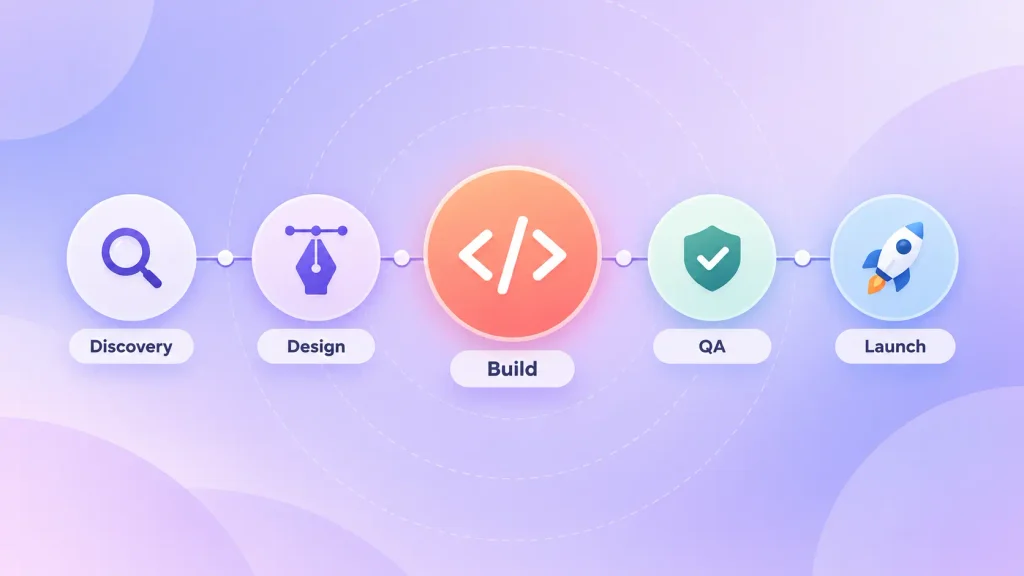
Every MVP moves through the same phases, whatever its tier, which is why planning your MVP timeline by phase works better than guessing one big number. What changes is how long each one runs. In Upsilon’s worked SaaS example, development took roughly 70% of a build that came in just under four months.
Here’s a typical MVP development timeline for each phase, and what you walk away with:
| Discovery and scoping | 1 to 3 weeks | Locked feature list, wireframes, architecture choice |
| Design | 1 to 2 weeks | UI for the core flow only |
| Development | 4 to 8 weeks (lean), 10 to 14 weeks (standard) | Working software, built in two-week sprints |
| QA and testing | Every sprint, plus 1 to 2 weeks before launch | A tested release candidate |
| Deployment | 3 to 5 days | Production setup and monitoring |
The phases overlap in practice, so your total usually comes in shorter than the rows added together. If you want the step-by-step work behind each phase, the SaaS development process guide covers it in depth.
Discovery and Scope Lock
You leave product discovery with a written list of user stories that says what version one includes, and what it leaves out. Brocoders reports that this is where 20% to 40% of the requested scope usually gets cut and moved to version two.
Skipping it feels like saving two weeks. But discovery is the only point where you can answer how long it takes to build an MVP for your idea with real confidence, because the scope is finally on paper. Upsilon found that founders who skip discovery routinely stretch their build by another four to six weeks.
UX/UI Design and a Clickable Prototype
Design for an MVP covers the core flow, not every screen you’ll eventually want. For a mobile app, We Are Affective puts the full design phase at two to four weeks.
The clickable prototype matters more than the polish. When developers can tap through every state, from error messages to success screens, they build what you meant rather than their best guess.
Development in Two-Week Sprints
This is where most of the calendar goes. Agile teams split it into two-week sprints, each ending with working software you can demo.
Sprints protect you from the worst kind of surprise: learning in week 10 that something went wrong in week two. You see progress every fortnight, so misunderstandings get caught while they’re still cheap to fix.
QA, Security, and Launch
Testing shouldn’t wait until the end. It runs inside every sprint, then gets a dedicated week or two before launch for regression, load, and edge cases.
Mobile needs more. We are allocating about two to three weeks of testing for a basic app MVP, since every device and OS version multiplies the test cases.
Post-Launch Iteration
Launch starts the learning. It doesn’t end the project. You’ll want budget for a few sprints of fixes driven by how real users behave.
That’s also why analytics belong in the build. An MVP with no event tracking leaves you guessing about what to build next.
How Long Different Types of MVPs Take
When you ask how long does it take to build an MVP, your product type shifts the range more than most founders expect. Marketplaces and AI-enabled products take longer because they carry more moving parts, even when the feature list looks short.
The ranges below come from Technijian’s 2026 timeline guide, the Wavect benchmark, and We Are Affective:
| Simple web app, 3 to 5 features | 4 to 6 weeks | Integrations nobody planned for |
| Standard SaaS MVP | 6 to 8 weeks | Accounts, dashboards, workflow automation |
| Web marketplace MVP | 8 to 12 weeks | Search, messaging, transactions, reviews |
| AI-enabled MVP | 9 to 21 weeks (13.5 median) | Data readiness, evaluation, guardrails |
| Fintech or health with compliance | 10 to 16+ weeks | HIPAA, PCI DSS, or SOC 2 work |
| Complex mobile marketplace app | 24 to 32 weeks | Real-time messaging, payments, backend |
Look at the gap between a web marketplace at eight to 12 weeks and a mobile one at 24 to 32. Some of that is platform, and some is that each firm measures from a different starting line. If your product fits one of these, the SaaS MVP development, mobile MVP development, and marketplace MVP development pages show how each kind of build gets scoped.
What Actually Decides Your MVP Timeline
How long does it take to build an MVP? It comes down to a handful of decisions, and most of them happen before anyone writes code. Each one below can move you a full tier up or down.
User Roles and Core Flows
Every extra role is a second product hiding inside the first. A customer view plus an admin view means two sets of screens, permissions, and test cases.
Upsilon puts it bluntly. The jump from almost nothing custom to some custom work everywhere, with a second role and custom UI, is what quietly doubles a timeline.
Integrations

Integrations are where estimates fall apart. Payments, logins, maps, and third-party APIs each bring their own documentation, edge cases, and outages.
The Wavect benchmark shows how fast this compounds. MVPs with two or three integrations had a median of 11 weeks. Those with seven or more had a median of 21 weeks. At that point, the benchmark notes, a build usually stops being “just an MVP” unless scope is held very tightly.
Compliance and Regulated Data
If you handle health records, card payments, or personal data in the EU, compliance can’t be bolted on after launch, and it changes how long does it take to build an MVP more than any single feature will. Technijian estimates regulatory compliance adds 30% to 100% to a timeline, depending on the framework.
That’s a wide range, and it’s an honest one. HIPAA work on a telehealth app looks nothing like a basic GDPR review of a signup form.
Your Build Approach
The same backlog takes wildly different amounts of time depending on who builds it. Upsilon compares the four common build models like this:
| No-code or DIY | 2 to 6 weeks | Testing one workflow fast |
| Freelancers | 2 to 4 months | Technical founders who can manage the build |
| Traditional agency | 3 to 6 months | Larger scopes needing PM support |
| Dedicated sprint-based team | About 3 months | Founders who need a fixed delivery date |
Freelancer timelines swing the most, because the estimate assumes everyone is free exactly when you need them. If you end up coordinating a separate designer, developer, and tester yourself, that’s time you’re not spending on sales or fundraising.
How Fast You Give Feedback
This is the delay nobody writes into the quote. Your sign-offs, design approvals, and sprint reviews sit on the critical path too.
Upsilon notes that feedback arriving three to seven days late, repeated across a dozen sprints, adds weeks to the calendar. I’d suggest blocking two or three hours a week for sprint reviews and treating them as part of the build.
Estimate Your Own MVP Timeline in Five Minutes
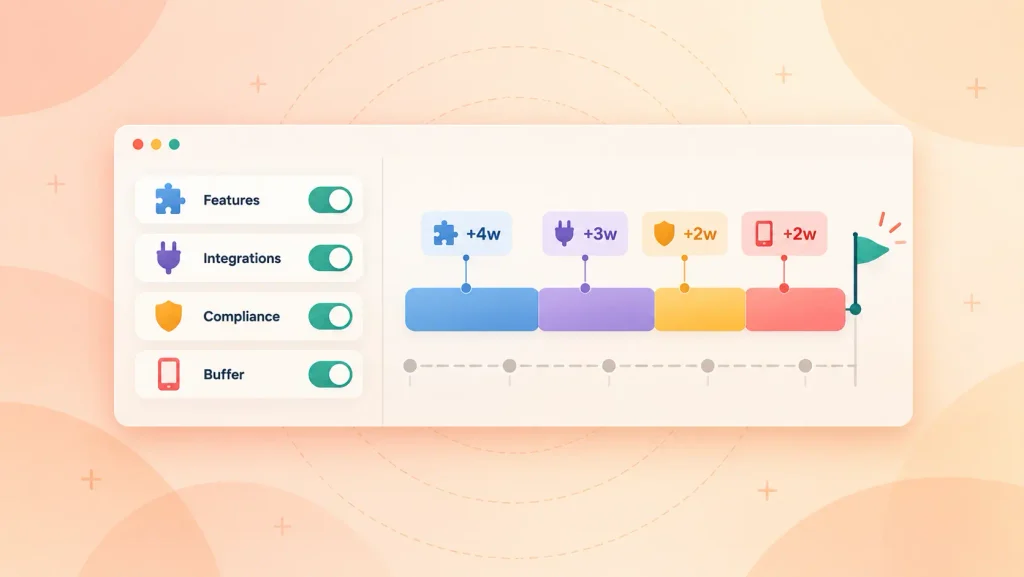
You can work out how long to build an MVP like yours before you talk to anyone, and get a rough, defensible number. It won’t replace a discovery phase, but it’ll tell you whether a quote you receive is realistic or wishful.
Work through these in order:
- Pick your tier. Lean is four to eight weeks, standard is two to four months, and complex is four to eight months.
- Count features beyond the core flow. Technician estimates each additional feature adds one to two weeks.
- Count your integrations. At seven or more, expect something near the 21-week median from the Wavect benchmark.
- Check for regulated data. If you have it, add 30% to 100% for compliance work.
- Check your platforms. Building native iOS and Android at the same time adds 30% to 50%, per We Are Affective. A cross-platform framework like Flutter or React Native can cut development time by 30% to 40% instead.
- Add a buffer. We Are Affective adds 20% to 30% for unexpected delays and scope changes, and it’s a habit worth copying.
Say you’re planning a B2B tool with one core workflow, a customer role and an admin role, and Stripe billing, on the web only. That’s the standard tier, so start at about three months. No regulated data and one platform means no multipliers, and a 25% buffer puts you near 16 weeks. That’s a realistic answer to how long it takes to build an MVP of this kind, and one you can plan a raise around.
If a firm quotes six weeks for that same scope, it’s worth asking what they left out.
Why MVPs Run Late (and What It Costs You)
MVPs rarely run late because developers type slowly. They run late because decisions change after the work starts. PMI’s 2018 Pulse of the Profession found that 52% of completed projects had scope creep or uncontrolled changes, up from 43% five years earlier.
These are the usual causes:
- Scope creep: “just one more feature” mid-sprint either pushes the date out or knocks something else off the plan.
- Skipped discovery: fuzzy requirements mean developers build their best guess, then rebuild it.
- Slow sign-offs: a design approval that takes a fortnight instead of a few days pushes back everything after it.
- Third-party surprises: payment gateways, social logins, and mapping services often take longer to implement than anyone expected.
- QA squeezed at the end: bugs that ship become a backlog that clogs your next release and piles up technical debt.
Every one of these stretches your MVP development timeline, and every one comes from decisions made in conversation rather than on paper. A written backlog and a simple change policy remove most of them before they cost you weeks.
Why Adding More Developers Won’t Save a Late MVP

When an MVP slips, the instinct is to add people. Fred Brooks named the result in his 1975 book The Mythical Man-Month: “adding manpower to a late software project makes it later.”
New people need onboarding, and that onboarding eats your senior developers’ time. Each new person also adds communication paths, and a lot of MVP work can’t be split cleanly in the first place.
Brooks’s own alternative fits MVPs well: ship a smaller essential version first and move later features into the next release. In practice, that means cutting scope or moving the date, not growing the team.
How to Build an MVP Faster Without Cutting Corners
If you’re asking how long does it take to build an MVP because the answer feels too long, you get time back by building less, not by rushing what’s left. Three levers shorten your time to market without hurting quality.
Cut to One Core Flow
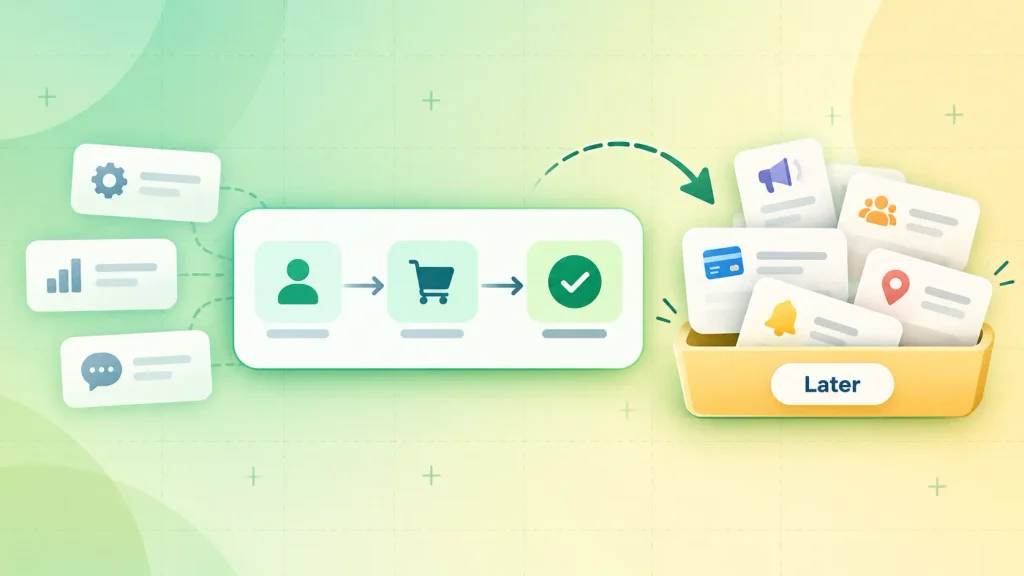
Pick the single job your first users said they’d pay for, and build only what that job needs. A feature prioritization method like MoSCoW, which sorts features into must, should, could, and won’t, takes some of the emotion out of the cuts.
Nothing you cut is gone. It moves to a later sprint, when real usage tells you whether anyone wants it.
Lean on Pre-Built Services
Authentication, payments, file storage, and email are solved problems. Upsilon’s examples of swaps that save real engineering time:
- Auth0 instead of a homegrown login system
- Stripe’s hosted checkout instead of custom payment flows
- AWS S3 instead of a custom upload pipeline
- SendGrid instead of running your own mail server
None of these are places where custom work buys you anything a user will notice. If you’re still settling the rest of your stack, this guide to choosing the right tech stack for web apps can help.
Use AI for the Build, Not the Thinking
Can AI change how long does it take to build an MVP? For the mechanical work, yes: scaffolding, CRUD screens, and test generation all move faster. Technijian estimates it compresses development phases by 25% to 40%, but only 15% to 25% across the whole project, since discovery, design, and compliance don’t get faster.
Building AI into the product cuts the other way. In the Wavect benchmark, AI-enabled MVPs had a median of 13.5 weeks against 11 for conventional SaaS, because data, evaluation, and fallbacks take time to validate. If AI is your product, the AI product development process explains where those weeks go.
How to Read an Agency’s MVP Timeline Quote
When an agency tells you how long does it take to build an MVP, that number is only as good as the assumptions behind it. Before you compare two numbers, it’s worth asking every firm the same questions:
- Does it include discovery? A quote that starts at development is running a shorter clock.
- Is the scope fixed? Ask what happens when you add a feature mid-build, and who absorbs the delay.
- Where is QA? Testing should show up inside each sprint and as its own block before launch.
- What counts as done? A live release with real users, a beta on a staging server, or a code handover.
- Who is on the team? Senior people on every sprint, or juniors learning on your timeline.
- How fast do they need your feedback? A good firm will tell you its sign-off window up front.
A short estimate with vague answers to these questions is the real warning sign. Those gaps tend to come back later as change requests and missed dates.
How Boomdevs Fixes MVP Timeline Slippage
Most of the delays above trace back to scope that was never locked. Boomdevs runs its MVP development services around that problem, starting with a scoping session before any design work begins.
Here’s what that looks like on a build:
- Scope locked before the build: every feature is tested against your core assumption, and the rest moves to the roadmap.
- A clickable prototype first: you see and click through the product before development starts.
- Two-week sprints: a clear MVP timeline by phase, with working, testable software at the end of every cycle.
- Tracking live before launch: analytics and event tracking are in place before your first user lands.
So how long does it take to build an MVP with Boomdevs? Most ship within eight to 12 weeks, and simpler products can launch in about six. For Rooftop Saunas, five dedicated developers replaced the company’s booking software with a custom platform in 90 days.
If you want a timeline you can plan a raise around, book a free scoping call with Boomdevs and get your MVP estimated sprint by sprint.
Frequently Asked Questions
Can You Build an MVP in a Month?
Yes, if it’s lean or built with no-code tools. Upsilon puts no-code MVP builds at two to six weeks. A custom MVP with production code, real users, and real data usually needs at least four to eight weeks, even with a dedicated team and no scope changes.
Can You Build an MVP in a Week?
Only if “MVP” means a clickable prototype, or a no-code tool that handles all your logic out of the box. That can be enough to test demand. It won’t give you a product you can grow on.
Is Six Months Too Long for an MVP?
Often, yes. Technijian’s view is that a timeline past 16 weeks almost always signals overscoping. The exception is a complex or regulated product, where four to eight months is realistic.
Does No-Code Make an MVP Faster?
It does, as long as your core value doesn’t depend on custom logic. The trade-off comes later: Technijian warns that picking no-code when you need custom development leaves you with a product you’ll rebuild within six months.
How Does Your MVP Development Timeline Relate to Cost?
They move together, because both reflect how much you’re asking a team to build before you reach product-market fit. Technijian’s 2026 ranges run from $15K to $40K for a simple MVP, $40K to $80K for standard SaaS, and $80K to $150K+ for complex builds. The SaaS MVP development cost breakdown goes deeper into pricing.