


- 1. Key Takeaways
- 2. Agentic AI vs Generative AI: Head-to-Head Comparison
- 3. What Is Generative AI, and Where Does It Stop?
- 4. What Is Agentic AI?
- 5. How Agentic AI Uses Generative AI Under the Hood
- 6. One Task, Two Approaches: A Side-by-Side Example
- 7. Generative AI vs Agentic AI Use Cases
- 8. The Risk and Cost Difference Nobody Puts in the Sales Deck
- 9. Which Should You Choose? A Decision Guide for Founders and CTOs
- 10. How Boomdevs Solves the "Assistant or Agent?" Decision
- 11. Frequently Asked Questions
Summarize with
Your team wants AI on the roadmap this quarter. One advisor says you need an agent. Another says a generative AI assistant will cover it, and both sound convincing.
The agentic AI vs generative AI choice isn’t about which one is smarter. It comes down to whether you need content or completed actions, and how much risk you can carry. Here’s how to tell which side your project falls on, with real agentic AI vs generative AI examples along the way.
Key Takeaways
- Generative AI produces something you review: a draft, a summary, an image, a block of code. You decide what happens next.
- Agentic AI takes actions toward a goal: it plans steps, calls your tools, checks results, and keeps going until the job is done.
- They aren’t rivals, whatever the generative AI vs agentic AI debate suggests. Almost every agent runs on a generative model as its reasoning engine, so the real question is whether you need the action layer on top.
- The risk shifts with that layer. A bad generative output is a wrong answer; a bad agentic step is a wrong action in a live system.
- Most agent projects stall on cost and value, not technology. Gartner expects over 40% of agentic AI projects to be canceled by the end of 2027.
Agentic AI vs Generative AI: Head-to-Head Comparison
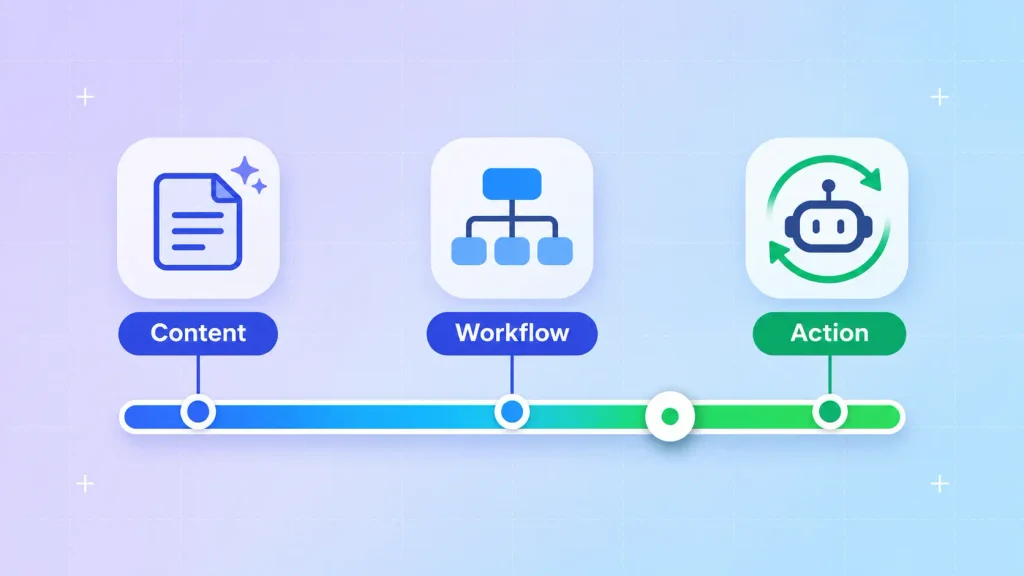
The core difference between agentic AI and generative AI is simple: generative AI responds to a prompt with content, then stops. Agentic AI receives a goal, works out the steps, and acts across your systems until that goal is met or it needs you.
That one difference changes almost everything downstream, from who stays in the loop to how failures show up on your invoice. Here’s how the two compare on the criteria that actually affect your build:
| Dimension | Generative AI | Agentic AI |
| Core job | Creates content | Completes tasks |
| What you give it | A prompt | A goal |
| Steps per request | Usually one | Many, chained |
| Takes real actions | No, you act on the output | Yes, through APIs and tools |
| Memory across steps | Limited to the conversation | Tracks state through the task |
| Your role | Review every output | Set the goal, approve key steps |
| Typical failure | Wrong or invented content | Wrong action in a live system |
| Cost pattern | Per prompt or per seat | Ongoing loop of model calls |
| Familiar examples | ChatGPT, Claude, Midjourney | Coding agents, support agents |
Read the agentic AI vs generative AI table as a spectrum, not two boxes. Plenty of products sit in between, and the useful question is how far along that line your use case needs to go.
What Is Generative AI, and Where Does It Stop?
Ask ChatGPT for a product description, and you get one back in seconds. That’s generative AI: a model trained on huge datasets that predicts new text, images, audio, or code from your prompt.
If you want the full background, our guide on what generative AI is and how it works covers it in depth. For the agentic AI vs generative AI comparison, what matters is where it shines:
- Drafting: emails, proposals, product copy, and documentation in a fraction of the time.
- Summarizing: long reports, call transcripts, and support threads boiled down to what you need.
- Transforming: translating, reformatting, or rewriting content for a new audience.
- Assisting code: suggesting functions, explaining unfamiliar code, and writing tests.
Here’s where it stops. A generative model hands you the output and waits. It doesn’t send the email, update the CRM, or check whether the fix worked.
That boundary is also its safety net. You stay between the output and any consequence, which is why most teams start here. The tradeoffs that do show up, like hallucinations and data privacy, are covered in our breakdown of common generative AI challenges.
What Is Agentic AI?
Picture handing a task to a capable new hire instead of a writing assistant. You say “resolve this customer’s refund,” and the system looks up the order, checks your policy, issues the refund, and tells you it’s done.
Agentic AI works that way, and that’s where the difference between agentic AI and generative AI becomes obvious. You give it an objective rather than a prompt, and it decides the steps, uses connected tools to carry them out, and adjusts when something doesn’t go to plan. IBM frames individual AI agents as one component of the broader agentic approach, which can coordinate one agent or several.
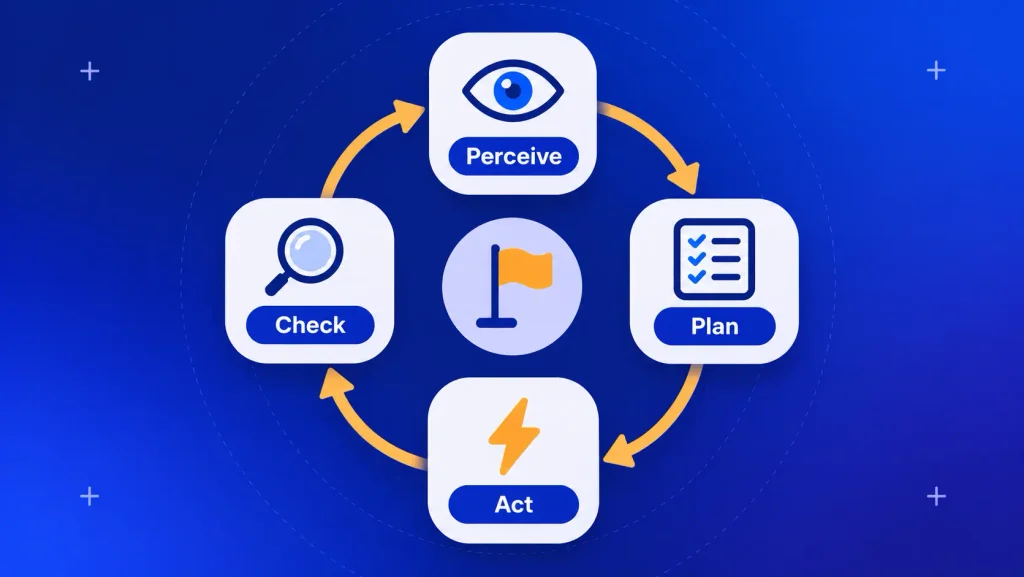
The Agentic Loop: Perceive, Plan, Act, Check
Every agentic system runs some version of the same cycle. It repeats until the task is finished or a stopping rule kicks in:
- Perceive: the agent gathers context from your data, a user request, an alert, or a webhook.
- Plan: it breaks the goal into steps and picks which tool to use first.
- Act: it calls an API, queries a database, writes a file, or sends a message.
- Check: it reads the result, compares it to the goal, and decides whether to continue, retry, or ask you.
That fourth step is what separates an agent from a script. A script follows its path even when the path is wrong; an agent is supposed to notice.
If you’re curious what this looks like in a real build, our walkthrough on building your first AI agent shows the loop in practice. For production systems, an experienced AI agent development team will spend most of its time on the tools and the checks, not the model.
How Agentic AI Uses Generative AI Under the Hood
Agentic AI doesn’t replace generative AI. It wraps a generative model in a layer that lets it act, which is why framing agentic AI vs generative AI as a rivalry misses the point.
Inside nearly every agent sits a large language model doing what LLMs always do: reading input, reasoning about it, and generating text. The difference is what surrounds it. Anthropic describes the basic building block as an LLM augmented with retrieval, tools, and memory, and that augmentation is where the agentic capability comes from:
- Tools: connections to your CRM, billing system, codebase, or calendar, increasingly through standards like the Model Context Protocol (MCP).
- Memory: a record of what the agent has done and learned during the task.
- Orchestration: the logic that decides which step runs next, and when to stop.
- Guardrails: permissions, approval gates, and limits that keep the agent inside its lane.
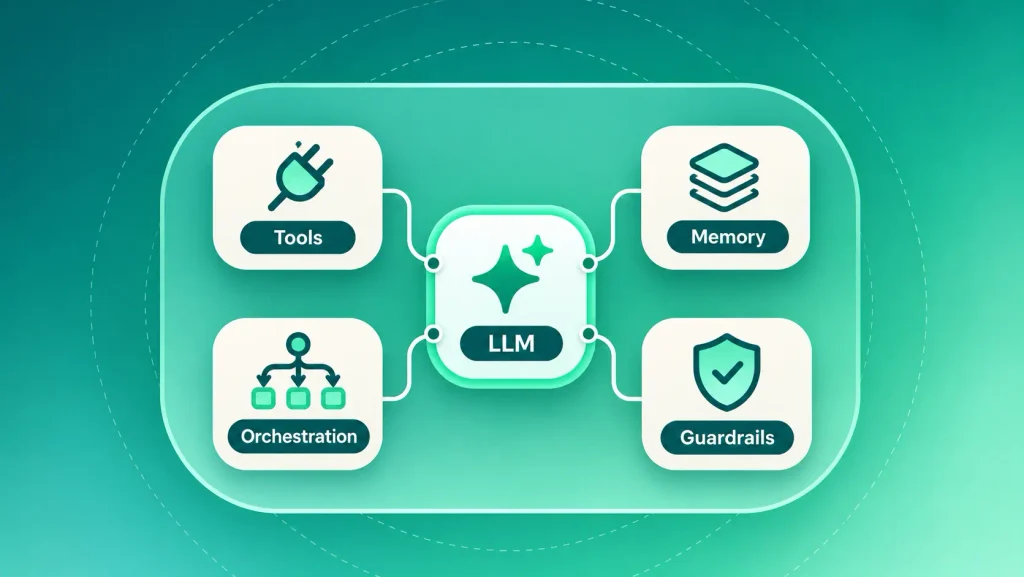
So you can’t build a capable agent without a capable generative model. But adding a model to your stack doesn’t make anything agentic. The value, and most of the engineering effort, sits in that surrounding layer and in how well it plugs into your existing systems. That’s usually where AI integration work earns or loses its budget.
Workflows vs Agents: The Distinction Most Comparisons Skip
Here’s the part most “agentic AI vs generative AI” articles leave out: a lot of what gets sold as an agent works better as a workflow.
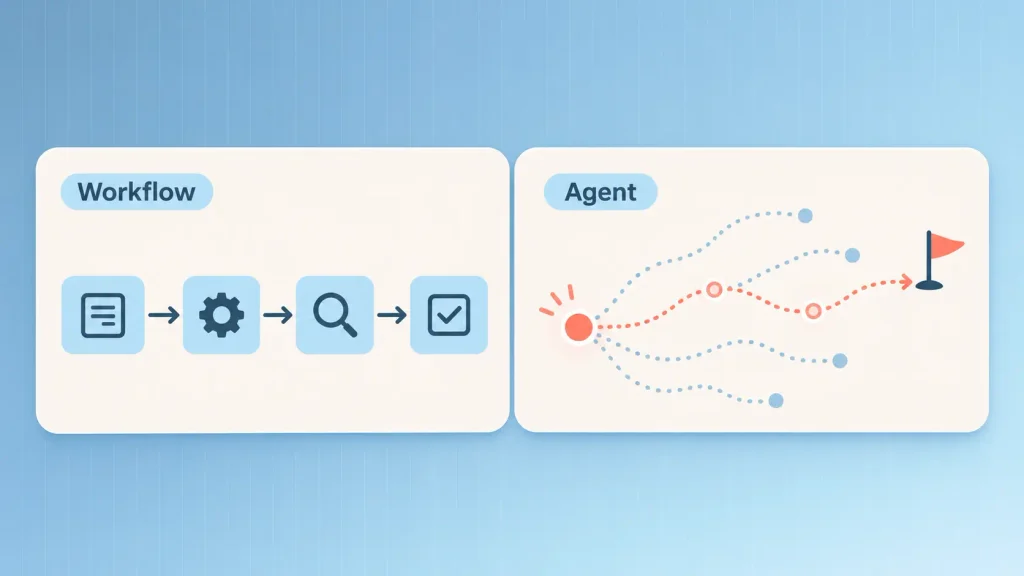
Anthropic draws a clear line between the two. In its guide, workflows follow predefined code paths, while agents let the model direct its own process and tool use. That difference has real consequences for you:
| Aspect | Workflow | Agent |
| Who decides the steps | Your code | The model |
| Predictability | High | Lower |
| Best for | Fixed, repeatable tasks | Open-ended tasks with unknown steps |
| Cost and latency | Lower | Higher |
Anthropic’s own advice is to find the simplest solution that works and add complexity only when it improves results. It notes that agentic systems trade latency and cost for better task performance, and that for many applications a single well-built model call is enough.
In practice, this means a tightly scripted pipeline with one or two AI steps often beats a free-roaming agent on cost, speed, and reliability. You’ll want a true agent only when you genuinely can’t predict the steps in advance.
One Task, Two Approaches: A Side-by-Side Example
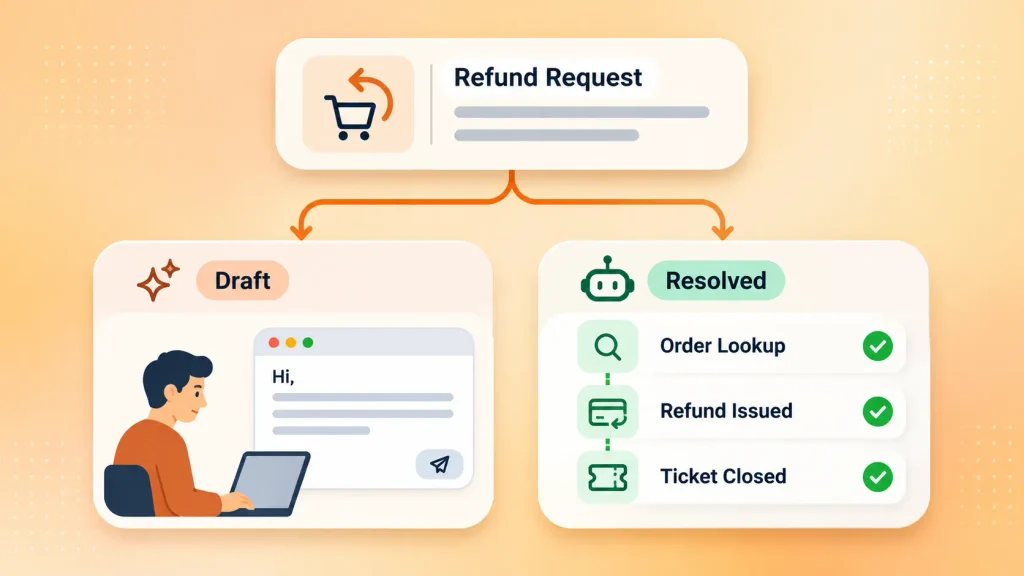
Abstract definitions only go so far, so here’s one of the clearest agentic AI vs generative AI examples: a customer asking for a refund on a late order. Watch how each approach handles it.
Here’s the same request, step by step:
| Step | Generative AI | Agentic AI |
| Request arrives | Rep pastes the message into a chat tool | Agent reads it straight from the help desk |
| Investigation | Human checks order and shipping status | Agent queries the order and shipping systems |
| Policy check | Human reads the refund policy | Agent compares the case against policy rules |
| Response | AI drafts a reply; human edits and sends | Agent issues the refund and sends the reply |
| Follow-up | Human closes the ticket | Agent closes the ticket and logs what it did |
Both versions use AI, but the generative AI vs agentic AI gap shows up in who does the work. The generative version saves your support rep a few minutes of writing. The agentic version removes the rep from routine cases entirely and escalates only the unusual ones.
Which one is “better” depends on volume and risk. With a handful of refunds a week, the draft is probably enough. With thousands, the agent starts to pay for itself, provided you trust it with your refund system.
Generative AI vs Agentic AI Use Cases
The cleanest agentic AI vs generative AI test is to ask what the deliverable is. If it’s a piece of content, generative AI usually fits; if it’s a finished action, you’re in agentic territory.
Where Generative AI Wins
Generative AI is the right call whenever a person should see the output before anything happens. Strong fits include:
- Marketing and sales content, from campaign copy to personalized outreach drafts.
- Internal knowledge search, where staff ask questions against your documents and get cited answers.
- Meeting and call summaries that a manager reviews before sharing.
- Code assistance inside a developer’s editor, where every suggestion gets accepted or rejected.
Our roundup of practical generative AI use cases goes deeper by industry. The pattern holds across all of them: fast output, human judgment.
Where Agentic AI Earns Its Cost
Agentic AI pays off on repetitive, multi-step processes that cross several systems and run at volume. Good candidates look like this:
- Customer support resolution, where the agent checks accounts, processes returns, and escalates edge cases.
- Software engineering tasks, where an agent reads a ticket, edits code, runs tests, and opens a pull request for review.
- IT and operations triage, such as diagnosing an alert and running approved fixes.
- Back-office processing, like routing invoices, reconciling records, or onboarding new hires across tools.
Notice that every example has clear success criteria. Anthropic points out that agents add the most value on tasks with measurable outcomes and room for human oversight, which is why it singles out customer support and coding as its two most promising applications.
The Risk and Cost Difference Nobody Puts in the Sales Deck
In any agentic AI vs generative AI decision, the action layer is what makes agentic AI powerful, and it’s also what makes it riskier and harder to budget. Before you commit, you’ll want to understand both sides of that trade.
Informational Risk vs Operational Risk
This is the most practical difference between agentic AI and generative AI. When generative AI fails, you get a wrong answer. When agentic AI fails, you get a wrong action, and it may have already happened by the time anyone notices.
Bigeye’s analysis frames this as the shift from informational risk to operational risk. A hallucinated paragraph gets caught in review. A refund issued to the wrong account, or a record updated from stale data, changes the state of your business.
That’s why agentic builds need controls that a chatbot never did:
- Least-privilege access, so each agent touches only the systems its task requires.
- Approval gates on irreversible actions like payments, deletions, and deployments.
- Audit trails that record every step the agent took and why.
- Stopping conditions, such as iteration caps or spend limits, to halt runaway loops.
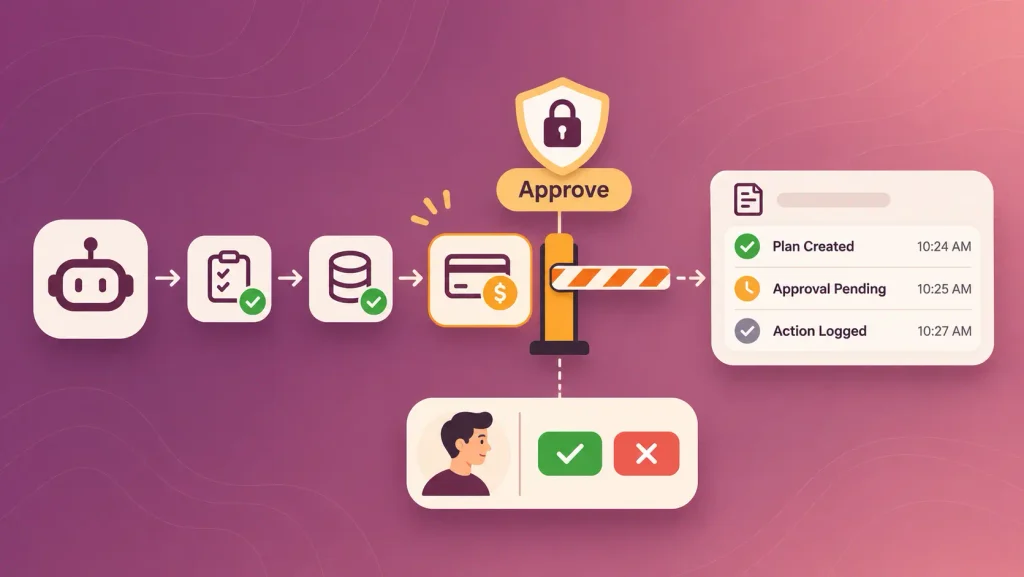
These aren’t nice-to-haves. They’re the difference between a pilot your security team approves and one it shuts down. We dig into the human side of this in our piece on ethical considerations in AI agent design.
Why Agentic AI Costs Behave Differently
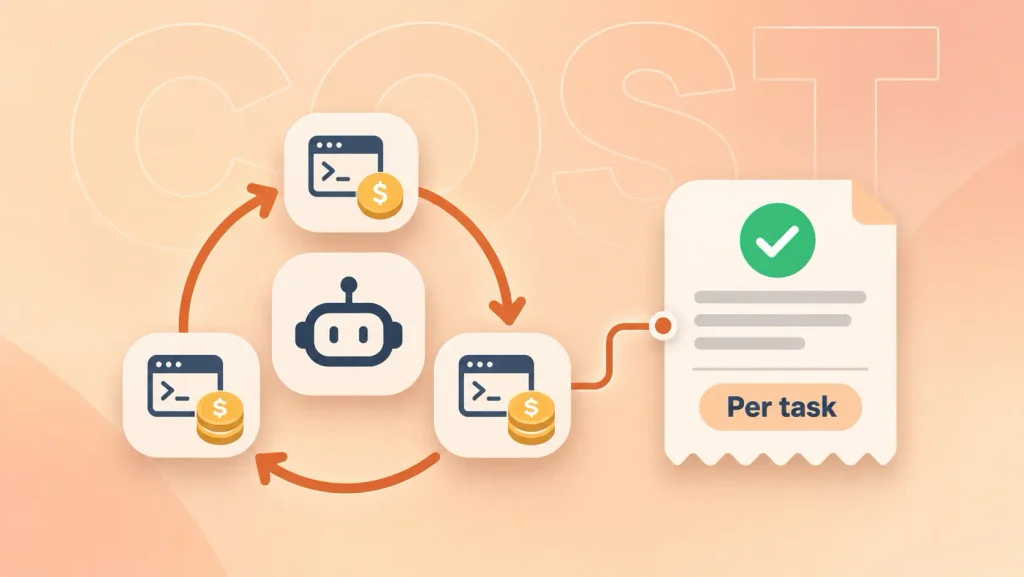
Budgets are where generative AI vs agentic AI really split. Generative AI costs scale roughly with use. You pay per prompt, per token, or per seat, and a quiet month costs less.
Agents work differently. Each pass through the loop is another model call, and one task can trigger many of them. Tyk’s breakdown notes that an agent’s ongoing compute and inference loop is the cost teams most often underestimate. Anthropic is blunt about it too: an agent’s autonomy brings higher costs and the potential for compounding errors.
The practical takeaway: price an agent per completed task, not per seat. If the cost of one finished outcome is lower than the human time it replaces, the math works. If you can’t measure that, you’re not ready to scale.
Why So Many Agentic AI Projects Get Canceled
The failure data is sobering. Gartner predicts that over 40% of agentic AI projects will be canceled by the end of 2027, citing escalating costs, unclear business value, and weak risk controls.
Adoption is also shallower than the headlines suggest. In McKinsey’s 2025 State of AI survey, 62% of organizations are at least experimenting with AI agents, and 23% are scaling one somewhere. Yet in any single business function, no more than 10% report scaling agents.
Part of the problem is labeling. Gartner calls it “agent washing”: rebranding chatbots, assistants, and automation scripts as agentic. By its estimate, only about 130 of the thousands of agentic AI providers offer genuine agentic capability.
None of this means you should avoid agents. It means you should start with a use case where the value is measurable, which brings us to the decision itself.
Which Should You Choose? A Decision Guide for Founders and CTOs
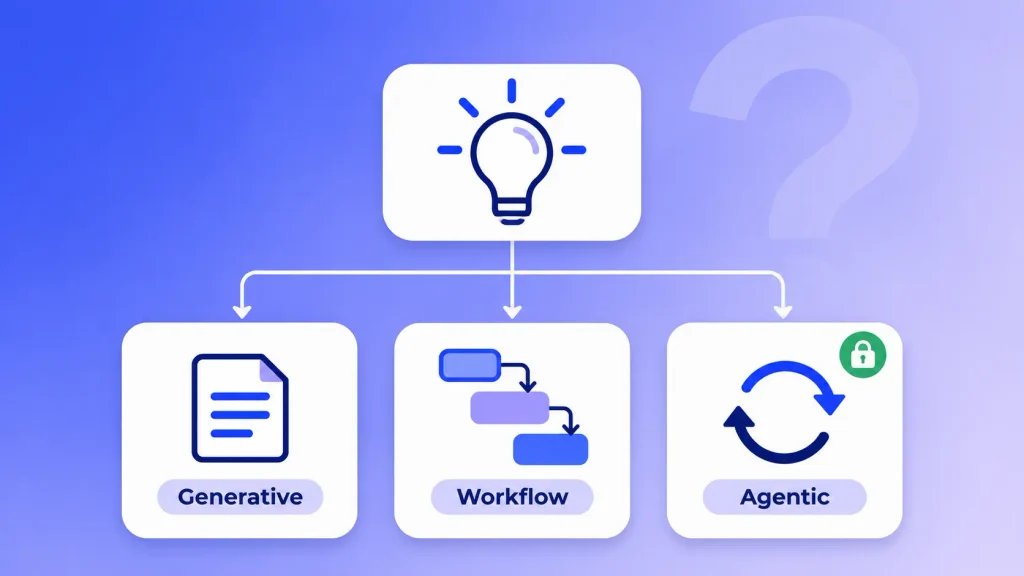
The agentic AI vs generative AI decision comes down to the deliverable. Pick generative AI when the output is the deliverable and a person reviews it. Pick agentic AI when the completed action is the deliverable, the task repeats at volume, and you can measure success.
Most teams end up using both. Here’s a quick way to map your use case:
| If your task… | Start with | Why |
| Produces content someone reviews | Generative AI | Fast, cheap, human stays in control |
| Follows the same fixed steps each time | Workflow with AI steps | Predictable and easier to test |
| Needs judgment across unpredictable steps | Agentic AI | Only an agent can adapt the path |
| Touches money, customer data, or production | Agent with approval gates | Limits the cost of a wrong action |
When in doubt, start one level simpler than you think you need. It’s far cheaper to add autonomy to a working system than to claw back trust after an agent misfires.
Questions to Ask Before You Fund an Agent
If someone pitches you an agentic solution, these five questions will tell you quickly whether it’s real and whether it’s right for you:
- What action does it take without human approval? If the answer is “it drafts something and a person sends it,” that’s generative AI, whatever the label says.
- Could a fixed workflow do this instead? If the steps never change, you probably don’t need an agent’s flexibility or its cost.
- How will you measure a successful outcome? Resolved tickets, closed invoices, and merged pull requests are measurable. “Better productivity” isn’t.
- What happens when it’s wrong? Ask about rollback, approval gates, and who gets alerted.
- What does one completed task cost? You want a per-outcome figure you can compare against today’s process.
If a partner can’t answer the first and last questions concretely, treat the proposal as a pilot, not a platform.
Not sure whether your idea needs an agent or a well-built assistant? See how Boomdevs, with 3.5K+ projects delivered, scopes the simplest version that works before you commit budget: explore our generative AI development approach.
How Boomdevs Solves the “Assistant or Agent?” Decision
By now you know the difference between agentic AI and generative AI. The harder part is deciding where your own use case sits, then building only as much autonomy as it justifies.
That’s how Boomdevs approaches generative AI development. We start with your process and your data, then work out whether a generative feature, a scripted workflow, or a full agent will deliver the outcome at the lowest risk.
When an agent is the right answer, our AI agent developers build the tool connections, guardrails, and audit trails that keep it trustworthy in production. When it isn’t, we’ll tell you, and save you a canceled project.
Ready to settle the agentic AI vs generative AI question for your own project? Book a free AI strategy call and leave with a clear recommendation and a scoped next step.
Frequently Asked Questions
Is ChatGPT Agentic AI or Generative AI?
ChatGPT is primarily generative AI. Its core job is producing text in response to your prompt. It becomes more agentic when it’s given tools and permission to take multi-step actions, such as browsing or running code, but the underlying model is still generative. So, is ChatGPT agentic AI? Only partly, and only when those tools are switched on.
Is Agentic AI Better Than Generative AI?
Neither is better; the agentic AI vs generative AI choice depends on the job. Generative AI is the faster, cheaper choice for creating content a person reviews. Agentic AI is worth its higher cost and risk only when you need completed actions across systems at volume.
What Is the Difference Between AI Agents and Agentic AI?
An AI agent is a single system that perceives, decides, and acts toward a goal. Agentic AI is the broader approach of building goal-driven, autonomous systems, which can use one agent or several working together. In short, agents are the building blocks and agentic AI is the overall design.
Can Generative AI Become Agentic?
Yes. A generative model becomes part of an agentic system when you connect it to tools, give it memory, and wrap it in a loop that plans, acts, and checks results. The model supplies the reasoning, and the surrounding layer supplies the ability to act.
Is Agentic AI the Same as AGI?
No. Agentic AI pursues specific goals inside defined systems, like resolving a support ticket or fixing a bug. Artificial general intelligence (AGI) refers to a hypothetical AI that could match humans across any intellectual task, and it doesn’t exist today.