


- 1. Key Takeaways
- 2. How Much Does AI Agent Development Cost in 2026?
- 3. What Drives AI Agent Development Cost?
- 4. AI Agent Development Cost Breakdown by Component
- 5. How Much Does an AI Agent Cost to Run Each Month?
- 6. Hidden AI Agent Costs That Never Show Up in a Quote
- 7. Build, Buy, or Configure: Which Route Fits Your Budget?
- 8. How to Estimate Your AI Agent Budget in 5 Steps
- 9. How to Reduce AI Agent Development Cost Without Cutting Corners
- 10. Is a Custom AI Agent Worth the Cost?
- 11. How Boomdevs Fixes Unpredictable AI Agent Budgets
- 12. Frequently Asked Questions
Summarize with
AI agent development cost runs from about $20,000 for a simple reactive agent to $200,000 or more for an enterprise system, and that range alone won’t help you budget.
What decides your number is how much the agent acts on its own, how many systems it touches, and how ready your data is.
This breaks down the cost to build an AI agent, run it, and keep it accurate, so you can plan before you ask for quotes.
Key Takeaways
- At the low end, AI agent development cost starts around $20,000 for a simple, single-task agent. Enterprise agents with multi-agent orchestration and legacy integrations pass $200,000.
- Autonomy, integrations, and data readiness move your price more than the AI model does.
- The build is only part of the bill. Model usage, hosting, monitoring, and upkeep cost you every month after launch.
- Several costs never appear on a quote, so add a buffer before you take a number to finance.
- The cheapest path is a narrow first agent with human approval, then a second agent that reuses the foundation.
How Much Does AI Agent Development Cost in 2026?
A custom AI agent costs anywhere from $20,000 for a simple reactive agent to $200,000 or more for an enterprise-grade autonomous system. That’s the range Boomdevs quotes for custom AI agent development, and it lines up with AI agent pricing across the wider market.
Across all AI projects, Clutch’s pricing data puts the average verified project at $120,594 over a typical 10 months. Its most common project size sits much lower, between $10,000 and $49,999. So most teams buy something modest first, while a smaller group spends far more.
AI Agent Cost by Tier
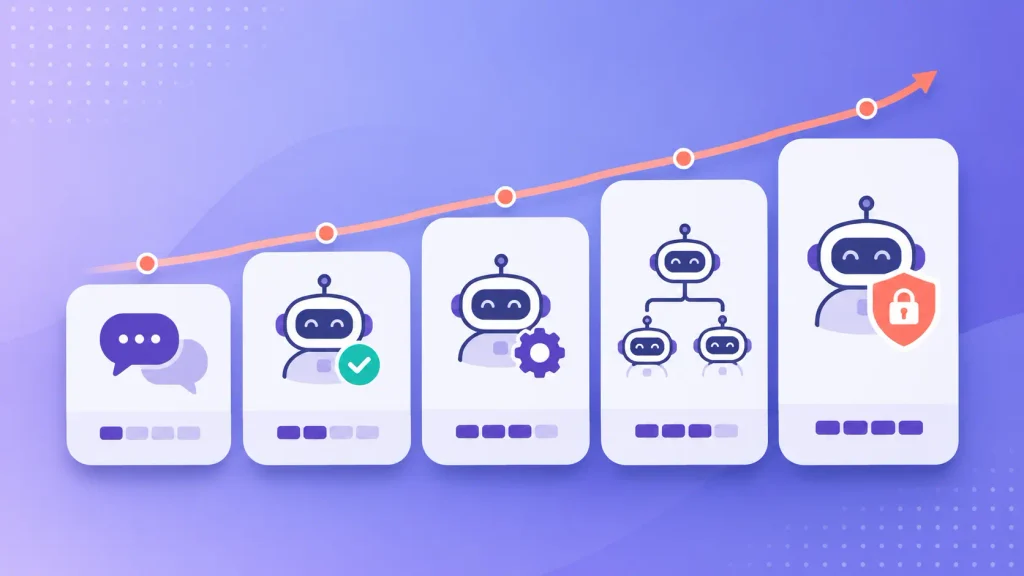
Your agent’s tier, and with it most of your AI agent development cost, comes down to one question: how much is it allowed to do without a person? Each step up adds engineering you can’t skip. Here’s how the tiers compare:
| Tier | What the agent does | What drives the cost |
| Reactive or FAQ agent | Answers questions from set sources | Prompt design, one integration, basic testing |
| Approval-based task agent | Prepares an action, a person approves it | Approval screens, action queue, audit trail |
| Autonomous task agent | Acts inside your systems within limits | Write access, rollback, exception handling, monitoring |
| Multi-agent system | Several agents split and hand off work | Shared state, routing, failure recovery across agents |
| Enterprise or regulated agent | Any tier above, plus compliance | Audit logs, access control, explainability, legacy systems |
The first row sits near the bottom of the range, and the last two push past $200,000. If you’re not sure which tier your idea falls into, this guide to types of AI agents helps you name it before you scope it.
Voice agents add their own layer of speech recognition, speech synthesis, and latency tuning. That pricing works differently, with per-minute rates on top of the build, so it has its own breakdown in our guide to AI voice agent cost.
Why Quotes for the Same AI Agent Vary So Much
You can send one brief to three teams and get three prices that look unrelated. Usually, nobody is lying. Each team pictured a different agent.
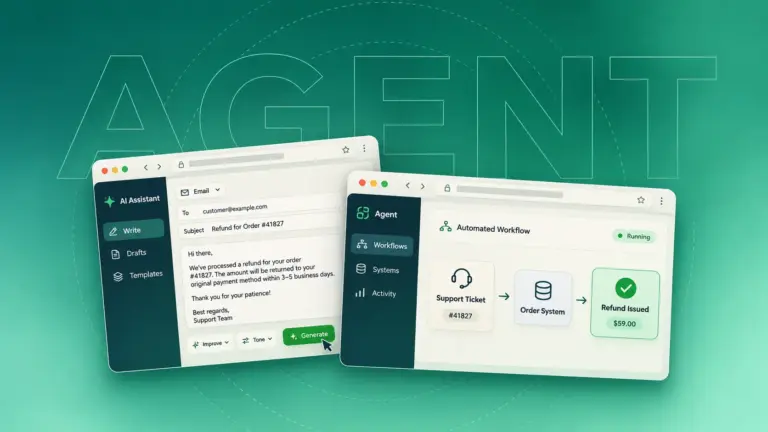
One read “handle refunds” as drafting a reply for your support lead. Another read it as logging into your billing system and issuing the refund. The second needs permissions, rollback, and far more testing, so it costs several times more.
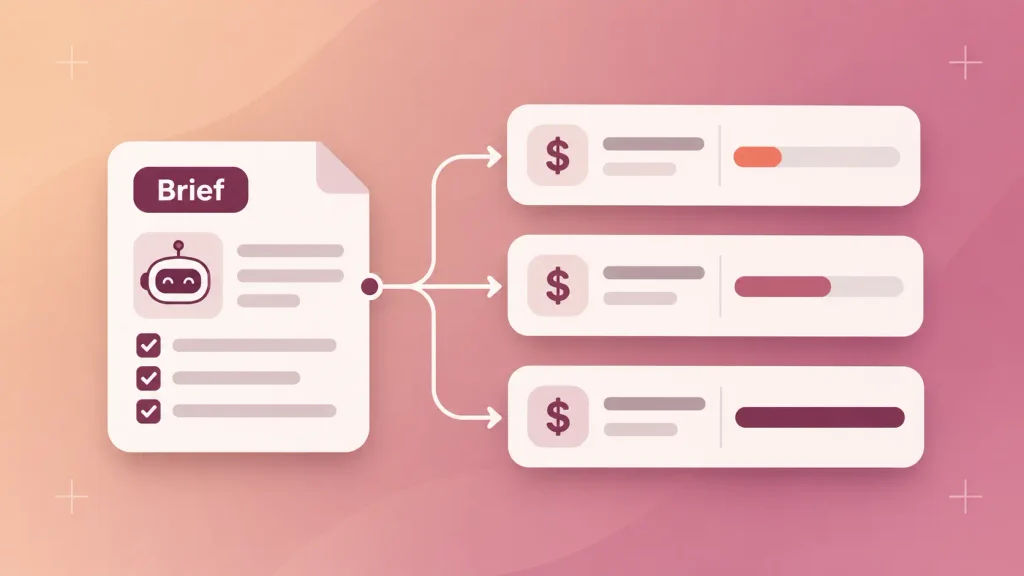
Quotes also split on what they leave out, which makes AI agent development cost hard to compare line by line. Some price the build only. Others include discovery, evaluation, and three months of tuning. A broader AI product, like a full app with an agent inside, prices differently again, which our breakdown of AI product development cost covers.
What Drives AI Agent Development Cost?
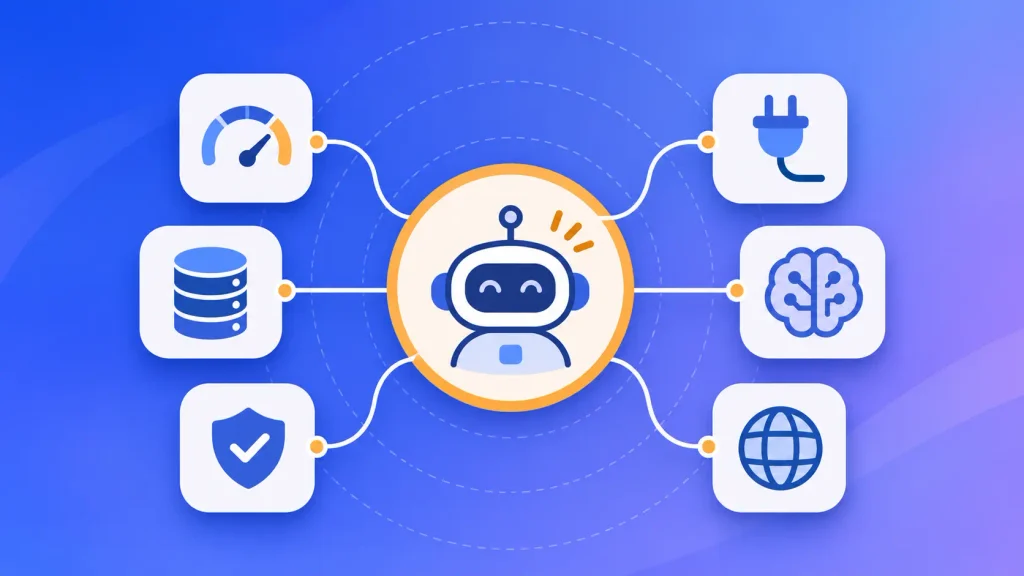
Six things decide most of your number. The model you pick matters less than you’d expect, since API access to a strong model is cheap next to the engineering around it.
Autonomy Level
Autonomy is the biggest single lever. An agent that only recommends needs no write access, so a mistake costs you a bad suggestion. An agent that acts on its own can make real changes, so it needs guardrails, rollback, and monitoring that catch quiet failures.
Most teams ask for more autonomy than the job needs. If a person approving each action works for your volume, start there. You can widen the agent’s permissions once it earns trust.
Number and Type of Integrations
Every system your agent reads from or writes to is its own small project. Each one needs authentication, data mapping, error handling, and testing against the real system.
The type matters as much as the count. Here’s what tends to push integration cost up:
- Old or undocumented APIs: legacy systems take longer to map and break in stranger ways.
- Write access: reading data is cheap; changing records means approvals, logging, and a way to undo.
- Rate limits: agents call APIs far more often than people do, so you may need retries and queues.
- Inconsistent data across systems: the agent needs rules for which source wins.
Three integrations don’t triple the cost to build an AI agent. Each new system adds testing paths with every system already connected. If your stack is messy, specialist AI integration services can save weeks of rework.
Data Readiness
Your agent is only as good as the documents and records it works from. If your knowledge base is current and structured, setup moves fast. If it lives in old PDFs, chat threads, and three versions of the same policy, cleanup becomes a phase of its own.
This is the cost teams spot last. It rarely looks like engineering, yet it often decides whether the agent gives right answers at all.
Model, Memory, and Retrieval Choices
A hosted model through an API keeps your build cost low and your launch fast. Fine-tuning or self-hosting an open-source model raises the upfront cost, though it can lower your bill at high volume.
Memory adds cost too. An agent that remembers a single conversation is simple. One that recalls a customer’s history from months ago needs retrieval (often called RAG), a vector database, and careful design so it doesn’t pull stale context. Your framework choice shapes all of this, and this roundup of AI agent development tools compares the main options.
Compliance and Industry
If you work in healthcare, finance, or another regulated field, compliance adds a layer you can’t skip. Expect audit trails for every decision, role-based access, encryption, and documentation your auditors can read.
Agents that act on people, like screening applicants or flagging fraud, also need bias testing and clear escalation paths. These choices are worth making early, and our guide to ethical considerations in AI agent design walks through them.
Team Location and Hourly Rates
Who builds your agent changes your AI agent development cost as much as any technical choice. According to Clutch’s AI rate data, AI development firms in the United States most often charge $50 to $99 an hour. Firms in India, Ukraine, and the Philippines most often charge $25 to $49.
Run that against a sample 400-hour build. The same scope lands near $10,000 to $19,600 at the lower band and $20,000 to $39,600 at the US band. Rate isn’t everything, though. A cheaper team that skips evaluation can cost you more by month three.
AI Agent Development Cost Breakdown by Component
When you get an itemized quote, your AI agent development cost usually splits into five parts. Prompt writing is the smallest piece, even though it gets the most attention in demos.
Here’s what each component covers, and why each gets underbudgeted:
| Component | What it covers | Why it gets underbudgeted |
| Discovery and design | Workflow mapping, architecture, failure planning | Skipped to make a quote look cheaper |
| Agent logic and orchestration | Tool selection, reasoning steps, escalation rules | Simple in a demo, complex with edge cases |
| Integrations | Connections to CRM, ERP, databases, APIs | Each system hides surprises |
| Evaluation and testing | Test scenarios, scoring, red-teaming | Invisible until the agent fails in public |
| Deployment and observability | Hosting, logging, alerts, cost limits | Feels optional until something breaks |
The two rows people cut first are discovery and evaluation. Those are also the two that protect you from paying twice.
How Much Does an AI Agent Cost to Run Each Month?
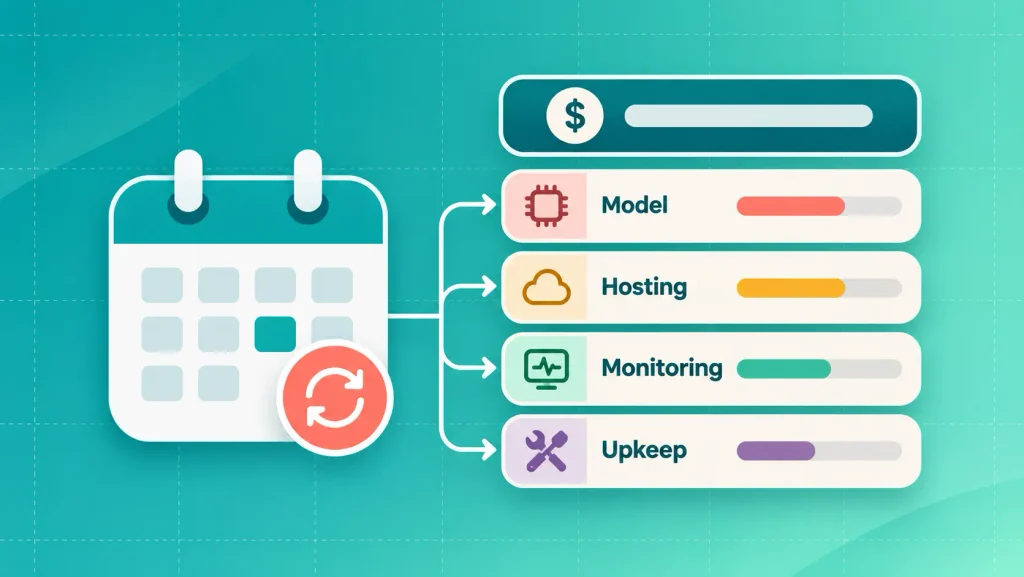
An AI agent keeps costing money after launch, and your AI agent cost per month grows with use, not with how complex the agent is. Every task it handles uses model tokens, compute, and logging. Double your volume and the usage part of the bill roughly doubles.
The Running-Cost Formula
Your monthly cost is the sum of four lines. Add them up before you approve any build:
- Model usage: tokens per task, times tasks per month, times your model’s price per token.
- Infrastructure: hosting, a vector database if you use retrieval, and storage for logs.
- Monitoring and evaluation: tracing tools plus the time someone spends reviewing flagged outputs.
- Upkeep: prompt updates, integration fixes when an API changes, and model migrations.
Lines one and two scale with traffic. Lines three and four scale with how much you change the agent. If a quote shows build cost only, I’d ask for a 12-month total at your expected volume before you sign.
Cost per Task: The Number That Tells You If It Pays Off
Monthly totals hide the useful number. Divide your AI agent cost per month by the tasks the agent completes, and you get cost per task.
Now compare that to what the same task costs when a person does it. Take the minutes your team spends on one ticket, times their hourly cost, and you have a clean benchmark. An agent that beats that number while matching quality is worth scaling. One that doesn’t needs a narrower job or a cheaper model.
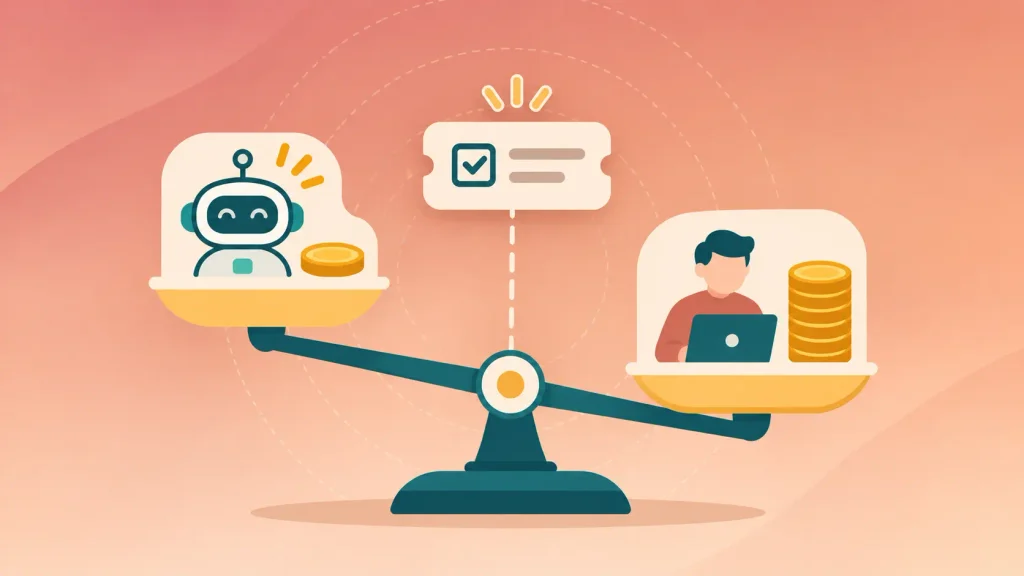
Cost per task also catches waste early. A sudden jump usually means long prompts, retry loops, or an agent calling tools it doesn’t need.
Hidden AI Agent Costs That Never Show Up in a Quote
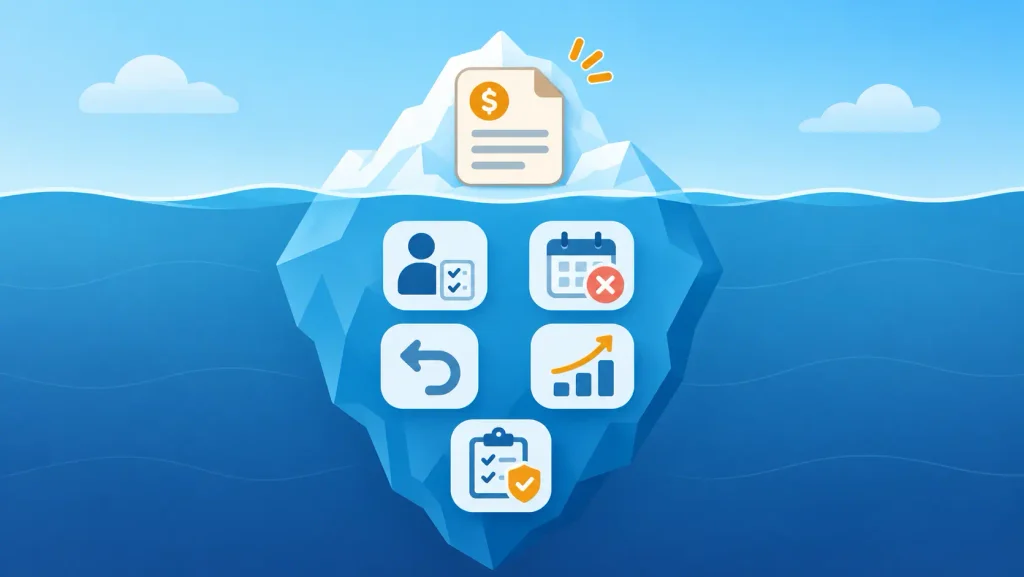
Some costs land on your side of the line, not your development partner’s. They’re real, and they’re why so many agent budgets break after launch.
Gartner predicts that over 40% of agentic AI projects will be canceled by the end of 2027, citing escalating costs, unclear business value, and weak risk controls. Costs nobody planned for are a big part of that story, and these are the usual ones:
- Your team’s review time: someone checks flagged decisions, especially in the first months.
- Model retirements: providers retire model versions, so prompts need retesting and sometimes rewriting.
- Cleaning up wrong actions: an agent with write access will eventually change the wrong record.
- Upstream plan upgrades: heavy API use can push your helpdesk or data tools into a higher tier.
- Change management: staff needs to know what the agent handles and how to override it.
- Ongoing compliance evidence: in regulated fields, proving correct behavior is a recurring task.
None of these is large on its own. Together, they’re the gap between your quoted AI agent development cost and what you actually spend, so keep a buffer for them in year one.
Build, Buy, or Configure: Which Route Fits Your Budget?
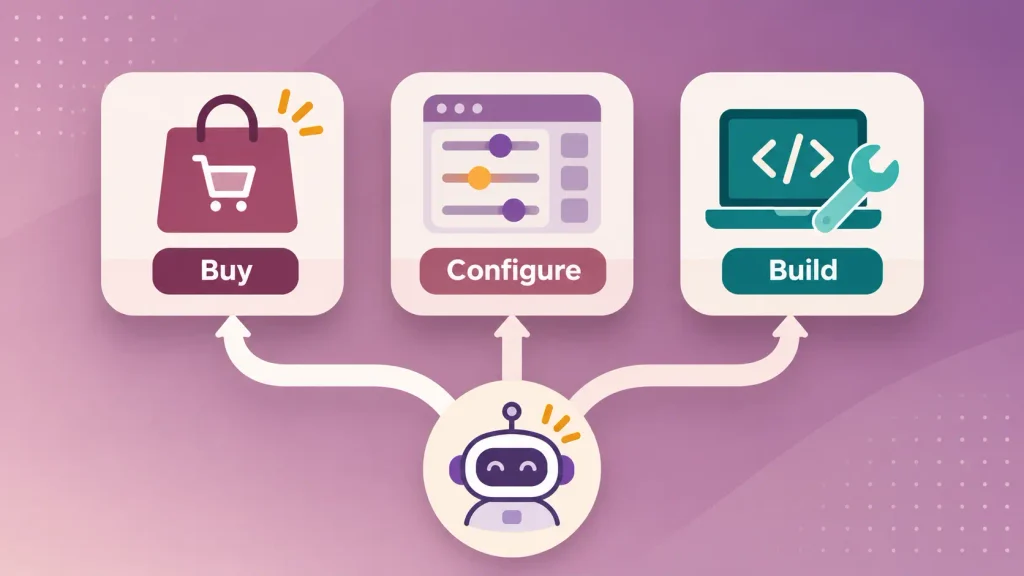
You have three ways to get an agent, and each one moves cost to a different place. Building custom gives you control and the highest upfront spend. Buying a ready-made agent costs little upfront but locks you into someone else’s roadmap.
Here’s how the three routes compare:
| Route | Best for | Cost profile | Main trade-off |
| Ready-made agent product | Standard tasks like FAQ or scheduling | Monthly subscription, little setup | Limited to the product’s features |
| Configured platform | Moderate workflows on a builder platform | Setup fee plus platform and usage fees | Platform limits and lock-in |
| Custom-built agent | Unique workflows, deep integrations, regulated data | Higher build cost, you own the code | Longer timeline, you own the upkeep |
The right answer depends on how unique your process is. If your edge comes from a workflow nobody else runs, custom usually wins over time. The same logic applies to chat assistants, as our comparison of a custom AI chatbot vs chatbot builder shows. Who builds it is a separate choice, covered in our guide to in-house vs outsourced AI development.
When You Don’t Need a Custom AI Agent
Not every task needs an agent. Gartner’s same analysis warns that many use cases sold as agentic today don’t require an agentic build at all.
You can probably skip a custom agent when:
- The task follows the same steps every time, so standard workflow automation handles it.
- A ready-made tool already covers most of the job.
- Your volume is too low for the savings to cover a build.
Saying no here is often the best cost decision you’ll make. Spend the budget where judgment and messy inputs are the real problem.
AI Agent Pricing Models Explained
In AI agent pricing, the structure of a quote matters as much as the number. Each pricing model puts risk on a different side of the table:
- Fixed scope: an agreed price for an agreed list of actions. It works when your workflow is clear and signed off.
- Time and materials: you pay for hours as the agent evolves. It fits builds where accuracy targets may shift.
- Dedicated team: a monthly fee for a team working only on your agent. It suits longer programs with several agents.
- Managed agent: a recurring fee for an agent the partner hosts and runs for you. You trade ownership for less overhead.
A fixed price on a vague brief usually gets padded, and you pay for the padding. I’d ask which model a team prefers before asking for a number, because it tells you how sure they are of the scope.
How to Estimate Your AI Agent Budget in 5 Steps
You can get to a defensible AI agent development cost estimate before talking to anyone. Work through these in order, because each answer feeds the next one:
- Name the exact task. Not “improve support,” but “read new tickets, check order status, and send the standard reply or escalate.”
- List every system the agent touches. Note whether each has a documented API and whether the agent needs write access.
- Pick the lowest autonomy that does the job. Approval-based is cheaper and safer than fully autonomous.
- Estimate monthly volume. Tasks per month drive your running cost, so a rough count beats a guess.
- Add running costs and a buffer. Combine the build estimate, 12 months of running cost, and room for hidden costs.
If steps one and two leave you unsure, a short discovery phase pays for itself. Our AI consulting team runs exactly that kind of scoping before any build starts.
How to Reduce AI Agent Development Cost Without Cutting Corners
The savings that hold up come from scope and sequencing, not from cheaper engineering. Here’s what keeps budgets under control:
- Start with one workflow. A narrow first agent cuts integration work, testing, and risk at the same time.
- Run a pilot before the full build. A focused pilot proves value on real data before you commit the larger budget.
- Use proven frameworks. Orchestration tools you don’t build yourself save weeks of backend work.
- Begin with human approval. You skip expensive rollback and monitoring work until the agent earns more freedom.
- Build evaluation in from day one. Retrofitting tests after a public failure always costs more.
If you’re building your first one, this guide on how to build your first AI agent shows how to pick a task small enough to succeed.
Why Your Second Agent Should Cost Less
The cost to build an AI agent is highest the first time, because your first agent carries the foundation: authentication, logging, evaluation tools, deployment pipelines, and shared integrations. The second agent can reuse most of that.
Costs rise again when agents start handing work to each other, because coordination is its own build. So if you plan several agents, design the shared pieces with reuse in mind from the start. Building agent one as a throwaway is the most expensive shortcut you can take.
Is a Custom AI Agent Worth the Cost?
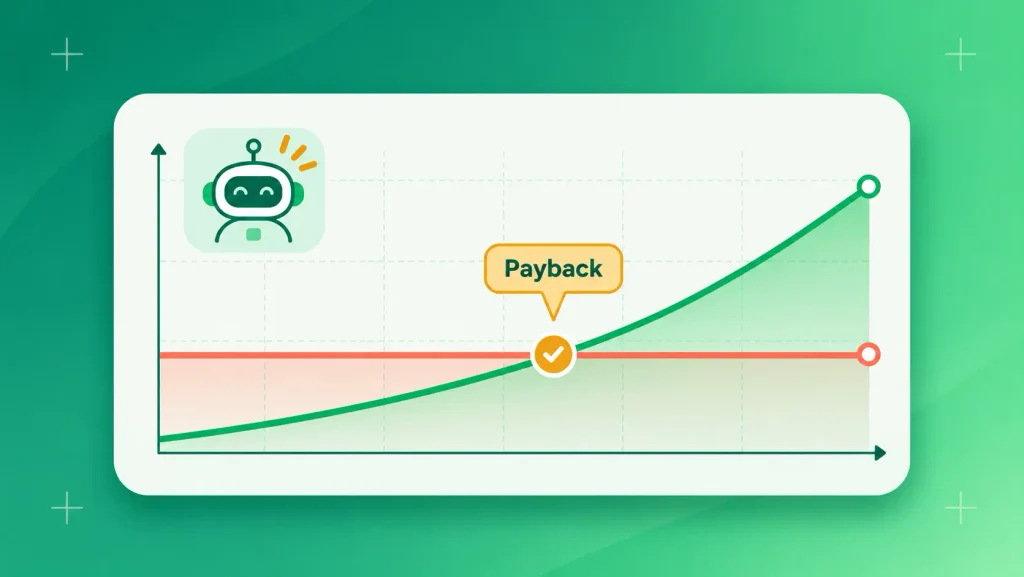
A custom agent is worth it when its yearly savings cover the full custom AI agent cost, meaning the build plus a year of running costs, inside your target payback period. Most teams only check the first half of that.
The math is simple enough to run on a napkin:
- Annual savings: hours saved per week, times 52, times your loaded hourly cost.
- Year-one cost: build cost, plus 12 months of running cost, plus your hidden-cost buffer.
- Payback: year-one cost divided by monthly savings.
Be conservative with the savings line. An agent rarely removes all of a task, so model a partial share of the hours, not the full amount. If the numbers only work at full automation, the case is weak.
The wider market shows why this discipline matters. McKinsey’s State of AI research found 23% of organizations scaling an agentic AI system and another 39% still experimenting. Yet only 39% reported any impact on enterprise-wide EBIT from AI. Plenty of teams build agents. Fewer pick tasks where the savings show up in the numbers.
How Boomdevs Fixes Unpredictable AI Agent Budgets
Most budget surprises trace back to scope nobody pinned down. Boomdevs starts every agent with workflow mapping, so you know the tier, the integrations, and the running cost before development money moves.
You get build and running costs as separate lines, evaluation built into the plan, and a pilot option if you want proof first. A focused single-use agent can go from discovery to deployment in 8 to 12 weeks. The team behind it has delivered 3.5K+ projects and earned Clutch Champion recognition in Fall 2024.
If you have a workflow in mind, book a free strategy call and get an itemized estimate for your agent. Or see how Boomdevs scopes and ships production-ready AI agents first.
Frequently Asked Questions
How long does it take to build an AI agent?
A focused, single-task agent can go from discovery to deployment in about 8 to 12 weeks. Agents with several integrations, memory, or compliance needs take longer. For context, Clutch reports a typical AI development project runs about 10 months.
Why does an AI agent cost more than a chatbot?
A chatbot answers questions. An agent decides what to do next, calls tools, changes records, and knows when to hand off to a person. Each of those abilities needs its own engineering, testing, and monitoring, which a chatbot skips, and that extra engineering is what raises AI agent development cost.
Can a small business afford a custom AI agent?
Often, yes, if the scope stays narrow, since custom AI agent cost tracks scope more than company size. Simple reactive agents start around $20,000, and one well-chosen workflow with human approval keeps costs near that end. Costs climb when you add more systems, memory, or full autonomy.
What should I budget after launch?
Plan for model usage, hosting, monitoring, and regular upkeep every month. Your AI agent cost per month rises with task volume, so estimate tasks per month before launch. Add a buffer for model retirements and integration fixes.
Does a voice AI agent cost more than a text agent?
Yes. Voice adds speech recognition, speech synthesis, and latency work, plus per-minute running costs. If voice is your main channel, it’s worth talking to a team that does AI voice agent development specifically.