


- 1. Key Takeaways
- 2. How Much Does AI Chatbot Development Cost in 2026?
- 3. What Drives AI Chatbot Development Cost Up or Down?
- 4. Where Your Chatbot Budget Actually Goes
- 5. What an AI Chatbot Costs to Run After Launch
- 6. Hidden Costs Most Chatbot Quotes Leave Out
- 7. Three Sample Chatbot Budgets, Start to Finish
- 8. Build vs Buy: When a Chatbot Platform Is Cheaper
- 9. Is an AI Chatbot Worth the Cost? The Payback Math
- 10. How to Compare Chatbot Quotes Line by Line
- 11. How to Reduce AI Chatbot Development Cost Without Hurting Accuracy
- 12. How Boomdevs Solves Chatbot Budget Surprises
- 13. Frequently Asked Questions
Summarize with
AI chatbot development cost runs from about $3,000 for a scripted FAQ bot to $300,000 or more for an enterprise assistant. That range alone won’t help you plan a budget.
Your number depends on what the bot must do, which systems it touches, how clean your content is, and who builds it.
This guide breaks each cost down, including the monthly bill after launch, so you can budget with real numbers.
Key Takeaways
- Build cost: published 2026 agency pricing puts the AI chatbot development cost of a scripted FAQ bot at $3,000 to $30,000, an LLM chatbot that answers from your documents at $25,000 to $180,000, and an agentic enterprise bot at $60,000 to $300,000 or more.
- Biggest driver: what the bot connects to. Every system it writes into, like a CRM, helpdesk, or billing tool, adds real engineering hours.
- Running cost: your AI chatbot cost per month after launch usually lands between $400 and $6,000 for hosting, model usage, and content upkeep.
- Year one: expect to spend 25% to 45% more than the build price once running costs and post-launch fixes land.
- Cheapest safe start: one channel, one use case, and read-only access, then expand once real conversations show you what’s worth adding.
How Much Does AI Chatbot Development Cost in 2026?
You can expect to pay $3,000 to $30,000 for a rule-based chatbot and $15,000 to $90,000 for an NLP chatbot. An LLM chatbot grounded in your own content runs $25,000 to $180,000, and an agentic bot that takes actions starts around $60,000 and can pass $300,000.
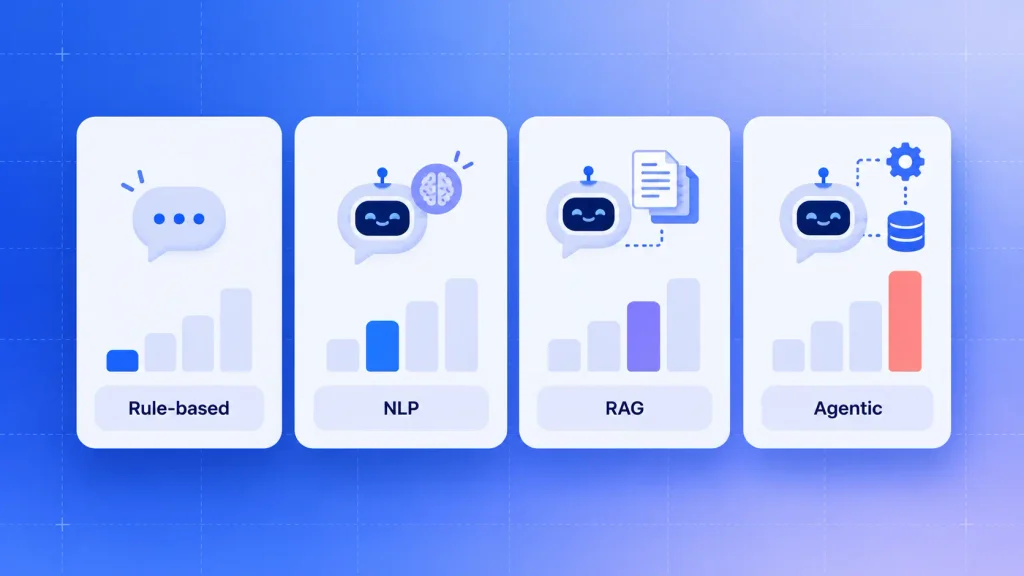
These bands come from the 2026 pricing that development agencies publish. They overlap because scope, not the label, sets your final chatbot development cost. Here’s how the four types compare:
| Chatbot type | What it handles | Typical build cost | Typical timeline |
| Rule-based | Scripted FAQs, lead capture, booking | $3,000 to $30,000 | 2 to 8 weeks |
| NLP | Free-text questions, intent routing | $15,000 to $90,000 | 4 to 16 weeks |
| LLM with RAG | Answers from your docs and policies | $25,000 to $180,000 | 8 to 24 weeks |
| Agentic | Updates records, runs workflows | $60,000 to $300,000+ | 16 to 52 weeks |
If you’re unsure which row is yours, ask one question first: does the bot only answer, or does it act? That answer usually moves you two rows. The AI chatbot development team at Boomdevs starts every project with exactly that scoping question, because it decides the architecture and the price.
Rule-Based Chatbots
These bots follow a decision tree. A visitor taps a button, and the bot answers from a fixed script.
They’re cheap and predictable. They also break the moment someone types a question you didn’t plan for.
The low end covers a single website widget, while builds near $30,000 usually add a custom interface, CRM logging, and more flows.
NLP Chatbots
An NLP bot reads free text and works out the intent behind it. “Where’s my package” and “my order never arrived” land in the same place.
You pay more here because someone has to build training data, tune intents, and design fallbacks. The bot will still misread some questions, so the fallback design matters as much as the happy path.
LLM Chatbots With RAG
Most new builds in 2026 sit in this row. The bot runs on a large language model, but it answers from your own help center, policies, or product docs through retrieval-augmented generation (RAG). That grounding is what keeps it from making things up.
The LLM chatbot cost in this row varies widely for a reason. A lean bot over one clean help center lands near the bottom. Thousands of messy PDFs with role-based access push you toward the top.
Agentic Chatbots
An agentic bot doesn’t stop at answering. It creates tickets, changes bookings, or updates customer records across several systems.
Every one of those actions needs permission checks, failure handling, and a point where a human can step in. Once your bot crosses into that territory, you’re closer to an agent build than a chatbot build, which is why Boomdevs scopes those projects through its AI agent development practice instead.
What Drives AI Chatbot Development Cost Up or Down?
Six things decide where you land inside those bands. They are conversation depth, integrations, content readiness, channels, compliance, and the team you hire. Integrations usually move the number more than the AI model does.
Conversation Depth and Architecture
A bot handling 20 scripted questions is a different product from one that holds context across a ten-turn conversation. Depth multiplies everything downstream: design time, retrieval tuning, and test coverage.
It’s the first thing worth locking down. Until you know how deep the conversations go, every other estimate is a guess.
Integrations: Read vs Write
Reading data is the cheap part. Letting the bot check an order status is simple, but letting it change a delivery date means authentication, permission checks, and rollback logic.
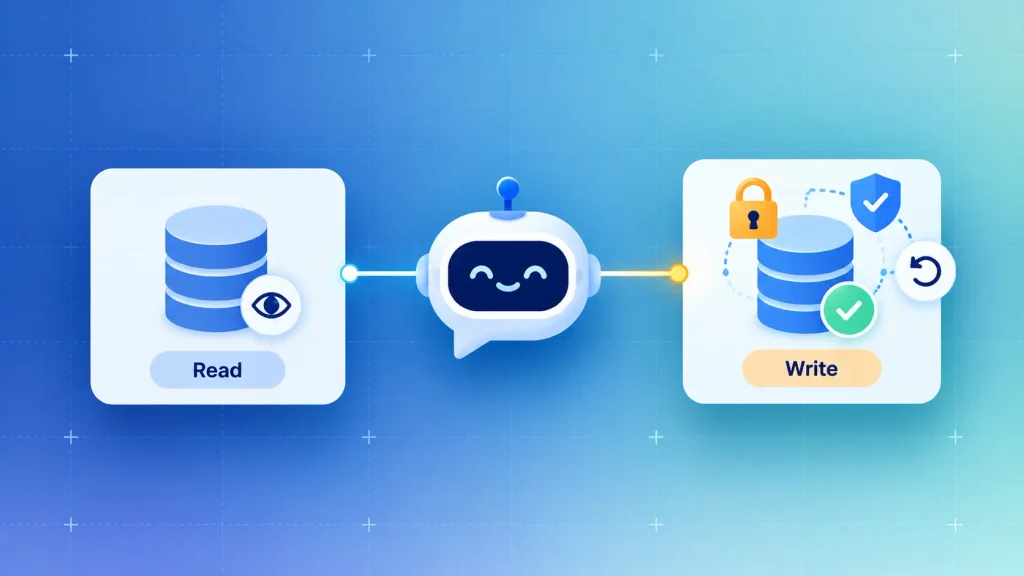
Published agency pricing for common connections looks like this:
| Integration | Typical added cost |
| Helpdesk (Zendesk, Freshdesk) | $4,000 to $12,000 |
| CRM (Salesforce, HubSpot) | $5,000 to $25,000 |
| Payment gateway | $3,000 to $15,000 |
| ERP (SAP, Oracle, NetSuite) | $10,000 to $40,000 |
| Legacy system needing middleware | $10,000 to $30,000 |
Two connections done well beat six done in a rush, and they keep your AI chatbot development cost predictable. If your systems are older or poorly documented, I’d suggest asking for each connection to be priced on its own line, the way an AI integration team should scope it.
Knowledge Base and Data Readiness
Your bot can only be as accurate as the content it reads. If your policies live in six places and two of them contradict each other, someone has to fix that before launch.
Published estimates put knowledge base prep at $10,000 to $40,000 on top of development when content is scattered across PDFs, wikis, and ticket systems. Clean, current help-center content is the cheapest way to lower your AI chatbot development cost.
Channels, Voice, and Languages
Each place your bot lives has its own interface rules and API limits. Running across several channels instead of one typically adds 15% to 30% to the build, and each extra language adds roughly $5,000 to $15,000 for localized intents, fallbacks, and testing.
Voice is a separate jump because of speech recognition and latency work. If voice is on your roadmap, the breakdown of AI voice agent cost covers that line in more detail.
Compliance and Security
HIPAA, SOC 2, PCI-DSS, and GDPR each add work in audit logging, encryption, access control, and data retention. For regulated deployments, published figures put that at $15,000 to $60,000.
Retrofitting compliance after launch tends to cost far more than designing it in. If your bot will touch patient, payment, or financial data, raise it in your first scoping call, not your last.
Team Location and Hourly Rates
The same scope can carry a very different cost to build an AI chatbot depending on where your team sits. Here are the hourly ranges agencies publish for chatbot work:
| Region | Typical hourly rate |
| North America | $100 to $200 |
| Western Europe | $80 to $170 |
| Eastern Europe | $40 to $80 |
| South Asia | $25 to $60 |
A lower rate only saves money if the team gets retrieval and testing right the first time. A cheap build that needs a rebuild in six months is the most expensive option on this list. If you’re weighing a hire against a partner, the comparison of in-house vs outsourced AI development walks through that trade-off.
Where Your Chatbot Budget Actually Goes
Most founders expect the AI model to eat most of the AI chatbot development cost. It doesn’t. Core development and integrations take the largest share, and testing costs about as much as design.
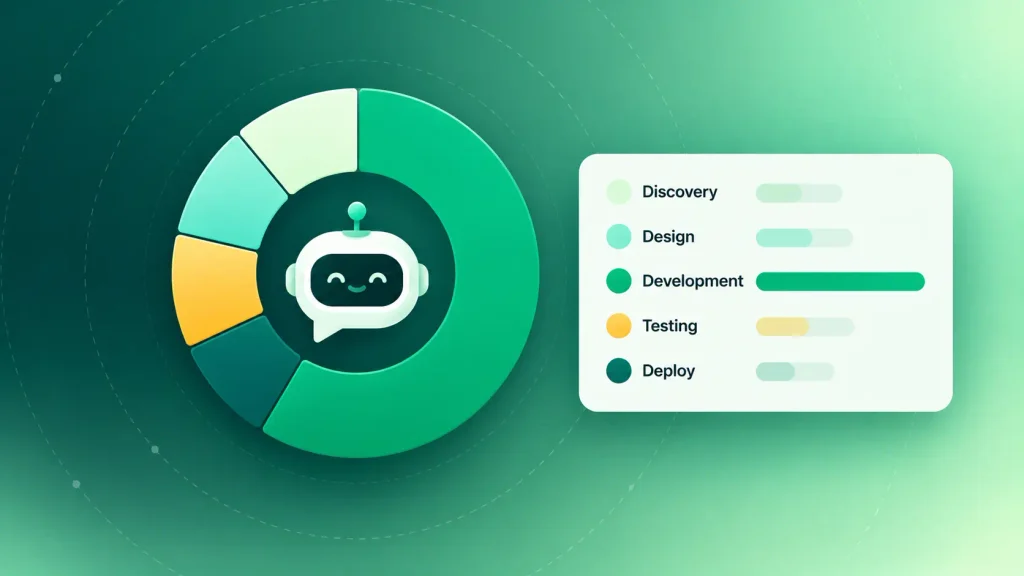
A typical split across a custom build looks like this:
| Phase | Share of build budget | What it covers |
| Discovery and planning | 10% to 15% | Use cases, question analysis, tech choices |
| Conversation and UX design | 10% to 15% | Flows, fallbacks, handoff rules |
| Core development | 40% to 50% | Backend, model setup, retrieval, integrations |
| Testing and QA | 15% to 20% | Accuracy suites, edge cases, load, security |
| Deployment | 5% to 10% | Hosting, channels, monitoring setup |
If a quote shows testing as one thin line, treat that as a warning. A bot that confidently quotes the wrong refund policy costs you more than the testing would have. And if your chatbot is one feature inside a larger product, the full AI product development cost guide shows how these phases scale up.
What an AI Chatbot Costs to Run After Launch
After launch, the typical AI chatbot cost per month runs $400 to $6,000. That money covers model usage, hosting, retrieval storage, monitoring, and someone keeping the content accurate.
Here’s where the monthly spend goes:
| Cost item | Typical monthly range | What drives it |
| LLM API usage | $100 to $2,500 | Volume, model choice, context size |
| App hosting | $200 to $2,500 | Traffic, uptime needs, redundancy |
| Vector database | $50 to $500 | Library size, query volume |
| Monitoring and analytics | $100 to $1,000 | Log retention, alerts, reporting |
| Content and accuracy upkeep | $500 to $2,000 | Reviewing chats, closing answer gaps |
Not every bot carries every line. A small FAQ bot may skip the vector database entirely, while a high-traffic support bot hits the top of several rows at once.
Cost per Conversation, Worked Out
Model pricing is published per million tokens, so you can estimate your LLM chatbot cost before anyone writes code. Take a typical support conversation that runs four turns. Each turn sends roughly 3,000 tokens, covering your system prompt, retrieved help-center passages, and the chat so far, and gets about 250 tokens back.
That adds up to 12,000 input tokens and 1,000 output tokens per conversation. At Anthropic’s current API rates, here’s what it costs:
| Model | Per conversation | 10,000 a month | 50,000 a month |
| Claude Haiku 5.5 | about $0.0017 | about $17 | about $85 |
| Claude Sonnet 5.5 | about $0.034 | about $340 | about $1,700 |
| Claude Opus 5.5 | about $0.068 | about $680 | about $3,400 |
The gap between rows is the whole story. Most support questions don’t need the top model. If you route simple questions to Haiku and send only the hardest 30% to Sonnet, 50,000 conversations a month drop from about $1,700 to about $570.
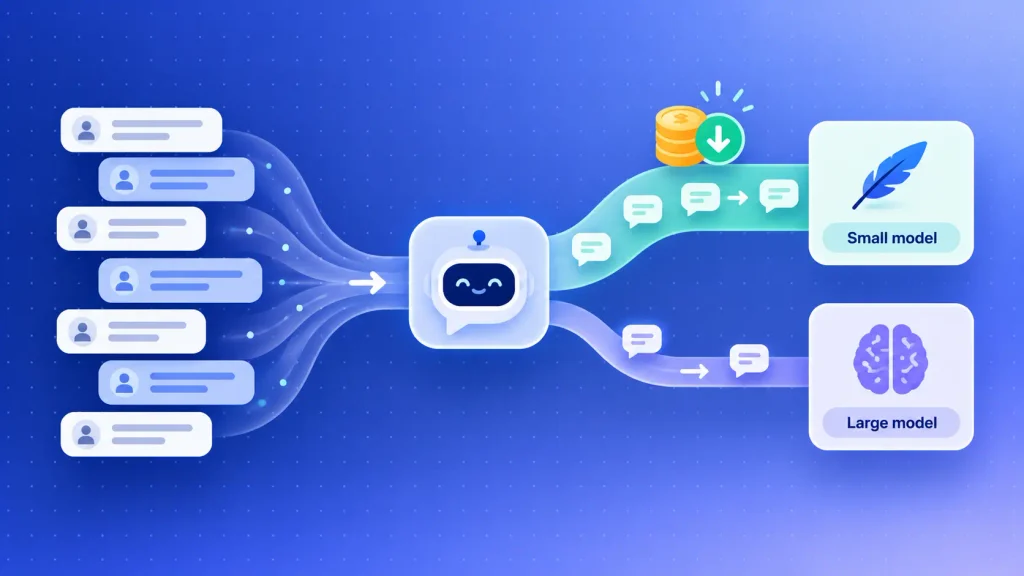
Prompt caching helps too. Repeated content like your system prompt is billed at 5% to 10% of the normal input price on a cache hit, which matters when every conversation starts with the same instructions.
Maintenance and Retraining
Plan on 15% to 25% of your build cost each year for upkeep. On a $60,000 bot, that’s $9,000 to $15,000 a year for knowledge updates, re-indexing, bug fixes, and security patches.
Model upgrades are the line people forget. When a provider releases a new version, someone has to re-test your prompts and answers before you switch.
Hidden Costs Most Chatbot Quotes Leave Out
The quoted AI chatbot development cost is rarely your year-one spend. Published agency estimates put the realistic first-year total at 25% to 45% above the build price, and these items cause most of that gap:
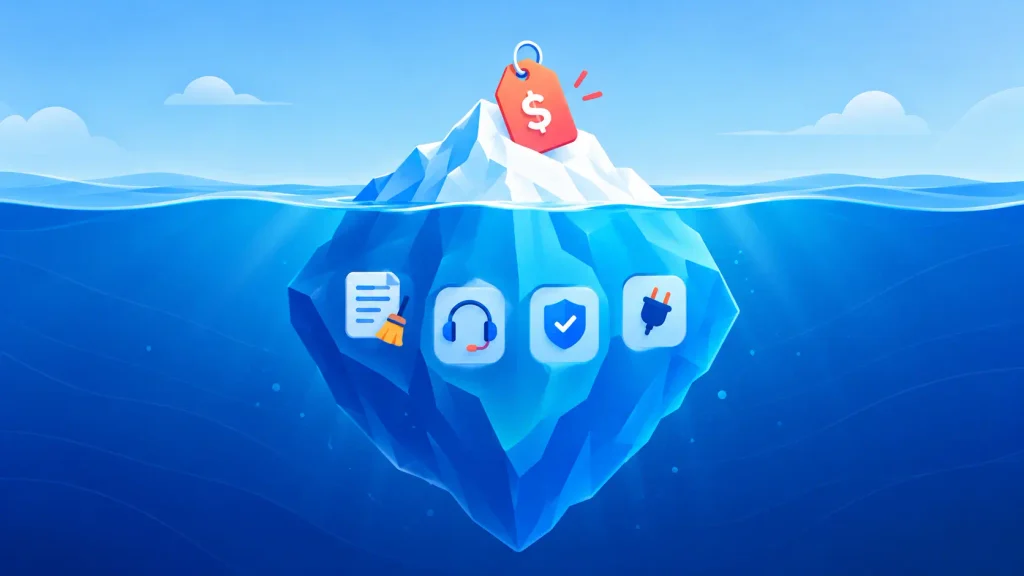
- Content cleanup: contradictory or outdated policies have to be fixed before the bot can answer from them, and that work usually takes one to three weeks.
- Handoff and escalation design: deciding what the bot must never answer, and what context passes to a human, is real design work. The guide to designing AI chatbot conversations shows what happens when teams skip it.
- Guardrails and accuracy testing: input filtering, hallucination checks, and PII redaction typically add $8,000 to $25,000.
- Second-wave integrations: a few months after launch, you’ll want the bot to check billing or update records, so setting aside 15% to 20% of the build for year-one additions saves a painful conversation later.
- Model and quality drift: answers that were right at launch go stale as your products change. Many of the common generative AI challenges teams hit after launch show up right here.
None of these are padding. They’re the work that separates a demo from a bot your customers can trust.
Three Sample Chatbot Budgets, Start to Finish
Chatbot development cost ranges get easier to use once you see them added up. The three scenarios below combine the build, integration, and monthly figures from this guide into a year-one total, so you can find the one closest to your project.
Startup FAQ Bot on One Channel
You want a website bot that answers your top 20 questions and captures leads. It reads from your help center and sends leads to your inbox, with no write access to other systems.
Expect a build around $3,000 to $15,000, with running costs near $100 to $500 a month.
SaaS Support Bot With RAG and Helpdesk Integration
You want the bot to answer from your product docs, create tickets in your helpdesk, and hand off to an agent with the conversation attached. A lean RAG build runs $35,000 to $80,000, plus $4,000 to $12,000 for the helpdesk connection.
Running costs typically sit around $1,000 to $3,000 a month at this stage.
Regulated Enterprise Assistant
You need single sign-on, role-based access, audit logs, HIPAA or SOC 2 controls, and connections to a CRM plus an internal system. Full enterprise builds are published at $150,000 to $350,000.
At that scale, running costs of $3,000 to $6,000 a month are realistic.
Here’s how the three compare over year one:
| Scenario | Build | Monthly run | Year-one total |
| Startup FAQ bot | $3,000 to $15,000 | $100 to $500 | $4,200 to $21,000 |
| SaaS support bot | $39,000 to $92,000 | $1,000 to $3,000 | $51,000 to $128,000 |
| Regulated enterprise | $150,000 to $350,000 | $3,000 to $6,000 | $186,000 to $422,000 |
Look at where the jumps happen. It isn’t the AI model. It’s write access, compliance, and the number of systems involved.
Build vs Buy: When a Chatbot Platform Is Cheaper
A subscription platform is cheaper upfront, and for simple, standard support it’s often cheaper overall. Published plans run from about $50 to over $5,000 a month, and per-resolution pricing sits between roughly $0.50 and $5 per resolved conversation.
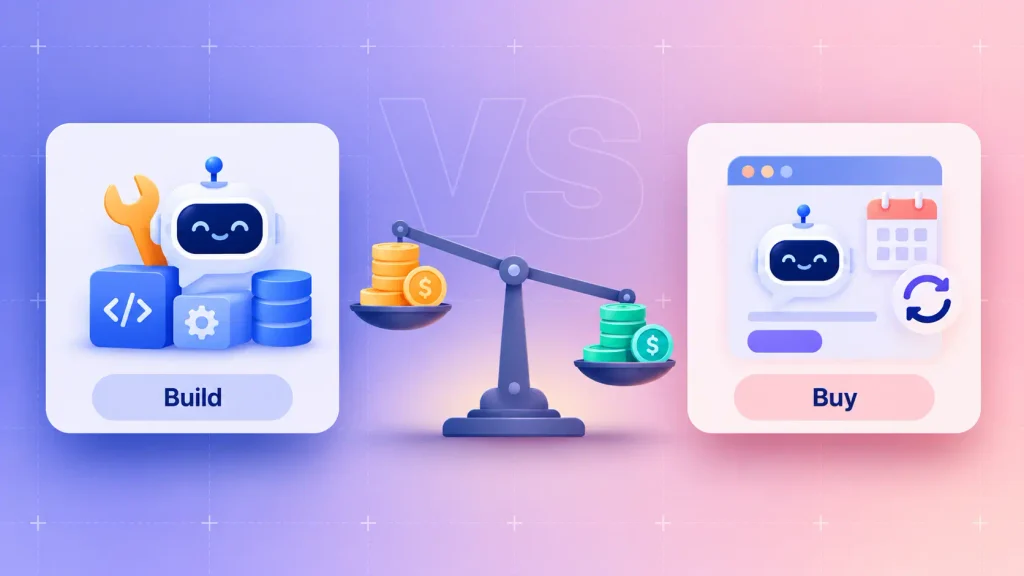
The math shifts over time, though. Here’s what common plan levels add up to across three years:
| Monthly platform fee | Three-year total |
| $600 | $21,600 |
| $1,500 | $54,000 |
| $3,000 | $108,000 |
A $600 plan passes the cost of a startup FAQ bot build within three years, and a $1,500 plan lands inside the SaaS support bot range. Custom tends to win when you need deep write access, your own permission rules, or control over where your data lives.
For the full trade-off, see custom AI chatbot vs chatbot builder. If you’re leaning toward a platform, this roundup of AI chatbot builders covers the main options.
Is an AI Chatbot Worth the Cost? The Payback Math
Your chatbot pays for itself when the contacts it absorbs cost less than the agents who would otherwise handle them. Gartner’s benchmarks put the median cost per contact at $1.84 for self-service and $13.50 for assisted channels. That $11.66 gap is your savings on every question the bot fully resolves.
It’s also why customer support leads chatbot spending. Support held 41.82% of chatbot market revenue in 2025, according to Mordor Intelligence.
You can estimate your own payback in four steps:
- Pull one month of tickets and count those with a documented answer.
- Pick a conservative share the bot will fully resolve, such as 30%.
- Multiply those resolved contacts by your cost-per-contact gap.
- Divide your build cost by the monthly savings minus running costs.
Say you handle 4,000 tickets a month. At 30%, the bot resolves 1,200 contacts and saves about $14,000 a month at Gartner’s medians. Against a $60,000 build and $2,000 in monthly running costs, you’d break even in about five months.
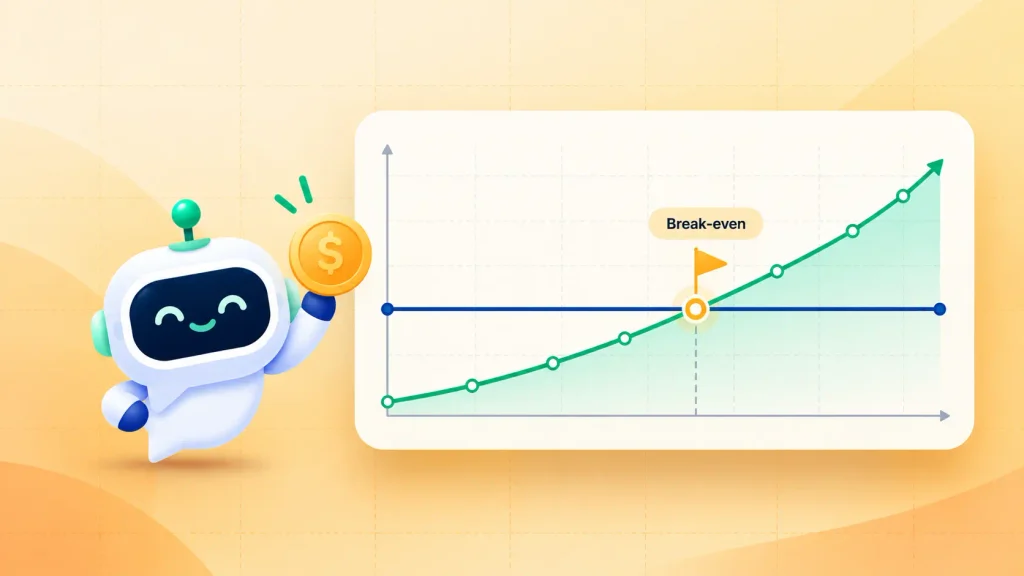
If your own math lands past 18 months, I’d narrow the scope before dropping the idea. And ticket savings aren’t the whole picture: the business benefits of AI chatbots include round-the-clock coverage and faster first responses that never show up in a cost-per-contact sheet.
How to Compare Chatbot Quotes Line by Line
When three quotes for one brief land tens of thousands of dollars apart, the firms are usually pricing three different bots. Lining the quotes up against the same six items shows you which one matches what you actually need:
| Line item | What to ask | Red flag |
| Chatbot type | Rule-based, NLP, or LLM with RAG? | No architecture named |
| Integrations | Read-only or write, priced per system? | One flat “integrations” line |
| Content prep | Who cleans the knowledge base? | Not mentioned at all |
| Testing | How many hours, against which questions? | Under 10% of the budget |
| Model and API costs | Who pays, and what’s the monthly estimate? | “Depends on usage,” no number |
| Post-launch support | What does year one include? | Priced only on request |
A quote that answers all six clearly is worth more than a cheaper one that skips three. If a firm can’t tell you how the bot connects to your existing systems, it hasn’t scoped your project yet.
How to Reduce AI Chatbot Development Cost Without Hurting Accuracy
The safest savings come from scope, not from cutting engineering. Published estimates show a focused first release can cut upfront cost by 40% to 60%, and these moves keep quality intact:
- Your top questions first: rank tickets by frequency and launch with the ones carrying the most volume.
- Read-only at launch: let the bot look things up before it changes anything, and add write access in phase two.
- RAG before fine-tuning: fine-tuning typically runs $10,000 to $60,000 and ties you to one model version, while retrieval updates the moment your content does.
- Routing by difficulty: send simple questions to a smaller model, as the cost-per-conversation table showed.
- Integrations in phases: start with the one or two connections that carry the most value.
This is the same thinking behind a good MVP development process. You ship the smallest version that’s genuinely useful, then let real conversations tell you what to build next.
How Boomdevs Solves Chatbot Budget Surprises
Budget surprises almost always come from scope nobody wrote down. Boomdevs gives you transparent, itemized pricing before any commitment, so you can see what each part of the build costs before work starts.
On Boomdevs’ current pricing, simple support chatbots start from around $15,000. Enterprise systems with deep integrations and compliance requirements typically range from $50,000 to $150,000. A focused single-use bot usually goes from discovery to deployment in 6 to 10 weeks.
Every project follows the same order:
- Discovery and conversation mapping around your real user queries.
- Data preparation that cleans and structures your knowledge base.
- Build, integration, and testing against edge cases and compliance requirements.
- Post-launch optimization with monitoring and retraining.
That process sits behind 3.5K+ delivered projects and a Clutch Champion award (Fall 2024). If you’d like a real number for your own bot, you can get a scoped estimate for your custom AI chatbot and see build and running costs side by side before you commit.
Frequently Asked Questions
How much does it cost to build an AI chatbot from scratch?
A custom AI chatbot built from scratch typically costs $25,000 to $180,000 when it answers from your own content through RAG. Simple rule-based bots start around $3,000. Agentic bots that update records across systems usually start near $60,000 and can pass $300,000.
How much does an AI chatbot cost per month to run?
Most production chatbots cost $400 to $6,000 a month after launch. The main lines are model API usage, hosting, a vector database, monitoring, and content upkeep. Smart model routing can cut the API share by more than half.
How long does it take to build an AI chatbot?
A rule-based bot takes 2 to 8 weeks, and an LLM chatbot with RAG usually takes 8 to 24 weeks. Agentic and enterprise builds can run 16 to 52 weeks. Content cleanup and integrations are the most common reasons timelines slip.
How much does a ChatGPT-style chatbot cost?
The build cost of an LLM-powered chatbot sits in the $25,000 to $180,000 range, depending on retrieval, guardrails, and integrations. Model usage then adds a monthly bill. At current Anthropic rates, a four-turn support conversation costs well under one cent on a small model and a few cents on a top model.
Is a chatbot cheaper than hiring support staff?
For repetitive questions, usually yes. Gartner puts the median cost per contact at $1.84 for self-service versus $13.50 for assisted channels. A chatbot works best alongside your team, absorbing routine questions so agents can focus on complex cases.