


- 1. Key Takeaways
- 2. How Much Does an AI Voice Agent Cost?
- 3. What Makes Up the Per-Minute Cost?
- 4. AI Voice Agent Pricing Models Compared
- 5. Custom AI Voice Agent Development Cost
- 6. Hidden Costs Most Budgets Miss
- 7. AI Voice Agent vs Human Agent: The Real Cost Comparison
- 8. How to Lower Your AI Voice Agent Cost Without Hurting Quality
- 9. How Boomdevs Builds Cost-Efficient AI Voice Agents
- 10. Frequently Asked Questions
- 11. Get a Clear Cost Estimate for Your Voice Agent
Summarize with
AI voice agent cost runs from about $0.05 to $1 per minute on a hosted platform, or $15,000 to $150,000+ for a custom build.
That range alone won’t help you set a budget. Your real AI voice agent cost depends on your call volume, the AI model and voice you pick, and how many systems the agent must connect to.
This guide breaks down every cost line, so you can plan year one before any sales call.
Key Takeaways
- Hosted platforms: most small and mid-size setups land at $0.10 to $0.25 per minute all-in, even when the advertised rate starts at $0.05.
- Custom builds: a focused agent typically costs $15,000 to $60,000 to build. Multi-location or heavily integrated systems run $60,000 to $150,000+.
- Hidden costs: silence billing, concurrency limits, compliance add-ons, and integration work can quietly outgrow the minutes themselves.
- The comparison that matters: one hour of a median US customer service rep’s wage buys about 137 AI call minutes at $0.15 per minute.
Prices in this guide come from each provider’s public pricing pages and pricing guides, checked in October 2026. Boomdevs isn’t affiliated with any of them.
How Much Does an AI Voice Agent Cost?
You’ll pay for an AI voice agent in one of two ways. Either you rent a hosted platform by the minute, or you pay a team to build one around your systems.
Most businesses start with the first path. Some graduate to the second once volume or integration needs outgrow it. Here’s how the three common options compare:
| Path | Typical cost | Best for |
| Hosted voice AI platform | ~$0.05 to $1 per minute, plus a possible monthly fee | Low volume, simple call flows, fast testing |
| Custom focused agent | $15,000 to $60,000 build, plus usage | One core workflow, such as booking or support |
| Custom enterprise system | $60,000 to $150,000+ build, plus usage | Many integrations, compliance needs, high volume |
The hosted AI voice agent pricing range is wide on purpose. Aircall’s pricing guide puts published per-minute rates at $0.05 to $1.00, because developer platforms and all-in-one business phone tools price very differently.
Where your AI voice agent cost lands depends less on your industry. It depends far more on how deeply the agent must plug into the tools you already run.
Advertised Rate vs All-In Rate
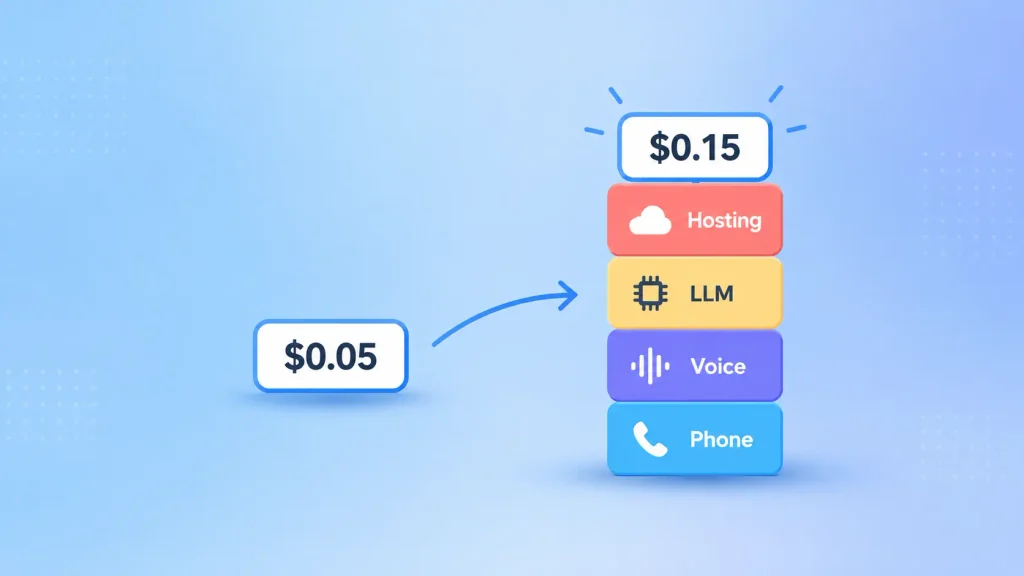
That $0.05 headline rate is real. It’s just rarely your real AI voice agent cost per minute. Vapi, for example, charges $0.05 per minute for hosting alone, and passes the speech, model, and voice costs through on top.
Once you add speech recognition, the language model, the voice, and the phone line, most small and mid-size businesses should expect $0.10 to $0.25 per minute all-in. Retell’s published pay-as-you-go range runs from $0.07 to $0.31, depending on the configuration you choose.
So when you compare AI voice agent pricing quotes, it’s worth asking for the all-in rate for your exact setup. Anything less is a partial price.
What Makes Up the Per-Minute Cost?
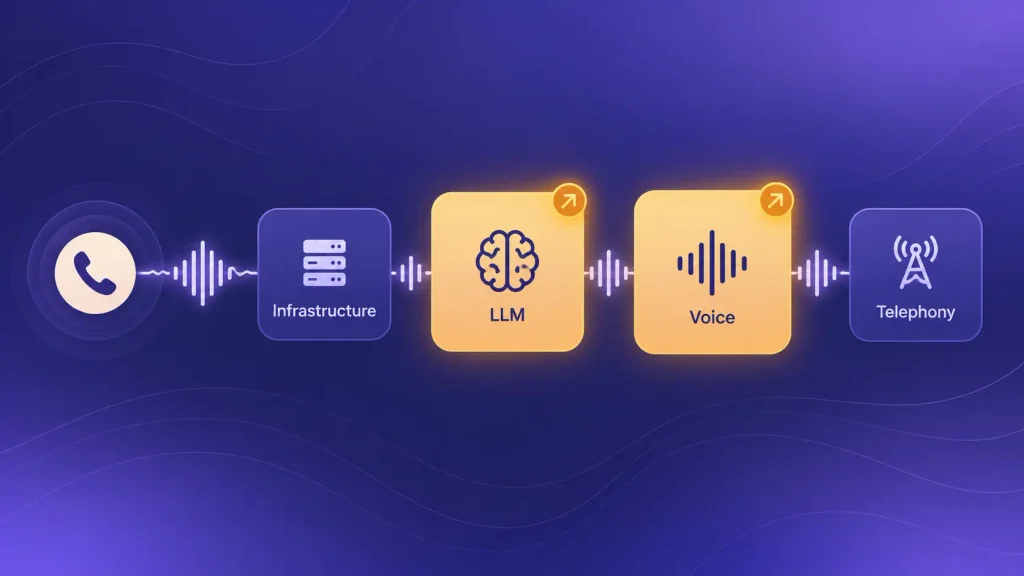
Your AI voice agent cost per minute is built from several paid layers that every call passes through. Some platforms bill each one separately, while others bundle them into one rate with a markup.
Here’s what each layer does and how much it tends to move your bill:
| Layer | What it does | Effect on your bill |
| Voice infrastructure | Listens, transcribes, handles interruptions | Fairly fixed |
| Large language model (LLM) | Decides what to say next | Swings the most |
| Text-to-speech (TTS) | Speaks the reply out loud | Swings with voice quality |
| Telephony | Carries the call over the phone network | Small and steady |
Infrastructure and telephony barely move. The model and the voice are where your bill really swings.
Why Your Model and Voice Choice Move the Number Most
A premium language model can push your AI voice agent cost per minute several times higher than a lightweight one. On a routine booking call, you’re often paying for reasoning power the conversation never uses.
Voice works the same way. Natural, expressive voices cost more than standard ones. If you’d rather buy a full agent straight from a voice company, ElevenLabs charges $0.08 per minute for its voice agents, on plans from $6 to $990 a month.
I’d suggest testing a cheaper voice with real callers before paying for the premium one. On a booking call, many people won’t notice. On a brand-sensitive sales call, they might.
AI Voice Agent Pricing Models Compared
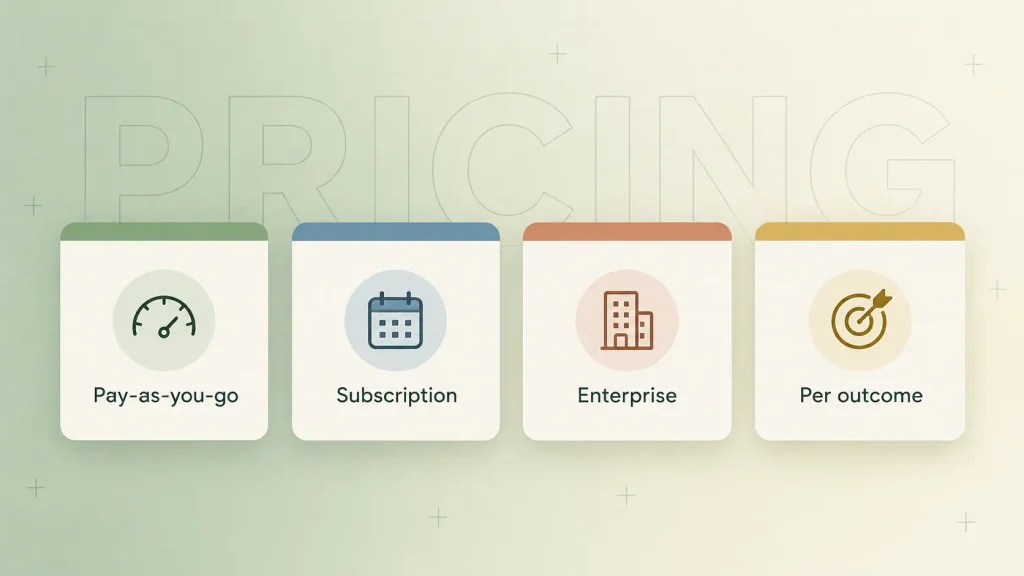
Providers package AI voice agent pricing in four main ways. The right one for you depends on how steady your call volume is.
Pay-As-You-Go
You pay only for the minutes you use, with no commitment. It suits you if your volume is low, or if it swings with the seasons.
The catch is a higher per-minute rate. A busy month can also land as a surprise on your invoice.
Subscription and Hybrid Plans
A monthly fee buys you bundled minutes or a lower per-minute rate. CloudTalk charges $99 a month for 200 minutes. Bland’s Build plan costs $299 a month and drops the rate to $0.12 per minute.
Read the overage clause closely. Going past your bundle can cost 1.5x to 2x the base rate.
Enterprise Contracts
Annual contracts bring dedicated infrastructure, compliance certifications, and volume-based rates. Some developer platforms pair a fixed platform fee with committed volume on these tiers.
Some providers now sell nothing else. Synthflow lists only enterprise contracts, starting at $30,000 a year.
Pay-Per-Outcome
Here you pay only when the agent books an appointment, qualifies a lead, or resolves a ticket. Your cost tracks results instead of talk time.
It’s harder to forecast, though. Before you sign, it’s worth asking exactly how the provider defines an “outcome,” because that definition sets your bill.
Here’s how the four models line up:
| Model | Best fit | Watch out for |
| Pay-as-you-go | Low or seasonal volume | Higher rates, unpredictable bills |
| Subscription or hybrid | Steady monthly volume | Overage at 1.5x to 2x |
| Enterprise contract | High, committed volume | 12-month lock-in |
| Pay-per-outcome | Sales-driven use cases | Vague “outcome” definitions |
Most teams start on pay-as-you-go. Once monthly volume settles, a plan almost always works out cheaper.
Custom AI Voice Agent Development Cost
A custom build makes sense when a platform can’t reach the systems your calls depend on. Think of a legacy booking tool, an in-house CRM, or strict rules about where call data lives.
You pay more up front, then less per minute at scale. A focused agent built around one workflow typically costs $15,000 to $60,000 and takes four to 12 weeks. Systems with many integrations or locations climb to $60,000 to $150,000+.
Cost by Build Phase
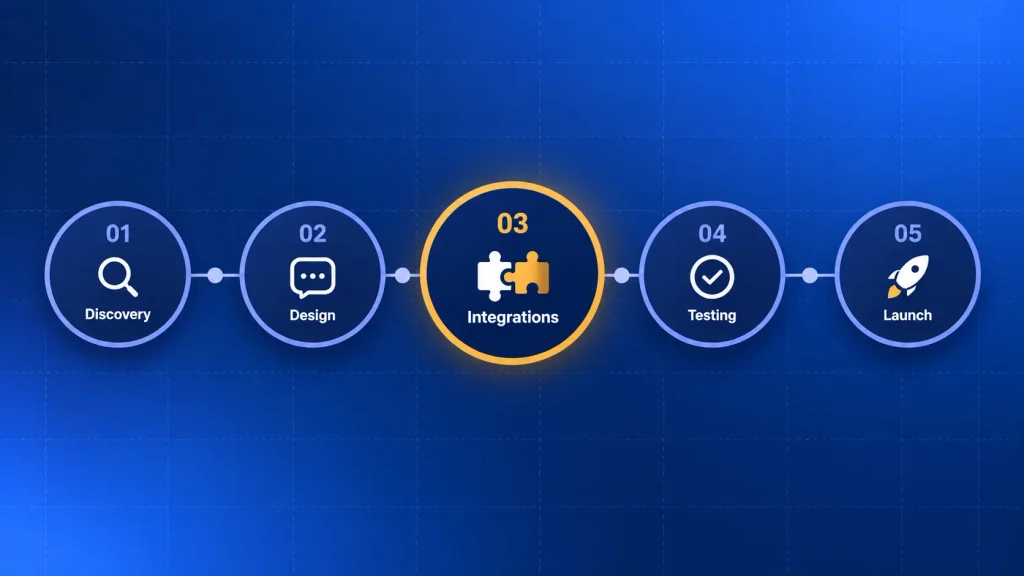
So where does that budget actually go? A typical custom build moves through five phases, in this order:
- Discovery and scoping. You map call types, volumes, and the systems involved. If you’re still unsure where AI fits at all, it helps to know what an AI consulting engagement costs before you commit to a build.
- Conversation design. Scripts, escalation rules, and fallback paths for when a caller goes off track. The same conversation design principles that shape chatbots apply here, with less room for error, because a caller can’t scroll back.
- Integrations. Connecting the agent to your CRM, calendar, or helpdesk. This is often the biggest single line, and Gartner estimates integration pricing at $1,000 to $1,500 per conversational AI agent, with some organizations paying up to $2,000.
- Testing. Real calls, accents, interruptions, edge cases, and clean handoffs to a human.
- Launch and early tuning. Reviewing transcripts in the first months and fixing wrong answers.
Integration and conversation design are where good builds spend their time. Skimp on either, and it shows up later as dropped calls and frustrated customers.
Cost by Use Case
What the agent does moves the price as much as how it’s built. Here’s how the three most common jobs compare:
| Use case | What drives cost | Cost note |
| AI receptionist | Call routing, calendar booking | Usually the simplest scope |
| Inbound support | Knowledge base, ticket lookups, human handoff | Grows with knowledge base size |
| Outbound sales | Lead qualification logic, deep CRM sync | Typically 20% to 30% above support |
Sales agents typically cost 20% to 30% more than support agents. They simply do more during the call, from lead qualification to deeper CRM work.
Outbound carries one more cost that never shows up on a rate card. The US FCC has ruled that AI-generated voices in robocalls fall under existing robocall rules, so legal review belongs in your outbound budget.
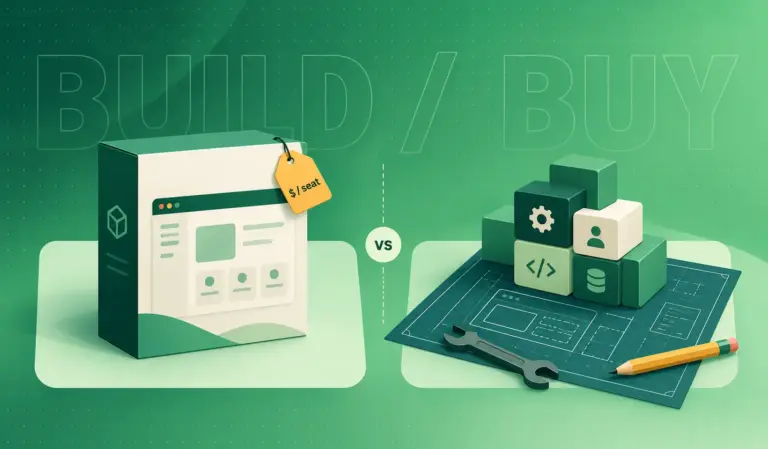
Build vs Buy: Where the Break-Even Sits
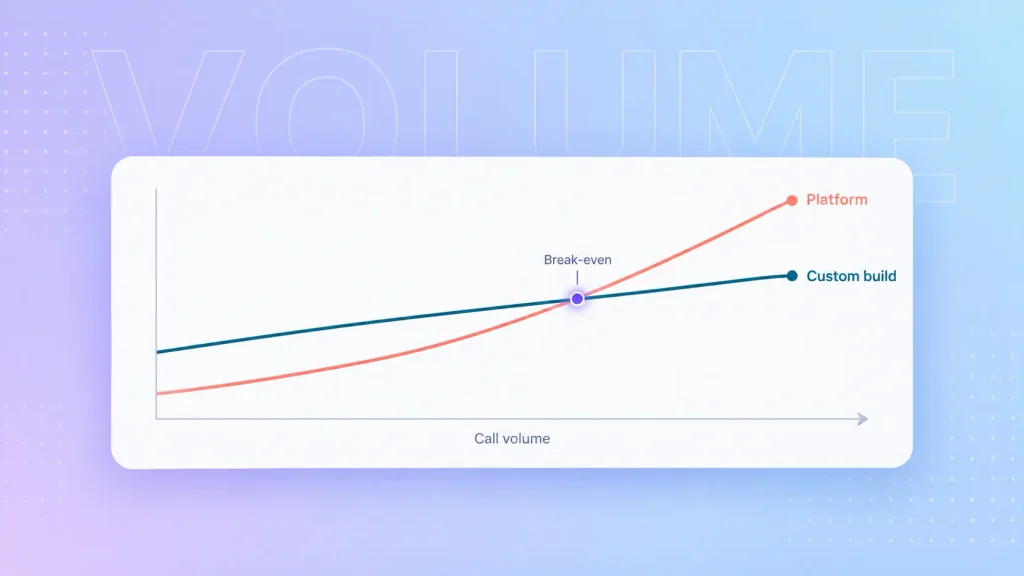
Buying wins on speed. A platform agent can go live in days, while a custom build takes weeks. Building wins on per-minute cost, control, and data ownership.
The break-even depends on volume. At low volume, a platform’s markup costs you less than an engineering team ever would. At high, steady volume, that per-minute markup adds up month after month, and a custom stack starts to pay for itself.
It doesn’t have to be one or the other. Many teams start on a platform to learn their call patterns, then build once the numbers justify it. If your roadmap already includes agents beyond the phone, broader AI agent development can share the same integrations and data layer. And if all you need is a text FAQ bot, no-code chatbot builders may cover it for far less.
Hidden Costs Most Budgets Miss
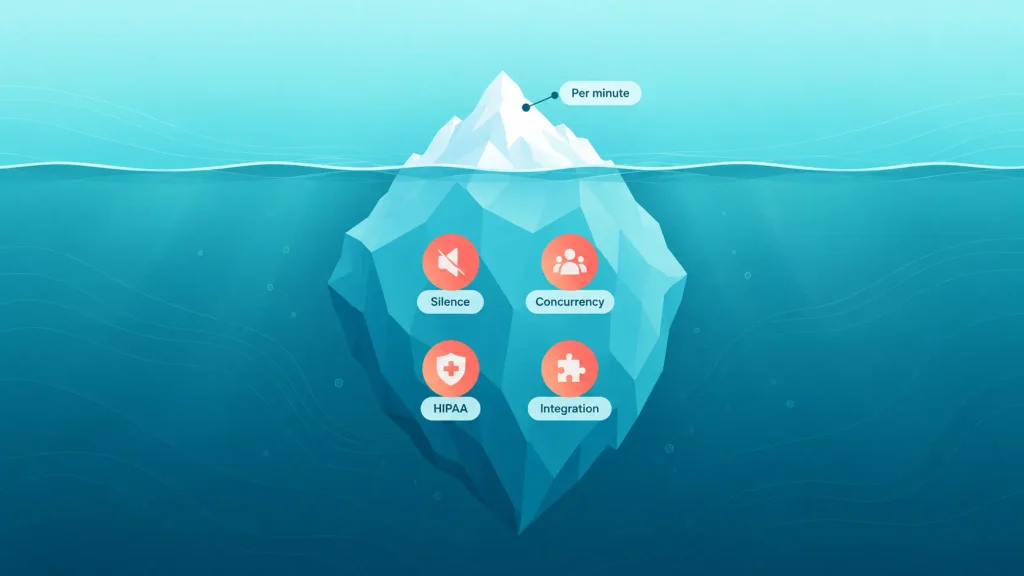
The per-minute rate is the number everyone compares. These are the costs that tend to appear after launch:
- Silence and hold time: Some platforms bill for the entire call, silence included, because speech recognition keeps listening. Thirty seconds of dead air on a two-minute call means paying 25% more than the actual conversation.
- Concurrency caps: Pay-as-you-go plans often include 10 to 20 simultaneous calls, and extra lines cost $8 to $10 per slot each month.
- Compliance add-ons: HIPAA isn’t always included. Vapi charges $2,000 a month for HIPAA on both of its plans.
- Failed outbound calls: Some platforms charge a $0.015 minimum per outbound attempt, even when the call never connects.
- Prompt bloat: a 2,000-token system prompt sends four times as many tokens per turn as a 500-token one, and you pay for every one of them.
- Setup and integration: onboarding fees often run $500 to $2,000, and custom integration work can add $1,000 to $5,000.
None of these should stop you. They just need their own line in your budget from day one.
Ongoing Tuning and Maintenance
A voice agent isn’t a buy-once purchase. Gartner’s conversational AI forecast notes that these systems need continuous support, updates, and maintenance after launch, and that work carries its own cost.
In practice, you’ll review transcripts, fix wrong answers, and update the knowledge base when prices or policies change. You’ll also retest after model updates. Many of the generative AI challenges that surface after launch, like confident wrong answers and drifting quality, show up on live calls first.
Plan for this as a monthly line, not a one-off. The first three months usually need the most attention.
AI Voice Agent vs Human Agent: The Real Cost Comparison
The honest comparison isn’t AI versus nothing. It’s AI versus the person who would otherwise answer your phone.
According to the US Bureau of Labor Statistics, customer service representatives earned a median of $42,830 a year, or $20.59 an hour, in May 2024. That’s wages only. Once you add benefits, training, and overhead, a support agent typically costs $3,000 to $4,000 a month.
Here’s how the two compare side by side:
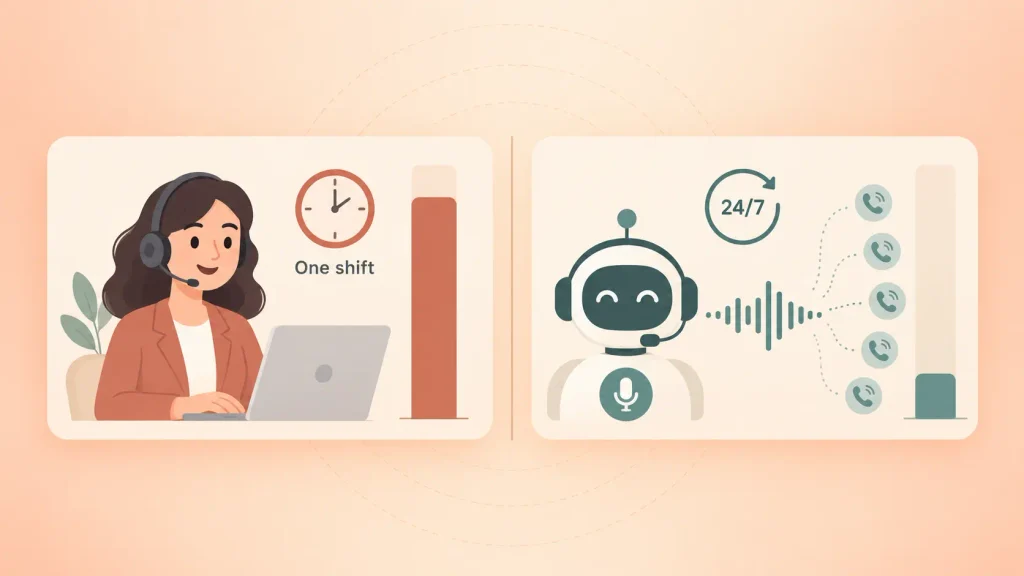
| Factor | Human agent | AI voice agent |
| Monthly cost at similar volume | $3,000 to $4,000 | $400 to $1,200 |
| Hours covered | One shift | 24/7 |
| Calls handled at once | One | Many, up to the plan limit |
| Paid when the phone is quiet | Yes | No |
AI voice systems handling similar volumes typically run at 10% to 30% of human cost, with most moderate-scale deployments landing at $400 to $1,200 a month. Still, people win on emotional, complex, and high-stakes calls, which is why most teams pair the two rather than pick one.
A Year-One Cost Example
Say you run inbound support at 5,000 minutes a month on a hosted platform. At $0.15 per minute all-in, here’s what year one looks like:
- Usage: 5,000 minutes × $0.15 × 12 months = $9,000
- Onboarding: $500 to $2,000, paid once
- Custom integration, if needed: $1,000 to $5,000, paid once
- Phone numbers: about $2 per number each month
- Tuning time: your team’s hours spent reviewing transcripts
That puts year one at roughly $9,500 to $16,000, before tuning time. One median rep costs $42,830 in wages alone and covers about 40 of the week’s 168 hours.
Another way to see it: $20.59, one hour of that rep’s median wage, buys about 137 minutes of AI calls at $0.15 per minute. This is an illustration, not a quote. Your volume, model, and integrations will move every line.
How to Lower Your AI Voice Agent Cost Without Hurting Quality
Most savings come from the same choices that set your per-minute rate. You rarely need to downgrade the agent to cut the bill.
Here’s where I’d look first, roughly in order of impact:
- Match the model to the task. Routine booking and FAQ calls run well on a lightweight model. You can save premium models for complex conversations, or route between the two mid-call.
- Trim your system prompt. Cutting a 2,000-token prompt down to 500 tokens shrinks LLM cost on every single turn.
- Summarize long conversations. Passing a running summary instead of the full history keeps token counts from snowballing on longer calls.
- Test a cheaper voice. A standard voice costs a fraction of a premium one, and many callers won’t hear the difference.
- Bring your own telephony. Some platforms charge nothing for SIP trunking or custom telephony, so your own carrier deal can beat their managed lines.
- Commit once volume is stable. Annual or prepaid deals usually unlock volume-based rates.
- Automate simple, high-volume calls first. Appointment confirmations and order status checks pay back fastest.
That last step matters most. Starting with the easy calls proves your ROI before you spend money on the hard ones.
How Boomdevs Builds Cost-Efficient AI Voice Agents
If a platform alone won’t cover your calls, the next question is who builds the rest, and how to keep the running cost down once it’s live. That second part is where most custom builds go wrong.
Our custom AI voice agent development starts from your call data, not a template. Here’s what that looks like in practice:
- Cost modeled before code: we estimate your all-in per-minute rate for your real volume and stack, so year one holds no surprises.
- Right-sized models and voices: lightweight where calls are simple, premium only where it earns its keep.
- Integrations done properly: our AI integration services connect the agent to your CRM, calendar, or legacy systems.
- Tuning after launch: transcript reviews and fixes during the first months, when they matter most.
With 10+ years and 3.5K+ projects behind us, we’ve learned that the cheapest agent to run is the one scoped properly from the start.
Frequently Asked Questions
How much does an AI voice agent cost per month?
It depends mostly on your minutes. Most moderate-scale deployments land at $400 to $1,200 a month all-in, depending on the model, voice, and platform. A custom system adds a one-time build cost on top of usage.
How much does it cost to build a custom AI voice agent?
A focused agent built around one workflow typically costs $15,000 to $60,000. Systems with many integrations, locations, or compliance needs run $60,000 to $150,000+. Most builds take four to 12 weeks.
Is an AI voice agent cheaper than a human receptionist?
For routine and after-hours calls, usually yes. AI voice systems typically cost 10% to 30% of a human agent at similar volume. People still handle complex or sensitive calls better, so a hybrid setup is common.
What affects AI voice agent cost the most?
The language model and the voice you choose move the per-minute rate the most. After that, call volume, integration depth, and compliance needs decide your total. A premium model can cost several times more than a lightweight one on the same call.
Can I try an AI voice agent for free?
Many platforms offer free credits or trial minutes, such as $10 in starter credits or 50 free minutes in your first month. These are fine for testing call quality, but not for production volume.
Get a Clear Cost Estimate for Your Voice Agent
You now know the per-minute ranges, the build costs, and the hidden lines most budgets miss. The next step is putting your own call volume and systems against those numbers.
Book a free scoping call with Boomdevs and get an all-in estimate for your voice agent, covering build, usage, and upkeep, before you commit to anything.