


- 1. Key Takeaways
- 2. How Much Does AI Product Development Cost in 2026?
- 3. AI Product Development Cost by Product Type
- 4. What Drives the Cost of Building an AI Product
- 5. The Part Nobody Prices: The Product Around the Model
- 6. What It Costs to Run an AI Product After Launch
- 7. Generative AI vs Traditional ML: Which Costs More?
- 8. In-House AI Team vs Development Partner: Cost Comparison
- 9. How to Budget an AI Product in Phases
- 10. Where AI Product Budgets Blow Up
- 11. What to Prepare Before You Ask for a Quote
- 12. How Boomdevs Fixes Unpredictable AI Product Budgets
- 13. Frequently Asked Questions
- 14. Ready to Put a Real Number on Your AI Product?
Summarize with
AI product development cost usually runs from $20,000 to $500,000+, depending on what you build and how far you take it.
The range alone won’t help you plan. Your number comes down to four things:
- Your data
- Your model approach
- Your integrations and
- What the product costs to run once real users arrive.
This guide breaks down each one so you can plan your AI product development cost without guessing.
Key Takeaways
- Most AI MVPs land between $20,000 and $80,000. Enterprise-grade systems start around $200,000.
- Data preparation is the biggest swing factor in AI product development cost. It can eat a large share of your budget before any model work starts.
- The build is only part of the bill. Running costs can overtake it within two years.
- Budget in phases with a clear decision point between each one. That’s how you avoid the classic overrun.
How Much Does AI Product Development Cost in 2026?
An entry-level AI product costs roughly $20,000 to $80,000, according to Nimap’s 2026 pricing guide. A mid-level product with custom-tuned models runs $80,000 to $200,000.
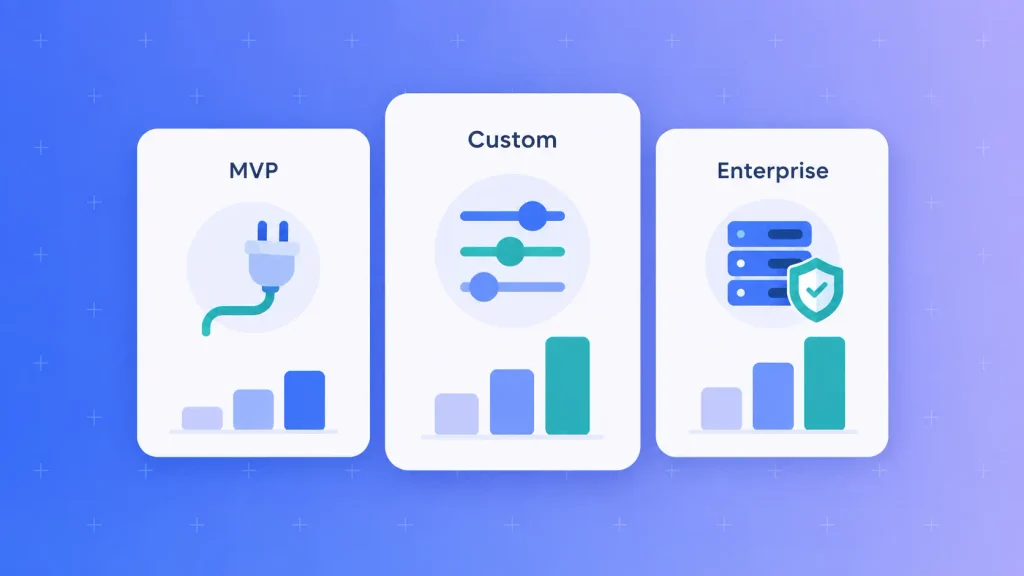
An enterprise-grade system starts at $200,000 and can pass $500,000. Those tiers mirror how most AI product development projects grow: a lean test first, then a tuned product, then a hardened system.
Other estimates stretch the edges. Azilen puts a basic proof of concept at $25,000 to $80,000 and a full enterprise AI platform at $400,000 to more than $1 million.
| Stage | What You Get | Typical Range | Timeline |
| AI MVP or API-based feature | Foundation model via API, basic RAG, lean interface | $20K to $80K | 4 to 12 weeks |
| Custom-tuned AI product | Fine-tuned open-source model on your own data, vector database | $80K to $200K | 3 to 6 months |
| Enterprise-grade AI system | Multi-agent workflows, custom models, strict compliance | $200K to $500K+ | 6 to 12+ months |
The jump between tiers isn’t about adding features. It’s about how much of the AI you own rather than rent.
AI MVP or Feature on a Foundation Model
This is where most startups should begin. You call an existing model through an API, feed it your context, and wrap it in a simple product. Many founders launch this as a SaaS MVP or a mobile MVP, because the AI layer is thin and the real test is whether users come back.
Already running a product? Then this tier is mostly about connecting AI to the systems you already have. Your existing app handles accounts and data, so the AI layer carries less weight.
Custom-Tuned AI Product
Here you move past a thin wrapper. You fine-tune a model on your proprietary data and host it somewhere you control. That gives you accuracy and defensibility, and it costs more to build and maintain.
You’ll want this tier once the MVP proves demand and generic answers stop being good enough.
Enterprise-Grade AI System
At this level, you’re building for reliability at scale. Multiple AI agents coordinating tasks, real-time processing, audit trails, and regulatory review all show up on the invoice.
Few startups need this on day one. If a quote pushes you here before you have users, I’d question it.
AI Product Development Cost by Product Type
What you’re building matters as much as how big it is. Techment’s 2026 enterprise pricing benchmarks show AI chatbots starting around $30,000, while autonomous AI agents can exceed $500,000.
| Product Type | Typical Range | Timeline | Main Cost Driver |
| AI chatbot or virtual assistant | $30K to $80K | 6 to 10 weeks | Conversation design, integrations |
| AI copilot or RAG app | $60K to $180K | 3 to 5 months | Data ingestion, retrieval quality |
| Recommendation engine | $80K to $200K | 4 to 6 months | User behavior data, real-time serving |
| Predictive analytics platform | $75K to $220K | 4 to 7 months | Historical data quality |
| Computer vision system | $120K to $350K+ | 6 to 9 months | Labeled image data, GPU compute |
| Autonomous AI agents | $150K to $500K+ | 6 to 12 months | Orchestration, guardrails, testing |
A customer support chatbot lives or dies on conversation quality and integrations. A computer vision system lives or dies on thousands of labeled images. That’s why the two can sit hundreds of thousands of dollars apart.
Notice the pattern. The more your product depends on data you have to clean or label yourself, the higher it climbs.
What Drives the Cost of Building an AI Product
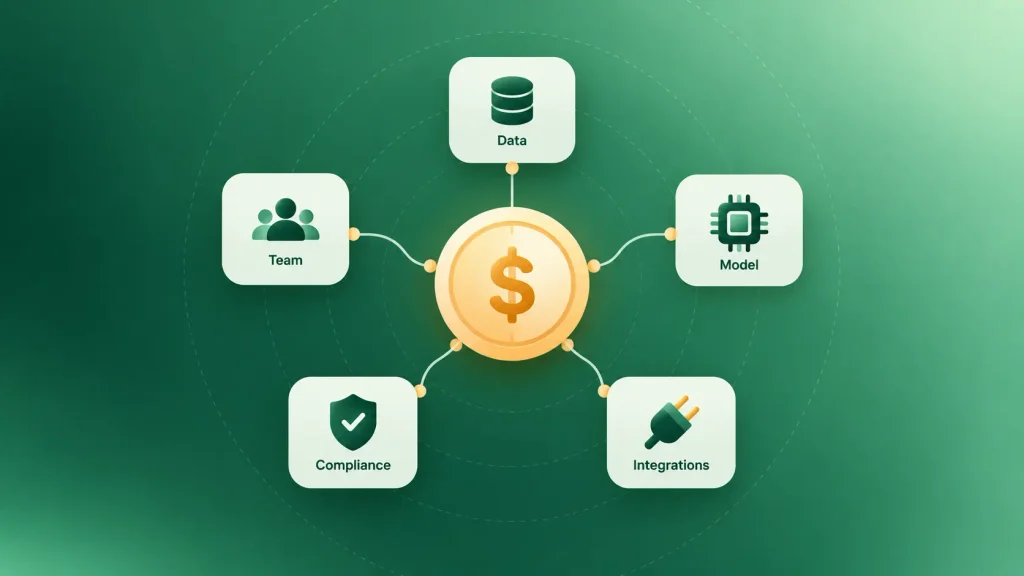
Five factors decide where your AI product development cost lands inside those ranges. Most quotes bundle them together. You’ll get a much sharper estimate if you look at each one separately.
Data Readiness
Data is usually the biggest swing factor, and the one founders underestimate most. Azilen reports that data engineering can consume 20% to 40% of total project cost on first-time AI implementations.
Clean, labeled, well-structured data lowers your bill fast. Data spread across spreadsheets, PDFs, and old databases raises it just as fast. When your records are that scattered, a round of data analytics groundwork often pays for itself before any model is trained.
Model Approach (API, RAG, Fine-Tuning, or Custom)
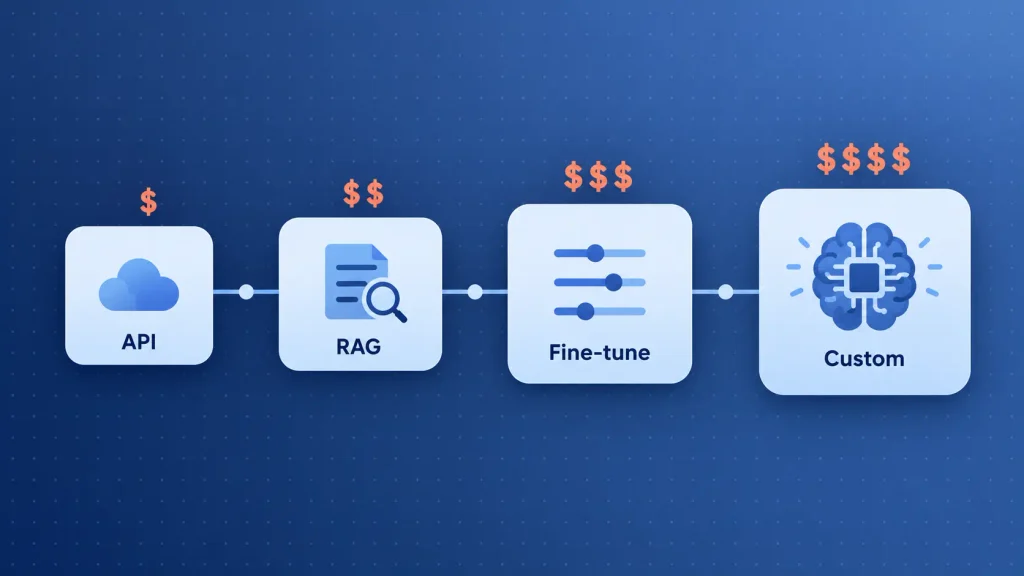
Your model choice sets both your upfront cost and your monthly bill. Building on an existing foundation model is the cheapest start, and it’s how most generative AI products begin.
Azilen’s cost breakdown puts fine-tuning at an extra $20,000 to $80,000. It says a custom model built from scratch can add $200,000 or more and is rarely needed.
| Approach | Upfront Cost | Ongoing Cost | Best For |
| Foundation model via API | Low | Per-token fees that grow with usage | MVPs, chatbots, content tools |
| RAG on your own data | Medium | Vector database hosting plus tokens | Knowledge assistants, internal search |
| Fine-tuned model | Adds $20K to $80K | Hosting and periodic retraining | Domain-specific accuracy |
| Custom model from scratch | Adds $200K+ | Dedicated ML operations | Proprietary IP only |
Open-weight models have also closed most of the quality gap. The Stanford AI Index found the gap between top closed models and leading open models shrank from 8.0% to 1.7% between January 2024 and February 2025. That gives you a cheaper path to owning your model if you need one.
Integrations With Your Existing Systems
An AI product that can’t read your CRM or write back to your database is a demo, not a product. Solid AI integration work closes that gap. It’s also where timelines quietly slip.
Complex enterprise integrations can add $40,000 to $150,000 to a project. Old APIs with thin documentation push you toward the top of that range.
Sometimes the cheaper move is modernizing the legacy application first, so the AI has something stable to plug into.
Compliance and Security
If you work in healthcare, fintech, or legal, expect a compliance line item. You’ll need audit trails, data residency controls, and security reviews. Azilen suggests budgeting an extra 20% to 40% for compliance-heavy environments.
This isn’t optional in regulated industries. Skipping it early usually means an expensive rebuild later.
Team Location and Hourly Rates
Who builds your product changes your AI product development cost as much as what they build. SecondTalent’s September 2026 rate benchmark shows mid-level AI developer rates varying by more than half across regions.
| Region | Hourly Rate (Mid-Level AI Developer) |
| United States | $119 to $185 |
| United Kingdom | $74 to $115 |
| Poland | $70 to $109 |
| Latin America | $62 to $96 |
| Southeast Asia | $53 to $81 |
| India | $28 to $72 |
A lower rate only saves you money if the team ships production-ready work. A cheap build you have to rewrite is the most expensive option on this list.
The Part Nobody Prices: The Product Around the Model
Most AI cost guides price only the AI layer. Some say so outright. CMARIX notes that its infrastructure cost ranges exclude developer rates, UI/UX, QA, and project management.
That leaves a big gap in your real AI product development cost, because users never touch your model directly. They touch the product around it. Here’s what that product layer usually includes:
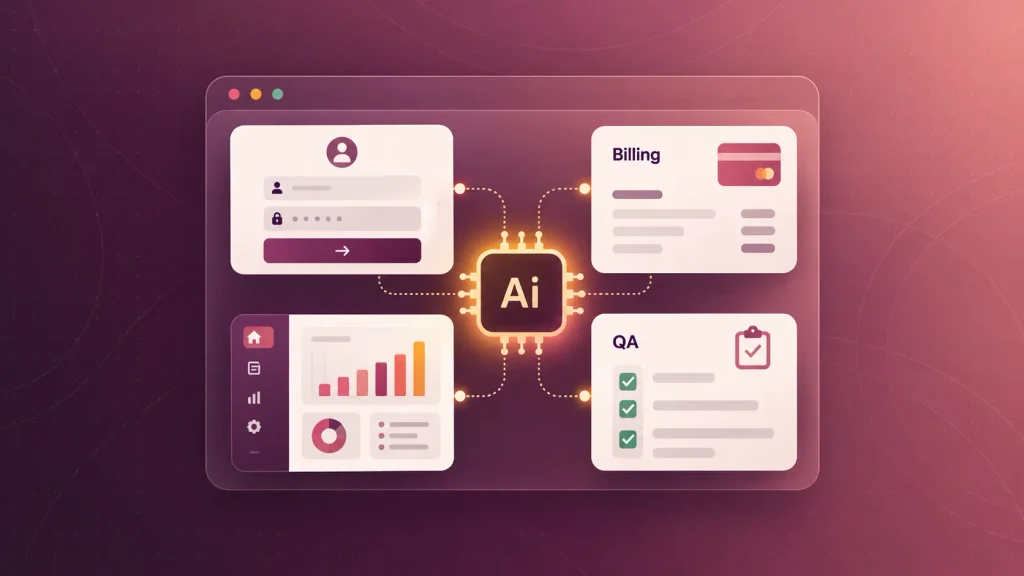
- Interface and UX design: the screens, flows, and states that make AI output understandable and trustworthy. This is often where teams bring in dedicated UI/UX designers rather than stretching developers thin.
- Accounts and permissions: sign-up, login, roles, and team access.
- Billing and usage metering: plans, payments, and limits that track how much AI each customer consumes.
- Admin dashboard: tools for your team to manage users, content, and settings.
- Guardrails and human review: ways to catch bad outputs before customers see them.
- QA and evaluation: testing that checks both the code and the quality of AI responses.
None of this is exotic. It’s the same work that goes into any custom web application, and it takes real hours. When you compare quotes, ask each team to split the AI work from the product work. You’ll quickly see who priced the whole thing.
What It Costs to Run an AI Product After Launch
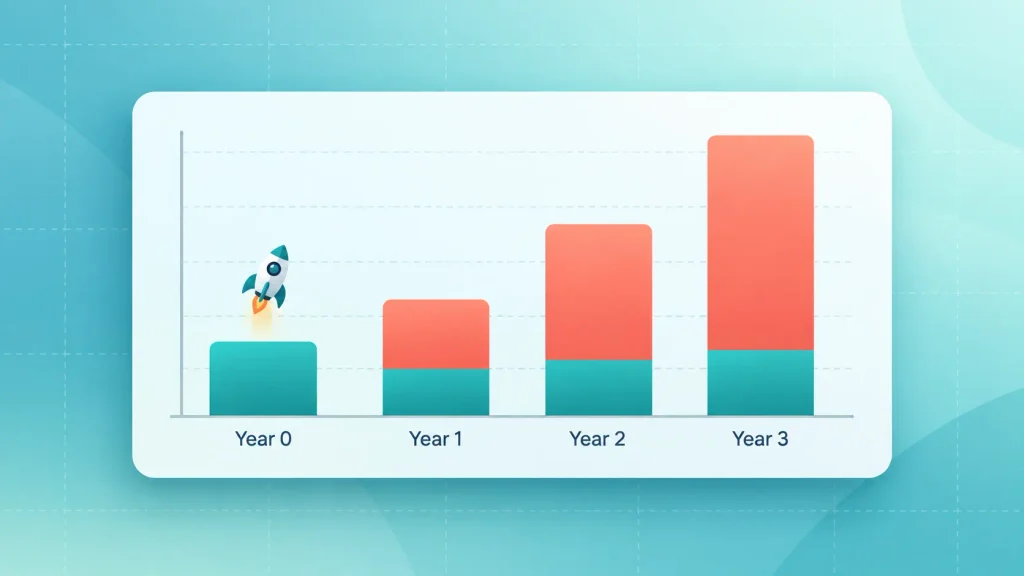
Launch day isn’t the finish line for your budget. It’s where a second budget starts, which is why post-launch planning matters as much as the build itself. In many cases, the ongoing cost of running AI exceeds the original build cost within 18 to 24 months.
Inference and API Spend
Every question a user asks your product adds to your AI inference cost. That’s inference, and it scales with usage.
The good news is that prices have collapsed. Stanford’s 2025 AI Index estimates the cost of GPT-3.5-level performance fell from $20 per million tokens in November 2022 to $0.07 by October 2024. That’s a drop of more than 280 times.
The catch is that products now make far more calls per user. At enterprise scale, inference for LLM-based applications can still reach $5,000 to $50,000 per month.
Monitoring, Retraining, and Maintenance
AI models drift. Your users change, your data changes, and accuracy slips quietly unless someone is watching. That means monitoring tools, retraining cycles, and engineering time every year. It’s the AI version of software maintenance and support, and it belongs in your budget from day one.
On top of that sits the cloud infrastructure that keeps everything running.
Azilen’s total cost of ownership estimate shows how a mid-complexity system’s costs spread over three years:
| Period | What You’re Paying For | Estimated Cost |
| Year 0 | Build and deployment | $150K to $350K |
| Year 1 | Infrastructure, operations, improvements | $80K to $200K |
| Year 2 | Infrastructure, retraining, improvements | $70K to $180K |
| Year 3 | Infrastructure, retraining, major update | $90K to $250K |
| 3-year total | Build plus three years of running costs | $390K to $980K |
If your budget ends at launch, you’ve planned for less than half of your real AI product development cost.
Check Your Unit Economics Before You Scale
Traditional software gets cheaper per user as you grow. AI doesn’t, because every active user adds inference cost. That’s the core difference between AI SaaS and classic subscription software: margins shrink as usage grows unless your pricing keeps pace.
Bessemer’s State of AI 2025 report found that efficient, fast-growing AI startups run around 60% gross margins. The most explosive ones often sit near 25%. Both are well below what classic SaaS investors are used to.
So before you set prices, work out what one active user costs you per month in AI calls. Then make sure your plan price covers it with room to spare. Teams that bake this into AI SaaS development from the start avoid repricing loyal customers later.
Generative AI vs Traditional ML: Which Costs More?
It depends on which bill you look at. Generative AI is often cheaper to start, because you build on models that already exist. It gets more expensive to run, because every response burns tokens.
Traditional machine learning flips that. CMARIX estimates that generative AI products need two to three times the infrastructure investment of comparable traditional ML products.
| Cost Dimension | Traditional ML | Generative AI |
| Upfront build | Higher data engineering effort | Lower, builds on existing models |
| Cost per query | Low and predictable | Higher, token-based |
| Vector database | Rarely needed | Common for RAG |
| Monitoring | Accuracy and latency | Also hallucinations, toxicity, drift |
| Year 1 infrastructure (mid-scale) | $80K to $200K | $200K to $500K+ |
Pick the approach that fits the job, not the one that sounds newer. Forecasting and fraud detection rarely need a language model. Classic machine learning development handles them at a far lower running cost.
In-House AI Team vs Development Partner: Cost Comparison
Hiring your own team gives you ownership. It also gives you a long runway before anything ships. AI Makers estimates that recruiting a senior AI engineer takes three to six months and costs $150,000 to $250,000 a year.
| Factor | In-House Team | Development Partner |
| Time to start | Months of hiring | Weeks |
| Cost structure | Fixed salaries and benefits | Variable, tied to scope |
| Skill coverage | Limited to who you hire | Data, ML, design, and engineering together |
| Long-term ownership | Built in | Needs a planned handover |
| Best when | AI is your core IP, and you have runway | You need to validate fast |
Many founders land on a hybrid. A partner builds the first version, then a small internal team takes it over. Others keep product ownership in-house and fill the gaps through software developer staff augmentation, paying for the skills they lack instead of a whole department.
If you go the partner route, judge them on how they scope, not how they pitch. The same signals that help you pick the right AI consultancy apply to any build partner.
How to Budget an AI Product in Phases
The safest way to budget your AI product development cost is to stop thinking of it as one number. Fund one phase at a time, and only move forward when that phase answers its question.
That staged logic is what keeps a solid AI product development process on budget: each stage has to earn the next one.
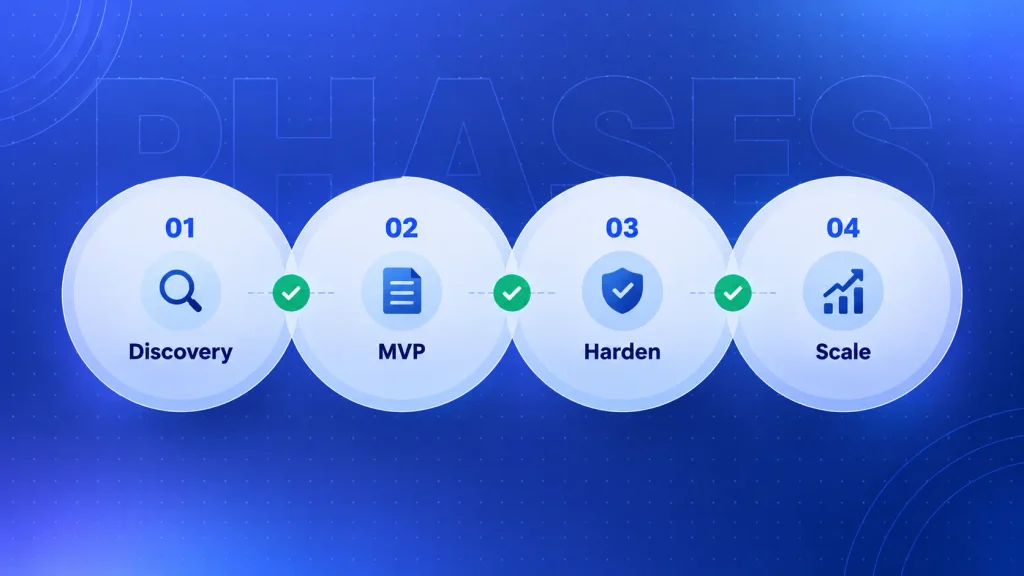
- Discovery and scoping. You define the problem, audit your data, and pick a model approach. The question is whether this can work with the data you have. A short AI consulting engagement fits here, and AI consulting costs are small next to a build that misses.
- MVP. You build the smallest version real users can try. The question is whether they come back.
- Production hardening. You add monitoring, security, error handling, and scale. The question is whether it holds up under real load.
- Scale and optimize. You tune models, cut inference costs, and add features users ask for. The question is whether each dollar of AI spend earns more than it costs.
Each phase gives you a clean exit. If phase one says your data isn’t ready, you’ve lost weeks instead of your whole budget.
Want a phase-by-phase estimate for your idea? Book a free scoping call with Boomdevs and get a clear number for each stage.
Where AI Product Budgets Blow Up
AI product development cost AI product development cost overruns rarely come from one big mistake. They come from a handful of predictable ones.
Gartner predicted in 2024 that at least 30% of generative AI projects would be abandoned after proof of concept by the end of 2025. It cited poor data quality, weak risk controls, rising costs, and unclear business value.
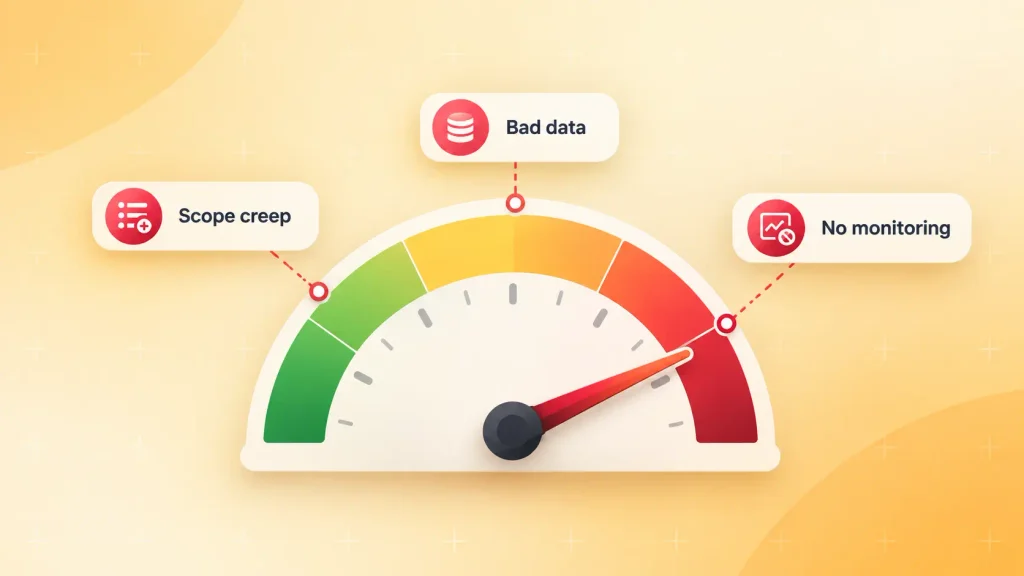
- Treating the prototype as the product. Demo code isn’t built for real users. Azilen reports that teams can spend 60% to 80% of their production budget rewriting proof-of-concept code instead of extending it.
- Letting scope creep in. Generative AI is flexible, so every “small addition” feels cheap. Scope creep sits near the top of the generative AI challenges teams run into, and overruns of 60% to 150% are common without hard scope gates.
- Skipping monitoring on the first build. Accuracy drops, nobody notices, and the fix becomes an emergency. A retroactive MLOps build can cost $40,000 to $100,000, more than doing it right the first time.
- Using a premium model for everything. The model you prototype with isn’t always the one you should pay for at volume. Routing simple tasks to smaller models can cut your monthly bill a lot.
- Starting before the data is ready. Dirty data doesn’t just slow the project. It can quietly cap how good the product can ever get.
Most of these trace back to the same root cause, which is moving forward before the last phase answered its question.
What to Prepare Before You Ask for a Quote
The more you bring to the first conversation, the tighter your estimate gets. Vague inputs get padded quotes. You’ll get a far more useful number if you have these ready:
- The problem and success metric: what the AI should do, for whom, and how you’ll know it works.
- Your data inventory: what exists, where it lives, what format it’s in, and whether it’s labeled.
- Your integration list: every system the product needs to read from or write to.
- Your accuracy bar: how good the output must be, and what a wrong answer costs you.
- Expected usage: rough users and requests per month, so inference can be modeled.
- Deployment constraints: cloud provider, data residency, and compliance rules.
Even rough answers help. “About 500 users in year one” beats “not sure” every time.
How Boomdevs Fixes Unpredictable AI Product Budgets
Most surprises in AI product development cost come from pricing the model and forgetting everything else. We scope the other parts upfront: the product layer, the data work, and the running costs.
Here’s what that looks like in practice:
- Phased scoping: you get a separate estimate for discovery, MVP, and production, so you only commit to what you’ve validated.
- Split quotes: AI work and product work are priced separately, so nothing hides inside a single number.
- Inference modeling: your expected usage is costed before a model is picked, not after the first bill.
With 3.5K+ projects delivered and recognition as a Clutch Champion, our team has seen where AI product builds break. We plan around those points from day one.
Frequently Asked Questions
How Much Does an AI MVP Cost?
A typical AI MVP cost is $20,000 to $80,000 when you build on an existing foundation model. It usually takes four to 12 weeks. Costs rise if your data needs heavy cleaning or the product must connect to several systems.
How Long Does It Take to Build an AI Product?
A simple AI feature or MVP can ship in four to 12 weeks. A custom-tuned product usually takes three to six months. Enterprise systems with strict compliance often need six to 12 months or more.
Is It Cheaper to Use an LLM API or Build My Own Model?
An API is almost always cheaper to start with. Your costs grow with usage, though, so high-volume products sometimes switch to fine-tuned or self-hosted models later. Building a model from scratch is rarely worth it unless the model itself is your core IP.
How Much Does an AI Product Cost to Maintain Each Month?
Post-launch costs often land between $3,000 and $15,000 a month for a typical system. That covers cloud infrastructure, inference, monitoring, and updates. High-traffic products can spend much more on inference alone.
Can You Build an AI Product for Under $50K?
Yes, if you keep the scope tight. A focused MVP on a foundation model, with one core workflow and light integrations, can fit under $50,000. The trick is to validate demand first and add complexity only after users prove they want it.
Ready to Put a Real Number on Your AI Product?
An AI product development cost range is a starting point, not a plan. Your data, your users, and your integrations decide the final figure, and a short scoping session can pin it down.
Get a scoped estimate for your AI product and see exactly what each phase will cost before you commit.