


- 1. Key Takeaways
- 2. RAG vs Fine-Tuning: The Head-to-Head Comparison
- 3. What Is RAG and How Does It Work?
- 4. What Is Fine-Tuning and What Does It Change?
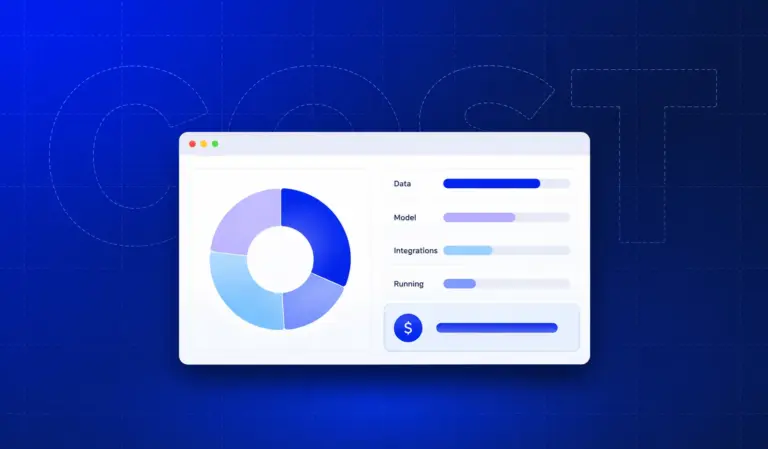
- 5. RAG vs Fine-Tuning Cost: Where Your Budget Actually Goes
- 6. Should You Try Prompt Engineering First?
- 7. Can You Combine RAG and Fine-Tuning?
- 8. How to Choose Between RAG and Fine-Tuning for Your Business
- 9. How Boomdevs Helps You Pick and Build the Right Approach
- 10. Frequently Asked Questions
Summarize with
You’re adding AI to your product, and your team can’t agree on the approach. Half want RAG, and the other half want to fine-tune a model on your data. Both camps have a fair point.
The honest answer to RAG vs fine-tuning depends on your situation, not on which technique sounds smarter. It comes down to what your model gets wrong today: facts or behavior. Here’s how to tell which problem you have before you spend on either.
Key Takeaways
- RAG changes what the model can read. It pulls your documents into the prompt at answer time, so it fixes missing, stale, or private facts.
- Fine-tuning changes how the model behaves. It retrains the model on your examples, so it fixes format, tone, and task skill.
- In RAG vs fine-tuning, pick by the failure, not the trend. Wrong facts point to RAG. Right facts in the wrong shape point to fine-tuning.
- Try a stronger prompt first. Many “we need fine-tuning” problems disappear with better instructions and examples.
- Combine them only when you’ve measured both gaps. A hybrid means two systems to build, test, and maintain.
RAG vs Fine-Tuning: The Head-to-Head Comparison
Retrieval-augmented generation (RAG) gives a model the right facts at the moment it answers. Fine-tuning teaches a model new habits before it ever sees a question. One works on the model’s input. The other works on the model itself.
That single difference drives every RAG vs fine-tuning trade-off below:
| Criteria | RAG | Fine-Tuning |
| What changes | The context the model reads | The model’s weights |
| What it fixes | Missing, stale, or private facts | Format, tone, task skill |
| Keeping it current | Re-index changed documents | Retrain and re-test |
| Cost profile | Low upfront, paid on every request | High upfront, leaner per request |
| Runtime speed | Extra retrieval step | No retrieval hop |
| Citations | Can show its sources | Can’t point to a source |
| Main failure | Pulls the wrong text | Overfits or forgets |
In any RAG vs fine-tuning comparison, the first two rows matter most. If your knowledge changes faster than you could retrain, only the RAG column keeps up. If the problem lives in how the model writes or works, only the fine-tuning column touches it.
Knowledge Gap or Behavior Gap? The Question That Decides It
Before you fund either side of RAG vs fine-tuning, find out what’s actually failing. You can do that by collecting real questions your users ask, running them through a base model with your best prompt, and reading every wrong answer.
You’ll usually see one of four patterns:
- Wrong or missing facts: the model invents your refund policy or quotes last quarter’s pricing. That’s a knowledge gap, and RAG is the fix.
- Right facts, wrong shape: the answer is correct but ignores your format, tone, or steps. That’s a behavior gap, and fine-tuning is the fix.
- Both at once: the model gets facts wrong and also breaks your output format. That’s the case for a hybrid.
- Neither, really: answers are close, just inconsistent. A tighter prompt is probably all you need.
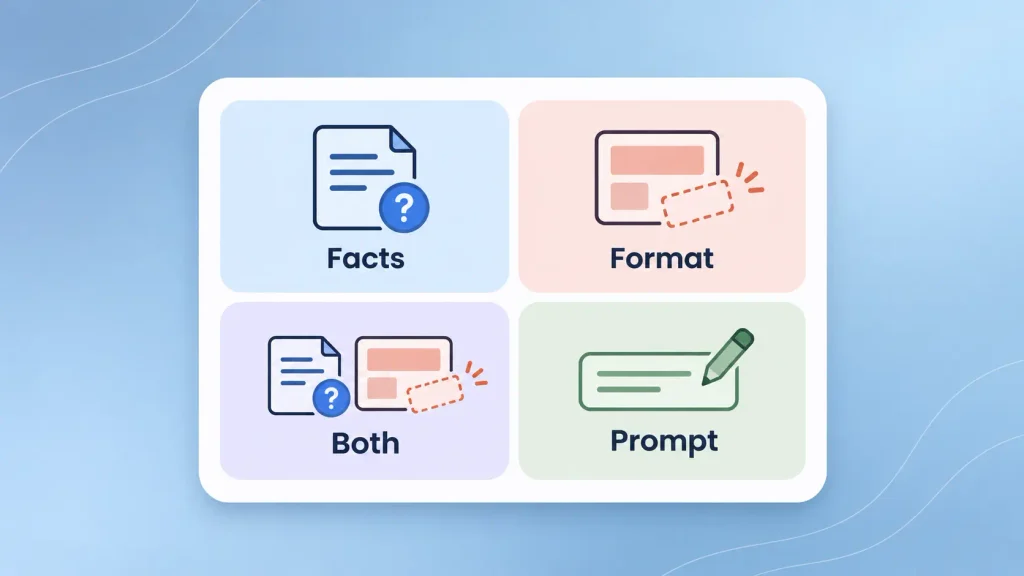
This test is quick to run, and it’s the clearest signal for when to use RAG vs fine tuning. It also gives you a baseline, so you can prove later that whatever you built actually helped.
What Is RAG and How Does It Work?
RAG is an open-book exam for a large language model. Instead of answering from memory, the model looks up the relevant pages first, then writes its answer from what it found. If the underlying tech is new to you, start with what generative AI is and how it works.
Under the hood, the pipeline runs in four steps:
- Split: your documents get broken into small chunks, such as a paragraph or a help article section.
- Embed and store: an embedding model turns each chunk into a vector, and a vector database indexes them.
- Retrieve: when a user asks something, the question gets converted the same way, and the closest chunks come back.
- Generate: those chunks go into the prompt, and the model answers from them.
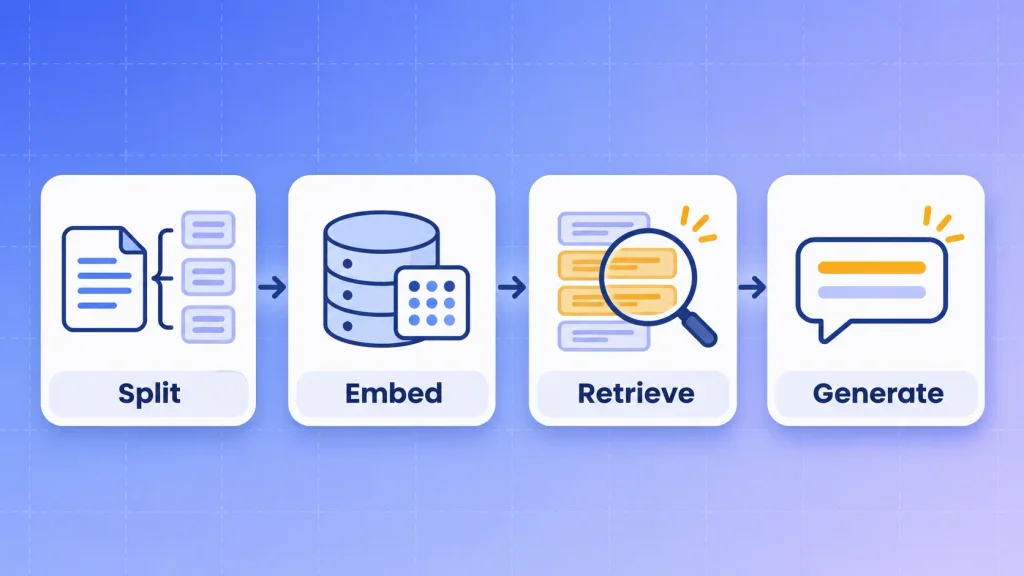
The model itself never changes. Update a document, re-index it, and the next answer reflects the change.
Where RAG Shines
RAG earns its place whenever the truth lives in your documents, not in the model’s training data. In most RAG vs fine-tuning decisions for business AI features, it’s the natural starting point.
It’s especially strong in these situations:
- Information that changes often: pricing, policies, product docs, inventory, and support articles.
- Answers that must show sources: RAG knows which chunks it used, so you can display citations and audit answers later.
- Private data with permissions: your data stays in a store you control, and you can filter what each user is allowed to retrieve.
- Large document collections: thousands of pages are fine, because the model only reads the few chunks that matter for each question.
Support assistants are the classic case. If you’re planning one, custom AI chatbot development almost always starts with a retrieval layer over your help center.
Where RAG Breaks
RAG isn’t a hallucination cure. It narrows what the model should say, but it can’t force the model to say it.
Most bad RAG answers trace back to one of these:
- Retrieval misses: chunking splits the answer in half, or the embedding model doesn’t connect your internal jargon to the user’s wording. The model can’t recover from text it never received.
- Lost in the middle: stuffing in extra chunks “just in case” can backfire. A Stanford-led study on long contexts found models used information best when it sat at the start or end of the context, and noticeably worse when it sat in the middle.
- Ignored context: retrieval works, but the model answers from its own memory anyway, or skips your citation format.
- Ongoing upkeep: someone has to refresh embeddings, fix stale documents, and monitor retrieval quality every month.
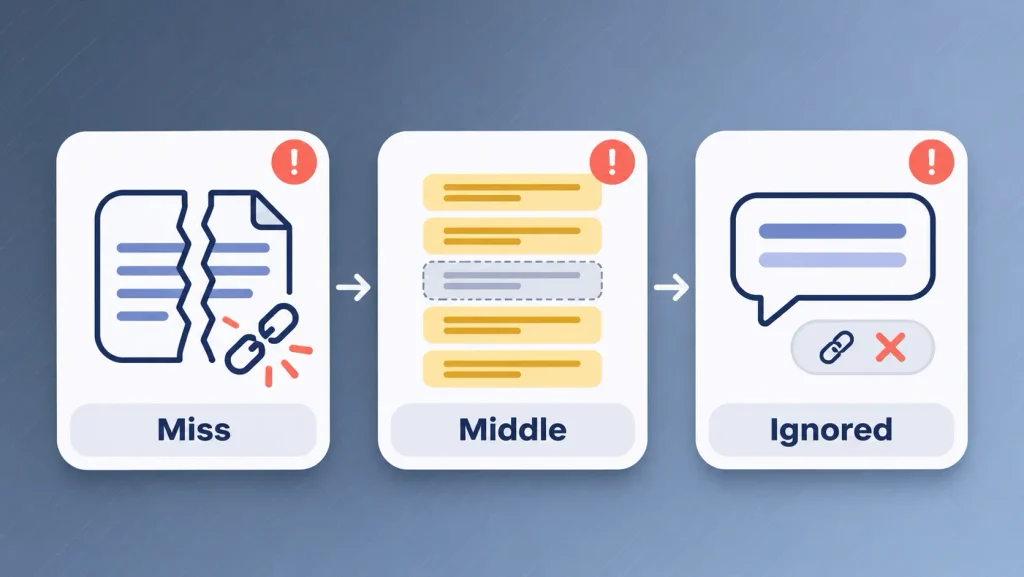
Notice that the third failure is a behavior problem inside a knowledge system. That’s exactly where RAG vs fine-tuning stops being an either-or choice, which we’ll get to. For a wider view of these traps, see the generative AI challenges teams hit most often.
What Is Fine-Tuning and What Does It Change?
Fine-tuning is extra training on your own examples. You show a pretrained model a curated set of input and output pairs, and its weights shift until it imitates those outputs on its own.
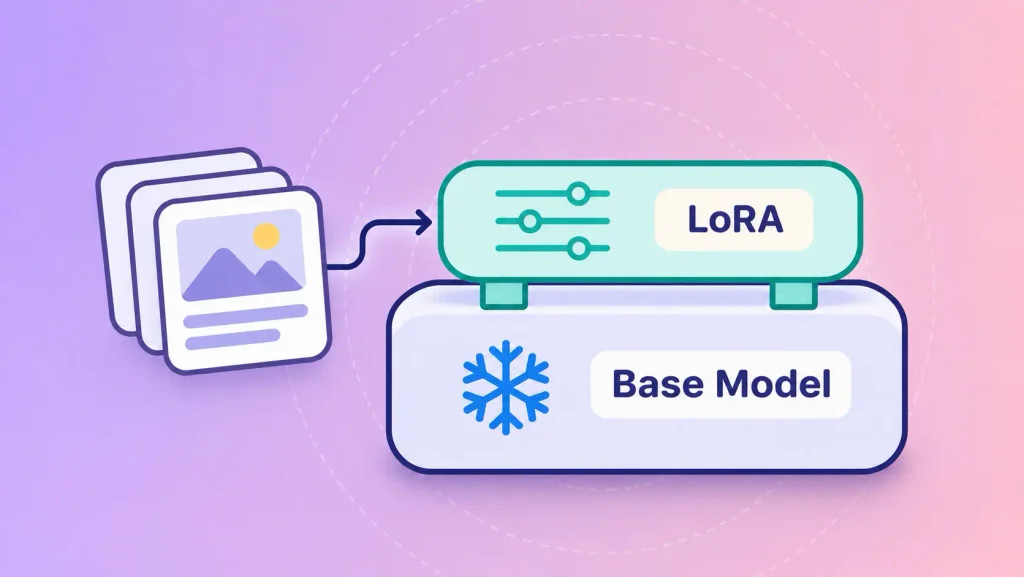
You rarely retrain the whole model anymore. Methods like LoRA (low-rank adaptation) train a small adapter on top of a frozen base model, which cuts compute cost sharply. Still, you’re now maintaining a custom model, with its own versions, tests, and release cycle.
Where Fine-Tuning Earns Its Cost
Fine-tuning pays off when the problem is a pattern, not a fact. Patterns are learned better from many examples than from a long list of instructions.
It’s worth the investment in cases like these:
- Strict output format: the model must return the same structure every time, such as JSON for your system or a fixed report layout.
- House tone and style: a three-page style guide in the prompt still drifts after a few turns, while a tuned model holds the voice.
- Narrow, repeated tasks: classifying tickets, extracting fields, or routing requests against your own labels.
- Cost and speed at high volume: a small tuned model with a one-line prompt can replace a large model carrying a long prompt.
- Unwanted habits: over-refusals, padded answers, or reflexive disclaimers you can’t prompt away.
Look at what’s missing from that list: new facts. That’s deliberate.
Why Fine-Tuning Is a Poor Way to Teach Facts
Many teams fine-tune to “teach the model our business.” Research on fine-tuning vs retrieval augmented generation says that’s usually the wrong tool for the job.
A 2023 Microsoft study comparing RAG with fine-tuning found RAG consistently beat unsupervised fine-tuning on knowledge-heavy tasks. That held for facts the model had seen before and for entirely new ones. A 2024 study on fine-tuning with new knowledge went further. Models learned unfamiliar facts slowly, and as they absorbed them, their tendency to hallucinate rose.
The practical problems agree with the research. A fine-tuned model can’t cite where an answer came from. It goes stale the day your data changes. Each retraining round also risks catastrophic forgetting, where skills the model already had start to slip.
RAG vs Fine-Tuning Cost: Where Your Budget Actually Goes
RAG costs little to start and charges you on every request. Fine-tuning costs a lot to start and gets cheaper per request. Who wins on RAG vs fine-tuning cost depends almost entirely on your volume and how often your data changes.
Here’s where the money goes on each side:
| Cost Line | RAG | Fine-Tuning |
| Upfront build | Pipeline, embeddings, vector database | Dataset curation, labeling, training runs |
| Every request | Longer prompts plus a retrieval call | Shorter prompts, maybe a smaller model |
| Staying current | Re-index changed documents | Retrain, re-evaluate, redeploy |
| Hidden cost | Chunking and retrieval tuning | Re-tuning when the base model changes |
| Pays off when | Data changes, volume is moderate | Task is stable, volume is high |
The RAG vs fine-tuning cost pattern is simple. Low volume and changing data favor RAG. A stable task running at heavy volume can justify fine-tuning, because the per-request savings eventually repay the training bill.
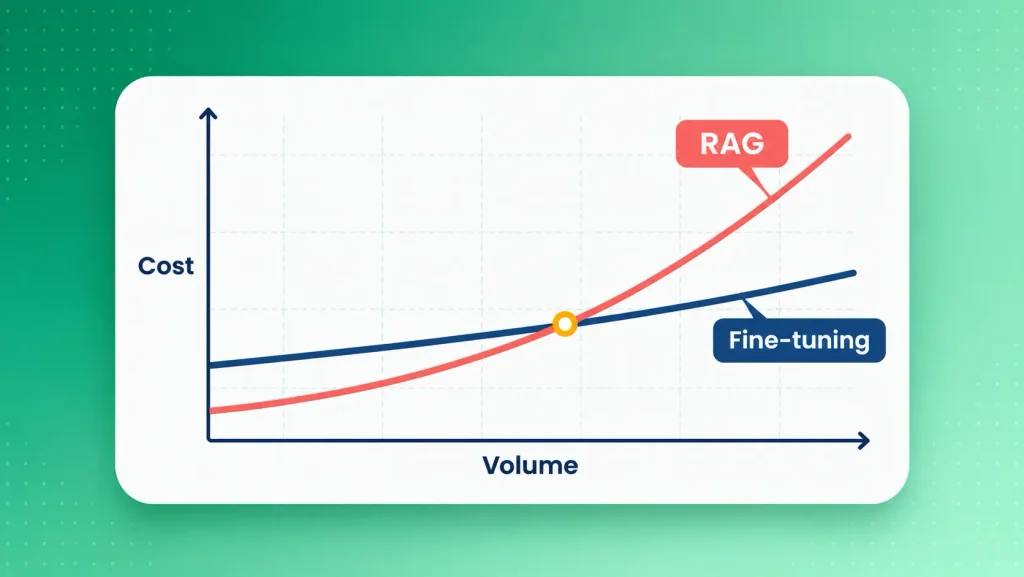
Training compute is rarely the biggest line, either. Building and labeling a clean dataset usually takes more time and money than the GPU hours. If you’re budgeting a full feature, our AI product development cost breakdown covers the rest of the project around the model.
The Cost Nobody Budgets For: Base Models Change Every Few Months
A fine-tuned model is closer to a subscription than a purchase. When a better base model ships, your tuned version doesn’t upgrade itself. You retrain, re-test, and redeploy, or you fall behind.
The latest data shows how hard that is to keep up with. According to Menlo Ventures’ 2026 State of Enterprise AI report, only 10% of AI builders post-train their own models, up from 6% in 2025. Among those who do, 91% rely on outside partners.
Menlo names two blockers. Specialized models need constant updates to keep pace with a frontier that moves every few months. And most teams lack the expertise to train them well.
That’s worth weighing before you commit. If you’re unsure whether to staff this internally, our comparison of in-house vs outsourced AI development breaks down the trade-offs. RAG has upkeep too, but swapping the base model under a RAG system is usually a configuration change, not a training project.
Should You Try Prompt Engineering First?
Yes, almost always, even before you weigh RAG vs fine-tuning. Prompting is the cheapest experiment you can run, a change takes minutes to test, and a bad prompt is fully reversible.
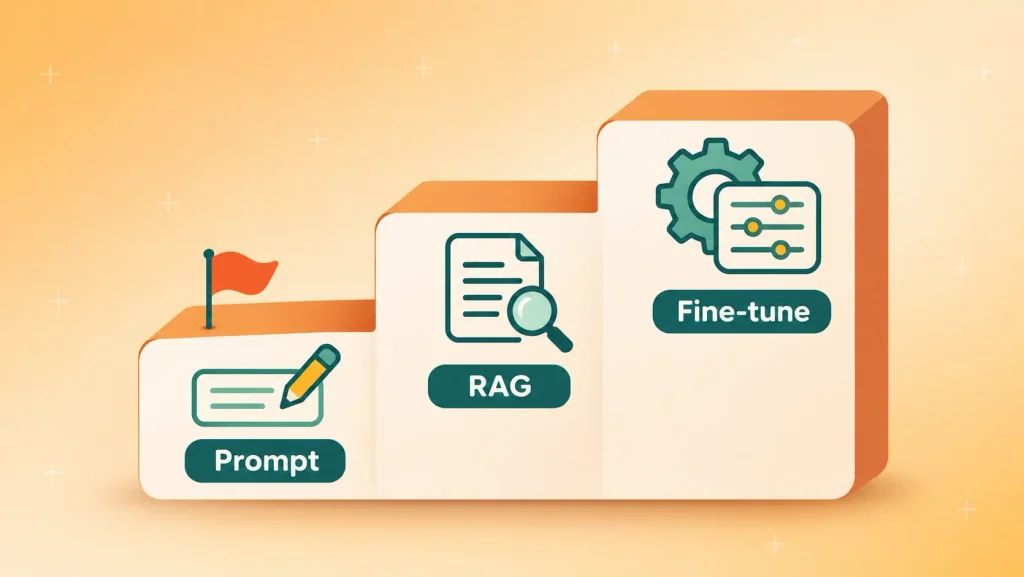
I’d suggest climbing this ladder in order and stopping at the first rung that works:
- Improve the prompt: add clear instructions, a few worked examples, and structured output settings if the model supports them.
- Add retrieval: if answers still miss facts, connect the model to your documents with RAG.
- Fine-tune: if the model still breaks format or tone, or a long prompt costs too much at your volume, train on examples.
Long context windows add a shortcut to the first rung. If your knowledge is a small, stable set of documents, you can sometimes paste it straight into the prompt and skip a retrieval pipeline. That stops scaling once the documents grow or change daily.
The same build-only-what-you-need logic applies when you’re weighing an off-the-shelf builder against a custom chatbot. Start simple, measure, then add complexity only where the numbers demand it.
Can You Combine RAG and Fine-Tuning?
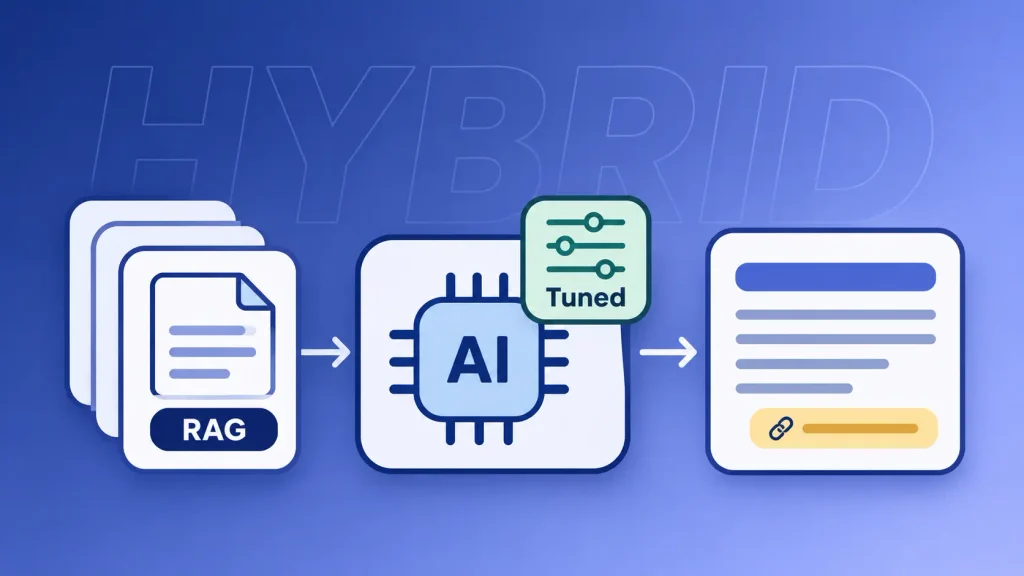
Yes, and mature AI products often do. In those products, RAG vs fine-tuning isn’t a contest: RAG supplies the facts, and fine-tuning shapes how the model uses them. Each half does only the job it’s good at.
Most hybrids follow one of three patterns:
- Train the model to read retrieved text: you fine-tune on questions paired with retrieved documents, including irrelevant ones, so the model learns to use the right passage and ignore the noise. This is the RAFT method from UC Berkeley researchers, which improved domain-specific RAG results on medical, multi-hop, and API-documentation datasets.
- Tune the retriever instead: when your jargon confuses off-the-shelf embeddings, fine-tuning the embedding model or adding a reranker often lifts answer quality for less effort than touching the main model.
- Tune the output on top of retrieval: facts stay in the index, while fine-tuning locks in your citation style, format, and tone.
A legal assistant is a good example. Fine-tuning teaches it your firm’s drafting style. RAG feeds it the current case file and the latest regulations.
When a Hybrid Is Overkill
A hybrid means two pipelines, two evaluation setups, and two places a regression can hide. When answers get worse, you have to work out whether retrieval or the tuned model caused it.
So I’d start with one technique. Add the second only when real questions show a gap you’ve measured, not one you expect to have.
How to Choose Between RAG and Fine-Tuning for Your Business
Choose RAG when your answers depend on facts that change or must be cited. Choose fine-tuning when the model knows enough but behaves wrong at scale. Most business AI features land on RAG first.
Six Questions to Ask Before You Commit Budget
Run through these RAG vs fine-tuning questions with your team before anyone writes code:
- Does the answer depend on changing or private data? If yes, you need RAG, whatever else you add.
- Must answers point to a source? If auditors, customers, or regulators will ask “where did this come from,” RAG is the only option that can show them.
- Is the failure about format, tone, or procedure? Those are behavior gaps, and retrieval won’t move them.
- Do you have clean, labeled examples? Fine-tuning without a quality dataset just teaches the model your mistakes.
- What volume and response time do you need? Heavy, latency-sensitive traffic favors a small tuned model. Light traffic favors prompting.
- Who maintains it next year? Someone owns the index, someone owns the training pipeline, and every base-model upgrade lands on somebody’s desk.
If you’re scoping this inside a larger build, an experienced AI product development team can run this assessment with you and turn the answers into an architecture.
Common Scenarios and the Right Pick
Here’s when to use RAG vs fine tuning in the scenarios teams hit most:
| Scenario | Start With | Why |
| Support bot over a changing help center | RAG | Facts change, answers need sources |
| Internal policy or HR assistant | RAG | Permissions enforced at retrieval |
| Contracts or clinical notes in a house format | Fine-tuning plus RAG | Format is behavior, case facts are knowledge |
| High-volume ticket classification | Fine-tuned small model | Fixed labels, cost driven by volume |
| AI feature that reads each customer’s data | RAG | Data differs per customer and per day |
| Low-volume internal tool | Prompting only | Tuning savings never pay back |
The fifth row is the one most SaaS teams face. If you’re bolting AI onto a product with existing users, our guide to adding AI features to an existing SaaS walks through the rollout side.
What This Means for AI Agents in 2026
Agents make the RAG vs fine-tuning question bigger, not smaller. An agent that books, files, or resolves things needs fresh context at every step, and retrieval is how it gets that context.
The shift is already visible. In Menlo’s latest enterprise AI survey, 74% of builders now use agents to run workflows. Adoption of search infrastructure for agents jumped from 5% to 30% in a year.
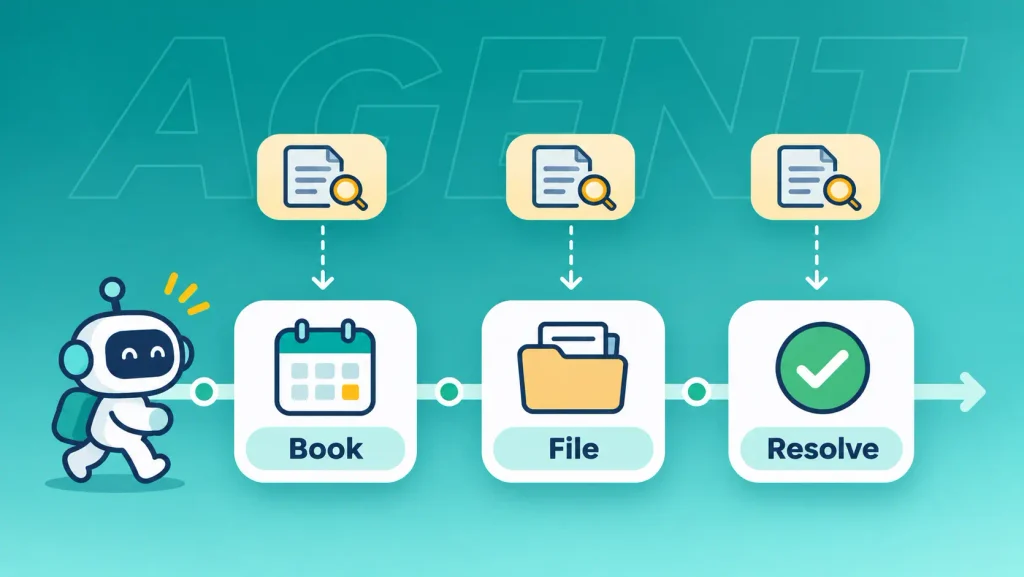
If you’re planning AI agent development, treat retrieval as core architecture, not an add-on. Fine-tuning still has a role, usually for reliable tool calling and output formats. For a primer on the distinction, see how agentic AI differs from generative AI.
How Boomdevs Helps You Pick and Build the Right Approach
The expensive mistake isn’t picking the wrong side of RAG vs fine-tuning. It’s choosing before you know which gap you have. So every engagement starts with the diagnosis, not the architecture.
Here’s how the work typically runs:
- Diagnose: we run your real user questions against a strong baseline and sort the failures into knowledge and behavior gaps.
- Prototype the cheapest fix: a better prompt, then retrieval, measured against that baseline.
- Fine-tune only on evidence: if a behavior gap survives, we build the dataset and train against it.
- Plan the upkeep: index refreshes, evaluation, and base-model upgrades get an owner before launch.
With 3.5K+ projects delivered over 10+ years, Boomdevs has seen what each path costs once it’s live. If you’re weighing this decision now, our generative AI development services cover the full path from diagnosis to production. Book a free architecture review, and you’ll leave knowing which approach fits your product.
Frequently Asked Questions
Is RAG Better Than Fine-Tuning?
Neither wins RAG vs fine-tuning in general, because they fix different problems. RAG is better for knowledge that changes or must be cited. Fine-tuning is better for consistent format, tone, and narrow tasks at high volume.
Which Is Cheaper, RAG or Fine-Tuning?
On RAG vs fine-tuning cost, RAG is cheaper to start, but it adds cost to every request through longer prompts and retrieval. Fine-tuning costs more upfront for data and training, then runs leaner per request. At low volume or with fast-changing data, RAG usually wins on total cost.
Does Fine-Tuning Reduce Hallucinations?
It can reduce format and task errors. Training on facts the model doesn’t already know can actually increase hallucinations, according to 2024 research on fine-tuning with new knowledge. In fine-tuning vs retrieval augmented generation, grounding answers with retrieval is the more direct fix.
Is Fine-Tuning Still Worth It in 2026?
Yes, for behavior, speed, and cost at scale, where a small tuned model can replace a large one with a long prompt. The catch is upkeep: base models improve every few months, and each upgrade means retraining. Most teams that fine-tune now use outside partners for that reason.
Can a Startup Build RAG Without an ML Team?
Usually, yes. A RAG system is mostly software and data engineering: document pipelines, a vector database, and prompt design. Fine-tuning is where specialized ML and MLOps skills become hard to avoid.
Can RAG and Fine Tuning Be Used Together?
Yes. RAG keeps your facts current and citable, while fine-tuning handles format, tone, and how the model reads retrieved text. Start with one, and add the second only when you’ve measured a gap it would close.