


- 1. Key Takeaway
- 2. 1. Simple Reflex Agents
- 3. 2. Model-Based Reflex Agents
- 4. 3. Goal-Based Agents
- 5. 4. Utility-Based Agents
- 6. 5. Learning Agents
- 7. 6. Multi-Agent Systems
- 8. 7. Hierarchical Agents
- 9. Types of AI Agents Compared at a Glance
- 10. Where LLM-Powered Agents Fit in This List
- 11. Types of AI Agents by Business Function
- 12. How to Choose the Right Type of AI Agent
- 13. How Boomdevs Solves the Wrong-Agent Problem
- 14. Frequently Asked Questions
Summarize with
Every pitch you’ve sat through this quarter promised an AI agent. One turned out to be a chatbot with a new label. Another quietly needed six months of your training data.
Below are the seven types of AI agents you’ll run into. Five come from the classic Russell and Norvig taxonomy, and two are multi-agent setups now in production. Match your use case to one, and you’ll know what you’re paying for.
Key Takeaway
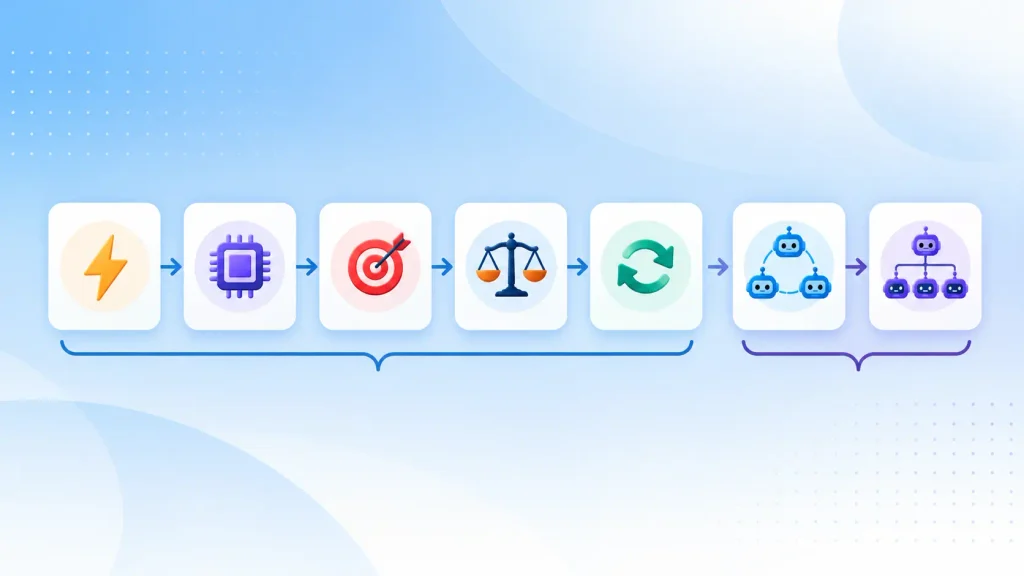
- Seven types matter: simple reflex, model-based reflex, goal-based, utility-based, learning, multi-agent systems, and hierarchical agents.
- The first five AI agent types differ in how much they remember, plan, and learn. The last two describe how several agents work as a team.
- Most agents you’d ship in 2026 are hybrids: a language model that plans, wrapped in hard rules that keep it safe.
- Start with the simplest type that does the job. Gartner expects over 40% of agentic AI projects to be canceled by the end of 2027, mostly over cost and unclear value.
1. Simple Reflex Agents
A simple reflex agent sees one input and fires one rule. If the ticket subject contains “refund,” it goes to billing. No memory, no planning, no second thought.
IBM calls these condition-action rules, and its go-to example is a thermostat. That sounds trivial. But of all the types of AI agents, this is the one most often sold to you as “AI automation.”
Here’s where this type earns its keep:
- Best for: ticket routing, threshold alerts, keyword-based spam filtering, and simple FAQ replies.
- Why you’d pick it: it’s cheap, fast, and completely predictable, so it’s easy to audit.
- Where it breaks: anything ambiguous. It can’t remember the last message, so it repeats the same mistake forever.
If your inputs always look the same, don’t let anyone talk you into something smarter. Predictable beats clever here.
2. Model-Based Reflex Agents
Picture a customer who writes “it’s still broken” in their third message. A simple reflex agent has no idea what “it” means. A model-based reflex agent does, because it keeps an internal picture of what happened earlier.
That internal state lets it work in what AI researchers call a partially observable environment. It still decides with rules. It just applies them to a fuller view of the situation.
You’ll see this type in a few common places:
- Inventory agents that track stock already in transit, not just what’s on the shelf.
- Support agents that carry context across a conversation instead of treating each message as new.
- Monitoring tools that compare today’s reading against the last week before raising an alarm.
The catch is maintenance. If the internal model drifts from reality, the agent makes confident decisions on stale assumptions. That can be worse than no memory at all.
3. Goal-Based Agents
Give a goal-based agent a destination, and it works out the route. Instead of reacting, it compares possible next steps and picks the one that moves it closer to the target.
A scheduling assistant is a good example. You ask for a 30-minute slot with four people across three time zones. The agent searches the options, rules out conflicts, and books the best fit.
Here’s what to know before you build one:
- Best for: scheduling, route planning, multi-step task execution, and resource allocation.
- Strength: it adapts its plan when something changes, like a missed turn or a declined invite.
- Weakness: planning gets expensive as options multiply. And it only works if you can state the goal clearly.
That last point trips up a lot of business projects. “Improve customer satisfaction” isn’t a goal an agent can plan toward. “Resolve password resets without a human” is.
4. Utility-Based Agents
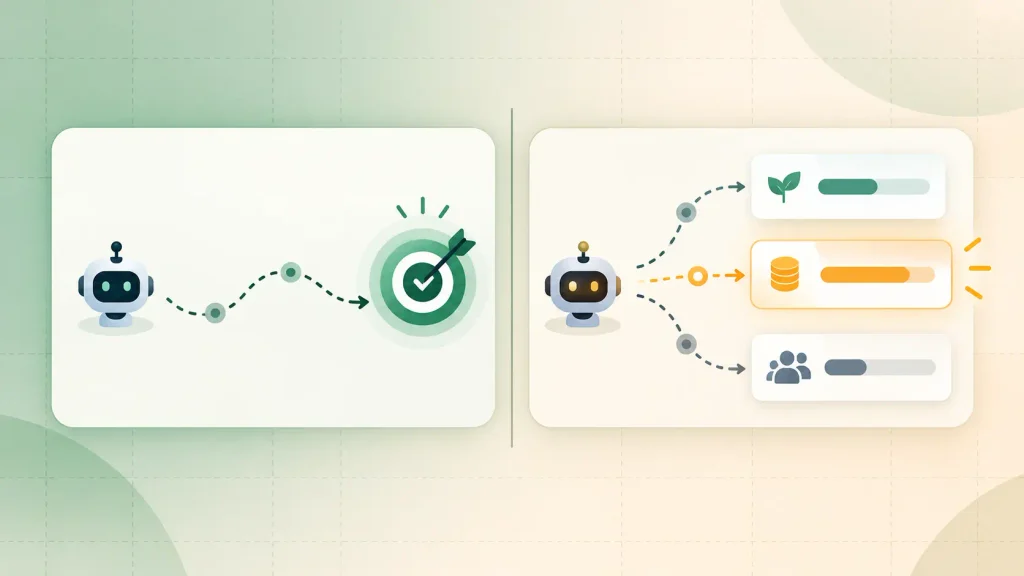
A goal-based agent asks “did I get there?” A utility-based agent asks “how good was the way I got there?” It scores each possible outcome with a utility function and picks the highest one.
IBM’s example is an e-commerce agent setting prices from sales history, customer preferences, and inventory levels. There’s no single right price. There’s a best trade-off between margin, volume, and stock on hand.
You’ll want a utility-based agent when:
- Several goals compete, such as speed against cost, or conversion against margin.
- Uncertainty is normal, so the agent has to weigh likely outcomes instead of guaranteed ones.
- “Good enough” leaves money on the table, as in pricing, bidding, or ad spend.
The hard part isn’t the code. It’s writing down what “better” means in numbers your team agrees on. Get the scoring wrong, and the agent chases the wrong number with total confidence.
5. Learning Agents
Learning agents get better with experience. Fraud detection is the classic case: fraud patterns shift every few months, so a fixed rule set falls behind fast.
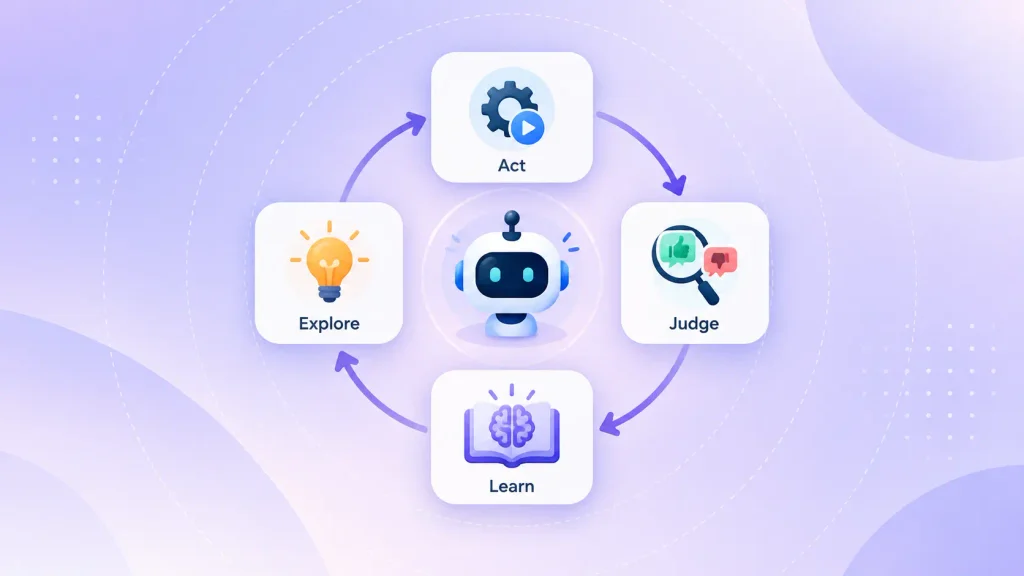
According to IBM, a learning agent has four working parts:
- Performance element: chooses what to do, based on what it knows now.
- Critic: judges how well that action went, often as a reward or a penalty. That’s the core idea behind reinforcement learning.
- Learning element: uses the critic’s feedback to update the agent’s knowledge.
- Problem generator: suggests new things to try, so the agent doesn’t get stuck on old habits.
This flexibility comes with real costs. You need lots of quality data, ongoing monitoring, and a plan for when the agent learns something you didn’t intend. That’s why ethics and guardrails in AI agent design matter most for learning agents.
6. Multi-Agent Systems
Multi-agent systems split one big job across several specialized agents. Each one handles the part it’s best at, and they share information to reach a common result.
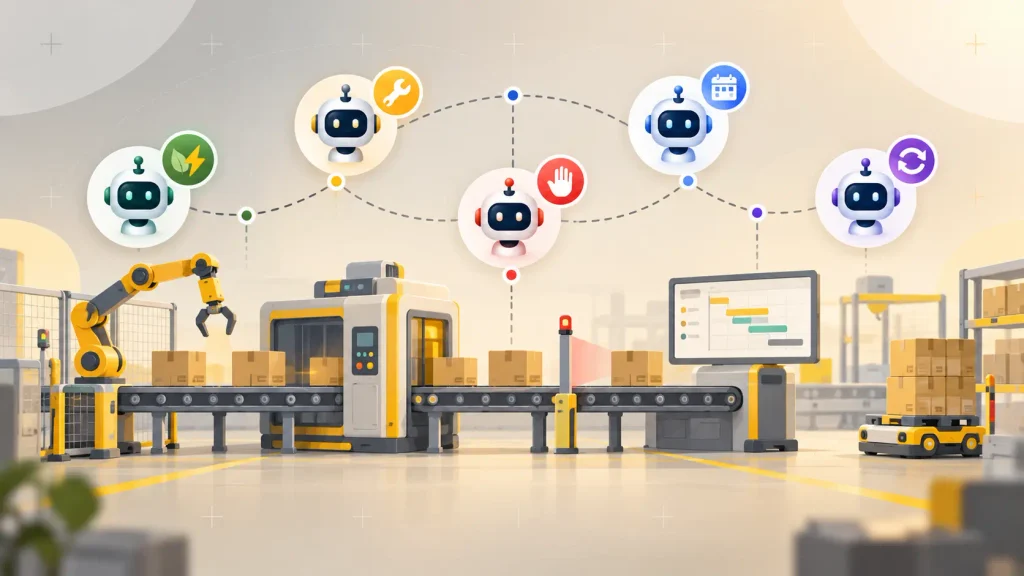
IBM notes that all five types above can run inside one system. Its smart-factory example shows how that looks:
- Reflex agents shut down a conveyor belt the moment a safety sensor trips.
- Model-based agents track machine states and flag maintenance before a breakdown.
- Goal-based agents plan production schedules.
- Utility-based agents balance energy use, cost, and speed.
- Learning agents improve the whole operation over time.
Agents in these systems can cooperate, compete, or do both. The trade-off with multi-agent systems is debugging. When something goes wrong, you’re tracing a conversation between agents, not a single decision.
7. Hierarchical Agents
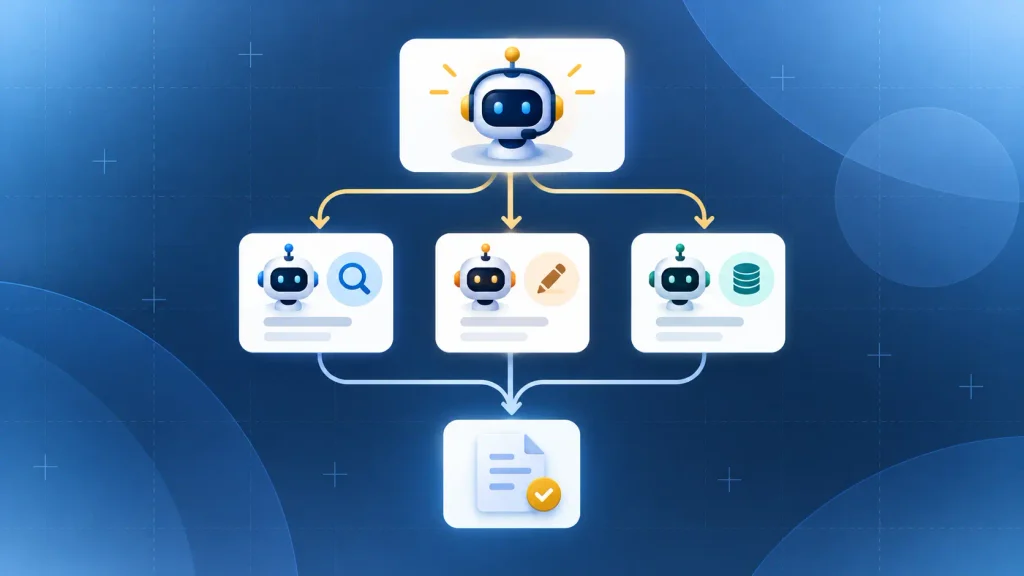
Hierarchical agents work like a small company. A manager agent owns the big goal, breaks it into tasks, and hands each task to a worker agent below it.
In LLM-based products, this shows up as what Anthropic calls the orchestrator-workers pattern. A central model splits the task, delegates the pieces to worker models, and then combines their results.
This structure fits well when:
- The subtasks aren’t known in advance, as in research reports or changes that touch many files of code.
- Different steps need different skills or tools, like search, writing, and data lookup.
- You want one point of control over a process that’s too big for a single agent.
The risk is cost and error buildup. Every extra layer adds model calls, and a bad instruction at the top spreads to every worker underneath.
Types of AI Agents Compared at a Glance
If you only remember one thing, remember this: each of these AI agent types adds one capability to the one before it. Here’s the side-by-side view:
| Type | How It Decides | Best For | Build Effort |
| Simple reflex | Fixed if-then rules | Routing, alerts | Low |
| Model-based reflex | Rules plus memory of past state | Context-aware support, inventory | Low to medium |
| Goal-based | Plans steps toward one goal | Scheduling, task execution | Medium |
| Utility-based | Scores trade-offs between outcomes | Pricing, prioritization | Medium to high |
| Learning | Improves from feedback | Fraud, recommendations | High |
| Multi-agent system | Specialists sharing work | Operations across departments | High |
| Hierarchical | Manager delegates to workers | Complex, unpredictable tasks | High |
Build effort climbs fast after the first two rows. That’s the main reason to start simple and move down the table only when the simpler type fails.
Where LLM-Powered Agents Fit in This List
Today’s agents mostly run on large language models, and the classic taxonomy predates them. That classic list of AI agent types is still useful. You just have to look at what the LLM is doing inside your system.
Workflows vs Agents
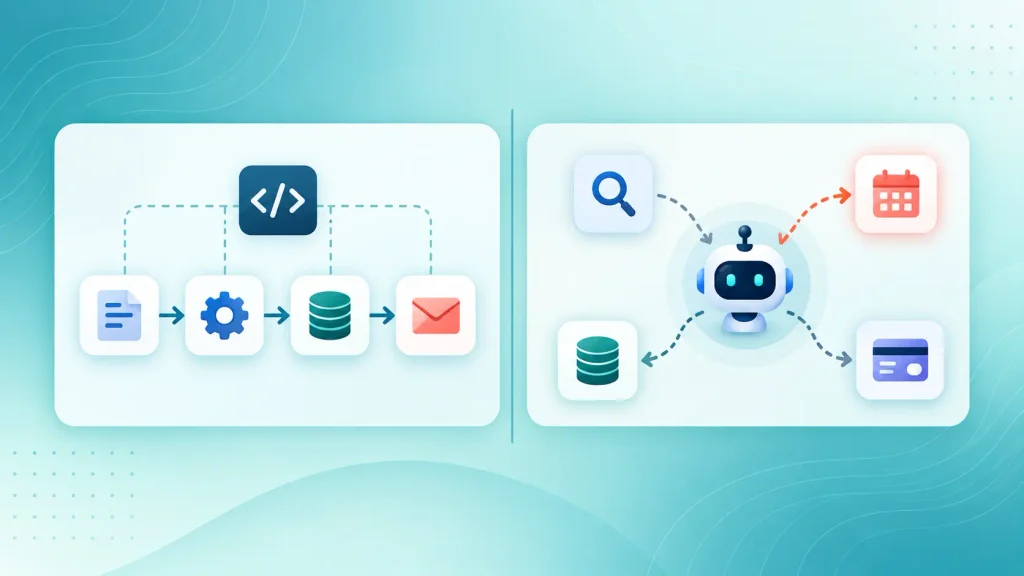
Anthropic draws a clear line here. In a workflow, your code decides the steps and the LLM fills them in. In an agent, the LLM decides its own next step and which tools to use.
That distinction matters more than any label on a sales deck:
- A workflow (often sold as an agentic workflow) behaves much like a goal-based or reflex agent with an LLM inside. It’s predictable, cheaper, and easier to test.
- A true agent is closer to a goal-based planner with memory. It’s flexible, but slower, pricier, and harder to debug.
- A plain chat assistant like ChatGPT, used on its own, just answers prompts. Connect it to tools and let it act in a loop, and it starts behaving like an agent.
One more detail most guides skip: a deployed LLM agent usually doesn’t update its own model as it works. The “learning element” tends to live outside it, in your team’s evaluations, prompt changes, and fine-tuning.
Plan for that work when you budget. If you’re comparing frameworks for building either type, this roundup of AI agent development tools is a useful starting point.
Why Production Agents Are Usually Hybrids
Real products rarely fit one row of the table. Take a support agent that handles refunds. Under the hood, it often stacks four types:
- Reflex rules block refunds above a set amount and route those to a human.
- Model-based memory keeps the order history and earlier messages in view.
- Goal-based planning uses tool calling to pick the right system: order lookup, policy check, payment system.
- A learning loop reviews resolved and escalated tickets, so your team can tune prompts and rules every few weeks.
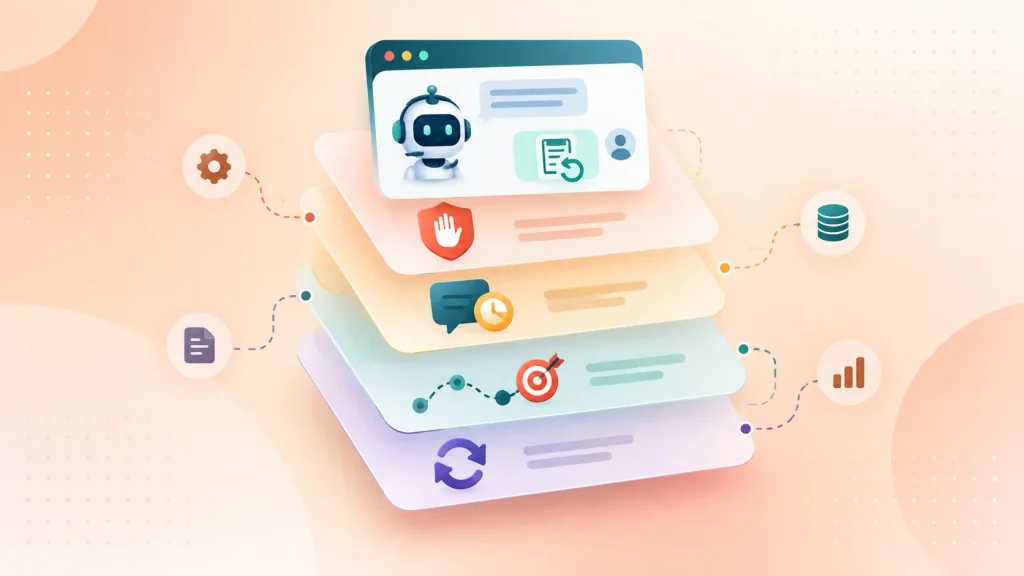
So when someone asks “which type of AI agent is this?”, the honest answer is often “a few, layered.” The useful question is which layer does what.
Types of AI Agents by Business Function
You’ll also hear agents described by the job they do, not how they think. Gartner predicts that 40% of enterprise apps will include task-specific AI agents by the end of 2026, up from less than 5% in 2025. Those agents mostly fall into a handful of roles:
| Function | What It Does | Type Underneath |
| Customer support | Answers, resolves, escalates | Model-based plus goal-based |
| Sales and SDR | Researches leads, drafts outreach | Goal-based, often hierarchical |
| Voice | Handles calls and bookings | Model-based plus goal-based |
| Coding | Writes, tests, and fixes code | Goal-based, often orchestrator-workers |
| Operations and finance | Reconciles, flags, prices | Utility-based or learning |
Customer-facing agents are where most teams start. If that’s you, it’s worth reading up on the real use cases for AI voice agents and the trade-offs between a custom AI chatbot and a chatbot builder before you commit.
When you’re ready to build, Boomdevs covers both AI voice agent development and custom AI chatbot development.
How to Choose the Right Type of AI Agent
Among all the types of AI agents, the right one is the simplest that reliably does the job. Anything more adds cost, latency, and new ways to fail.
Start With the Simplest Type That Works
Anthropic’s own guidance says to find the simplest solution first and add complexity only when you need it. For many tasks, that means a well-built workflow, not an autonomous agent.
Sometimes it means no agent at all. A clean AI integration into the tools you already use can solve the problem for a fraction of the cost.
Questions to Ask Before You Build
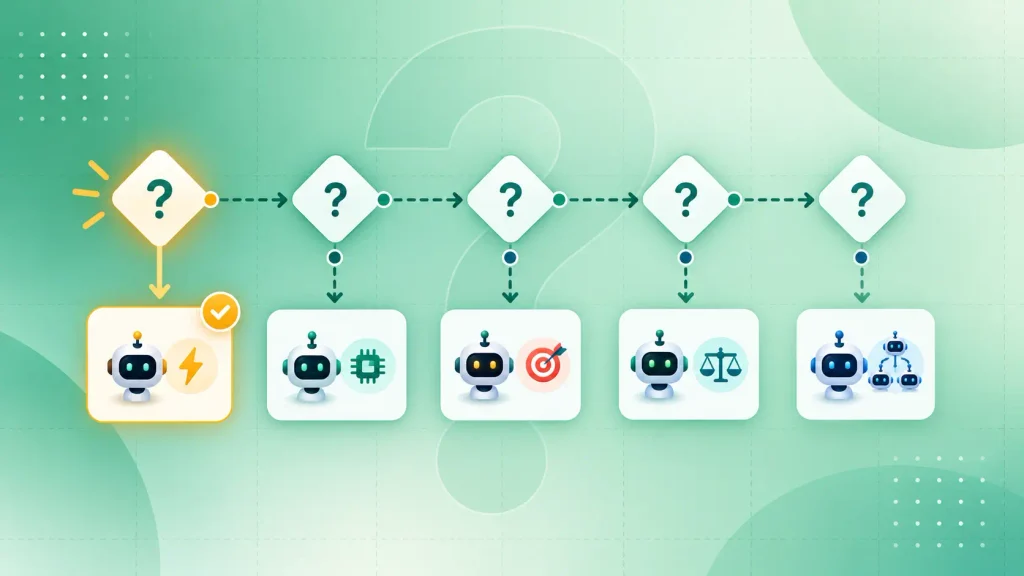
You can work through these in order. The first “yes” usually points to your type:
- Can you write every step down in advance? A simple reflex agent or a fixed workflow is probably enough.
- Does the agent need context it can’t see in the current input? You’re looking at a model-based agent.
- Is there one clear goal, or several competing ones? One goal points to goal-based. Competing goals point to utility-based.
- Will the conditions keep shifting? Budget for a learning loop.
- Is the job too big or too varied for one agent? Consider a multi-agent or hierarchical setup.
Once you’ve picked a type, this guide on how to build your first AI agent walks through the next steps.
Watch for Agent Washing
Not everything sold as an agent is one. Gartner has a name for rebranding chatbots, assistants, and RPA tools as agents without real agentic ability: “agent washing.”
Its numbers are blunt. Gartner predicts over 40% of agentic AI projects will be canceled by the end of 2027, due to rising costs, unclear business value, or weak risk controls. It also estimates that only about 130 of the thousands of agentic AI companies offer the real thing.
If a provider can’t tell you which type of agent they’re building, and why that type fits your problem, treat it as a red flag.
How Boomdevs Solves the Wrong-Agent Problem
Most failed agent projects pick the type last. Boomdevs flips that order: you define the problem, then choose the simplest agent type that can solve it reliably.
Here’s how that plays out in a typical engagement:
- Scope first: you map the task, the data it needs, and where a human must stay in the loop.
- Type second: the team recommends a workflow, a single agent, or a multi-agent setup, and explains the trade-offs in plain terms.
- Guardrails built in: reflex-style limits, logging, and evaluations ship with the first version, not as an afterthought.
After 10+ years and 3.5K+ projects, the pattern is consistent: the simpler build usually reaches production sooner.
If you’re weighing whether to build this in-house, it’s worth reading about in-house vs outsourced AI development first. When you’re ready to scope your own agent, Boomdevs’ AI agent development team can help you pick the right type before you spend on the wrong one.
Frequently Asked Questions
How Many Types of AI Agents Are There?
The classic taxonomy, used by IBM and drawn from Russell and Norvig, lists five types of intelligent agents: simple reflex, model-based reflex, goal-based, utility-based, and learning agents. Most current guides add multi-agent systems and hierarchical agents, which describe how several agents work together. That makes seven types worth knowing.
Is ChatGPT an AI Agent?
On its own, ChatGPT is a chat assistant that responds to your prompts. It starts acting like an agent when it can use tools and decide its own next steps in a loop, such as browsing, running code, or completing tasks. The classic five-type taxonomy doesn’t map neatly onto LLM products, so it’s more useful to ask what the system is allowed to do.
What Is the Difference Between Goal-Based and Utility-Based Agents?
A goal-based agent picks actions that reach a defined target. A utility-based agent scores several possible outcomes and picks the best one, which matters when goals compete, like speed against cost. Use goal-based when success is yes or no, and utility-based when success is a matter of degree.
What Type of AI Agent Is Most Common in Business?
Most business agents today are hybrids built on a language model. They combine goal-based planning with model-based memory, and wrap both in reflex-style rules for safety. Customer support, sales, voice, and coding agents all tend to follow this pattern.
Can Different Types of AI Agents Work Together?
Yes. A multi-agent system can run all five classic types side by side, each handling the part of the job it suits best. IBM’s smart-factory example uses reflex agents for safety stops, goal-based agents for scheduling, and learning agents to improve operations over time.