


- 1. Average AI Consulting Rates by Firm Tier in 2026
- 2. What AI Projects Actually Cost by Scope
- AI Readiness Assessments and Strategy ($5,000-$30,000)
- Proof of Concept and Pilots ($15,000-$75,000)
- Mid-Range Custom AI Builds ($50,000-$200,000)
- AI Consulting Services for Small Businesses ($2,000-$50,000)
- Fractional Chief AI Officer Retainers ($5,000-$30,000/month)
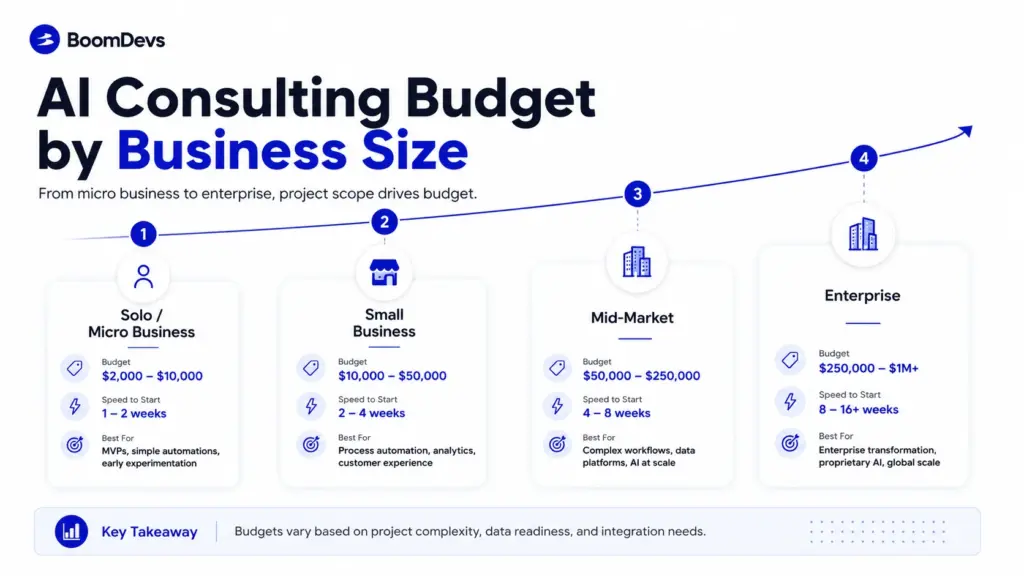
- By Business Size
- By Industry
- By Geography
- 3. A Simple AI Consulting Budget Calculator
- 4. The Real Reason AI Consulting Rates Have Not Dropped in 2026
- 5. Four Hidden Costs Most AI Consulting Quotes Leave Out
- 6. How AI Consulting Pricing Models Work in 2026
- 7. A Note on Methodology
- 8. How Boomdevs Fixes the AI Consulting Pricing Problem
- 9. How to Calculate the ROI of Your AI Investment
- 10. Frequently Asked Questions
- 11. Conclusion and Next Steps
Summarize with
Get three quotes for the same AI project, and you might see $15,000 from one firm and $180,000 from another. Both numbers can be legitimate.
AI consulting cost in 2026 depends almost entirely on who you hire and what counts as “done.” Independent AI consulting services run $100 to $350 an hour. Big Four and top strategy firms bill $400 to $1,200 or more. Most standalone projects land between $20,000 and $200,000, and full enterprise builds can cross $500,000.
This guide breaks down what actually drives that spread: rates by firm tier, real project costs by scope, the hidden line items most quotes leave out, and why AI has made consultants faster without making them cheaper.
AI consulting costs $100–$1,200+ per hour depending on firm tier, and $5,000–$500,000+ per project depending on scope. Small businesses typically spend $10,000–$50,000; mid-market custom builds run $50,000–$200,000; enterprise transformations exceed $500,000. A fractional Chief AI Officer costs $5,000–$30,000 a month.
Key Takeaways
- Hourly AI consulting rates in 2026 span $100 to $1,200+, depending on firm tier and specialization.
- Most standalone projects cost $20,000 to $200,000; readiness assessments start around $5,000.
- Four hidden costs (data prep, software and inference fees, change management, and maintenance) can add 30 to 50 percent to the sticker price.
- A fractional Chief AI Officer costs $5,000 to $30,000 a month, versus $400,000 or more for a full-time hire.
- More than 80 percent of AI projects fail to deliver value, mostly for organizational reasons, not technical ones.
Average AI Consulting Rates by Firm Tier in 2026
Hourly rates in 2026 range from $100 for independent consultants to $1,200+ for Big Four and MBB partners, with the tier you choose mattering more than almost any other variable in the quote.
A senior independent consultant and a Big Four partner can bill wildly different amounts for advice that looks similar on paper.
| Firm Tier | Typical Hourly Rate | Best For |
| Independent Consultants & Freelancers | $100-$300/hr | Well-defined, tactical work |
| Boutique AI Consultancy Services | $175-$450/hr | Senior-led delivery, mid-market |
| Mid-Tier & Regional IT Firms | $250-$600/hr | Larger builds, broader teams |
| Big Four & MBB Partners | $400-$1,200+/hr | Enterprise transformation, compliance |
Rates converge across several 2026 industry rate guides, including AIDOLS’ research report and Iternal’s AI consulting breakdown, which puts elite Big Four engineers as high as $900 an hour and MBB senior partners at $1,100 to $1,200 an hour for strategy work.
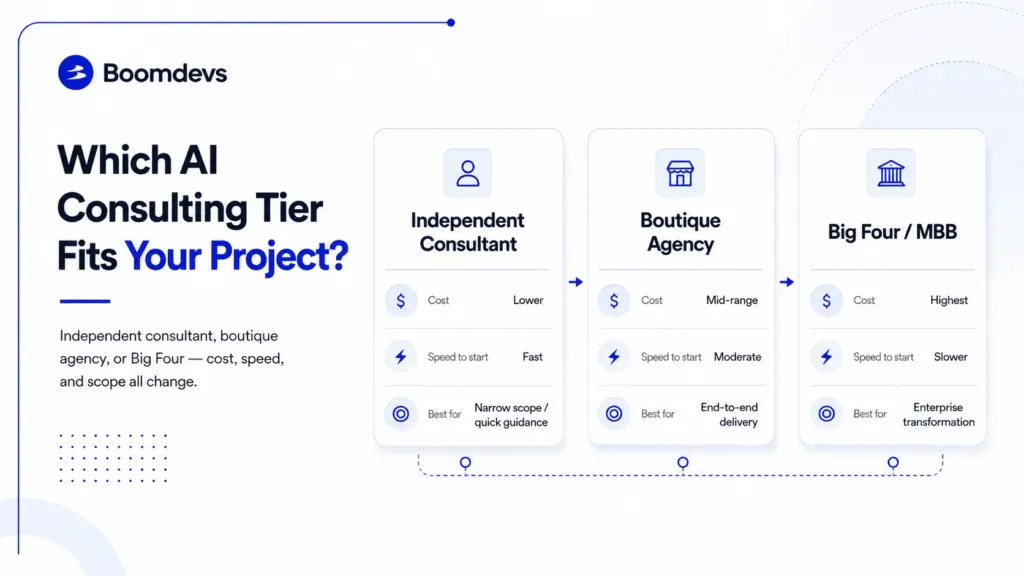
Independent Consultants vs. Boutique Agencies vs. Big Four: A Side-by-Side Comparison
| Factor | Independent Consultant | Boutique Agency | Big Four / MBB |
| Typical engagement size | $5,000–$40,000 | $20,000–$150,000 | $150,000–$1M+ |
| Team staffed on the project | 1 person | 2–6 senior people | Partner + large junior team |
| Speed to start | Fast (days) | Fast to moderate (1–2 weeks) | Slow (procurement cycles) |
| Best for | Narrow, well-defined tasks | Full builds, mid-market strategy | Regulatory, board-level, global scale |
| Risk | Single point of failure | Low-moderate | Low (institutional backing) |
| Typical downside | Limited bandwidth | Less brand recognition | Junior staff learning on your budget |
Independent AI Consultant Services
Freelance and independent AI consultant services suit tactical, well-scoped work: a technical audit, a model evaluation, a specific integration. You are paying for judgment, not headcount, so the rate reflects one person’s time.
Boutique AI Consultancy Services
Boutique AI consultancy services staff senior people on every engagement instead of a partner-plus-junior-team pyramid. That structure usually delivers the best value for mid-market companies that need real expertise without enterprise overhead.
Mid-Tier and Big Four Firms
Mid-tier IT firms and the Big Four exist for enterprise-scale transformation, heavy regulatory compliance, and board-level credibility. You are paying for scale and risk coverage as much as technical skill, which is exactly why the hourly rate climbs so fast at this tier. (For a look at how a senior-led firm structures these engagement models day to day, Boomdevs’ consulting services overview breaks down the fixed-price, sprint-based, and retainer options it offers across stages.)
What AI Projects Actually Cost by Scope
Project cost scales with scope, from $5,000 readiness assessments to $500,000+ enterprise builds, with most standalone projects landing between $20,000 and $200,000.
AI Readiness Assessments and Strategy ($5,000-$30,000)
This audit tells you whether your data, team, and use case are actually ready for AI, and it is the cheapest insurance against a failed build. Pricing runs from about $5,000 for a focused strategy engagement up to $30,000 for a full roadmap with vendor evaluation and budget forecasting.
Proof of Concept and Pilots ($15,000-$75,000)
A pilot validates one use case against real data before anyone commits to a full build. Most run four to eight weeks, and small business pilots typically land between $15,000 and $50,000, while enterprise pilots run higher.
Mid-Range Custom AI Builds ($50,000-$200,000)
This is the tier where AI automation consulting services and the best AI consulting services for automating business processes tend to land: custom RAG systems, workflow automation, AI agent consulting services builds, and conversational AI. Full enterprise implementations with heavy legacy integration can push past $500,000. Most of these builds also need a user-facing interface, so it’s worth checking what UI/UX design costs before you lock in the budget.
AI Consulting Services for Small Businesses ($2,000-$50,000)
Small businesses do not need enterprise pricing to get real results. Most SMB implementations land between $10,000 and $15,000, and a focused readiness assessment alone can start around $2,000.
Fractional Chief AI Officer Retainers ($5,000-$30,000/month)
A fractional CAIO gives you senior AI leadership, vendor decisions, and governance, without a $400,000-plus full-time hire. Monthly retainers in 2026 typically run $5,000 to $30,000, depending on hours committed and seniority.
Pricing by Business Size, Industry, and Region
Business size, industry regulation, and geography each shift AI consulting costs. A small unregulated business in a lower-cost region can pay a fraction of what a regulated enterprise in the US or UK pays for a comparable-scope project.
By Business Size
| Business Size | Typical Project Budget | Common Engagement |
| Solo / micro business | $2,000–$10,000 | Readiness check, single automation |
| Small business (10–50 staff) | $10,000–$50,000 | Pilot or single-workflow build |
| Mid-market (50–500 staff) | $50,000–$250,000 | Custom RAG system, multi-workflow automation |
| Enterprise (500+ staff) | $250,000–$1M+ | Full transformation, multi-department rollout |
By Industry
Regulated and data-sensitive industries carry a premium because of compliance overhead, security review, and the cost of getting things wrong:
Healthcare and life sciences: Higher end of every tier due to HIPAA and clinical-data handling; expect a 20–40 percent premium over unregulated industries for comparable scope.
Financial services: Similarly elevated due to model risk management, audit trails, and regulatory reporting requirements. Boomdevs’ fintech development outsourcing guide covers a related angle where compliance and security overhead tend to hide in a fintech quote.
Retail, e-commerce, and logistics: Mid-range pricing; less compliance overhead, faster iteration cycles.
Professional services and SaaS: Often the cheapest to serve per dollar of value delivered, since data is typically cleaner and use cases (support, content, internal tooling) are well-trodden.
By Geography
United States and United Kingdom: Highest rates across all tiers; reflect both cost of living and market demand.
Western Europe: Slightly below the US/UK, with strong governance expertise tied to GDPR and the EU AI Act.
Eastern Europe: 30–50 percent below Western rates for comparable engineering talent.
South Asia and Southeast Asia: Often the lowest hourly rates, though senior-strategy work still commands a premium regardless of region.
A Simple AI Consulting Budget Calculator
A rough budget estimate is the base project cost plus 30–50 percent for hidden costs, plus 15–25 percent of the total annually for maintenance.
Use this framework to sanity-check any quote:
Start with the scope tier
Pick the closest match: readiness assessment ($5K–$30K), pilot ($15K–$75K), mid-range build ($50K–$200K), or enterprise transformation ($250K+).
Add hidden costs
Multiply the base figure by 1.3 to 1.5 to account for data preparation, software/inference fees, and change management (detailed below).
Add year-one maintenance
Budget an additional 15 to 25 percent of the original build cost for the first year of monitoring, retraining, and support.
Sanity-check against ROI
If the tool won’t plausibly save more in labor cost or revenue than steps 1–3 combined within 12–18 months, the scope is probably too large for the problem.
Worked example: A $50,000 mid-range build → $65,000–$75,000 with hidden costs → +$7,500–$12,500 in year-one maintenance → roughly $75,000–$90,000 all-in for the first year.
The Real Reason AI Consulting Rates Have Not Dropped in 2026
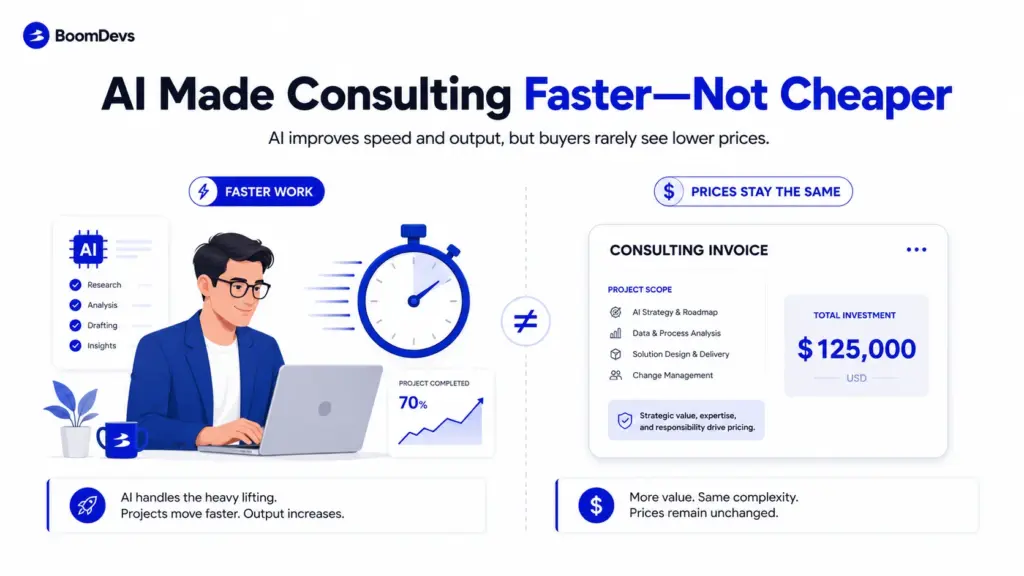
AI tools have made consultants faster, but firms have converted that speed into margin and capacity rather than lower client prices.
AI has made consultants measurably faster, yet 2026 hourly rates look almost identical to 2024. That is not an accident.
A Harvard Business School study of 758 Boston Consulting Group consultants found that AI assistance let them complete about 12 percent more tasks, 25 percent faster, with over 40 percent higher quality output, according to Forbes. That speed gain rarely reaches the client, though.
At traditional firms, one analysis of the consulting industry’s AI shift found that when tasks that used to take a consultant weeks now take hours, the firm typically keeps billing close to the old scope. The saved time becomes margin instead of a client discount, according to Future of Consulting.
Independent consultants monetize the same efficiency gain differently. Rather than lowering their rate, many now run three or four concurrent client engagements at once, so the AI multiplier shows up as more capacity, not a lower bill, per Let’s Data Science.
Either way, the buyer rarely sees the savings directly. If you are comparing quotes, ask what a firm’s AI tooling actually changed about the scope, not just the price.
Four Hidden Costs Most AI Consulting Quotes Leave Out
Data preparation, software and inference fees, change management, and ongoing maintenance are the four costs most quotes underestimate, and together they can add 30 to 50 percent to the sticker price.
Data Preparation and Engineering
If your data lives across five systems in inconsistent formats, expect this stage to eat your timeline. A widely cited CrowdFlower survey reported in Forbes found that data scientists spend about 60 percent of their time cleaning and organizing data, with data preparation overall consuming roughly 80 percent of a project’s working hours. Budget for this before you budget for the model.
Software, API, and Inference Costs
Every AI system runs on something besides the consulting invoice. LLM API calls, vector database storage, and platform licenses rarely appear in the initial quote. Microsoft 365 Copilot’s enterprise add-on alone runs $30 per user per month on top of a qualifying base license, and inference costs for a custom-built agent scale with usage, not with a flat fee. If you’re planning to automate phone support, budgeting for an AI voice agent means looking at call volume and ongoing running costs, not just the initial build.
Change Management and Team Training
Most AI budgets fail to price the human side of the rollout, and that is usually where the project actually breaks. BCG’s research puts it plainly: about 70 percent of what determines AI success is people and process, only 20 percent is technology, and just 10 percent is the algorithm itself. A separate cost analysis found that businesses should plan for 40 to 60 percent of a project’s total budget to go toward people rather than code: engineers, project managers, and the internal champions who actually drive adoption.
Ongoing Maintenance and Optimization
AI systems are not something you deploy once and forget. Models drift, vendors change their APIs, and usage patterns shift. JanBask’s 2026 guide recommends budgeting 15 to 25 percent of the initial build cost every year for monitoring, retraining, and support.
How AI Consulting Pricing Models Work in 2026
Four pricing models cover almost every AI consulting quote you will see, and picking the wrong one costs more than picking the wrong vendor.
Hourly, or time and materials, billing fits exploratory advisory work where the scope genuinely cannot be defined upfront. Fixed-fee pricing suits implementation projects with clear deliverables, since it rewards efficient delivery instead of extended engagements. Monthly retainers work for ongoing advisory relationships or fractional leadership. Value-based pricing ties the fee to a percentage of measurable savings or revenue.
Client preference is shifting toward outcome-based pricing over time-based billing, and outcome-based fees typically run 10 to 40 percent of the value created.
For implementation work, ask for a fixed fee to avoid scope creep. For open-ended strategy or discovery, hourly billing is fair to both sides. Generative AI consulting services in particular tend to carry a premium over general software consulting, since specialized model and prompt expertise is still scarce relative to demand.
A Note on Methodology
The figures in this guide are pulled from a mix of industry rate-survey content published by AI consulting vendors (AIDOLS, Iternal, JanBask) and peer-reviewed or institutional research (Harvard Business School, RAND Corporation, MIT Project NANDA). Vendor-published rate ranges reflect market consensus rather than independently audited data; institutional sources are cited with their original methodology where available.
How Boomdevs Fixes the AI Consulting Pricing Problem
Most of the sticker shock in AI consulting comes from paying enterprise rates for a startup-sized problem, or hiring a firm that hands over a strategy deck and disappears before anything ships.
That gap is exactly why Boomdevs structures AI engagements differently. Boomdevs pairs AI and generative AI consulting services with the engineering team that actually builds the solution, so the same people who write the roadmap own the agents, automations, and RAG systems that come out of it.
The firm has run more than 350 projects across fintech, healthcare, SaaS, and logistics over 10-plus years, with senior strategists and engineers staffed on every engagement instead of junior analysts learning on a client’s budget.
Pricing is scoped and fixed before work starts. MVP and tech stack engagements typically run two to four weeks, full AI strategy and go-to-market work runs six to 12 weeks, and AI transformation programs are scoped separately based on deployment complexity. If you’re planning an AI-powered SaaS product, here’s what a SaaS MVP costs to build.
Whether the need is a generative AI consulting services engagement to scope a new copilot feature or an AI agent consulting services build to automate a back-office workflow, the strategy and the build stay under one roof.
See what a fixed-fee AI consulting engagement would actually cost for your project. Get a scoped quote from Boomdevs before committing budget to a slide deck.
How to Calculate the ROI of Your AI Investment
Run the math backward from time saved, not forward from the invoice most well-scoped automations pay for themselves within five to twelve months.
The fastest way to judge any AI consulting quote is to run the math backward from time saved, not forward from the invoice.
Say an automation frees up 20 hours a week for a $55-an-hour employee. That is roughly $57,000 a year in recovered time. A $20,000 build pays for itself in under five months, and the first-year return often runs three to six times the initial spend once the tool is fully adopted.
Real engagements back this up. One landscaping company paid $12,000 for an AI consultant to automate its quote generation process. The system now handles about 80 percent of quote requests without a human touch, saving roughly 15 hours a week, according to AI Essentials.
Frequently Asked Questions
What Is AI Consulting?
AI consulting services help an organization figure out where artificial intelligence can create real value, then design and deploy the systems that make it happen. A good AI consultant combines strategy, engineering, and governance, so the initiative actually reaches production instead of stalling as a pilot.
Why Do So Many Enterprise AI Projects Fail?
More than 80 percent of AI projects fail to deliver their intended value, according to RAND Corporation’s 2024 research, roughly twice the failure rate of non-AI IT projects. A separate MIT Project NANDA study found that 95 percent of generative AI pilots show no measurable financial return, mostly for organizational and data readiness reasons, not model quality.
Should I Hire an AI Consultant or Build an In-House Team?
For a first AI project, buying expertise usually beats building it from scratch. The same MIT NANDA research found that purchasing from specialized vendors and forming partnerships succeeded about 67 percent of the time, while internal builds succeeded only about 33 percent of the time roughly half as often. An in-house AI team also costs $300,000 to over $1,000,000 a year in salaries alone, before tooling.
How Long Does It Take to Deploy an AI Solution?
Small pilots typically take four to eight weeks. Full production deployments run three to six months, and enterprise-wide AI transformations, especially in regulated industries, can stretch nine months to two years. Boomdevs scopes MVP and tech stack engagements at two to four weeks and full product strategy work at six to 12 weeks, with AI transformation timelines set separately.
What Does a Fractional Chief AI Officer Cost?
A fractional CAIO typically costs $5,000 to $30,000 a month, depending on hours committed and seniority, compared with $400,000 or more in total compensation for a full-time hire. Most mid-market companies use the fractional model to get executive-level AI direction without the recruiting cycle or the headcount.
Who Provides the Best AI Consulting Services for Scaling Businesses?
The best fit depends on stage and budget more than brand name. Scaling startups and mid-market companies generally do better with a senior-led firm that keeps strategy and engineering under one roof, rather than a name-brand consultancy that hands execution off to junior staff. Boomdevs, for example, has run more than 350 projects across fintech, healthcare, and SaaS with senior consultants and engineers on every engagement, transparent fixed pricing, and AI considered as part of every strategy conversation.
Conclusion and Next Steps
AI consulting cost in 2026 is not really about finding the cheapest hourly rate. It is about matching the engagement type to the problem: an assessment before a strategy, a pilot before a full build, and a partner who prices transparently instead of padding the invoice with hidden fees.
Start with a narrow, high-ROI workflow. Get a fixed-fee quote for the build phase. Insist on a data-readiness audit before anyone writes a line of model code, and ask any firm you are considering exactly how they price change management and maintenance, not just the build.
Ready to see what a scoped, fixed-fee AI consulting engagement actually costs for your business? Book a consulting scope call with Boomdevs and get a transparent quote before you commit budget.