


- 1. Key Takeaways
- 2. How to Choose a Mobile App Development Company in 8 Steps
- Step 1: Define What You're Building Before You Talk to Anyone
- Step 2: Build a Shortlist From the Right Places
- Step 3: Judge the Portfolio by Live Apps, Not Screenshots
- Step 4: Test Their Technical Judgment, Even If You're Not Technical
- Step 5: Call References and Ask How Problems Were Handled
- Step 6: Compare Proposals Line by Line
- Step 7: Put Ownership, Security, and Support in the Contract
- Step 8: Start With a Paid Discovery or Trial Phase
- 3. How to Compare Your Shortlist Side by Side
- 4. Questions to Ask a Mobile App Development Company Before You Sign
- 5. Red Flags That Should End the Conversation
- 6. What Post-Launch Support Should Actually Cover
- 7. Freelancer, Agency, or In-House Team: Which Fits Your App?
- 8. When to Bring In a Mobile App Consultant Before You Choose
- 9. How Boomdevs Fixes the Wrong-Partner Problem
- 10. Frequently Asked Questions
Summarize with
You signed with the team that had the slickest portfolio and the friendliest quote. Four months later, the app half works. Every fix comes back as a change request, and you’re paying for each one.
That story is common, and it rarely starts with bad code. It starts with picking on price and pitch instead of evidence. Here’s how to choose a mobile app development company using checks that expose the difference before you sign anything.
Key Takeaways
- Write a one-page brief before you contact anyone, so every company quotes the same project.
- Judge candidates on evidence you can verify: live apps, reference calls, and how they justify technical choices.
- Compare itemized proposals, not headline prices, and settle fixed price vs time and materials based on how firm your scope is.
- Get the code, design files, and App Store and Google Play accounts in your company’s name, in writing.
- Start with a short paid discovery or trial phase before you commit to a mobile app development partner for the full build.
- Bring the same questions to ask a mobile app development company to every call, so you can compare answers side by side.
How to Choose a Mobile App Development Company in 8 Steps
If you’re wondering how to choose a mobile app development company, start by defining your project, then shortlist mobile specialists and verify their work through live apps and references. Then compare itemized proposals, lock ownership into the contract, and test the relationship with a short paid phase.
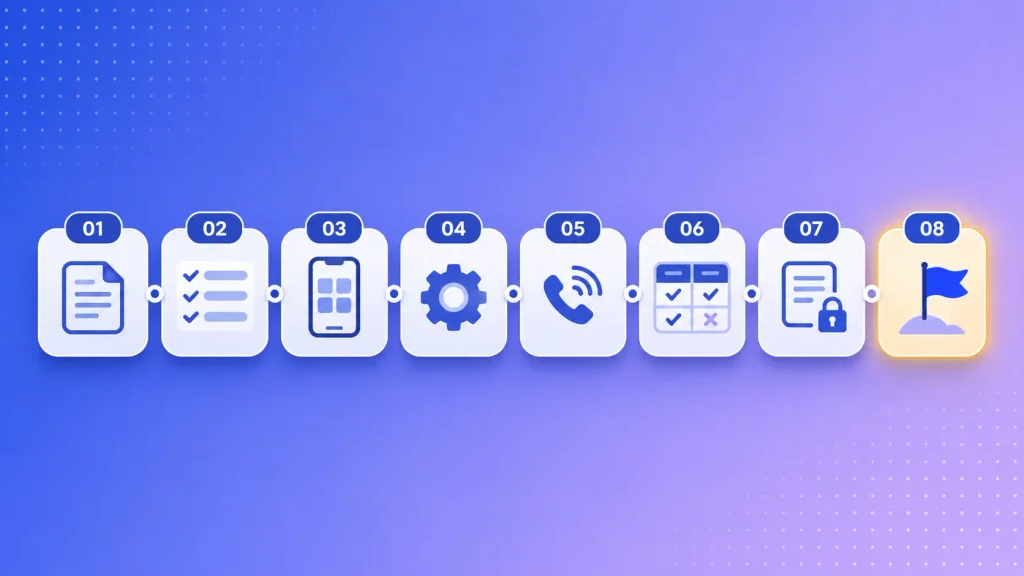
The order matters. Each step filters out companies the next step would waste your time on:
- Define what you’re building.
- Build a shortlist from the right places.
- Judge portfolios by live apps.
- Test their technical judgment.
- Call references.
- Compare proposals line by line.
- Put ownership, security, and support in the contract.
- Start with a paid discovery or trial phase.
Most founders jump straight to step 6. That’s exactly where bad decisions get locked in.
Step 1: Define What You’re Building Before You Talk to Anyone
When you’re working out how to choose a mobile app development company, a short written brief is the best filter you have. Without one, each company quotes a different imagined app, and their numbers can’t be compared.
You don’t need a full specification. One or two pages covering these points will do:
- The business goal: what the app has to change, such as bookings, retention, or a manual process you want gone.
- Your users: who opens it, how often, and on which devices.
- Platforms: iOS, Android, or both, and whether a web version matters too.
- Must-have features: the five to eight things version one can’t ship without.
- Budget range and deadline: a real range, even a rough one, plus any hard date like a funding round.
- A clear range: also makes the fixed price vs time and materials decision easier later.
If the idea itself is still untested, it’s worth validating your app idea before you spend on a build. A good company will ask about demand anyway.
Step 2: Build a Shortlist From the Right Places
Three to five serious candidates is plenty. Any more and you won’t have time to vet each one properly.
Referrals from founders who shipped an app recently are your strongest source. Review directories like Clutch help too, since they pair verified client reviews with rates and specialties. LinkedIn is handy for checking who actually leads each team.
As you build the list, filter on two things:
- Mobile as a core service: a firm where mobile is a side line tends to have thinner iOS and Android depth.
- A size that fits your project: a 1,000-person firm may hand a small account to juniors, while a five-person studio may run out of capacity once you raise and need to scale.
Location comes third, and it’s mostly about overlap hours. An offshore team can work well if you share a few working hours each day and have a named lead you can reach.
It’s worth opening each company’s own apps in the store. How often they ship updates tells you a lot about how they work.
Step 3: Judge the Portfolio by Live Apps, Not Screenshots
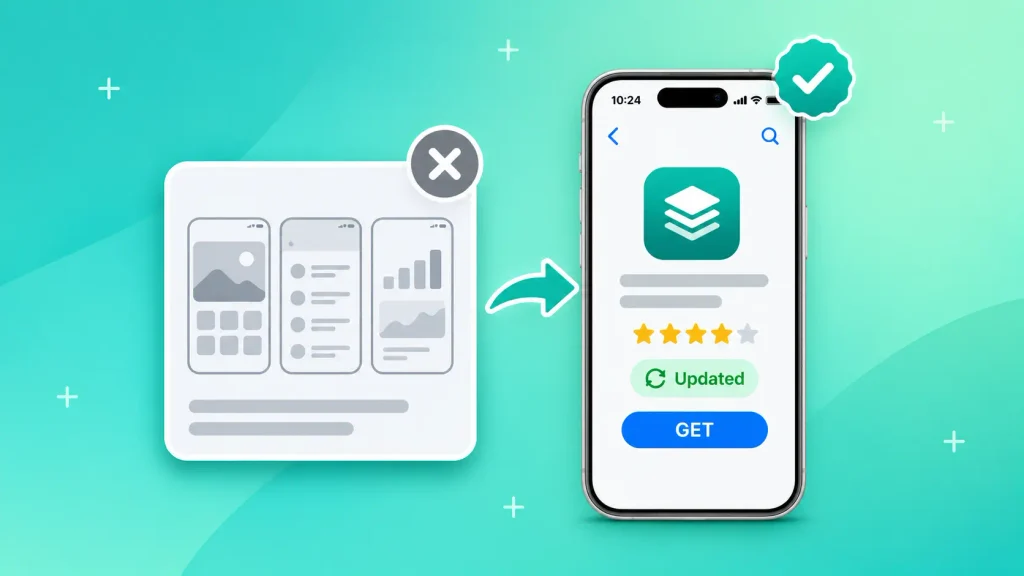
A portfolio proves a company can make things look good. Live apps prove it can ship them and keep them running.
For each candidate, I’d pick the two projects closest to yours in complexity and check:
- Is the app still live on the App Store or Google Play, and when was it last updated?
- What did this company build: the whole product, the design, or one feature?
- Does it handle something like your hardest feature, such as payments, real-time sync, or offline use?
It’s worth downloading those apps and spending 10 minutes in each, then reading the recent store reviews. Crash complaints and “hasn’t been updated in a year” comments are app development red flags that tell you more than any case study page.
Step 4: Test Their Technical Judgment, Even If You’re Not Technical
Knowing how to choose a mobile app development company doesn’t require reading code. You need to hear how a team explains its choices.
You’ll learn a lot by asking each company which approach they’d use for your app, and why. Native iOS and Android, a cross-platform framework like Flutter or React Native, and a web-based app all carry real trade-offs in cost, performance, and upkeep. Our breakdown of native vs cross-platform app development covers those trade-offs if you want to go in prepared.
Strong answers tend to share a few traits:
- They ask about your users and roadmap before naming a stack.
- They tell you the downside of what they recommend.
- They describe testing and release in specifics, not “we follow best practices.”
A team that pitches the same framework to every client is optimizing for its own comfort, not your product.
Step 5: Call References and Ask How Problems Were Handled
Reviews tell you whether clients were happy at the end. Reference calls tell you what happened in the middle, which is where projects actually go wrong.
I’d suggest asking each company for two references from projects like yours, ideally one finished and one still running. On the call, skip “were you happy?” and ask these instead:
- What went wrong, and how did the team respond?
- Did the estimate hold, and if not, how was the change handled?
- Was the same lead on the project from start to finish?
- Would you hire them again for your next app?
I’d weight the first answer above the rest. Every project hits problems. You’re testing whether the company owns them or explains them away. Keep these calls short. Fifteen honest minutes with a past client will tell you more than an hour of sales demos.
Step 6: Compare Proposals Line by Line
Two quotes for the same app can sit far apart simply because they cover different work. Before you compare prices, line up what each proposal includes: discovery, design, development, QA, project management, store release, and post-launch support.
Scope also drifts once building starts. PMI’s 2018 Pulse of the Profession found that 52% of projects completed that year experienced scope creep, up from 43% five years earlier. So the pricing model matters as much as the price itself:
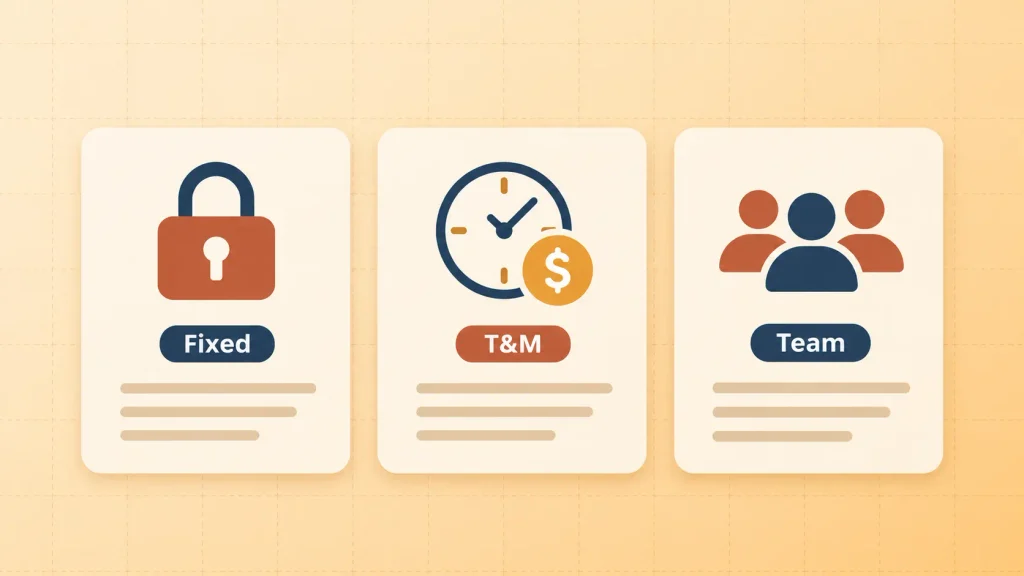
| Pricing model | Best for | Risk to you |
| Fixed price | Small, settled scope | Change requests get expensive |
| Time and materials | MVPs and evolving products | Needs active budget tracking |
| Dedicated team | Long-running roadmaps | Pays off only with steady work |
The fixed price vs time and materials choice usually comes down to one thing: how settled your scope really is.
It’s also worth asking how each company would trim the scope to fit your budget range. A good mobile app development partner suggests specific cuts. A weak one just lowers the number and hopes. For realistic figures by app type, see our guide to mobile app development cost.
Step 7: Put Ownership, Security, and Support in the Contract
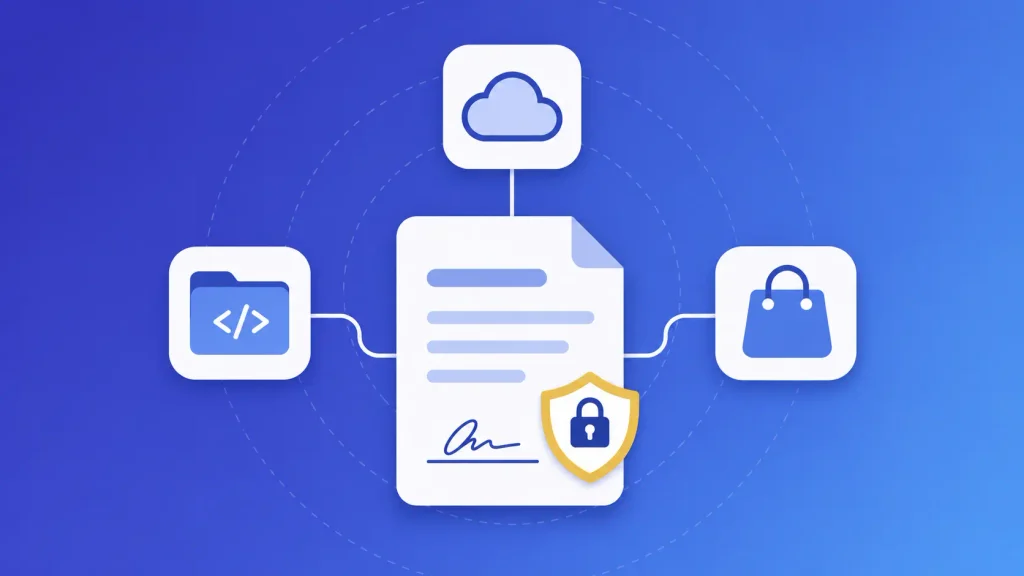
Ownership questions feel awkward to raise early. They’re far more awkward after launch.
Your contract should cover these points:
- IP assignment: all code, designs, and documentation transfer to your company, usually on payment.
- Repository access: your company owns the code repository from day one, and the team is invited in.
- Store and cloud accounts: App Store, Google Play, and hosting accounts sit in your company’s name.
- NDA and security practices: how they handle your data, credentials, and user information.
- Support terms: a defined bug-fix window after launch and the rate for work beyond it.
The store account point catches a lot of founders out. Apple requires organizations to enroll with a D-U-N-S Number, and the enrolled legal entity’s name appears as the seller on the App Store. If a company publishes your app under its own developer account, its name sits on your listing, and moving the app later turns into a project of its own.
Step 8: Start With a Paid Discovery or Trial Phase
A short paid phase is the cheapest way to see how a team works day to day. It’s worth scoping it to a concrete deliverable, such as a clickable prototype, a technical architecture, or a prioritized feature list.
You keep that output either way. If the fit feels off, you walk away with something useful instead of a half-built app.
While it runs, watch how your potential mobile app development partner behaves:
- Do they ask sharp questions about your users and business model?
- Are decisions written down, or do they live in someone’s head?
- Do small deadlines hold?
Founders building a first product often fold this into a mobile MVP development engagement. If you want to see what comes after discovery, here’s the mobile app development process from scoping to release.
Not sure your shortlist is the right one? Book a free strategy call with Boomdevs and get a second opinion before you sign.
How to Compare Your Shortlist Side by Side
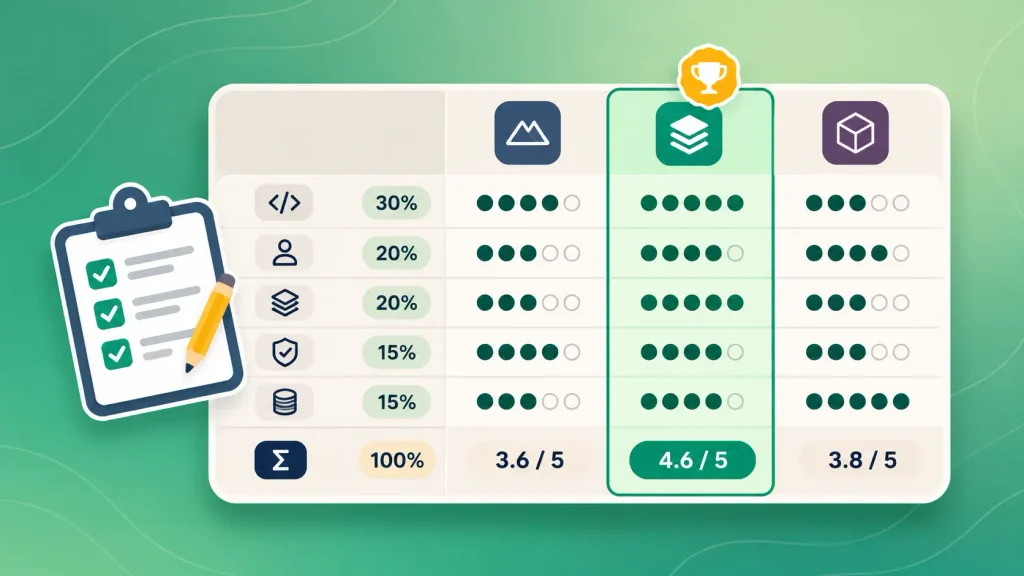
A simple scorecard keeps the decision honest, and it’s the step most founders skip when they figure out how to choose a mobile app development company. Without one, the last company you spoke to tends to win.
Score each candidate from one to five on every row below, then weight the rows that matter most for your product. A fintech or health app, for example, should lean harder on ownership and security:
| Criterion | What good looks like | Red flag |
| Relevant experience | Live apps of similar complexity | Only screenshots and mockups |
| Technical judgment | Reasoned stack recommendation | Same stack for every client |
| Proposal clarity | Itemized scope and assumptions | One lump-sum number |
| References | Candid stories about problems | No references offered |
| Communication | Named lead, regular updates | Only a sales contact |
| Ownership and support | IP, accounts, support window in writing | Vague on code ownership |
If two companies end up tied, pick the one whose reference calls went better. Those calls are the closest preview you’ll get of life with that mobile app development partner.
Questions to Ask a Mobile App Development Company Before You Sign
The right questions to ask a mobile app development company turn sales claims into evidence. If you ask every shortlisted company the same set, you can compare their answers directly.
About the Team
Most of the risk in an outsourced build comes down to who actually does the work. These questions get you past the sales deck:
- Who exactly will work on my app, and can I meet the technical lead?
- Will the same lead stay on the project from kickoff to launch?
- How many other projects is that team running right now?
Vague answers about “our team” are classic app development red flags. They usually mean the people you met in sales won’t be the people building.
About Process and Delivery
Next, you want to see how the work moves from idea to store:
- How did you estimate this, and what assumptions sit behind the number?
- How do you handle a change request in the middle of a sprint?
- How is testing done, and on which devices?
- Who handles App Store and Google Play submissions, and rejections?
That last question matters more than most founders expect, for reasons the post-launch section below makes clear.
About Ownership and Exit
Of all the questions to ask a mobile app development company, few buyers ask what happens if the relationship ends. It’s the question that protects you most, so it’s worth asking even when everything feels great:
- If we part ways, how do you hand over code, documentation, and credentials?
- Is the code documented well enough for another team to pick it up?
- Is any part built on your proprietary libraries that I wouldn’t own?
A confident team answers these calmly. Defensiveness here is a signal in itself.
Red Flags That Should End the Conversation
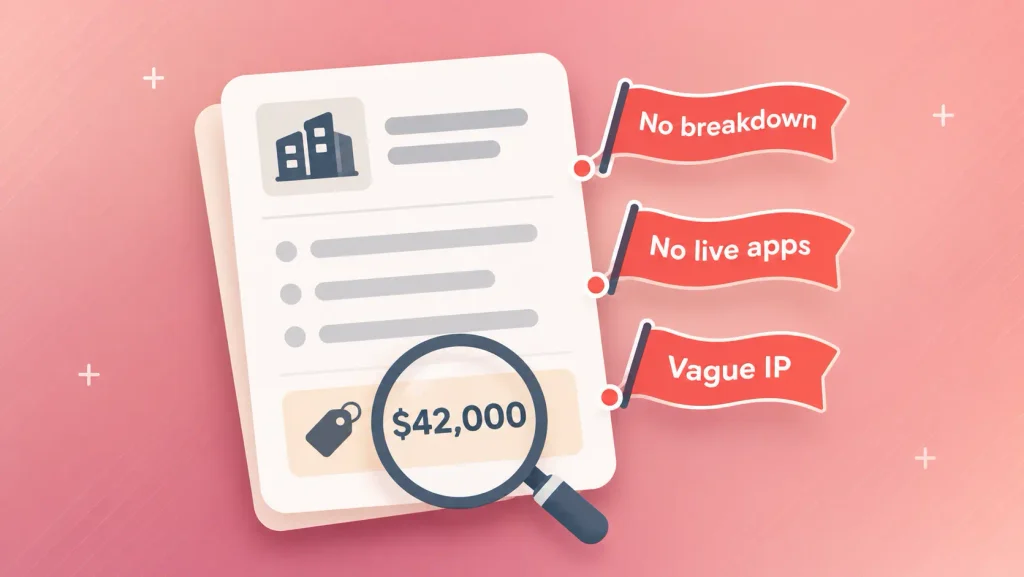
Some warning signs deserve a follow-up question. These app development red flags usually don’t:
- A lump-sum quote with no breakdown. You can’t compare it, and you can’t hold anyone to it.
- No live apps to show. Screenshots don’t prove anything ever shipped.
- Hesitation over code ownership. If they won’t confirm in writing that you own the code, walk away.
- A stack chosen before anyone asked about your users. That’s a sales script, not advice.
- Silence on post-launch support. Your app will need work after release, and someone has to own it.
- A price far below every other quote. It’s usually missing scope, which returns later as change requests.
One of these is enough to pause. Two is enough to move on.
What Post-Launch Support Should Actually Cover
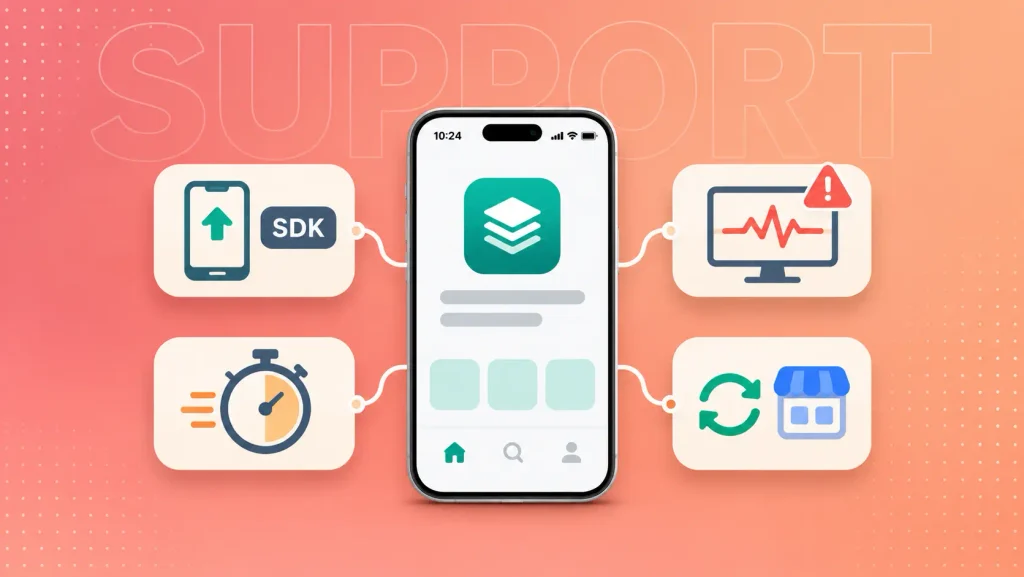
Launch isn’t the finish line for a mobile app. Apple and Google tighten their rules every year, and an app nobody maintains starts losing ground quickly.
The store data makes the point. Apple’s 2025 App Store Transparency Report shows it reviewed 9,100,620 submissions and rejected 2,093,244, roughly 23%. Performance problems were the biggest category.
Android moves just as fast. Since August 31, 2026, Google Play requires new apps and app updates to target Android 16 (API level 36). Existing apps must target at least API level 35 to stay visible to new users on newer devices.
So a real support agreement should spell out:
- OS and store updates: yearly SDK and target API upgrades, scheduled well before each deadline.
- Release handling: who fixes and resubmits when a store rejects an update.
- Response times: how fast critical bugs get a first response and a fix.
- Monitoring: crash reporting and performance tracking, with someone actually reading it.
If a company treats support as an optional extra, plan for who will own it instead. This ongoing work is what Boomdevs’ mobile app maintenance and support service is built around.
Freelancer, Agency, or In-House Team: Which Fits Your App?
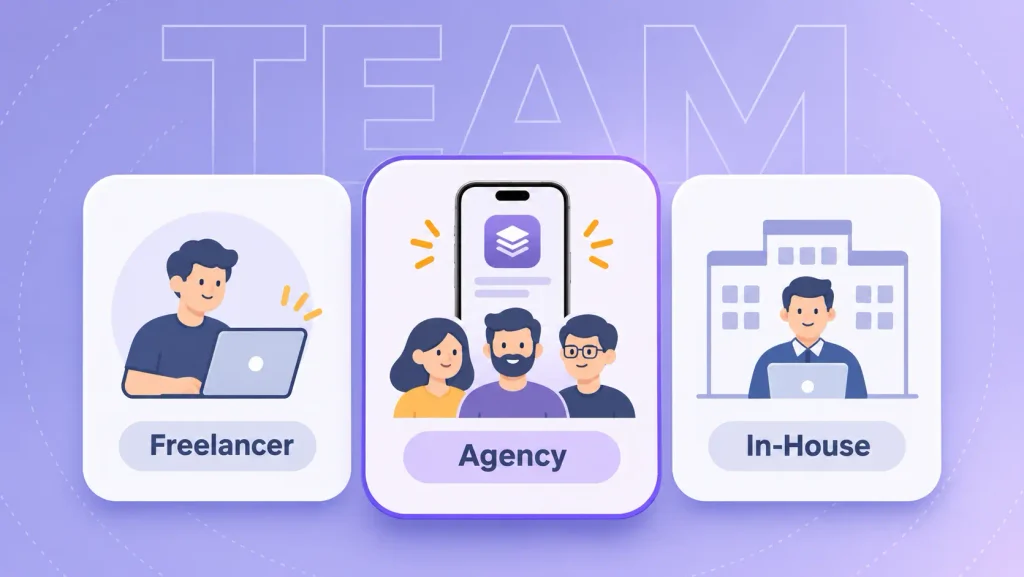
The right model depends on how complex your app is and how long you’ll keep building it. A development company isn’t always the answer.
Here’s how the options compare:
| Option | Best for | Watch out for |
| Freelancer | Small, well-defined builds | No backup if they’re unavailable |
| Development company | Full products needing design, build, and QA | Less senior attention on small accounts |
| In-house team | Ongoing development as a core function | Hiring time and fixed salaries |
| Hybrid | Company builds version one, in-house takes over | Needs a planned handover |
For most founders shipping a first app, a development company gets you a complete team without months of hiring. If you expect to bring development in-house later, plan the hybrid route early. It shapes the documentation and handover terms you’ll want in step 7.
When to Bring In a Mobile App Consultant Before You Choose
If you’re not technical and still unsure how to choose a mobile app development company, an independent consultant can run this selection process with you. They pressure-test proposals, sit in on technical calls, and flag weak answers you might otherwise miss.
It pays off when the stakes are high: a regulated product, a large budget, or a choice between sharply different technical approaches. A mobile app consultant’s role covers strategy, platform choice, and architecture, so the brief you send out is sharper from the start.
Mobile app consulting also gives you a neutral reference point. When three companies recommend three different stacks, you have someone who isn’t bidding on the build to help break the tie.
How Boomdevs Fixes the Wrong-Partner Problem
Plenty of founders reach Boomdevs after learning how to choose a mobile app development company the hard way, with a first build that went sideways. BatchLearn came to us after a failed attempt with another agency, and needed a mobile app development partner that would understand the product before writing code.
That’s the gap Boomdevs is set up to close. Consulting and mobile app development run under one roof, so the team that scopes your app is the team that builds it.
Your strategy, architecture, and security get defined before development starts. Code and account ownership are yours from day one. More than 350 founders have worked with Boomdevs, and Clutch named the studio a Champion in 2024.
Talk to Boomdevs before you sign with anyone. Book a free strategy call and get an honest read on your brief, your shortlist, and the proposals on your desk.
Frequently Asked Questions
How Much Does It Cost to Hire a Mobile App Development Company?
It depends on your features, platforms, integrations, and the team’s location and pricing model. Compare itemized proposals rather than headline numbers, since quotes often cover different work. Our mobile app cost breakdown walks through realistic ranges by app type.
Should I Choose a Local or Offshore Company?
Either can work well. What matters more is daily overlap hours, a technical lead you can reach directly, and clear written processes. Offshore teams often cost less, but they only pay off when communication is structured.
Who Should Own the Source Code of My App?
You should. Your contract should assign all code, designs, and documentation to your company. The code repository and the App Store and Google Play accounts should also sit in your company’s name from the start.
How Many Companies Should I Shortlist?
Three to five is a practical range. Fewer gives you too little to compare. More makes proper reference calls and proposal reviews hard to finish.
What If My Development Company Fails Mid-Project?
If you own the repository, accounts, and documentation, another team can pick up the work. Ask the new team for a code audit before they quote the rest, so you both know what they’re inheriting.