


- 1. Key Takeaways
- 2. AI SaaS Examples at a Glance
- 3. The Two Kinds of AI SaaS: AI-Native vs AI-Enhanced
- 4. 1. ChatGPT (OpenAI)
- 5. 2. Cursor
- 6. 3. GitHub Copilot
- 7. 4. Harvey
- 8. 5. Sierra
- 9. 6. Fin
- 10. 7. Gong
- 11. 8. Salesforce Agentforce
- 12. 9. Notion AI
- 13. 10. Abridge
- 14. 11. Basis
- 15. 12. Darktrace
- 16. What the Best AI SaaS Examples Have in Common
- 17. How These AI SaaS Examples Make Money
- 18. AI SaaS Examples That Stalled (And Why)
- 19. Turning These Examples Into Your Own AI SaaS Product
- 20. How Boomdevs Solves the Build Problem for AI SaaS Founders
- 21. Frequently Asked Questions About AI SaaS Examples
Summarize with
You’re scoping an AI product, and your investor deck needs comparables. Every list of AI SaaS companies you find mixes chatbots, CRMs, and API platforms into one pile. None of it tells you what’s working.
These are 12 AI SaaS examples worth studying in 2026, picked for verified traction and a clear business model. Each one comes with an honest limitation, not just the upside. You can read them as patterns to borrow, not products to copy.
Key Takeaways
- The strongest AI SaaS examples right now include ChatGPT, Cursor, GitHub Copilot, Harvey, Sierra, Fin, Gong, Salesforce Agentforce, Notion AI, Abridge, Basis, and Darktrace.
- They split into two camps: AI-native products that can’t exist without the model, and AI-enhanced products that added AI to software people already used.
- Pricing is shifting from seats toward outcomes. Sierra and Fin get paid when the AI resolves a case, not when someone logs in.
- The winning AI SaaS companies share one habit. Each owns a single workflow end to end instead of bolting a chatbot onto everything.
AI SaaS Examples at a Glance
Each of these examples of AI SaaS products passed three tests. It’s sold as cloud software on a recurring plan, and AI does the core job rather than a side feature. Its traction is also backed by a public number or a named source, not a pitch deck.
You’ll find one older company in the mix, plus an honest limitation for every entry. Here’s the full set side by side:
| ChatGPT | General assistant | AI-native | Subscriptions plus usage-based API |
| Cursor | AI coding | AI-native | Per-seat plans |
| GitHub Copilot | Developer tooling | AI-enhanced | Per-seat plans |
| Harvey | Legal | AI-native | Per-seat enterprise licenses |
| Sierra | Customer experience | AI-native | Per resolved outcome |
| Fin | Customer support | AI-enhanced, now agent-first | $0.99 per resolution |
| Gong | Revenue intelligence | AI-native | Per-seat platform license |
| Salesforce Agentforce | CRM agents | AI-enhanced | Consumption credits |
| Notion AI | Team workspace | AI-enhanced | Per-seat workspace plans |
| Abridge | Clinical documentation | AI-native | Health-system contracts |
| Basis | Accounting | AI-native | Enterprise contracts |
| Darktrace | Cybersecurity | AI-native | Annual subscription |
Notice that only two of the 12 charge per outcome. That’s still the exception, but it’s the column changing fastest. If you’re planning your own product, our AI SaaS development page shows how these choices shape a build.
The Two Kinds of AI SaaS: AI-Native vs AI-Enhanced
Strip the AI out of an AI SaaS product and ask what’s left. That one test sorts all 12 AI SaaS examples into two groups:
- AI-native: nothing useful remains. Harvey without its models is an empty legal workspace, and Sierra without its agents is a phone tree.
- AI-enhanced: the original product still works. Notion is still a workspace, and Salesforce is still a CRM, and AI makes each one faster.
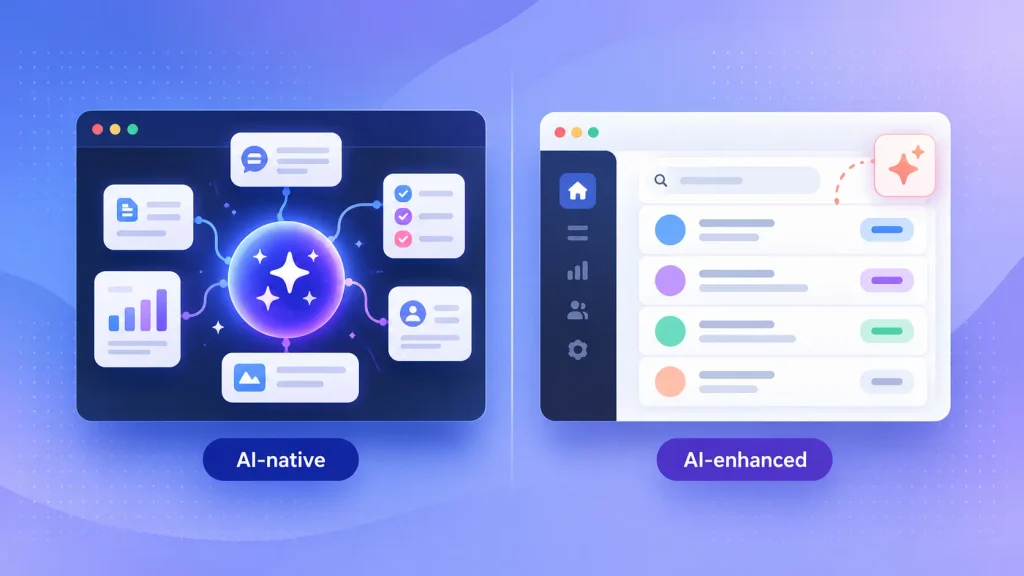
Neither camp wins by default. AI-native SaaS gets to build the whole product around the model, while AI-enhanced tools have the distribution edge because their customers are already inside. If you’d like the fuller definition first, our explainer on what AI SaaS means covers the basics, so this piece can stay on the examples.
1. ChatGPT (OpenAI)
Of all the AI SaaS examples here, ChatGPT is the one almost everyone has used, which makes it easy to forget it’s a subscription business. OpenAI reported more than 900 million weekly active users in February 2026, plus over 50 million consumer subscribers and 9 million paying business users.
For you as a founder, ChatGPT matters less as a rival and more as a baseline. Whatever you build gets compared with what a user can already do in a ChatGPT tab.
- What it is: a general assistant for writing, research, analysis, and code, built on OpenAI’s large language models and sold as subscriptions plus an API.
- Who it’s for: almost anyone, which is both its strength and its limit.
- What sets it apart: scale. Hundreds of millions of weekly users feed OpenAI more usage signal than any startup can gather.
- Honest limitation: it doesn’t know your workflow, your data, or your rules unless you wire them in, and its answers still need checking.
That last point is the opening for every vertical AI SaaS product further down this list.
2. Cursor
Cursor is an AI code editor that writes, edits, and refactors code across a whole project, not one line at a time. It also has the steepest revenue curve on this list. Cursor passed $4 billion in annualized revenue in early June 2026, up from $2 billion in February, according to a person familiar with the figures.
Ownership changed soon after. SpaceX completed its acquisition of Cursor’s parent company, Anysphere, on August 14, 2026.
- What it is: an AI-first coding environment with agents that work across files and repositories.
- Who it’s for: engineering teams, with enterprise customers now driving most of its revenue.
- What sets it apart: it was designed around the AI from day one, so the agent sees your whole codebase, not just the open file.
- Honest limitation: the output is still code your engineers must review, and the new ownership is worth watching if you’re signing a multi-year deal.
Cursor’s lesson is focus. Few AI SaaS examples show it as clearly: one job, done better than anyone else, can outgrow a much bigger company’s side feature.
3. GitHub Copilot
GitHub Copilot is the AI-enhanced counterpart to Cursor. It lives inside tools developers already use, which gives it a distribution edge no startup can buy.
In GitHub’s own controlled study, developers with Copilot finished a coding task 55% faster, averaging 1 hour 11 minutes against 2 hours 41 minutes without it.
- What it is: AI code suggestions, chat, and agents built into GitHub and popular editors.
- Who it’s for: teams already working in GitHub who want AI without switching tools.
- What sets it apart: it’s one setting away for developers who already pay for GitHub.
- Honest limitation: that 55% came from a single controlled task. Your gain on a large, messy legacy codebase will likely be smaller and harder to measure.
If you’re building an AI-enhanced product, this is your model: meet users where their work already happens.
4. Harvey
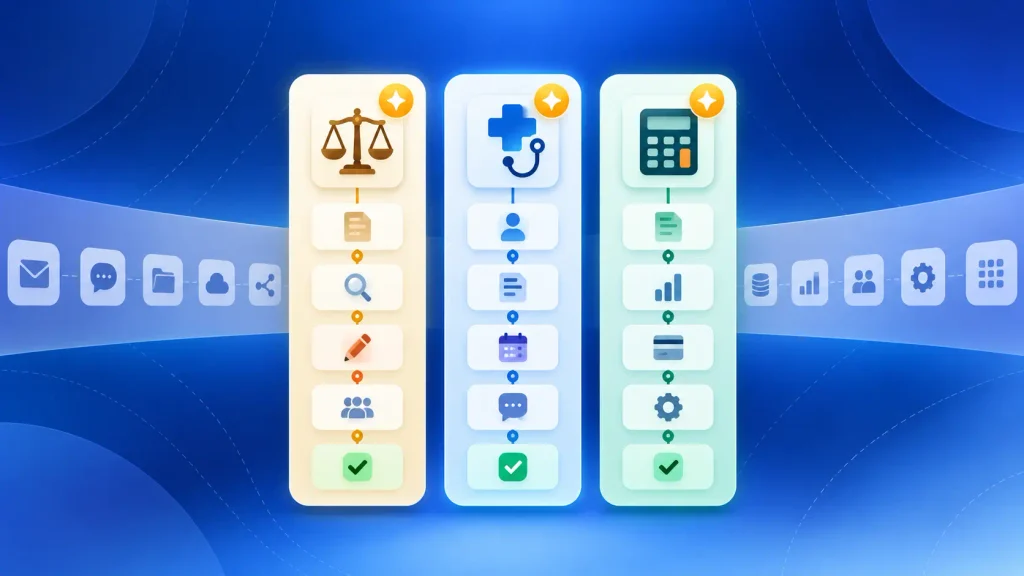
Harvey is the clearest case of vertical AI SaaS. It handles legal research, drafting, and review for law firms and in-house legal teams, and nothing else.
That focus paid off quickly. Harvey confirmed passing $400 million in annual recurring revenue on October 1, 2026, after adding more than $100 million in a single quarter.
- What it is: an AI platform shaped around legal work, from case-law research to contract review.
- Who it’s for: large law firms and corporate legal departments.
- What sets it apart: deep legal workflows, plus trust earned with firms that rarely adopt new tools fast.
- Honest limitation: it’s sold as enterprise seat licenses, which suits big firms better than small practices, and lawyers still own every word that reaches a client.
Harvey shows you can win a slow, conservative industry by going deep instead of wide.
5. Sierra
Sierra builds AI agents that handle customer conversations for large brands, from support questions to cancellations. The interesting part is how it charges.
Co-founder Bret Taylor has said Sierra reached $100 million in ARR in seven quarters and $150 million in eight. In the same interview, he described the model: a pre-negotiated rate when the agent resolves a case alone, and no charge when it hands off to a person.
- What it is: an enterprise platform for customer-facing AI agents.
- Who it’s for: large consumer brands with heavy support volume.
- What sets it apart: outcome-based pricing that ties Sierra’s revenue to results its customers can see.
- Honest limitation: Sierra publishes no pricing and negotiates every deal, so it’s built for big contracts, not a 20-person startup.
Even if you never charge per outcome, Sierra is worth studying for how closely it links price to customer value. Most AI SaaS companies still price by the seat, so that link is rarer than it sounds.
6. Fin
Fin started as Intercom’s AI support agent. Today, Fin is both the company’s name and its AI agent, with the Intercom Helpdesk sold alongside it. It answers customers using your own help content, a retrieval-augmented generation setup, and can take actions through connected tools.
Its numbers are public, which is rare in this space. Fin says it averages a 76% resolution rate, serves more than 12,000 customers, and starts at $0.99 per resolution.
- What it is: an AI customer agent for support, sales, and onboarding conversations.
- Who it’s for: support teams of any size, including those running other helpdesks.
- What sets it apart: published per-resolution pricing you can model before you ever talk to sales.
- Honest limitation: per-resolution billing means your bill rises as the resolution rate rises, even when your traffic stays flat.
That trade-off is the real cost of outcome pricing, so it’s worth modeling before you copy it.
7. Gong
Gong records and analyzes sales calls, emails, and meetings, then tells revenue teams which deals are slipping and why. It was running AI-driven conversation analysis long before generative AI became a sales pitch, which makes it one of the more seasoned AI-native SaaS products here.
Its value comes from volume. Every recorded call gives its models more examples of what winning deals have in common.
- What it is: a revenue intelligence platform built on call and email analysis.
- Who it’s for: B2B sales teams and the managers who coach them.
- What sets it apart: years of conversation data that a CRM add-on can’t recreate overnight.
- Honest limitation: it’s only as good as what gets recorded. Low call volume, or reps who avoid the tool, leave it little to learn from.
Gong is the best example here of data that compounds over time.
8. Salesforce Agentforce
Agentforce is Salesforce’s platform for AI agents that work inside its CRM, handling service cases, sales tasks, and internal requests through agentic workflows. It’s the biggest proof that incumbents can sell AI too.
In its August 2026 results, Salesforce reported Agentforce ARR above $1.5 billion, up more than 240% year over year.
- What it is: AI agents built on top of Salesforce’s data, workflows, and permissions.
- Who it’s for: companies already running on Salesforce.
- What sets it apart: agents start with your customer data, history, and business rules on day one.
- Honest limitation: the value drops sharply outside the Salesforce ecosystem, and usage-based credits are harder to forecast than a flat seat price.
For smaller AI SaaS companies, Agentforce is a warning. If your feature fits neatly inside a big platform, the platform may ship it first.
9. Notion AI
Notion AI adds writing, search, and summaries to the Notion workspace teams already use for docs and projects. It’s a classic horizontal, AI-enhanced product.
Its pitch is breadth rather than depth, the opposite of the vertical AI SaaS approach Harvey and Abridge take. One assistant works across meeting notes, wikis, and project pages instead of solving one industry’s problem.
- What it is: an AI assistant built into Notion’s docs, wikis, and databases.
- Who it’s for: teams that already keep their knowledge in Notion.
- What sets it apart: it works on your own content, so answers come from your workspace instead of the open web.
- Honest limitation: it’s only as useful as what’s in Notion, and it won’t match a specialist tool for legal, medical, or financial work.
Notion AI shows how far you can get when the data already belongs to your users.
10. Abridge
Abridge listens to doctor-patient conversations and turns them into clinical notes, so clinicians spend less time typing after visits. It’s vertical AI SaaS in one of the hardest markets to sell into.
In mid-2025, Abridge raised $300 million at a $5.3 billion valuation while serving more than 150 health systems, including Kaiser Permanente and UPMC.
- What it is: ambient AI documentation that drafts clinical notes from recorded visits.
- Who it’s for: health systems and their clinicians.
- What sets it apart: deep integration with hospital record systems, where most documentation tools struggle.
- Honest limitation: it competes head-to-head with Microsoft’s Nuance, which also has tight Epic integration, so many deals come down to a direct two-way comparison.
Healthcare proves that regulated markets reward teams willing to do the slow integration work.
11. Basis
Basis builds AI agents for accounting firms that prepare financial statements, file tax returns, and track expenses. Its agents are designed to work on complex tasks for hours, not seconds.
In February 2026, Basis raised $100 million at a $1.15 billion valuation. The company says about 30% of the top 25 accounting firms use its platform.
- What it is: long-running AI agents for tax, audit, and client accounting work.
- Who it’s for: accounting firms short on experienced staff.
- What sets it apart: it goes after complex, multi-step filings, not just data entry.
- Honest limitation: accounting is regulated and risk-sensitive, so every output still needs an accountant’s sign-off.
Basis is proof that unglamorous industries are where AI agents find paying customers fastest, and it’s one of the strongest vertical AI SaaS examples on this list.
12. Darktrace
Darktrace is a reminder that AI SaaS didn’t start with ChatGPT. Founded in 2013, it uses AI that learns each customer’s normal patterns in real time and flags threats that break them.
In October 2024, Thoma Bravo completed its acquisition of Darktrace at a value of about $5.3 billion, when the company protected nearly 10,000 customers.
- What it is: AI-driven cybersecurity that detects and responds to unusual activity.
- Who it’s for: security teams that can’t review every alert by hand.
- What sets it apart: self-learning models tuned to each customer’s environment rather than one generic threat list.
- Honest limitation: now that it’s private, you get far less public data to judge it by than when it was listed.
Its long run is a useful counterweight to the idea that AI-native SaaS is a brand-new category.
What the Best AI SaaS Examples Have in Common
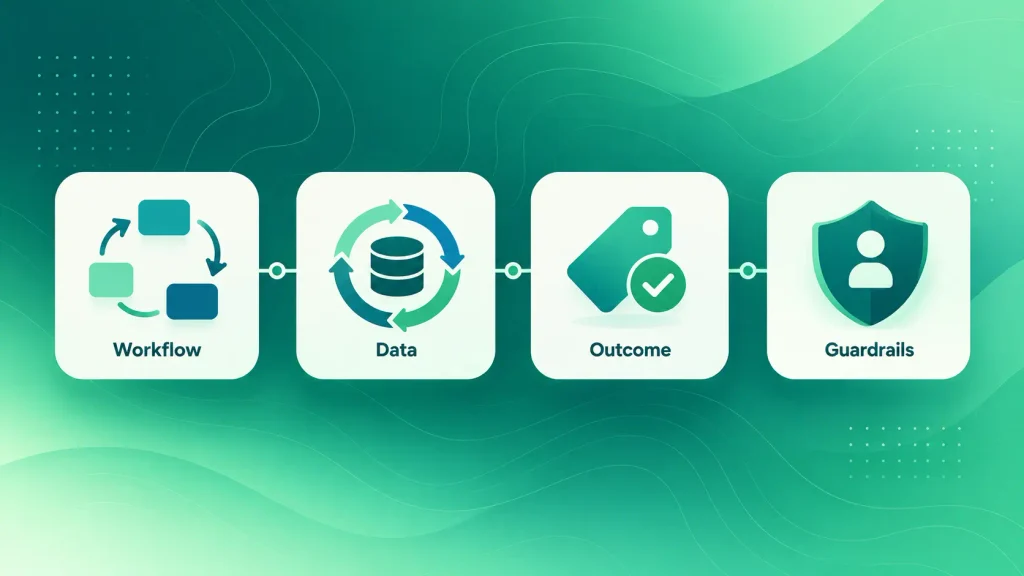
Put the 12 side by side and four habits keep showing up. None of them is about having a better model.
They Own One Workflow End to End
Harvey does legal work. Abridge writes clinical notes. Basis prepares filings, start to finish.
That focus makes each product hard to replace with a general assistant. It’s also what lets them charge enterprise prices for workflow automation instead of a few dollars for a feature.
Their Data Gets Better With Use
Gong learns from every call, and Fin learns from every resolved conversation. The longer you use them, the harder they are to leave.
If your product’s output on day 300 looks the same as on day one, a competitor using the same model can catch you quickly.
They Price the Outcome, Not the Login
Sierra and Fin get paid when work gets done, and Salesforce now sells consumption credits alongside seats. Agents are spreading fast: Gartner predicts 40% of enterprise applications will include task-specific AI agents by the end of 2026, up from less than 5% in 2025.
When software does the work, charging per login stops making sense. The next section breaks down what each pricing model means for you.
They Ship Guardrails, Not Just Features
Every serious example keeps a human in the loop where mistakes cost money. Lawyers review Harvey’s drafts, accountants sign off on Basis output, and clinicians approve Abridge notes.
The guardrails you’ll see most often:
- Human review before anything reaches a client, patient, or regulator.
- Escalation paths that hand a conversation to a person when the AI isn’t confident.
- Audit trails so your team can see what the AI did and why.
- Clear limits on which systems an agent is allowed to touch.
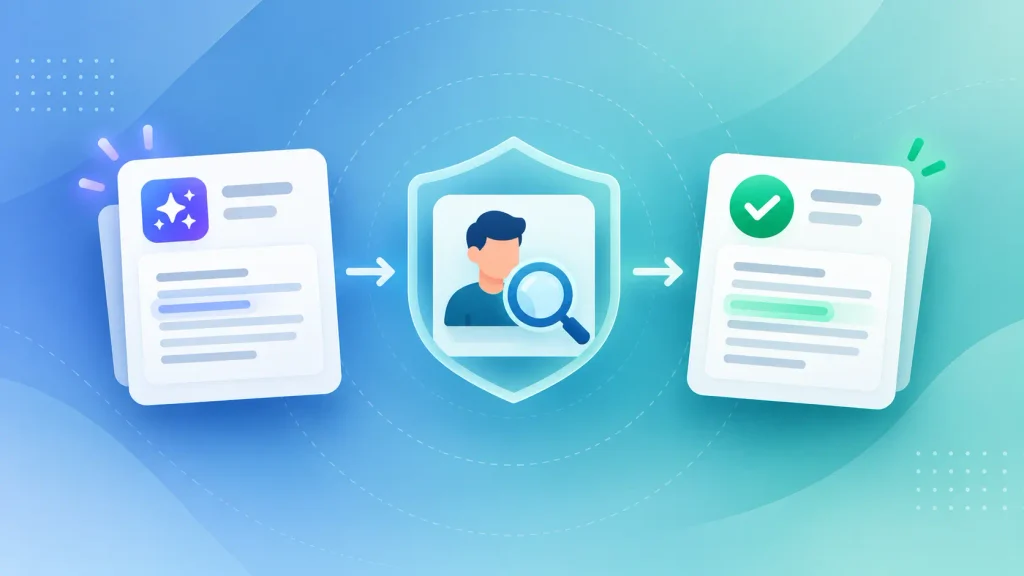
If you’re planning an agent product, it pays to design these in from the start. That’s where our AI agent development projects begin, because bolting guardrails on after launch is slower and riskier.
How These AI SaaS Examples Make Money
Look at how the 12 charge, and you’ll find four models. Each one shifts risk between you and your customer differently:
| Per-seat | Named users | GitHub Copilot, Harvey | Seats priced below the work the AI does |
| Usage-based | Tokens, credits, or API calls | ChatGPT API, Agentforce | Bills customers struggle to forecast |
| Outcome-based | Resolved cases or finished tasks | Sierra, Fin | Revenue grows only if the AI performs |
| Hybrid | Base plan plus usage | Fin with Intercom Helpdesk | Two price levers to explain |
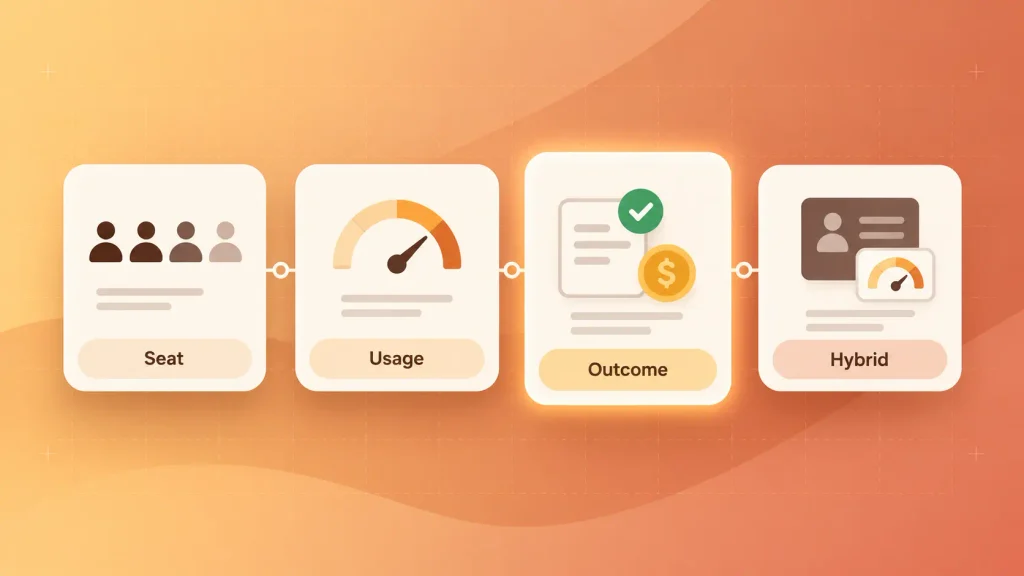
If you’re early, per-seat is the easiest model to sell and forecast. Outcome pricing earns more trust, but only once you can prove your resolution rate with real customers.
Your pricing also depends on what each AI call costs you to run, which our breakdown of AI product development cost covers. For the build choices behind each model, our guide to AI SaaS development goes deeper.
AI SaaS Examples That Stalled (And Why)
Not every AI SaaS story ends with a bigger round. These three are worth knowing because each one stumbled for a different reason:
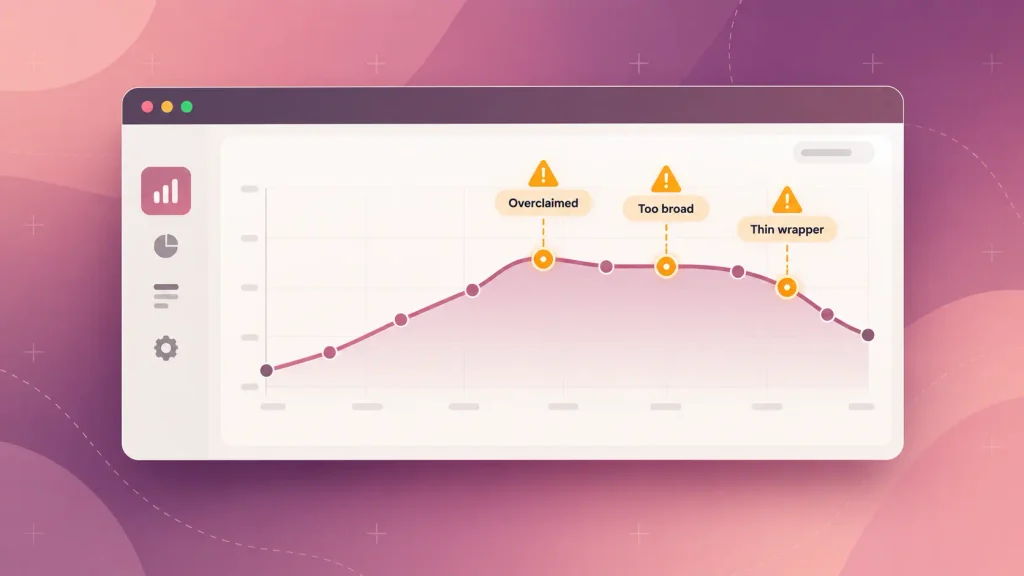
- Builder.ai: the app-building startup entered insolvency in May 2025 after a lender seized most of its cash. Bloomberg reported its 2024 sales came to about $55 million, against a projected $220 million.
- Olive AI: the healthcare automation company, once valued at $4 billion, shut down in October 2023 and sold off its remaining units. Its own leadership pointed to growing too fast across too many products.
- Jasper: the AI writing tool cut its internal valuation by about 20% in 2023 after ChatGPT handed marketers a cheaper alternative, then refocused on enterprise marketing teams.
Read together, they map the main risks: overstating what the AI does, spreading across too many products, and selling a thin wrapper on someone else’s foundation model. Our rundown of common generative AI challenges covers the technical side of the same problems.
Turning These Examples Into Your Own AI SaaS Product
The real value of AI SaaS examples is pressure-testing your own idea before you spend on it. I’d suggest running yours through these five questions, in order:
- What single workflow will you own end to end? If the honest answer is “lots of things,” Olive’s story is worth rereading.
- Could ChatGPT do this in a tab? If a general assistant gets your user most of the way, you need a clear reason they’d pay for the rest.
- What data gets better as customers use you? That’s what keeps a competitor with the same model from catching up.
- Where does a human stay in the loop? Decide where review happens before you decide which model to use.
- How will you charge? Pick seats, usage, or outcomes based on what your customer can measure.
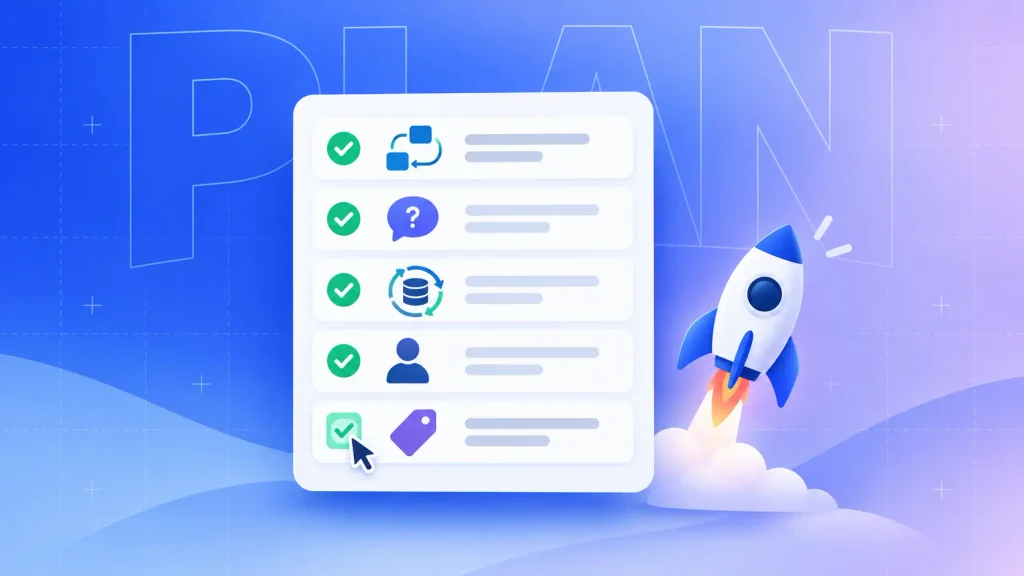
Once you have clear answers, our step-by-step guide to building an AI SaaS product walks through the build. If you’d rather test demand first, an AI SaaS MVP scoped around question one is the cheapest way in, and it’s how our SaaS MVP development engagements start.
How Boomdevs Solves the Build Problem for AI SaaS Founders
Most of the examples above didn’t win on the model. They won on workflow design, data handling, and the guardrails around the AI, which is the hard part of any build.
Boomdevs brings 10+ years of shipping software and 3.5K+ delivered projects to that problem. Our AI SaaS development services cover the full path, from scoping one workflow to launching a multi-tenant product with human review built in.
If you’re sizing up an AI SaaS idea, book a free AI SaaS scoping call. You’ll leave with a clear first workflow, a realistic build plan, and a pricing model you can defend.
Frequently Asked Questions About AI SaaS Examples
Is ChatGPT a SaaS Product?
Yes. ChatGPT runs in the cloud, needs no installation, and charges recurring subscriptions, which fits the standard SaaS definition. OpenAI also sells API access, so many other AI SaaS products are built on top of it.
How Is AI SaaS Different From Traditional SaaS?
Traditional SaaS follows fixed rules you configure. AI SaaS uses models that interpret inputs and produce new output, such as a drafted note or a resolved ticket. That changes pricing too, since every AI action costs money to run.
What Are Examples of Vertical AI SaaS?
Harvey in legal, Abridge in clinical documentation, and Basis in accounting are three strong examples. Each serves one industry and one core workflow rather than offering a general assistant.
Can a Small Team Build an AI SaaS Product?
Yes, if the scope is narrow. Hosted models mean you don’t need to train your own, so a small team can focus on one workflow, the data around it, and the review steps. Most of the risk sits in picking the right problem, not the model.
How Do AI SaaS Companies Charge Customers?
Most use per-seat plans, usage-based billing, outcome-based fees, or a mix. GitHub Copilot charges per seat, Agentforce sells consumption credits, and Fin charges $0.99 per resolution. Outcome pricing is growing because it ties cost to results.