



- 1. Key Takeaways
- 2. React Native vs Flutter: Head-to-Head Comparison
- 3. Is Flutter Faster Than React Native in 2026?
- 4. Look and Feel: Native Components vs Pixel-Perfect Branding
- 5. Team, Hiring, and Cost: The Factor Most Comparisons Underweight
- 6. Shipping Fixes After Launch: OTA Updates and Upgrades
- 7. When React Native Is the Better Choice
- 8. When Flutter Is the Better Choice
- 9. How to Choose Between React Native and Flutter
- 10. How Boomdevs Solves the Framework Decision
- 11. Frequently Asked Questions
Summarize with
You’re about to pick the framework your app will live on for years. React Native and Flutter both ship iOS and Android from one codebase. Both have teams who swear by them, which is why the React Native vs Flutter debate never quite settles.
The honest answer to React Native vs Flutter depends on your situation, not on which one wins a benchmark. It mostly comes down to who will build and maintain your app, and how fast you need to ship fixes. Here’s how to tell which side you’re on.
Key Takeaways
- Pick React Native if your team already knows JavaScript or React, you want to share code with a web app, or you need to push fixes without waiting on App Store review.
- Pick Flutter if your product lives or dies on custom, animation-heavy UI, or you want one codebase for mobile, web, and desktop.
- Performance is rarely the decider anymore. The React Native New Architecture and Flutter’s Impeller engine closed most of the old gap for business apps.
- Hiring and life after launch decide more than specs do. The JavaScript talent pool is far larger than Dart’s, and update workflows differ in ways you’ll feel every month.
React Native vs Flutter: Head-to-Head Comparison
In any Flutter vs React Native comparison, the first thing to know is that they solve the same problem in opposite ways. React Native drives the phone’s own UI components from JavaScript. Flutter skips them and draws every pixel itself with its own engine.
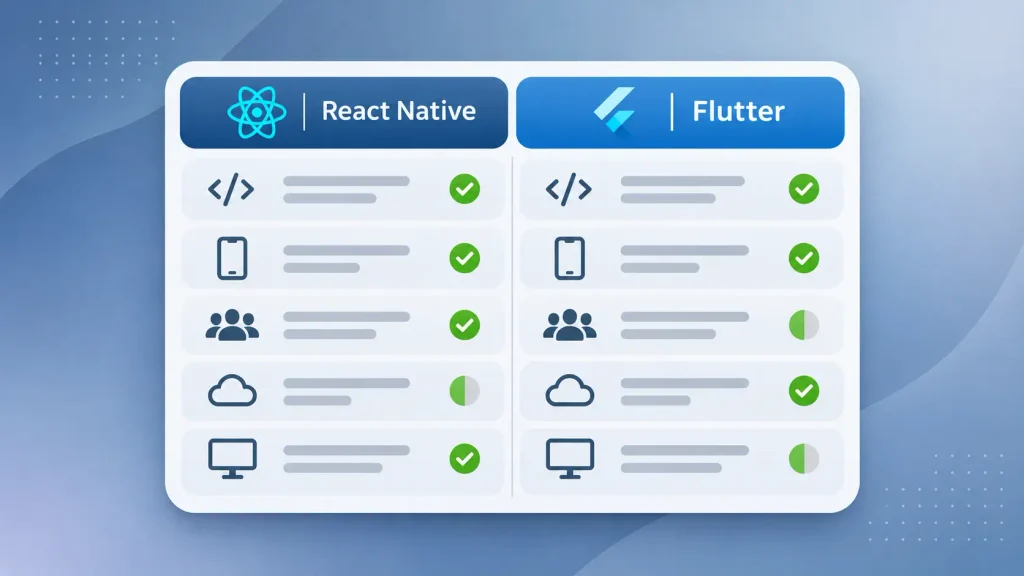
Here’s how that plays out on the criteria that actually affect your build:
| Criterion | React Native | Flutter |
| Language | JavaScript / TypeScript | Dart |
| How the UI is drawn | Native iOS and Android components | Its own rendering engine (Impeller) |
| Performance ceiling | Close to Flutter for most apps | Stronger for heavy custom animation |
| Look and feel | Matches each platform by default | Identical on every platform |
| Talent pool | Very large (JavaScript) | Smaller (Dart) |
| Over-the-air fixes | Mature (Expo EAS Update) | Third-party (Shorebird) |
| Web and desktop | Via community and Microsoft projects | Official targets in the SDK |
| Backed by | Meta |
If two rows on that table matter more to you than the rest, you probably already know where you land on React Native vs Flutter. The sections below show why each row lands where it does.
The One Difference That Drives All the Others
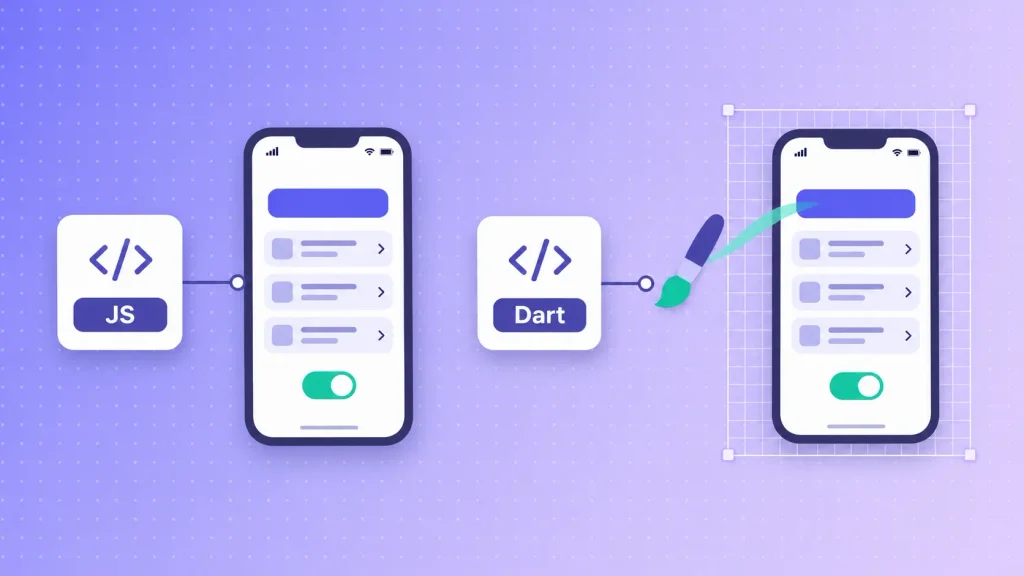
React Native renders real native controls. When your app shows a button on iOS, it’s an actual iOS button, driven by your JavaScript.
Flutter takes the opposite route. Your Dart code compiles to native machine code, and the engine paints every widget onto a canvas. No native platform widgets are involved at all.
That single choice explains most of the React Native vs Flutter differences that follow. It’s why Flutter apps look identical everywhere, and why React Native apps pick up platform behavior for free.
Is Flutter Faster Than React Native in 2026?
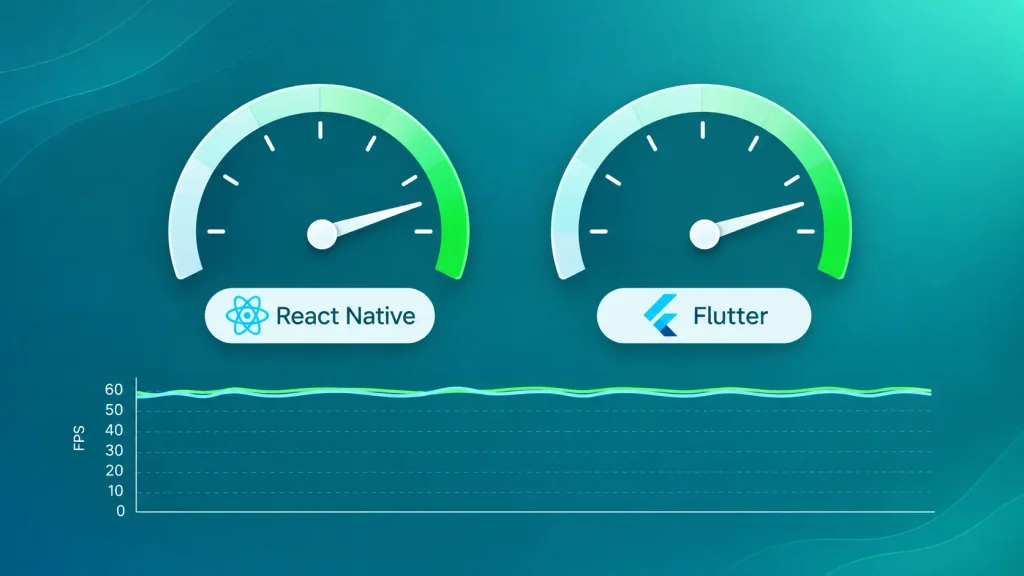
So, is Flutter faster than React Native? For most business apps, you won’t notice a difference. Both frameworks rebuilt their internals recently, and the old “Flutter for speed rule no longer holds by default.
React Native’s big shift came with version 0.76, which made the New Architecture the default and declared it ready for production. It replaced the old asynchronous bridge, the main cause of dropped frames in older apps.
Later releases kept building on the React Native New Architecture. Version 0.84 made Hermes V1 the default JavaScript engine and kept removing legacy code.
Flutter fixed its own weak spot. Its Impeller engine precompiles shaders at build time instead of at runtime, which removes the first-run stutter older Flutter apps had. Impeller is now the only renderer on iOS and the default on Android API 29 and up.
So where does a gap still show up? A few places:
- Heavy custom animation: long animated sequences, game-like screens, and intensive canvas work still favor Flutter, because it controls the whole rendering pipeline.
- Embedded native views: maps, WebViews, and video players favor React Native. Flutter wraps these in a PlatformView, which can cause jank in complex layouts, especially on Android.
- Everything else: forms, lists, dashboards, chat, and checkout flows run well on both.
If your app is a typical product (accounts, data, payments, notifications), I’d treat performance as a tie in the React Native vs Flutter decision and choose based on the factors below.
Look and Feel: Native Components vs Pixel-Perfect Branding
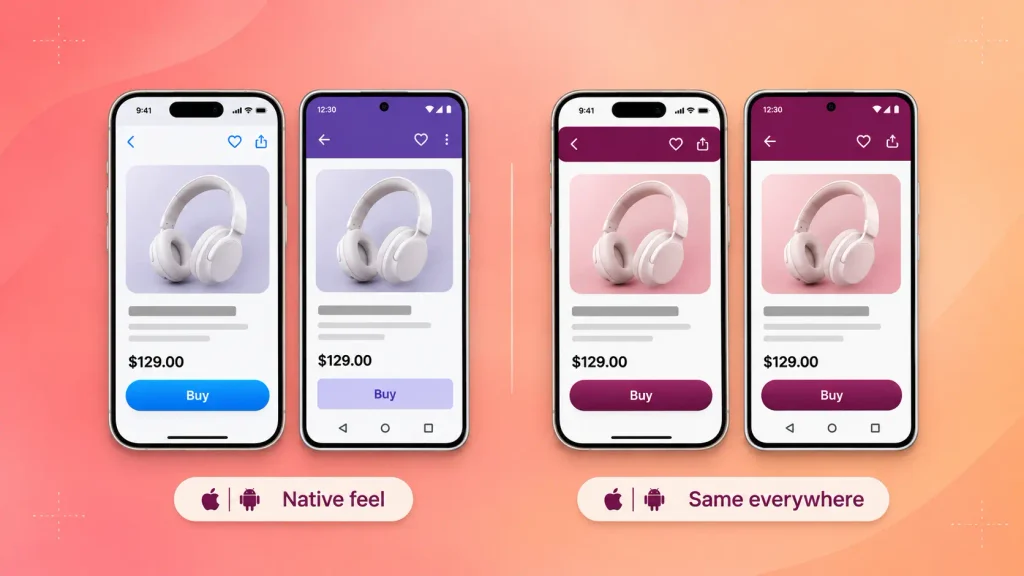
On design, Flutter vs React Native is a product question, not a technical one. React Native gives you each platform’s look and behavior by default. Flutter gives you one design that looks the same everywhere.
With React Native, a scroll view is the platform’s real scroll view. You inherit iOS scroll physics, Android’s touch feedback, system fonts, and accessibility hooks without extra work. The trade-off: your app looks slightly different on each platform, and getting them identical takes deliberate effort.
Flutter flips that. Your brand’s design system renders pixel for pixel on iOS, Android, web, and desktop. The catch shows up when Apple or Google redesign their UI. Because Flutter draws its own widgets, those changes have to be recreated in Flutter before your app can match them.
Here’s a quick way to tell which one matters more to you:
- You lean toward React Native if your users expect the app to feel like every other app on their phone, such as a banking, utility, or productivity app.
- You lean toward Flutter if your brand is the experience, such as a consumer app with a distinctive visual identity or heavy motion design.
Either way, good design work matters more than the framework. Our guide to mobile UI/UX best practices covers what to get right regardless of which one you pick.
Team, Hiring, and Cost: The Factor Most Comparisons Underweight
In React Native vs Flutter, the framework your team can staff for years matters more than the one that wins on paper. An app needs continuous engineering after launch, and a framework you can’t hire for becomes a liability fast.
The Talent Pool Math
JavaScript dwarfs Dart in raw developer numbers. In the 2025 Stack Overflow Developer Survey, 66% of respondents had done extensive work in JavaScript and 43.6% in TypeScript. Only 5.9% had worked in Dart.
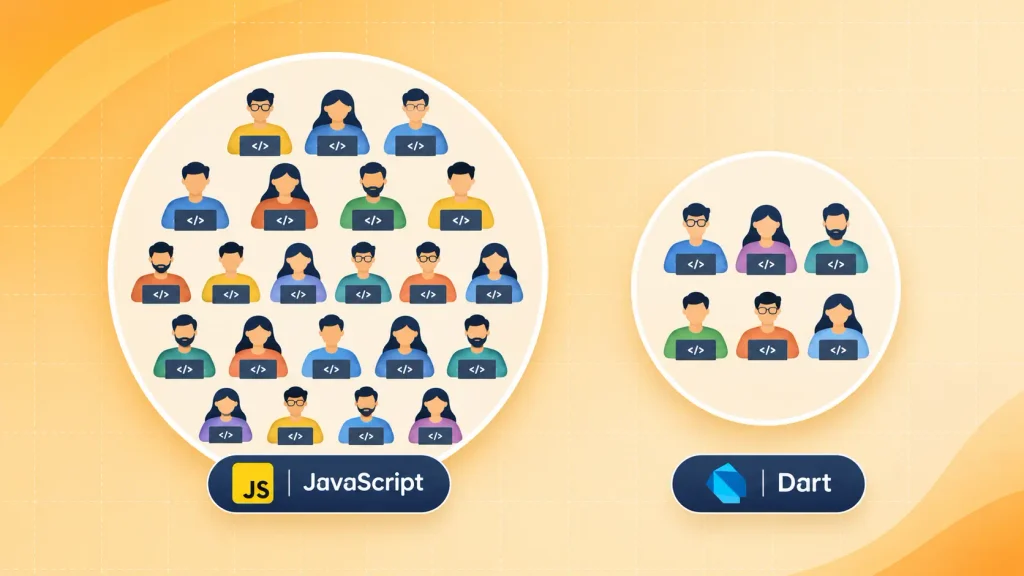
That’s roughly 11 JavaScript users for every Dart user in the survey. Not all of them build mobile apps, of course. But any React web developer can move into React Native far faster than they can learn Dart and Flutter’s widget model.
Among developers who already build cross-platform apps, the race is much closer. Statista’s 2023 survey had Flutter at 46% and React Native at 35%. JetBrains data analyzed by The New Stack showed 39% using React Native and 38% using Flutter among cross-platform developers. So Flutter has plenty of specialists. React Native just has a much larger pool to pull from. That gap matters most when you’re weighing React Native or Flutter for startups, where your first few hires shape the whole product.
Hiring Depends on Where Your Team Sits
Here’s the part most comparisons skip: the talent split isn’t the same everywhere. Stack Overflow data shows Germany and India lean toward Flutter, while the US and UK lean toward React Native.

That changes the decision depending on how you staff the build:
| Your setup | What to check |
| In-house team in the US or UK | React Native hiring is usually easier |
| In-house team in India or Germany | Flutter talent is strong locally |
| Outsourced development partner | Their bench depth in each framework, not the market’s |
| Mixed web and mobile team | Whether web developers can cover mobile too |
If you outsource, ask your partner how many senior engineers they have in each framework. A team with deep Flutter experience will ship a better Flutter app than a React Native shop learning on your budget.
What It Does to Your Budget
Both frameworks cut cost the same basic way: one codebase instead of two native apps. The difference comes from hiring speed, rates in your market, and how much custom native code your features need. That’s why the cost side of choosing React Native or Flutter for startups usually comes down to how fast you can hire.
You’ll find the full set of cost drivers in our mobile app development cost guide, so this section stays short.
Not sure which way your team and budget point? Talk to a Boomdevs mobile consultant and get a straight recommendation for your project before you commit.
Shipping Fixes After Launch: OTA Updates and Upgrades
Your launch is the start of the work, not the end. How fast you can push a fix, and how painful version upgrades are, will shape your team’s month far more than a benchmark ever will.
Over-the-Air Updates
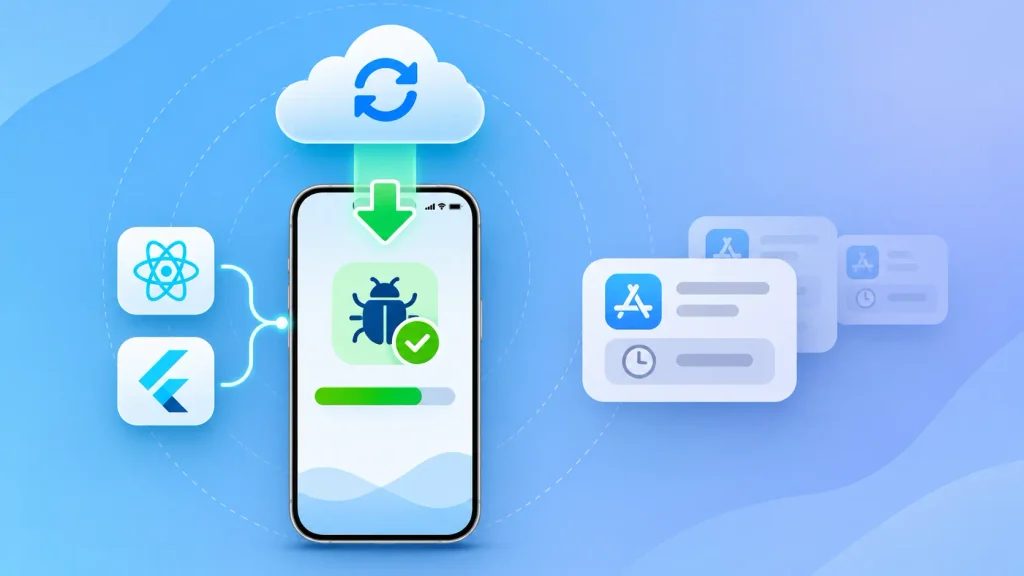
Over-the-air (OTA) updates let you fix a bug without waiting for an app store review. On this point, Flutter vs React Native isn’t close: React Native has a clear lead.
With Expo’s EAS Update, your app can update its JavaScript, styling, and images over the air, and users get the fix on their next launch. Flutter has no official equivalent. The main option is Shorebird, a third-party service that replaces the Flutter engine to add code push for Dart updates.
A few rules apply either way:
- Native changes still need a store release. OTA covers your JavaScript or Dart layer, not new native modules or SDK upgrades.
- Store guidelines still apply. Shorebird notes that patches must not change your app’s primary purpose under Apple’s developer agreement.
- It’s a fix tool, not a release strategy. Use it for bugs and small changes, not to sneak features past review.
If you ship to a large user base and a broken checkout costs real money, a mature OTA workflow is worth weighting heavily.
The Upgrade Tax
Both frameworks move fast, and you’ll pay a small tax every time you upgrade. The question is where that tax lands.
React Native’s tax has been the New Architecture migration. Apps built on the old bridge had to move over, and third-party native modules didn’t always keep pace. Expo softens this by bundling compatible versions together, which is one reason most new projects start there.
Flutter’s tax is different. Google controls the whole stack, so upgrades tend to be smoother, and Dart’s strict typing catches breaking changes at compile time. The downside is that skipping several versions can stack up deprecated widgets into one larger migration.
My advice: whichever you choose, budget a few days per quarter for upgrades. Teams that skip them end up with the kind of technical debt behind many of the reasons mobile apps fail.
When React Native Is the Better Choice
React Native fits best when your app sits inside a JavaScript company. If your web product runs on React or Next.js, the same people, patterns, and libraries carry straight into mobile.
It’s the stronger pick when:
- Your team already writes TypeScript or React. They’ll be productive in weeks, not months.
- You want to share logic with a web app. Validation, API clients, and state management can live in one place.
- You need fast fixes in production. EAS Update is mature and widely used.
- Your app leans on AI or third-party SDKs. OpenAI and Anthropic both ship official TypeScript SDKs, and npm covers most other integrations.
- You want each platform’s native feel without building it by hand.
It runs at real scale, too. Meta, Microsoft, Amazon, Shopify, and Wix all use React Native in production, and Shopify builds all its new mobile apps with it.
If that profile sounds like your team, our React Native app development team can take it from scoping to launch.
When Flutter Is the Better Choice
Flutter fits best when the interface is the product. If your app has a distinctive look, lots of motion, or needs to run on more than phones, Flutter’s control over every pixel pays off.
It’s the stronger pick when:
- Your UI is custom and animation-heavy. Flutter’s own engine keeps complex motion smooth because it controls every frame. Here, the answer to is Flutter faster than React Native? is a clear yes.
- Brand consistency beats platform feel. Your app looks identical on every device.
- You need web and desktop too. Flutter’s Impeller engine now defaults on macOS, Windows, and Linux, alongside official web support.
- You’re starting fresh with no existing JavaScript investment, so the language switch costs you nothing.
Flutter powers serious apps as well. Google rebuilt Google Pay in Flutter, and BMW built its My BMW app on it for both iOS and Android.
If you’re leaning this way, here’s how we approach Flutter app development for teams that want one codebase across every screen.
How to Choose Between React Native and Flutter
The fastest way to settle React Native vs Flutter is to answer a handful of questions about your team and product, in this order. Each one narrows the field more than any spec sheet can:
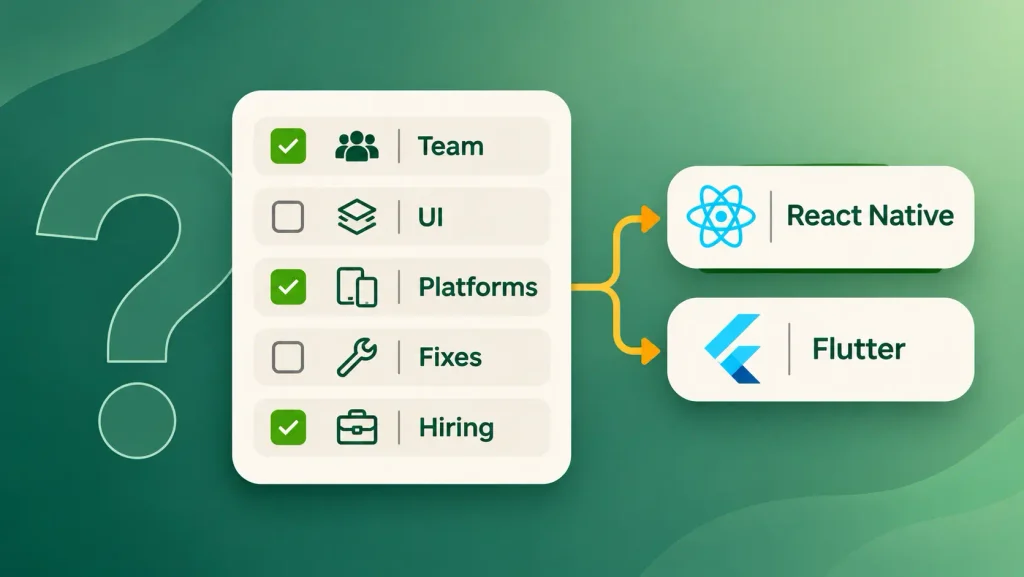
- Who will maintain this app in two years? If it’s your web team, lean React Native. If it’s a dedicated mobile team, both work.
- Is your UI standard or a signature feature? Standard screens fit either. Heavy custom motion points to Flutter.
- Do you need web or desktop from the same code? If yes, Flutter has the more complete story.
- How often will you need emergency fixes? If often, React Native’s OTA workflow is a real advantage.
- Where is your team, and what can they hire for? Check the local market or your partner’s bench before anything else.
Then match your answers to the situation that fits best:
| Your situation | Lean toward | Why |
| React or Next.js web team adding mobile | React Native | Shared skills and code |
| Brand-led consumer app with rich motion | Flutter | Full control of every pixel |
| One product across mobile, web, desktop | Flutter | Official multi-platform targets |
| Startup MVP that must iterate weekly | React Native | Fast OTA fixes, larger hiring pool |
| AI-first app calling cloud models | React Native | Official TypeScript AI SDKs |
If your answers split down the middle, either side of the Flutter vs React Native choice will serve you well. Pick the one your team can hire for, and move on. Our step-by-step guide on how to build a mobile app covers what comes after the framework decision.
When Neither Is Right
Sometimes the honest answer to React Native vs Flutter is neither: a fully native app. If you need deep hardware access, a single platform, or new OS features the week they launch, Swift and Kotlin may serve you better. Kotlin Multiplatform is another middle path that shares business logic while keeping native UI. We cover that trade-off in detail in native vs cross-platform app development.
How Boomdevs Solves the Framework Decision
Boomdevs builds production apps in both React Native and Flutter, so the recommendation comes from your requirements, not from the stack we happen to sell. We start with your team, your product, and your release needs, then pick the framework that fits.
Here’s what that looks like in practice:
- A short framework assessment that maps your answers to the questions above.
- Senior engineers in both stacks, so you’re never the training project.
- A delivery plan that includes upgrades and OTA setup, not just launch day.
Over 10 years and 3.5K+ projects, we’ve seen the framework choice make or break maintenance costs long after launch. Book a free call with Boomdevs and get a clear framework recommendation for your app in one conversation.
Frequently Asked Questions
Is React Native Dying?
No. The React Native New Architecture became the default in version 0.76, and the framework keeps releasing regularly. Meta, Microsoft, Amazon, and Shopify all run it in production, and Shopify builds its new mobile apps with it.
Is React Native or Flutter Better for a Startup MVP?
Both can ship a solid MVP. React Native usually wins when you need to hire fast or push weekly fixes over the air. Flutter wins when your MVP’s value depends on a polished, custom interface.
Which Is Easier to Learn, React Native or Flutter?
React Native is easier if you already know JavaScript or React, since the component model carries over. Flutter means learning Dart, but its structure and documentation are consistent, so developers from Java or Kotlin often pick it up quickly.
Can React Native and Flutter Build Web and Desktop Apps?
Yes, with different levels of support. Flutter includes official web, Windows, macOS, and Linux targets in its SDK. React Native reaches the web and desktop through community and Microsoft-maintained projects, which work but get less polish than mobile.
Which Is Better for AI-Powered Apps?
React Native has the edge for apps that call cloud AI models, because OpenAI and Anthropic both ship official TypeScript SDKs. Flutter works well too, especially with Google’s own Firebase AI packages, but community wrappers for other providers can lag behind.