


- 1. Key Takeaways
- 2. What Software Development Consulting Actually Includes
- 3. Software Development Consulting vs Outsourcing vs Staff Augmentation
- 4. When You Need a Software Development Consultant (and When You Don't)
- 5. How a Software Consulting Engagement Works
- 6. How Much Software Development Consulting Costs in 2026
- 7. How to Choose a Software Development Consulting Firm
- 8. How to Tell If the Engagement Is Working
- 9. How Boomdevs Fixes Misaligned Builds Before the First Sprint
- 10. Frequently Asked Questions
Summarize with
Your board approved the budget last week. Your lead developer wants to rebuild in a new framework. Your agency wants to start sprints on Monday.
Everyone has a plan, and every plan suits the person pitching it. You’re the one who has to sign off.
A neutral second opinion is exactly what software development consulting gives you. Here’s what you actually get from it, what it costs in 2026, and when it’s worth paying for.
Key Takeaways
- What it is: software development consulting is paid, independent advice on what to build and how, before or during development.
- What it costs: software consulting rates run roughly $50 to $400 an hour in 2026, with most US and UK boutique firms charging $150 to $250.
- How long it takes: two to four weeks for a focused audit or roadmap, four to eight weeks for full strategy and architecture.
- When it pays off: a new product, a stalled build, a scaling wall, or a regulated market, anywhere a wrong early call gets expensive.
- When it doesn’t: an off-the-shelf tool already solves the problem, or you have a senior technical lead with time to own the plan.
What Software Development Consulting Actually Includes
With software development consulting, you bring in an experienced team to make the big technical calls alongside you. What goes into version one, how the system is structured, which stack fits, and who should build it.
It’s technical advisory and technology strategy in one engagement. The consultant advises, documents, and reviews. Building can come later, from them or from someone else. If you want to see how that looks as a service, the Boomdevs software development consulting page lays out the full menu.
What a Software Development Consultant Does

Think of a software consultant as a translator between your business goals and your engineering team, with enough experience to say “not like that.” Day to day, the work looks like this:
- Reads your business first: goals, users, budget, deadlines, and the constraints nobody wrote down.
- Audits what already exists: codebase, infrastructure, integrations, and security, if anything is built yet.
- Makes the expensive calls: software architecture, tech stack, build versus buy, and what makes the first release.
- Reviews the build: code reviews, sprint check-ins, and a second opinion when your team hits a fork.
- Hands over cleanly: every decision written down, so your developers aren’t guessing.
Notice what’s missing from that list. Writing most of the code isn’t the core job of software development consulting. The same split shows up in narrower roles too, as you’ll see in this breakdown of what a mobile app consultant does.
The Deliverables You Should Walk Away With
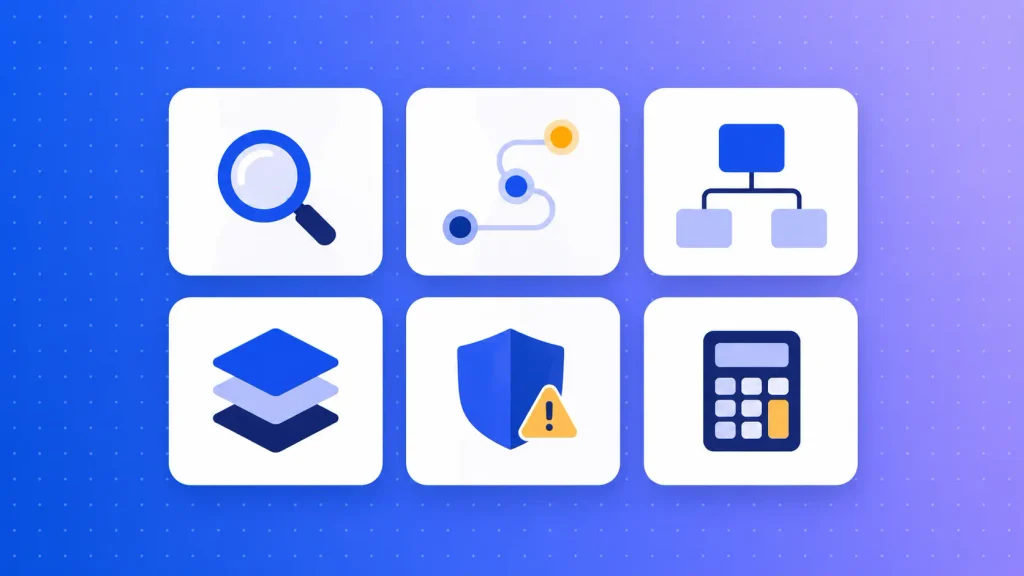
Most proposals stay vague here, and that’s a problem. A good software development consulting engagement ends with documents your team can act on next week, not a slide deck that ages quietly in a shared drive.
Here’s what you should expect in hand, and who on your side uses each one:
| Deliverable | Question it answers | Who uses it |
| Discovery summary | What problem are we really solving? | Founders, product lead |
| Prioritized product roadmap | What ships first, and why? | Product, investors |
| Architecture blueprint | Will this hold up at 10x the users? | Engineering |
| Tech stack recommendation | Which tools, and what are the trade-offs? | Engineering, hiring |
| Technical audit report | What’s broken or risky today? | CTO, leadership |
| Scope and estimate | What will the build cost and take? | Finance, leadership |
If a firm offering software consulting services can’t tell you which of these you’ll get, ask before you sign. Stack choice alone deserves real attention, and our guide on choosing the right tech stack for web apps goes deeper on that one decision.
Software Development Consulting vs Outsourcing vs Staff Augmentation
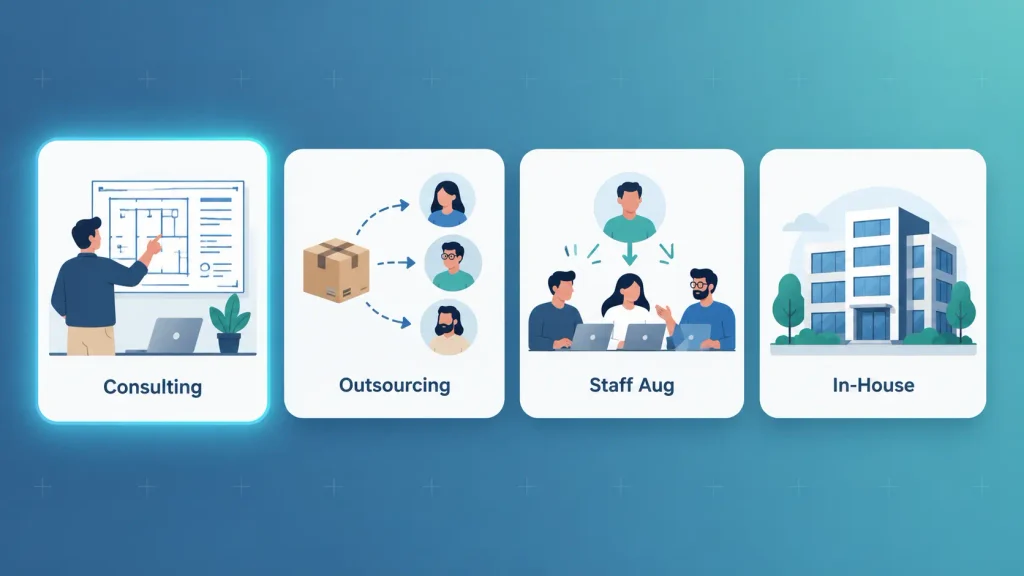
The real difference in software consulting vs outsourcing comes down to one question: who decides what gets built? In consulting, an outside expert shapes the plan with you. In outsourcing, an outside team executes a plan you already have. With staff augmentation, you add people and keep every decision yourself.
Thoughtworks, which runs both consulting and outsourcing work, frames it the same way: consultants diagnose the problem and propose the fix, while outsourcing teams solve problems the client has already defined, using the client’s chosen technology.
Side by side, the four common models compare like this:
| Model | Who decides what to build | Who writes the code | Best when |
| Consulting | The consultant, with you | Your team or theirs | The plan itself is uncertain |
| Project outsourcing | You, up front | The outside team | Scope is clear and stable |
| Staff augmentation | You, ongoing | Embedded hires you manage | You have a lead but lack hands |
| In-house team | You | Your employees | Software is your long-term core |
Plenty of projects use two of these in sequence. A short software development consulting phase sets the plan, then IT staff augmentation or an outsourced team builds it. The costly mistake is skipping the first step and going straight to sprints.
When You Need a Software Development Consultant (and When You Don’t)
You need a software development consultant when a wrong decision now would cost far more than the advice. That’s usually at the start of a product, in the middle of a stalled build, or right before you scale.
The stakes are real. A McKinsey and University of Oxford study of more than 5,400 IT projects found large projects ran 45% over budget and delivered 56% less value than predicted, with software projects carrying the highest overrun risk. Those were big enterprise programs. The root causes, like goals nobody pinned down and stakeholders nobody aligned, show up at every size.
Signs It’s Time

If you recognize your situation below, it’s worth a conversation:
- You’re about to build version one: the cheapest moment to fix scope and architecture is before the first sprint. Early-stage founders often pair this with MVP design and product strategy.
- Your build has stalled: deadlines keep slipping, costs keep climbing, and nobody can explain why.
- Your product works now but won’t at scale: more users, more data, or a new market will break what you have.
- You’re running on legacy systems: every change is slow and risky. This software modernization strategy guide covers the keep, refactor, or replace decision in depth.
- You’re entering a regulated space: healthcare, fintech, and payments punish compliance gaps found late.
- You have no senior technical voice: you’re a non-technical founder, or the CTO seat is empty and a fractional CTO isn’t in place yet.
One of these is reason enough to look at software consulting services. Two or more usually means you’re already paying for the missing advice, just in rework.
When a Consultant Is the Wrong Spend
Here’s the part most consulting firms leave out of the sales deck. Sometimes you don’t need one, and paying for it anyway is waste:
- An off-the-shelf tool already does the job: if a subscription covers almost everything you need, planning a custom build is backwards. Our comparison of custom software vs off-the-shelf helps you check honestly.
- You already have a senior technical lead with time: if that person owns the roadmap and has room to think, a consultant mostly repeats their work.
- The change is small and well understood: a new integration or a feature with a clear spec doesn’t need a strategy phase.
- You won’t act on what you hear: a report you plan to ignore is the most expensive document you’ll ever buy.
In those cases, put the money into building. Consulting earns its fee when it changes a decision.
How a Software Consulting Engagement Works
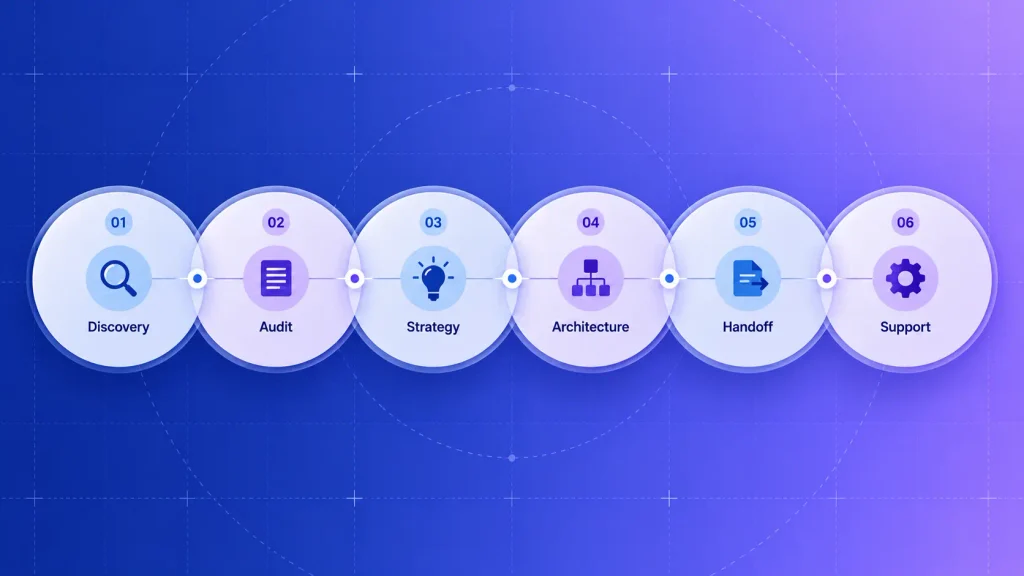
Most engagements follow the same arc across the software development lifecycle (SDLC): understand, assess, decide, document, then support the build. The stage names change from firm to firm. The order shouldn’t.
A typical engagement runs through six stages:
- Discovery: interviews with you, your team, and sometimes your users, to pin down goals, constraints, and what success means in numbers.
- Technical audit: a review of existing code, infrastructure, and integrations. A brand-new product skips this.
- Strategy and roadmap: what to build first, what to leave out, and a realistic sequence.
- Architecture and stack: the technical foundation, with every major choice written down and justified.
- Handoff: specs and documents your developers can start from on day one.
- Implementation support: reviews and check-ins while the build runs, so the plan you agreed on is the plan that ships.
Stages five and six are where weak engagements fall apart. Advice that stops at a deck tends to get quietly rewritten by the first sprint.
How Long It Takes
A focused audit or roadmap session usually takes two to four weeks. A full strategy and architecture engagement typically runs four to eight weeks, based on the timelines Boomdevs works to.
Independent firms land in the same range. RaftLabs, for example, puts a well-run discovery phase at two to four weeks. After that, many teams keep a consultant on a light monthly advisory basis while the build runs.
How Much Software Development Consulting Costs in 2026
Software development consulting typically costs $50 to $400 an hour in 2026, according to a 2026 rate breakdown from RaftLabs. Where you land depends on who you hire, where they’re based, and how specialized the work is.
Rates by Firm Type and Region
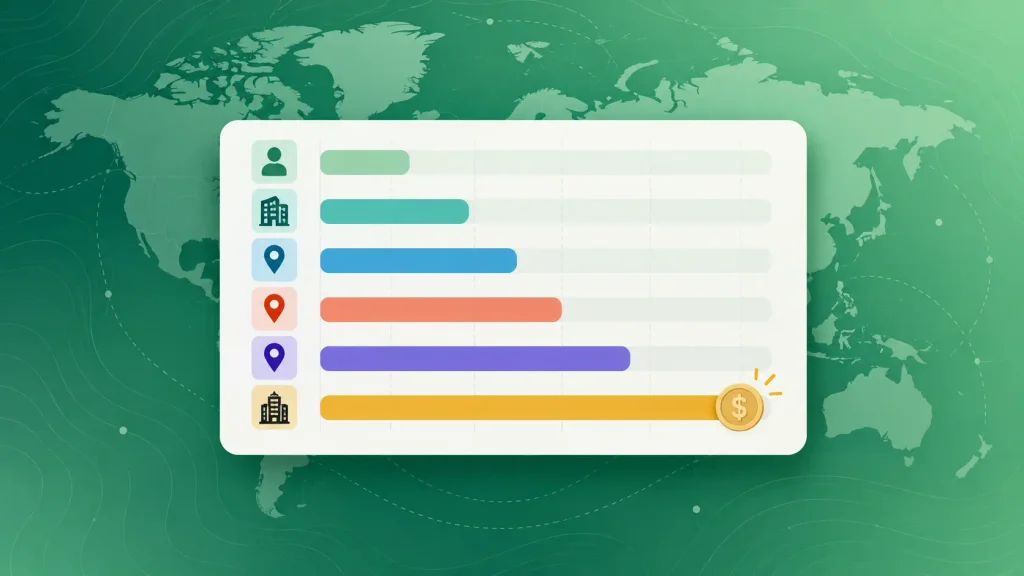
Firm type and geography explain most of that spread. Here’s how the same source breaks it down:
| Who you hire | Typical hourly rate | What you usually get |
| Independent freelancer | $75 to $150 | One senior person, working to your spec |
| Boutique firm, US or UK | $150 to $250 | A team, architecture, delivery management |
| Firm in Eastern Europe | $50 to $120 | Strong engineering, some time-zone offset |
| Firm in Latin America | $40 to $100 | Good overlap with US working hours |
| Firm in India | $25 to $75 | Lowest rates, closer oversight needed |
| Big 4 or tier-one consultancy | $300 and up | Brand and governance overhead |
Specialization stacks on top of that. The same breakdown puts AI and machine learning consulting at $175 to $350 an hour, and our AI consulting cost guide covers that market specifically. If you’re budgeting the build itself, not just the advice, see what custom web app development costs.
Hourly vs Fixed-Price vs Retainer
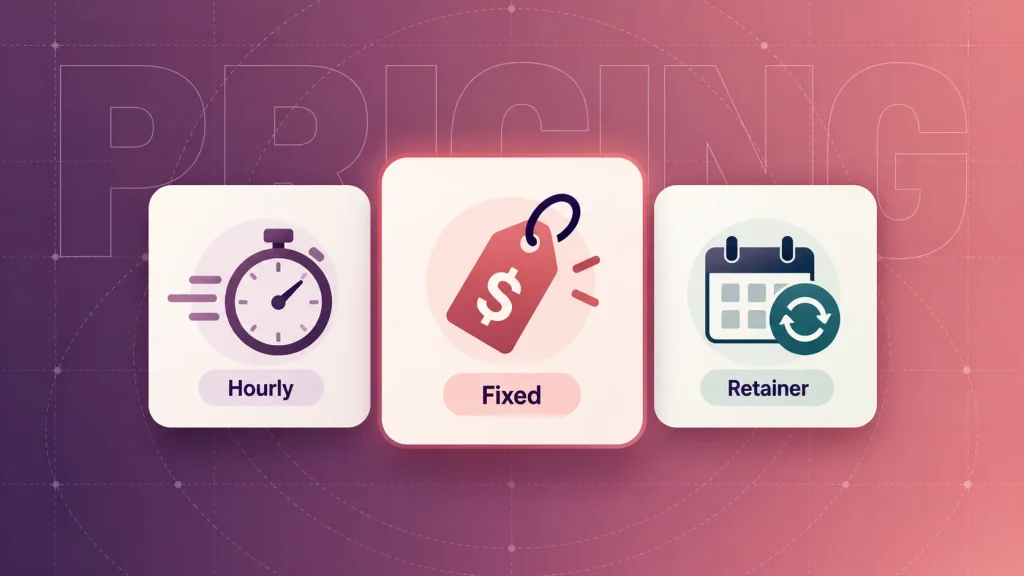
How you pay matters as much as the rate. It decides who absorbs the cost when the plan changes or scope creep sets in:
| Pricing model | Who carries the overrun risk | Best for |
| Hourly (time and materials) | You | Open-ended research, unclear scope |
| Fixed price | The consulting firm | A defined audit, roadmap, or discovery phase |
| Monthly retainer | Shared | Ongoing advisory once the build starts |
RaftLabs reports discovery phases at roughly $5,000 to $15,000 and retainers at $8,000 to $25,000 a month. I’d push for a fixed price on any phase with a clear output. Hourly billing with no ceiling gives the firm no reason to move quickly.
Want a number for your own project instead of a range? You can book a free strategy call with Boomdevs and get a scoped estimate.
How to Choose a Software Development Consulting Firm
The right firm spends more time on your problem than on its pitch. You’ll learn most by watching how they handle the first conversation.
Questions to Ask Before You Sign
These questions separate real consultants from sales teams pretty quickly:
- Who exactly will work on this? Names, seniority, and how much of their week you get.
- What will I have in hand at the end? Ask them to map the answer to specific deliverables.
- What would you tell me not to build? A good consultant has an opinion here. A weak one agrees with everything.
- Have you done this at my stage and in my industry? Ask for a case study you can verify.
- Is the fee fixed, capped, or open? And what triggers a change order?
- Do you also build, and could that bias your advice? It’s fine if they build. It’s not fine if they dodge the question.
I’d suggest calling two references and asking one thing: what did the firm push back on? The answer tells you whether you’re buying advice or agreement.
Onshore, Nearshore, or Offshore
Onshore firms share your country and time zone, which makes long strategy sessions easy, but you pay the highest rates. Nearshore firms sit a few hours away and usually cost less.
Offshore firms offer the biggest rate gap. They work well when the firm keeps a reliable daily overlap window and writes things down clearly.
For consulting specifically, time-zone overlap matters more than it does for pure development. Strategy happens in conversation, so you’ll want at least a few shared working hours.
Red Flags That Should End the Conversation

Some warning signs aren’t worth negotiating around:
- A quote after one short call: they’re pricing a template, not your problem.
- A favorite stack before discovery: if the answer arrives before the questions, it’s a pitch.
- No names on the team: you’re entitled to know who’s doing the thinking.
- Vague deliverables: “strategic guidance” is not a deliverable.
- No ownership terms: if IP and document ownership aren’t spelled out, walk away.
Any one of these is reason enough to keep looking.
How to Tell If the Engagement Is Working
You’ll know within the first few weeks. Good consulting changes decisions, and you can watch that happen:
- Decisions are getting made: open questions close each week instead of piling up.
- Your scope got smaller or sharper: a first release that shrank is usually a sign the work is honest.
- Your team can explain the plan: if only the consultant understands it, the handoff will fail.
- Estimates hold: the build budget after consulting stays close to the number you were given.
- Risks are named early: in writing, with an owner next to each one.
If none of this is happening by week three, say so. A good firm will want to hear it.
How Boomdevs Fixes Misaligned Builds Before the First Sprint
Boomdevs runs consulting the same way it runs builds. Start from the business problem, write down every decision, and stay involved through implementation. With 3,500+ projects delivered over 10+ years, the advice comes from software that actually shipped.
That includes rescues. BatchLearn came to Boomdevs after a failed attempt with another agency, and the platform now serves 100+ schools.
You can bring Boomdevs in for whichever piece you need:
- A fixed-scope audit or roadmap when you need a second opinion fast.
- Architecture and stack planning before you hire a team or sign a build contract.
- Mid-project recovery when a build has stalled, including legacy application modernization.
You can take the plan to your own team or have Boomdevs build it. Either way, you start knowing what to build. Book a free strategy call and get a straight read on your plan before the next sprint starts.
Frequently Asked Questions
Is Software Development Consulting Worth It for a Startup?
Usually, if you’re about to commit serious money to a first build and nobody on your team has shipped something similar. A few weeks of planning costs far less than rebuilding version one. If you already have an experienced technical cofounder, you’ll need less of it.
Does a Software Development Consultant Write Code?
Sometimes, but it isn’t the main job. A consultant’s output is decisions and documents: the roadmap, the architecture, and the stack. Many firms, Boomdevs included, can also build, but you’re free to take the plan to any team.
How Is Software Consulting Different From IT Consulting?
Software consulting focuses on products you build: what to build, how to architect it, and how to ship it. IT consulting usually covers the systems you run, like infrastructure, networks, security, and internal tools. The two overlap on cloud and integrations.
Can You Hire a Software Consultant Mid-Project?
Yes, and it’s one of the most common reasons people do. The consultant audits what’s been built, finds where the plan broke, and gives you a path forward. The sooner you bring them in after things start slipping, the cheaper the fix.
What Should a Software Consulting Proposal Include?
Named team members, a list of deliverables, a timeline, and a pricing model with clear limits. It should also state who owns the documents and any code. If one of these is missing, ask before you sign.