


- 1. Key Takeaways
- 2. How Can C Be Used in Web Development?
- 3. Understanding C Language
- 4. History of C Language
- 5. C Web Frameworks and Libraries Worth Knowing
- 6. Can C Run in the Browser? Yes, Through WebAssembly
- 7. Is C Frontend or Backend?
- 8. When to Use C for Web Development
- 9. Advantages of Using C for Web Development
- 10. Limitations of Using C for Web Development
- 11. Can You Build a Website Using Only C?
- 12. Comparing C With Other Web Development Languages
- 13. Use of C and Key Applications
- 14. How the C Programming Language Works
- 15. How to Learn C Programming
- 16. Why Learn C Language?
- 17. Future of C Programming Language
- 18. What This Means If You’re Building a Web Product
- 19. How Boomdevs Solves the C vs. Speed-to-Market Trade-Off
- 20. Frequently Asked Questions
- Can the C Programming Language Be Used for Web Development?
- What Is CGI Programming in the Context of C and Web Development?
- How Do I Write a Simple CGI Program in C?
- Can I Use C to Write a Web Server?
- What Are the Advantages of Using C for Web Development?
- What Are the Limitations of Using C for Web Development?
- Why Is C Not Commonly Used for Web Development?
- In What Scenarios Is Using C for Web Development Beneficial?
- How Does C Compare to Other Web Development Languages Like PHP and JavaScript?
- Can Learning C for Web Development Improve My Programming Skills?
- Is C Used for Frontend or Backend?
- Can I Make a Website Using Only C?
- Are There Web Frameworks for C?
- Is C the Same as CSS?
- What Does a C Developer Do for a Web Project?
- 21. The Bottom Line on C for Web Development
Summarize with
Can C be used for web development? When you think about web development, you probably picture HTML, CSS, and JavaScript, not a systems language built for drivers and firmware.
That instinct is half right. C can be used for web development, and it already runs under almost every site you visit. It just rarely builds the pages and features your users actually click.
Here’s where C fits on the web, where it becomes a liability, and how to decide whether it belongs in your own project.
Key Takeaways
- C already powers the web’s plumbing: web servers, reverse proxies, databases, and the runtimes other web languages run on.
- You can build with it directly through CGI, embedded HTTP libraries, C web frameworks, or WebAssembly in the browser.
- The real trade-off isn’t speed. It’s development time, memory safety, and how hard it is to hire people who write C safely.
- For most websites and SaaS products, Go, Rust, Python, PHP, or Node.js will get you to launch faster with fewer security risks.
How Can C Be Used in Web Development?
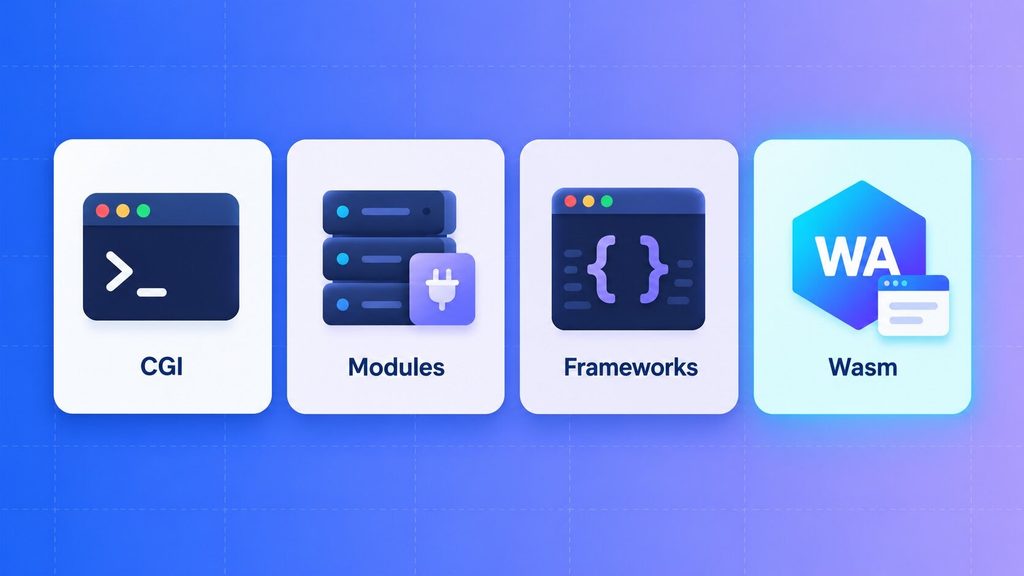
You can use C on the web in four practical ways. Each one sits at a different layer of the stack, so the right answer depends on what you’re building.
Some of these routes are decades old. One of them is the most interesting thing to happen to C in years.
CGI and FastCGI Programs
CGI stands for Common Gateway Interface. It’s the oldest route: your web server runs a compiled C program for each request, and that program prints the HTML or JSON response.
FastCGI fixes CGI’s biggest weakness. Instead of starting a fresh process for every visitor, it keeps your program running and feeds it requests one after another.
Both still work. Today you’ll mostly find them in internal tools and legacy systems rather than new products.
Web Servers and Server Modules
This is where C quietly dominates. Nginx and the Apache HTTP Server are both written in C, and they handle every connection before your application code sees a single request.
When a team needs speed at that layer, it writes custom C modules to extend the server itself. It’s specialist work, but it’s real web development.
Web APIs With C Libraries and Frameworks
You can also let a C program speak HTTP on its own. Libraries like GNU libmicrohttpd and frameworks like Kore handle the protocol, so your code can focus on routes and responses.
The main options get a full breakdown in the frameworks section below.
Browser and Edge Code Through WebAssembly
Compilers such as Emscripten convert C code into WebAssembly, a binary format that all major browsers are able to run. Your current C code can then be run right alongside your JavaScript.
The same idea now reaches servers and edge platforms through WASI. For C on the web, this is the route that has changed most in recent years.
Here’s how the four routes compare at a glance:
| Route | Where it runs | Best used for |
| CGI and FastCGI | Behind a web server | Simple tools, legacy systems |
| Server modules | Inside Nginx or Apache | Connection-level performance |
| C libraries and frameworks | Your own server process | Lean APIs, device dashboards |
| WebAssembly | Browser, server, or edge | Reusing existing C code |
Notice that only one of the four touches the browser. That detail answers the frontend or backend question you’ll see later on.
Understanding C Language
Picture code that runs straight on the processor, with nothing translating it at runtime. That’s C: a compiled, general-purpose language created at Bell Labs in the early 1970s.
You write source code, a compiler turns it into machine code, and the result runs directly on the hardware. That directness is why C still powers operating systems, drivers, and embedded firmware.
The trade-off shows up fast on the web. C ships with no built-in tools for HTTP, sessions, or HTML templates, so each one comes from a library or from code you write yourself.
Its fingerprints are everywhere, though:
- Syntax: C++, Java, C#, JavaScript, and Go all borrow its curly braces, semicolons, and control flow.
- Runtimes: CPython, the standard Python interpreter, is written in C.
- Infrastructure: the Linux kernel and SQLite are both C projects.
That overlap is also why web development and software development blur together more than people expect. If you want the business side of that picture, our guide to software development for business covers it.
History of C Language
C grew out of a practical problem. Between 1969 and 1973, Dennis Ritchie developed it at Bell Labs from Ken Thompson’s earlier language, B, because UNIX was stuck in assembly language.
Assembly made UNIX slow to extend and painful to move to new machines. By 1973, C was mature enough that the team rewrote the UNIX kernel in it.
The milestones since then are worth knowing:
- 1978: Brian Kernighan and Dennis Ritchie publish The C Programming Language, the book that carried C far beyond Bell Labs.
- 1989: ANSI ratifies the first official standard, known as ANSI C or C89. ISO adopts it in 1990 as C90.
- 1999 and 2011: the C99 and C11 revisions modernize the language.
- 2024: C23, formally ISO/IEC 9899:2024, is published on October 31, 2024.
C also shaped what came after it. C++ started as an extension of C, and Java, C#, and JavaScript borrowed heavily from its syntax.
C Web Frameworks and Libraries Worth Knowing
Yes, C has web frameworks. The ecosystem is small and uneven, and nothing in it comes close to Django, Laravel, or Express, so you’ll write more of the plumbing yourself.
These are the options you’ll actually run into:
| Tool | What it does | Best fit |
| GNU libmicrohttpd | Embeds a small HTTP server in your C program | Adding a web UI or API to existing C software |
| Kore | Web API framework with TLS on by default, optional PostgreSQL | New APIs for teams already fluent in C |
| Onion (libonion) | HTTP server library with WebSockets, SSL, templating | Small apps that need more than bare routing |
| CGI on Apache or Nginx | Server runs a C binary per request | Internal tools, learning projects |
If you’re weighing them, start from what you already have. libmicrohttpd suits code that exists today, while Kore suits an API you’re choosing to write in C on purpose.
One caution before you commit. The FreeBSD ports collection retired its Kore package in January 2025 after marking it unmaintained and broken.
That says more about packaging than about Kore itself. Still, in a small ecosystem, one stalled project can leave you owning the whole stack, so it’s worth checking commit history before feature lists.
Database and Cache Clients in C
A web app is only as useful as the data behind it. The good news is that the major data stores have mature C clients:
- PostgreSQL: libpq is the official C client library, and Kore builds asynchronous PostgreSQL support on top of it.
- Redis: hiredis is the minimal C client maintained under the Redis organization.
- SQLite: it’s written in C, so you can embed the whole database directly inside your program.
What you won’t find is a full ORM, a migrations tool, or an admin panel. Those are exactly the conveniences other ecosystems hand you for free.
Can C Run in the Browser? Yes, Through WebAssembly
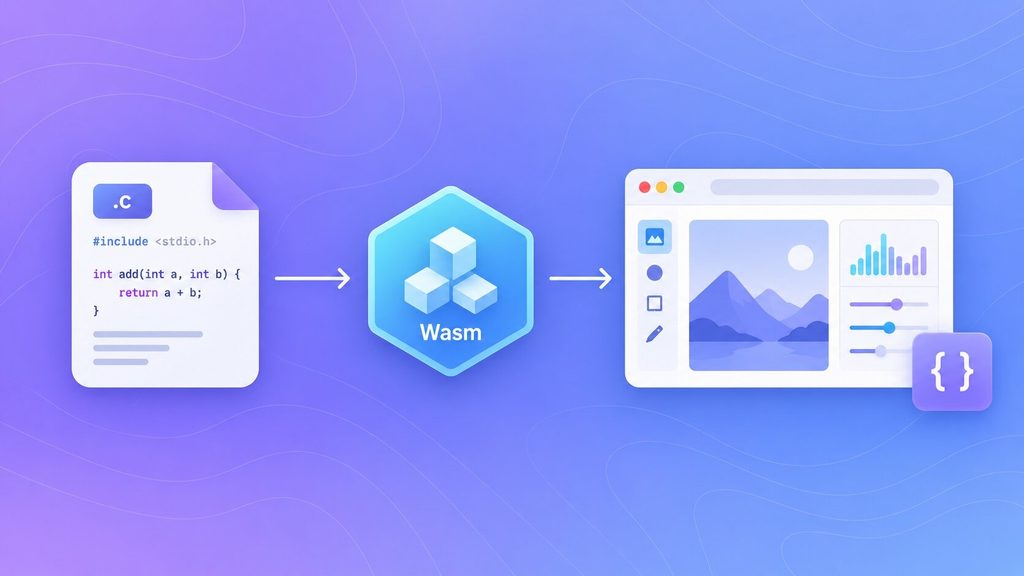
C can’t replace JavaScript in the browser, but it can run right beside it. You compile C to WebAssembly (Wasm), a compact binary format all major browsers execute, then call it from JavaScript like any other module.
This isn’t a hack. The WebAssembly FAQ says the format initially focused on C and C++, and Fermyon’s C guide notes its original designers had C in mind as a target language.
C in the Browser With Emscripten
Emscripten is the standard toolchain for this. It compiles C and C++ to WebAssembly through LLVM, and its output runs in browsers, in Node.js, and in standalone Wasm runtimes.
It’s how big native codebases reach the web without a rewrite. SQLite, AutoCAD, and the Unity engine’s HTML5 export have all been brought to the browser with Emscripten.
Solita’s developers even built a small to-do app with a front end in mostly pure C. Their own verdict was that it made a fun experiment, not a recommendation, which is a fair summary.
WebAssembly with C makes sense when you’re:
- Porting an existing C library such as image processing, compression, or a physics engine, instead of rewriting it in JavaScript.
- Running CPU-heavy work in the browser, like audio, video, or large data calculations.
- Sharing one core library across your backend, desktop app, and web app.
It doesn’t make sense for buttons, forms, and layouts. WebAssembly still talks to the page through JavaScript, so your UI stays in HTML, CSS, and a JavaScript framework. Mozilla’s guide to compiling C to Wasm is a good first stop if you want to try it.
C on the Server and Edge With WASI
WebAssembly isn’t only for browsers anymore. With WASI, the WebAssembly System Interface, you can compile C into a Wasm module that runs on servers and edge platforms inside a sandbox.
Fermyon’s guide walks through a C program compiled with the WASI SDK and served over HTTP by a Wasm runtime. The catch: not all of the C standard library works in that sandbox, and the guide notes sockets weren’t supported when it was written.
For you, that opens a middle path. You can keep proven C logic, but run it somewhere that limits the damage a memory bug can do.
Is C Frontend or Backend?
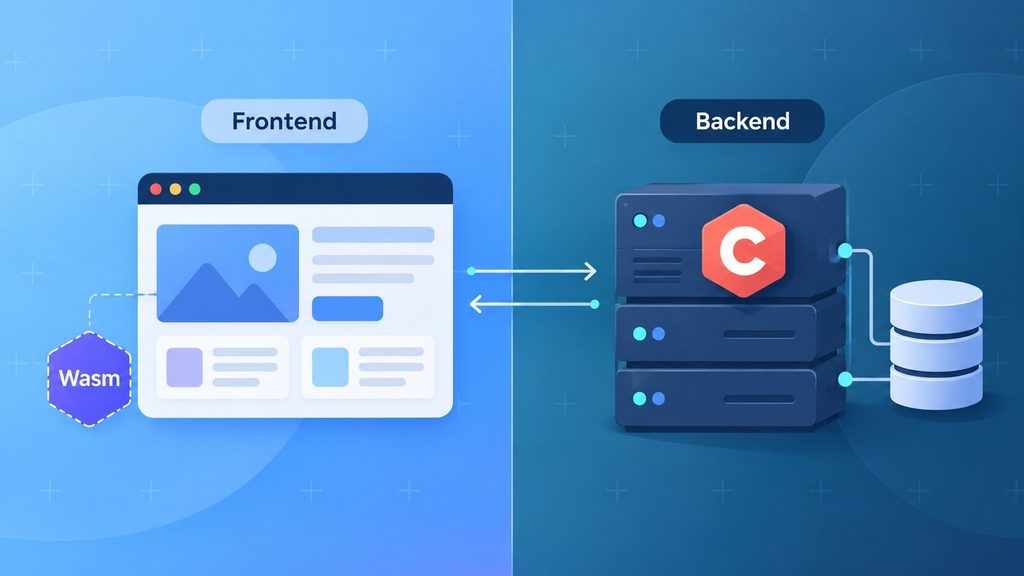
C is a backend language. When it’s part of a web project, it runs on the server: inside the web server, behind an API, or on a device serving its own dashboard.
The only exception is WebAssembly. There, compiled C runs in the browser, but it does the heavy computing while HTML, CSS, and JavaScript draw what users see.
Here’s the split in plain terms:
- Frontend: everything that runs in your user’s browser, meaning HTML, CSS, JavaScript, and any WebAssembly modules.
- Backend: the server side, meaning routing, business logic, databases, and authentication.
- Where C lands: backend by default, frontend only as compiled Wasm.
If you’re mapping other stacks the same way, our breakdown of whether .NET Core is backend or frontend follows the same logic. For the browser side, see whether jQuery counts as a front-end framework.
When to Use C for Web Development
C earns a place in a web project when speed, memory, or hardware access is the actual problem. If none of those is your bottleneck, it’s usually the wrong tool.
Three situations where it genuinely fits:
Performance-Critical Applications
When every microsecond or megabyte counts, C pays for itself. Think of a custom module handling huge connection volumes inside a web server, a real-time data feed, or a compression step that runs on every request.
Usually it’s one hot path in C, with the rest of your app in a higher-level language. That split gives you speed where it matters without paying for C everywhere.
Learning and Experimentation
Building a web server in C is one of the best ways to see what frameworks hide from you. You’ll open sockets, parse raw HTTP, and manage every byte of memory yourself.
It’s a brilliant learning project. It’s a poor way to ship a product on a deadline.
Embedded Systems
On embedded systems and IoT devices, C is often the only realistic choice. The admin page you open for a router or a smart thermostat is frequently served by a small C program on the device itself.
You’ll also see “Embedded C” in job posts. It isn’t a separate language: it’s standard C plus compiler extensions and conventions for talking directly to microcontroller hardware.
If you’re building a connected product, our IoT development work covers that full path from firmware to dashboard.
Advantages of Using C for Web Development
C’s strengths are real. They just apply to fewer web projects than people assume, and all three depend on having someone on your team who writes C well.
Performance
C compiles straight to machine code, so no interpreter or garbage collector pauses your program. For a web server juggling thousands of connections, that predictability is worth a lot.
Control
You decide exactly how memory is allocated, reused, and freed. That control lets you fit servers onto small machines or tight embedded hardware.
Stability
Nginx and Apache have run on C for decades. A well-written C program has few moving parts, no heavy runtime to patch, and behavior you can reason about line by line.
Limitations of Using C for Web Development
These are the real challenges of web development in C, and the reason building websites in C still counts as unconventional. None of them is about speed. They’re about time, safety, and people.
Complexity
C ships without the libraries web languages take for granted. Routing, JSON parsing, sessions, and templating all need extra libraries or your own code, so you write more to get the same result.
Security
C leaves memory management to you, so one missed bounds check can become a buffer overflow an attacker can exploit. This risk is well documented, not theoretical.
In February 2024, the White House Office of the National Cyber Director published a report urging a move to memory-safe languages. It named C and C++ as examples without those safeguards.
The report cites Microsoft and Google estimates that about 70% of the vulnerabilities in their codebases come from memory safety issues. It also lists Heartbleed (2014) among the major memory safety failures of recent decades.
For a public web app that accepts input from anyone, that history is hard to ignore.
Development Speed
Developing web applications in C is slower at every step. Each feature takes longer, and so does each fix. You’ll also need developers who can write C safely, which narrows your hiring options compared with Python or JavaScript.
Can You Build a Website Using Only C?
Is it possible to develop a website using only the C programming language? Technically yes, practically no. Browsers only understand HTML, CSS, JavaScript, and WebAssembly, so your C program still has to produce HTML and CSS before anything appears on screen.
What you can do is write the entire server side in C. If you’d like a refresher on what that server side actually does, our guide to how a website works walks through it.
The Smallest CGI Page in C
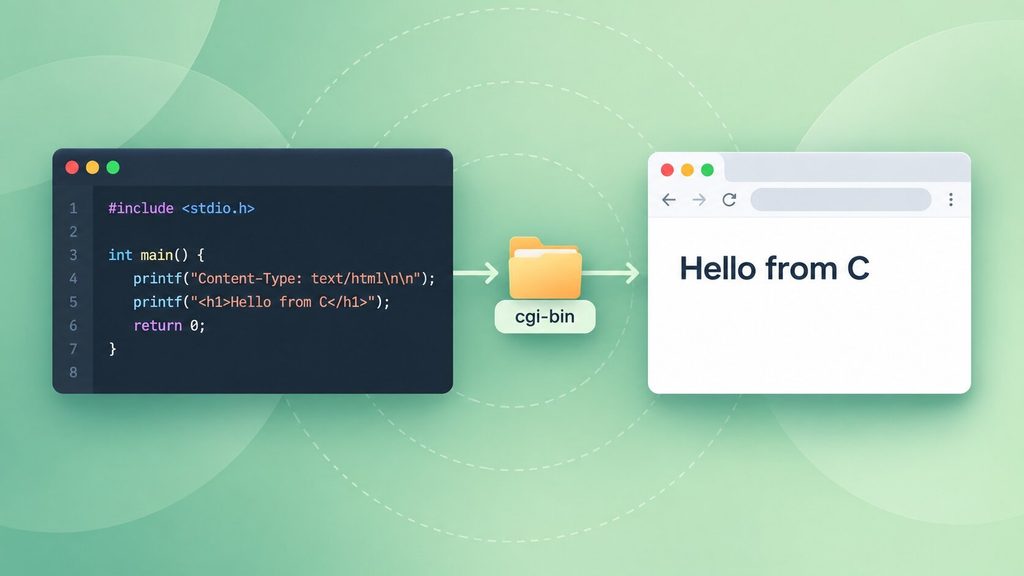
Here’s a complete, working page. Think of it as the web version of the classic hello world program:
#include <stdio.h>
int main(void) {
printf(“Content-Type: text/html\r\n\r\n”);
printf(“<h1>Hello from C</h1>\n”);
return 0;
}
Compile it, place the binary in your server’s cgi-bin folder, and the server runs it on each request. The first printf sends the HTTP header, and the second sends the page itself.
What You’d Have to Build Yourself
That page is the easy part. When you’re developing a website using only C, everything a real product needs is where the cost shows up:
- Sessions and logins, including secure cookies and password hashing.
- Form handling, with input validation that can’t be turned into a buffer overflow.
- Templating, so you’re not assembling HTML one printf at a time.
- Routing, file uploads, and error pages, which most frameworks give you on day one.
For a hobby project or a lesson in how the web works, it’s a great exercise. For a product with paying users, it’s months of work you’d get for free elsewhere.
Comparing C With Other Web Development Languages
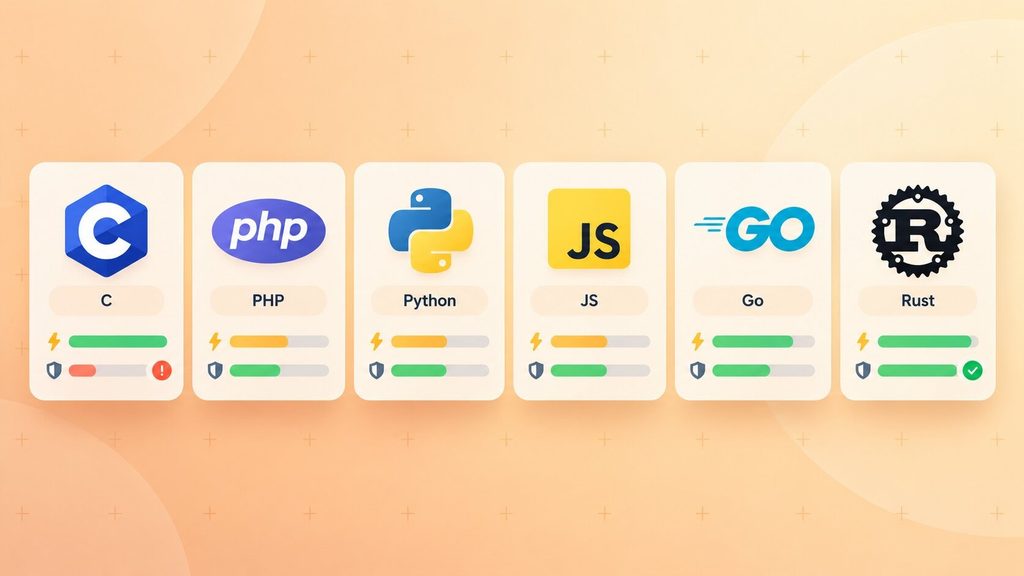
C wins on raw control and on little else in a typical web project. Here’s where each language usually earns its place:
| Language | Development speed | Memory safety | Typical web use |
| C | Slow | Manual | Web servers, modules, device dashboards |
| PHP | Fast | Managed by runtime | WordPress and CMS sites |
| Python | Fast | Managed by runtime | APIs, data and AI backends |
| JavaScript (Node.js) | Fast | Managed by runtime | Full-stack and real-time apps |
| Go | Moderate | Garbage collected | High-throughput APIs, microservices |
| Rust | Moderate | Enforced by the compiler | Performance-critical, security-sensitive services |
If memory safety and hiring matter to you, and for most products they do, C starts behind every other row in that table.
PHP
PHP was built for the web from day one. You can drop it straight into HTML, and because it powers WordPress, hosting and developers are easy to find.
Python
Python trades some raw speed for a lot of development speed. Frameworks like Django, Flask, and FastAPI handle routing, security basics, and database access, and it’s the default backend for many AI features.
JavaScript
JavaScript is the only language every browser runs natively, and Node.js brings it to the server too. One language across your whole stack is a real productivity win for a small team.
Go
Go is fast and deploys as a single binary. Garbage collection means it won’t match hand-tuned C in every benchmark, but it gives most web APIs all the speed they need with far less risk.
Rust
Rust is the closest match to C on performance, with memory safety checked at compile time. The NSA’s 2022 memory safety guidance lists it among memory-safe languages alongside C#, Go, Java, Ruby, and Swift.
Choosing between two mainstream options instead? Our comparison of Python vs Java for web development breaks that decision down.
Not sure which language fits your product? Get a clear stack recommendation from Boomdevs before you commit engineering time.
Use of C and Key Applications
Most of the software the web depends on sits one layer below the code you’d call web development. C is a big part of that layer, which is why it keeps coming up in questions about the web.
Here’s where C runs today:
- Operating systems: the Linux kernel, which runs a large share of the servers behind the web, is written largely in C.
- Web servers and proxies: Nginx and Apache handle connections before your app ever sees a request.
- Language runtimes: CPython and the PHP engine are written in C, so your Python or PHP app runs on C underneath.
- Databases: SQLite is a C project, small enough to embed inside apps and devices.
- Embedded devices: routers, cameras, and industrial controllers often run C firmware with a small web interface.
- Games and graphics: engines and graphics tools lean on C and C++ for their performance-critical code.
So even if you never write a line of C, your web stack almost certainly depends on it. That’s the practical reason to understand it.
How the C Programming Language Works
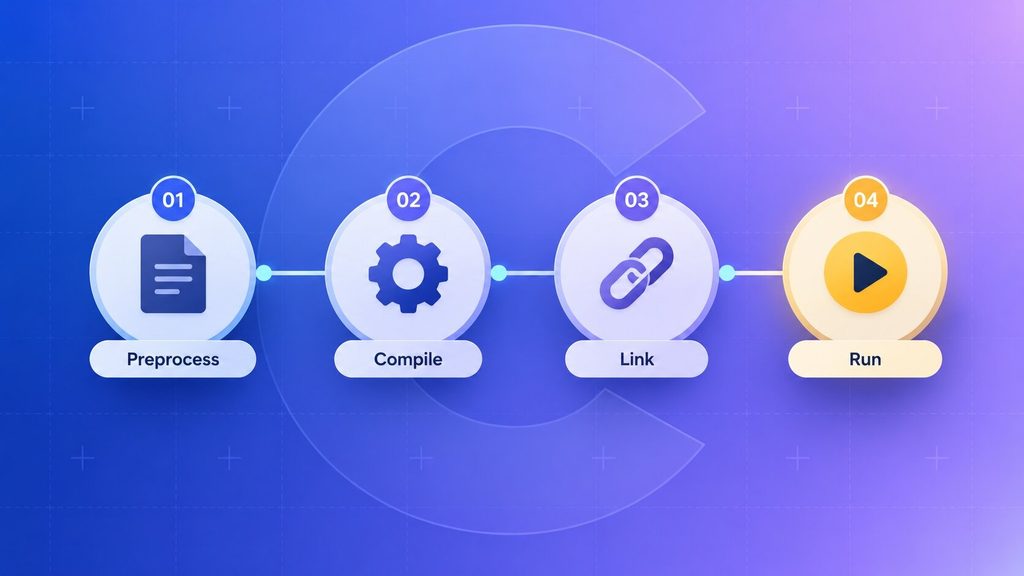
C turns your source code into a running program through a fixed pipeline. Knowing the stages helps you read build errors and explains why C runs so fast.
Here’s the whole pipeline at a glance:
| Stage | Typical tool | What it produces |
| Preprocessing | Built into gcc or clang | Expanded source code |
| Compiling | gcc or clang | Object files (.o) |
| Linking | A linker such as ld | One executable file |
| Loading | Your operating system | A running process |
Each stage has one job, and they always run in the same order.
Writing Code
You start with plain text files ending in .c, plus header files ending in .h. Any code editor works, though one with C support will catch typos before the compiler does.
Fixing Up the Details
The preprocessor runs first. It pastes in the header files you #include, expands macros, and strips out code you’ve switched off with conditional directives.
Making It Computer-Friendly
Next, the compiler translates each source file into machine code for your processor. The output is a set of object files, and this is where most syntax and type errors surface.
Putting the Pieces Together
The linker combines your object files with any libraries you use, such as the standard C library. If a function is declared but never defined, this is the step that complains.
Getting Ready to Go
Finally, when you run the program, the operating system’s loader copies it into memory, connects any shared libraries, and hands control to your main function.
How to Learn C Programming
You’ll learn C fastest by writing small programs early and reading compiler errors closely. A book or course gives you structure, but daily practice is what makes it stick.
A roadmap that works for most people:
- Learn the basics: syntax, data types, loops, and functions, through an online course or Kernighan and Ritchie’s book.
- Get comfortable with pointers and memory: malloc, free, and why strings in C are just arrays of characters.
- Solve small challenges on practice sites like Codecademy or LeetCode to build fluency.
- Use real tools: compile with warnings turned on (-Wall), step through code with a debugger like gdb, and check for leaks with Valgrind.
- Build a project: a command-line tool first, then a tiny HTTP server using sockets.
Those last two double as strong C programming projects for students, because they connect the language to real systems. When you get stuck, coding communities like Stack Overflow are still one of the quickest ways forward, and reading other people’s answers teaches you almost as much as asking.
Why Learn C Language?
C is more than 50 years old and still one of the most useful languages to understand. Learning it shows you what every higher-level language is doing for you behind the scenes.
Here’s what you get from the effort:
- You’ll understand memory: the stack, the heap, pointers, and why leaks happen in any language.
- Other languages get easier: C++, Java, C#, JavaScript, and Go all share its syntax.
- You’ll debug better: performance problems make more sense once you know what the machine is doing.
- Your career options widen: embedded, systems, and security roles still expect C.
The honest caveat: C is not an easy first language. Manual memory management punishes small mistakes, so expect a steeper start than you’d have with Python or JavaScript.
Career in C Programming
C skills lead to several distinct careers rather than one job title. These are the areas where it’s used most.
Software Engineering
Many C programmers work as software engineers on system software, from operating systems like Linux to the tools other developers rely on. The job covers writing, testing, and maintaining code that has to run for years.
Systems Programming
Systems programmers write the software that manages hardware: operating system components, network drivers, and system utilities. C fits because it gives direct control over memory and resources.
Embedded Systems Engineering
Embedded engineers program the small computers inside appliances, medical equipment, cars, and industrial machines. Most of that firmware is still written in C.
Firmware Development
Firmware controls hardware at the lowest level, just above the circuitry. You’ll find these roles across electronics, telecommunications, and automotive companies.
Game Development
C++ is more common in games, but C still appears in engines and performance-critical components. Speed is the reason in both cases.
Cybersecurity
Security specialists read C to find and fix vulnerabilities, since so many attacks target memory bugs. Many security tools and exploit analyses are written in C too.
Hardware Engineering
Hardware engineers use C to write device drivers, the software that lets an operating system talk to a new chip or peripheral.
Academic and Research
Universities and research labs use C for simulations, scientific computing, and research tools where performance matters.
Future of C Programming Language
C isn’t going away, but its role is narrowing. It’s holding firm where performance and hardware access matter, and losing ground wherever security matters more.
Why C Is Still Popular
Three things keep C in demand:
- Portability: there’s a C compiler for almost every processor ever made.
- Versatility: the same language writes an operating system kernel and a tiny sensor’s firmware.
- Legacy code: decades of production software, from kernels to databases, won’t be rewritten overnight.
That combination is hard for any newer language to replace all at once.
The Future of C
The language is still evolving. C23 added a nullptr constant, binary integer literals, and digit separators, among other updates.
At the same time, the push toward memory-safe languages is real and government-backed. Expect new web-facing code to move toward Rust and Go, while C keeps its hold on kernels, devices, and performance-critical cores.
What This Means If You’re Building a Web Product
If you’re a founder or product lead, the real question isn’t “can we use C?” It’s “should any part of our product be in C?” The answer shifts with your situation:
- You already own a C codebase. A pricing engine, a signal-processing library, or device firmware is too valuable to rewrite blindly. Wrapping it in an API, or compiling it to WebAssembly, often beats a full rewrite.
- You’re shipping a connected device. The device’s local dashboard will likely be C, while your cloud app and customer portal should run on a mainstream web stack.
- You’re building a new SaaS or marketplace. Start with a productive stack. If one hot path later proves too slow, you can move just that piece to Go, Rust, or C.
- You need C expertise for a specific piece. Hiring a full-time C specialist for one module rarely makes sense, and embedding experienced engineers for the project usually does.
The expensive mistake is choosing C for the whole product because it’s fast. Speed rarely decides whether a new web product succeeds. Shipping, iterating, and staying secure usually do.
If you’re still weighing options, our guide to choosing the right tech stack for web apps walks through that decision step by step.
How Boomdevs Solves the C vs. Speed-to-Market Trade-Off
Boomdevs doesn’t start with a language. We start with what your product has to do, then keep C only where it earns its place.
Depending on where you are, that looks like one of these:
- Existing C systems: our legacy application modernization work puts a modern API and web interface on top of proven C code, so you keep what works and stop maintaining what doesn’t.
- New web products: our custom web app development team builds on stacks that let you launch fast, with performance-critical pieces isolated where they belong.
- Connected hardware: IoT development covers the path from device firmware to the dashboard your customers use.
- A C specialist for your team: pre-vetted, professional C and backend developers can join your existing team for the part of the project that needs them.
With 10+ years of experience, 50+ full-time experts, and 3.5K+ projects delivered, the pattern holds: the right stack is the one your team can ship and secure.
Not sure whether C belongs in your stack? Book a free strategy call and get a clear recommendation for your product.
Frequently Asked Questions
Can the C Programming Language Be Used for Web Development?
Yes. C runs web servers like Nginx and Apache, powers CGI programs and web APIs, and can run in browsers through WebAssembly. It’s rarely used for a full website because development is slower and memory bugs are easier to introduce than in PHP, Python, or JavaScript.
What Is CGI Programming in the Context of C and Web Development?
CGI is short for Common Gateway Interface, a standard that lets a web server run an external program for each request. A C CGI program reads request data from environment variables and standard input, then prints an HTTP header and the response body to standard output.
How Do I Write a Simple CGI Program in C?
You need three steps:
Write a C program that prints a Content-Type header, a blank line, and then your HTML.
Compile it into an executable.
Place it in your server’s cgi-bin folder, or configure Apache or Nginx to run it as a CGI script.
The minimal example in the “Can Y
Can I Use C to Write a Web Server?
Yes, and it’s a classic project. You use socket functions to listen on a port, accept connections, read the HTTP request, and write a response. Production servers like Nginx and Apache are written in C, though a hobby server needs a lot of hardening before it’s safe on the public internet.
What Are the Advantages of Using C for Web Development?
The main advantages are speed, low memory use, and close control over hardware. They matter most for web servers, server modules, embedded device dashboards, and performance-critical code paths rather than whole applications.
What Are the Limitations of Using C for Web Development?
The biggest limits are slow development, a thin web ecosystem, and memory safety risk. You’ll write your own routing, sessions, and templating or stitch together small libraries, and every buffer your code touches has to be handled carefully.
Why Is C Not Commonly Used for Web Development?
Because the cost is high and the payoff is small for most web apps. Web-first languages give you HTTP handling, security basics, and database tools out of the box, while C makes you build or assemble them. Most web apps also wait on databases and networks, not the CPU, so C’s speed rarely changes the user experience.
In What Scenarios Is Using C for Web Development Beneficial?
C makes sense when you’re extending a web server, serving a web interface from an embedded or IoT device, reusing an existing C library through WebAssembly, or optimizing one hot path inside a larger app. It’s also a strong choice for learning how servers work.
How Does C Compare to Other Web Development Languages Like PHP and JavaScript?
PHP and JavaScript were designed for the web, so building pages, handling forms, and talking to databases takes a fraction of the code. C gives you more control and speed, but you trade away development time and built-in memory safety. The comparison table above shows the full picture, including Python, Go, and Rust.
Can Learning C for Web Development Improve My Programming Skills?
Yes. Writing even a small web server in C teaches you sockets, HTTP parsing, and memory management, which most frameworks hide. That knowledge makes you faster at debugging performance and security problems in any language.
Is C Used for Frontend or Backend?
Backend, almost always. C runs on servers and devices, and its only frontend route is compiling to WebAssembly. Even then, HTML, CSS, and JavaScript handle the interface itself.
Can I Make a Website Using Only C?
You can write the entire server side in C, but browsers still need HTML and CSS to display a page. Your C program generates that markup and sends it back, either through CGI or an embedded HTTP library.
Are There Web Frameworks for C?
Yes, though the choice is small. Kore is a framework for building web APIs in C, Onion is an HTTP server library with templating, and GNU libmicrohttpd embeds a lightweight HTTP server in any C application. None of them matches the ecosystem around Django, Laravel, or Express.
Is C the Same as CSS?
No. C is a general-purpose programming language that compiles into programs, while CSS is a styling language that tells browsers how web pages should look. They share a letter, not a purpose, and a typical web project uses CSS far more often than C.
What Does a C Developer Do for a Web Project?
A C developer usually works below the application layer. That might mean writing a web server module, optimizing a performance-critical service, building firmware and a local web interface for a device, or porting an existing C library to the browser with WebAssembly.
The Bottom Line on C for Web Development
C is part of almost every web request you make, just not the part you’d usually write. It runs the servers, runtimes, and devices underneath, and through WebAssembly it can now run in the browser too.
For a full website or SaaS product, though, C trades weeks of development time and real security risk for performance you probably don’t need yet. Use it where speed is the product, and use a web-first stack everywhere else.
Weighing the stack for your next build? Talk to Boomdevs about the right mix of speed, safety, and time to launch.