


- 1. Key Takeaways
- 2. What Is an AI Proof of Concept?
- 3. AI PoC vs Prototype vs Pilot vs MVP
- 4. When Should You Run an AI PoC (and When Should You Skip It)?
- 5. How to Run an AI Proof of Concept in Seven Steps
- Step One: Write Down the Decision and the Hypothesis
- Step Two: Set the Baseline, Target, and Stop Threshold Before You Build
- Step Three: Check Your Data Is Representative, Not Just Clean
- Step Four: Pick the Simplest Approach That Can Answer the Question
- Step Five: Build the Minimum and Test the Hard Cases
- Step Six: Judge Business Value, Model Quality, and Operations Together
- Step Seven: Make the Call: Go, Iterate, Pause, or Stop
- 6. How Do You Measure AI PoC Success?
- 7. Testing a Generative AI or AI Agent PoC
- 8. How Long Does an AI PoC Take and What Drives the Cost?
- 9. Why Most AI Proofs of Concept Never Reach Production
- 10. AI PoC for Startups: What Changes When the Budget Is Yours
- 11. Should You Build Your AI PoC In-House or With a Partner?
- 12. From PoC to Production: What Has to Change
- 13. How Boomdevs Runs an AI Proof of Concept
- 14. Frequently Asked Questions
Summarize with
Your board wants AI in the product by next quarter. A partner quotes six months and a budget that makes your CFO wince. Nobody can tell you if it will actually work.
That gap is what an AI proof of concept closes. You test one narrow idea on your real data, against a bar you set first.
Here’s how to run one that ends in a clear decision, not a demo. You’ll also see why most stall before production.
Key Takeaways
- An AI proof of concept is a short, narrow test of one AI idea on your own data, judged against a pass mark you agree on before the build.
- It should end in one of four calls: go, iterate, pause, or stop. A “stop” counts as a win if it saves you from a build that wouldn’t pay off.
- Set the baseline, target, and stop threshold first. Picking metrics after you see the results is how weak PoCs get dressed up as successes.
- Most PoCs stall on data, ownership, and integration, not on the model itself.
- Generative AI and agent PoCs need extra checks: groundedness, prompt injection, cost per task, and limits on what the agent can do.
What Is an AI Proof of Concept?
An AI proof of concept points one AI approach at one specific business problem and checks whether the result clears a bar you agreed on beforehand. It runs on your own data, in a controlled setting, for a fixed window. What comes out isn’t software you ship. It’s evidence.
Think of it as a bet you can afford to lose. You spend a little to find out whether the big spend makes sense.
What an AI PoC Should Prove
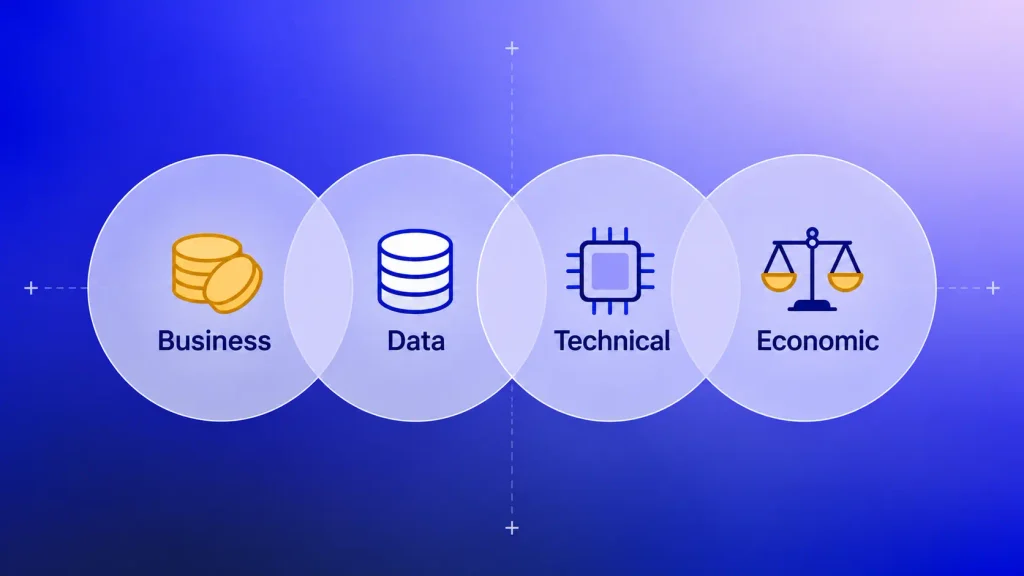
A useful PoC answers four separate questions. Skip one and you can end up with a demo that impresses the room but still can’t ship:
- Business proof: the problem is worth solving, and you have a current number (time, cost, or error rate) to beat.
- Data proof: the data the approach needs exists, you can reach it, and it looks like what production will send.
- Technical proof: the model hits the accuracy, speed, or quality bar the use case demands.
- Economic proof: the value still beats the cost once you price in running it at real volume.
Most teams obsess over the third and wave the other three through.
That’s backwards. The model is often the easiest part to prove.
What a PoC Doesn’t Prove
A green light from a PoC is narrower than it feels. It doesn’t show the system will hold up under real traffic, that your team will trust its output, or that quality will stay steady as your data drifts.
Those questions belong to the pilot and production stages. Treat a passed PoC as permission to keep going, not as a finished product.
Proof of Concept vs Proof of Value
A proof of concept asks “can this work?” A proof of value asks “is it worth paying for?” You might prove a model reads your invoices accurately enough. Whether that saves enough review hours to cover the full build is a different question.
Some teams run these as two separate phases. For most founders, it’s cleaner to build both into one PoC, with the technical bar and the money bar sitting side by side in the same scorecard.
AI PoC vs Prototype vs Pilot vs MVP
These four terms get swapped in meetings all the time. That habit is expensive, because each stage removes a different kind of risk and ends in a different decision. A PoC tests feasibility, a prototype tests the experience, a pilot tests real use, and an MVP is the first version you actually ship.
Here’s how they line up:
| Stage | Question it answers | Data used | Who uses it | Decision it ends in |
| Proof of concept | Can this AI approach work here? | Real, limited sample | Small internal group | Go, iterate, pause, or stop |
| Prototype | What should it look and feel like? | Sample or mocked data | Designers, stakeholders | Which design to build |
| Pilot | Does it work with real users? | Live data, one team or region | A real user group | Expand, adjust, or drop |
| MVP | What’s the smallest version worth launching? | Production data | Paying or end users | Ongoing investment |
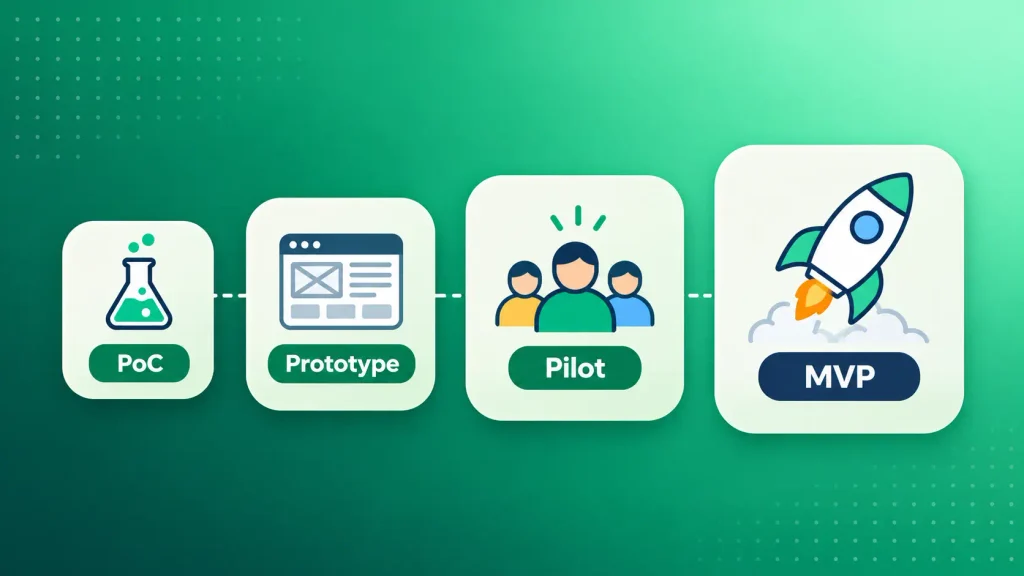
You won’t always need all four. If you’re adopting a mature off-the-shelf AI tool, you can often go straight to a pilot. What matters is knowing which question you’re answering at each step. For how an MVP fits into a wider product plan, our explainer on what an MVP means in software development walks through it.
When Should You Run an AI PoC (and When Should You Skip It)?
Run a PoC when the big unknown is whether AI can do the job on your data. Skip it when that’s already known, or when no result would change what you do next.
It’s worth running one when:
- Performance on your data is unknown: nobody can say how a model will handle your documents, tickets, or transactions without trying.
- The full build is big enough to hurt: a wrong bet on months of development costs far more than a few weeks of testing.
- You need evidence to get a yes: your board, investors, or a budget owner want proof, not a pitch.
- You’re choosing between approaches: retrieval vs fine-tuning, or AI vs plain business rules, and you want data to settle it.
You can usually skip it when:
- A proven product already solves it: an existing tool covers the use case and you only need to configure it.
- The problem isn’t defined yet: “use AI to be more efficient” can’t pass or fail. Pin down the workflow first.
- The data isn’t there: if the records don’t exist or you can’t legally use them, fix that before any model work.
- Nobody owns the next step: if no one has the budget or authority to act on a good result, the PoC will sit on a shelf.
That last one is the quiet killer. If you’re not sure you’re ready, an AI consulting partner can run a readiness check and tell you what to fix before you spend on a build.
How to Run an AI Proof of Concept in Seven Steps
The seven steps below keep your PoC tight and pointed at a decision. Each one closes a door that sinks most failed PoCs, so it’s worth doing them in order rather than jumping straight to the build.
Step One: Write Down the Decision and the Hypothesis
Start with the decision the PoC will feed, not the technology. “Should we automate first-line support replies?” is a decision. “Let’s try an LLM” isn’t.
Then turn that decision into a hypothesis you can test. A simple fill-in works well:
- Who: [user group] currently spends [time or cost] on [workflow].
- Problem: this causes [a specific pain, such as slow replies or rework].
- Bet: [AI approach] can improve [metric] to [target].
- Limit: without going over [a cost, risk, or error ceiling].
If you can’t fill in every bracket, you’re not ready to build. That’s a useful finding on its own.
Step Two: Set the Baseline, Target, and Stop Threshold Before You Build
Measure how the work performs today. Without a baseline, any result can be spun as progress.
Then agree three numbers with whoever owns the decision:
- Minimum acceptable: below this, the idea isn’t worth pursuing.
- Target: the result that would justify a pilot.
- Stop condition: a result, cost, or risk level that ends the PoC early.
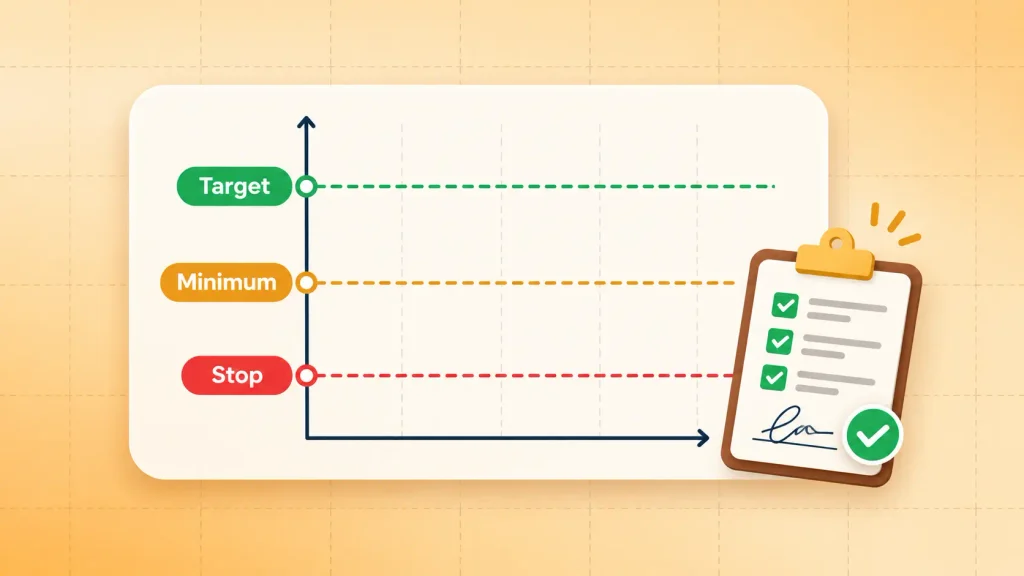
Write these down and get them signed off. Choosing metrics after you’ve seen the results is the most common way teams fool themselves.
Step Three: Check Your Data Is Representative, Not Just Clean
Clean data makes a PoC look great. Representative data tells you the truth.
Your test set should include the messy inputs production will send: missing fields, odd formats, edge cases, and the long tail of strange requests. Check access and legal use early, too. Personal or regulated data may need consent checks, anonymizing, or a privacy review before a model touches it.
If the data sits across several systems or behind slow approvals, plan time for that. It’s often the slowest part of the whole PoC.
Step Four: Pick the Simplest Approach That Can Answer the Question
Choose the lightest setup that can prove or disprove your hypothesis. You can always add complexity later. Ripping it out is much harder.
Here’s how the common options compare:
| Approach | Use it when | Watch out for |
| Hosted model via API | The task is general: summarizing, drafting, classifying | Per-call cost at volume, data sent to a third party |
| Retrieval-augmented generation (RAG) | Answers must come from your own documents | Retrieval quality, stale or messy source content |
| Fine-tuning | You need a style or format the base model keeps missing | Labeled data, retraining effort |
| Classic machine learning | You’re predicting from structured data, like churn or demand | Enough historical examples, feature work |
A sensible order: try a hosted model first, add retrieval if answers need grounding in your content, and reach for fine-tuning only when the first two fall short.
Step Five: Build the Minimum and Test the Hard Cases
Build only what the hypothesis needs: a way to feed data in, the model, an evaluation script, and basic logging. Skip the polished interface. A spreadsheet of inputs and outputs is often enough to judge results.
Then test the hard cases on purpose. Easy examples flatter every model. The failures you care about live in the edge cases, so add them to the test set before you start tuning.
Keep a record of prompts, settings, and changes. If the result is good, someone will ask how you got there. That log also pays off later. Your next AI proof of concept starts from a tested setup instead of a blank page.
Step Six: Judge Business Value, Model Quality, and Operations Together
Score the result against the numbers you agreed in step two. Look at three things at once: did it move the business metric, how did the model perform across case types, and would it actually fit the workflow?
A model can score well and still fail here. If reviewers spend more time checking AI output than the AI saved them, the PoC hasn’t passed, whatever the accuracy figure says. The goal of an AI proof of concept is less work for your team, not a better score on a test set.
Step Seven: Make the Call: Go, Iterate, Pause, or Stop
End with one written decision and the evidence behind it:
- Go: results clear the target. Move to a pilot with a named owner and budget.
- Iterate: close, but the data, scope, or approach needs a change. Run one more tight round.
- Pause: promising, but something outside the PoC blocks it, such as data access or budget.
- Stop: the value, cost, or risk doesn’t add up. Record why and move on.
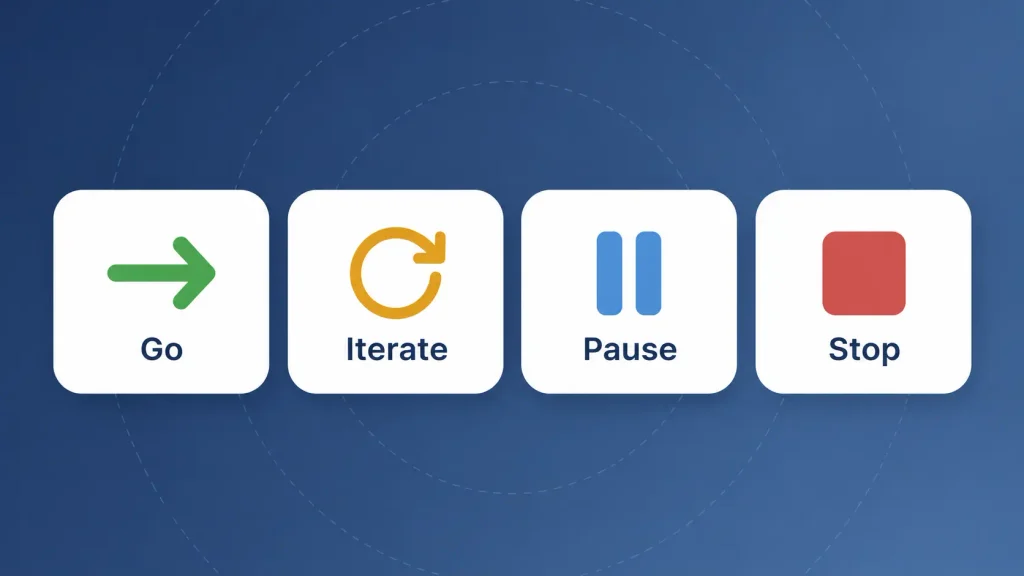
A stop isn’t a failure. It’s the cheapest way to learn that an idea won’t pay off.
How Do You Measure AI PoC Success?
You measure an AI PoC against the baseline you set before the build, across business, model, operational, adoption, and risk metrics. One accuracy score isn’t enough. It can hide weak results on the cases that matter most, or a review burden that cancels out the time saved.
Track a small set from each category:
| Category | What to track | Example |
| Business | Time saved, cost per task, cost of errors | Minutes per ticket vs today |
| Model quality | Accuracy, precision, recall, consistency | Correct field extraction rate |
| Operations | Latency, cost per request, integration effort | Response time inside the help desk |
| Adoption | Override rate, review time, user trust | How often agents edit AI drafts |
| Risk | Errors across groups, data exposure, audit trail | Error rate by customer segment |
Weight the two or three metrics tied directly to your hypothesis most heavily. Treat the rest as guardrails, not goals.
Testing a Generative AI or AI Agent PoC
Generative AI and agent PoCs need checks that classic machine learning tests skip. The output is free text or an action, so “accuracy” is harder to pin down, and a confident wrong answer can do real damage.
If you’re testing a chatbot, copilot, or agent, add these to your evaluation:
- Groundedness: does each answer trace back to a real source in your content, or is the model filling gaps on its own?
- A real-question test set: collect actual questions from customers or staff, awkward ones included, and grade answers against what an expert on your team would say.
- Prompt injection and data leaks: try to trick it into ignoring its instructions or revealing data it shouldn’t. Someone will try in production.
- Cost per task: track model spend per finished task, not per call. Multi-step flows can multiply cost quietly.
- Action limits for agents: if the agent can send emails, issue refunds, or edit records, test what happens when it gets it wrong, and decide where a human must approve.
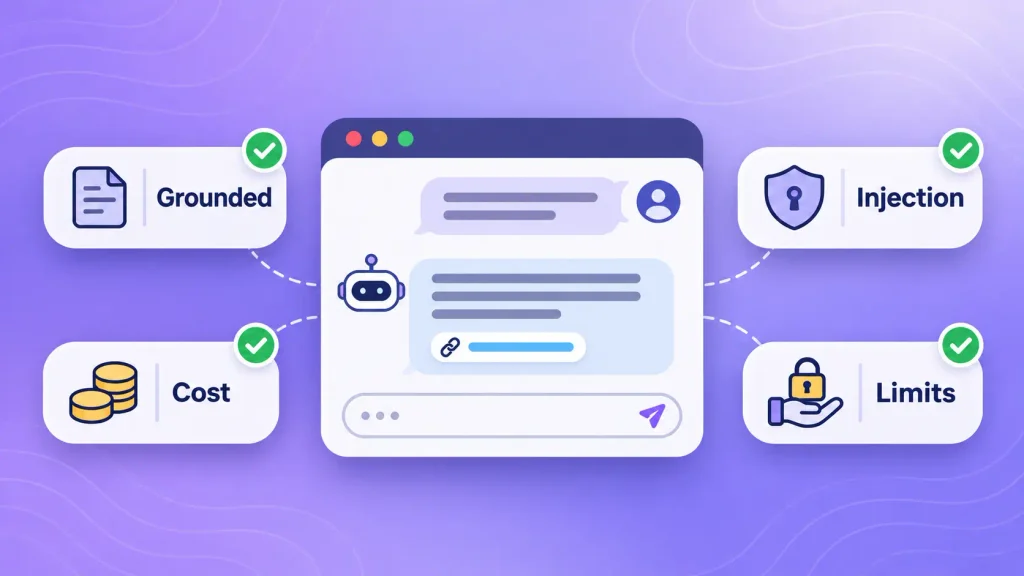
None of these failure modes are new. Our rundown of common generative AI challenges goes deeper on hallucination and data risk.
Agents raise the stakes. Gartner predicts over 40% of agentic AI projects will be canceled by the end of 2027, so a tight PoC with clear action limits is worth the effort. Once an agent passes, the build moves into AI agent development. Assistants and content tools follow a similar path into custom generative AI development.
How Long Does an AI PoC Take and What Drives the Cost?
An AI PoC should run for weeks, not months. If yours is heading toward a full quarter with no decision in sight, the scope is probably too wide. The exact time and cost come down to a handful of factors you can largely control:
| Cost driver | Pushes it up when | Keeps it down when |
| Data readiness | Data is scattered, unlabeled, or restricted | Data sits in one system you can export |
| Scope | Several workflows or user groups at once | One workflow, one decision |
| Integration | The PoC must connect to live systems | It runs on exported data |
| Approach | Custom training or fine-tuning | A hosted model with prompts or retrieval |
| Compliance | Regulated data needs reviews first | Internal, non-sensitive data |
Data readiness is usually the biggest swing factor. Sort out access before kickoff and everything else moves faster. An AI proof of concept rarely runs late because of the model. It runs late because someone is still waiting on data access.
Keep in mind the PoC is a small slice of the total spend. For what the full build costs once you get a green light, our guide to AI product development cost breaks it down.
Why Most AI Proofs of Concept Never Reach Production
Most AI PoCs stall because of gaps in data, ownership, and integration, not because the model failed. The research shows how wide that gap has been.
In IDC research done with Lenovo, only four of every 33 AI PoCs made it into production, an 88% drop-off. IDC linked that to low readiness in data, processes, and IT infrastructure. Gartner had already predicted that at least 30% of generative AI projects would be abandoned after the PoC stage by the end of 2025, pointing to poor data quality, weak risk controls, rising costs, and unclear business value.
Newer data is more hopeful. The 2026 Lenovo CIO Playbook, built on IDC research with 3,120 decision-makers, reports that 46% of AI PoCs have already moved into production. That suggests teams are getting pickier about which PoCs they start. Half still don’t make it, though.
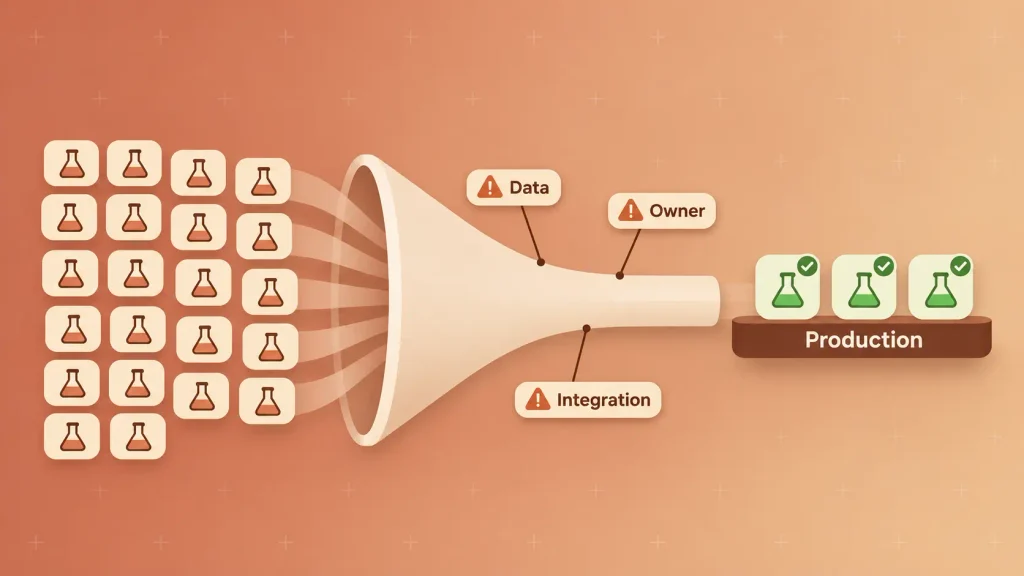
The causes repeat from company to company:
- Starting from the tech, not a decision: “test generative AI” can’t pass or fail.
- Scoping too wide: an enterprise-wide assistant can’t be judged cleanly in a few weeks.
- Testing on curated data: the PoC passes in the lab, then meets real data and breaks.
- No baseline, or metrics chosen late: without a “before” number, the result proves nothing.
- No owner for the next stage: a good result with no budget behind it simply stops.
- Governance left for later: privacy and security reviews block the pilot when they show up late.
Almost every item on that list gets fixed before the first line of code. That’s the real lesson in the failure data.
AI PoC for Startups: What Changes When the Budget Is Yours
For a startup, an AI PoC often has a second job: convincing investors as well as you. That makes it tempting to build a slick demo instead of a real test. Resist it. A demo that only works on hand-picked examples can win a meeting and then sink your roadmap.
Smaller companies also face a steeper climb to scale. In McKinsey’s 2025 State of AI survey, only about a third of organizations said they were scaling AI across the business. By size, nearly half of companies with more than $5 billion in revenue had reached that phase, compared with 29% of those under $100 million.
A lean PoC helps you close that gap without burning runway:
- Start with an API, not a custom model: a hosted model plus your own data answers most early questions without an ML hire.
- Test demand alongside feasibility: put the output in front of a few real customers. Their reaction is evidence investors respect.
- Show the failure cases in your pitch: explaining where the model breaks, and your plan for it, reads as maturity.
- Pick the one workflow users complain about most: a sharp pain makes results easy to judge.
If you’re still pressure-testing the product itself, it’s worth stepping back to validate the app idea before you build any AI on top of it.
Should You Build Your AI PoC In-House or With a Partner?
Build in-house if your team has run AI PoCs before and owns the data. Bring in a partner if it’s your first one, the timeline is tight, or you lack people who know how to evaluate AI output. We cover the full trade-off in our guide to in-house vs outsourced AI development.
The short version:
| Factor | In-house | Partner-led |
| Speed to first result | Slower without past PoC experience | Faster with a tested method |
| Domain knowledge | Strong from day one | Needs onboarding |
| Cost structure | Fixed salaries | Scoped engagement |
| Best fit | Repeat, well-understood use cases | First PoC or a novel use case |
Plenty of teams mix both. A partner runs the first PoC and hands over the method, then your team owns the ones that follow.
From PoC to Production: What Has to Change
A passed PoC is a decision, not a deployment. The shortcuts that made it fast need replacing before real users depend on it:
- Manual data pulls become pipelines that refresh on their own.
- Notebook scripts become versioned, tested services.
- Spot checks become monitoring for drift, latency, cost, and error spikes.
- Informal review becomes defined approval points, plus a fallback when the model fails.
- One-off access becomes proper permissions, audit logs, and a security review.
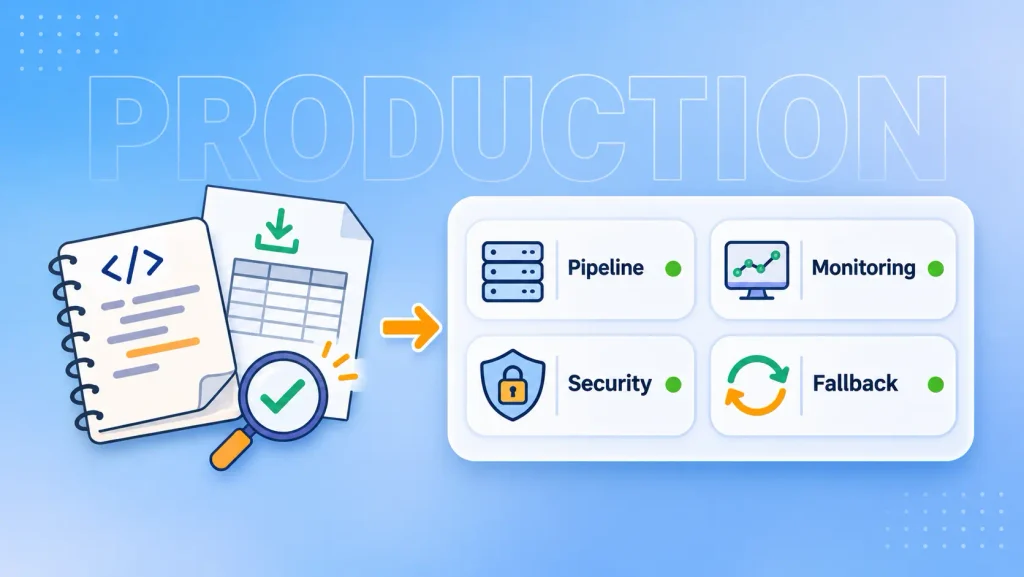
Plan for these during the PoC, even if you don’t build them yet. Our walkthrough of the AI product development process shows where each fits in a full build. When you’re ready to take a validated idea to launch, an experienced AI product development team can carry it through.
How Boomdevs Runs an AI Proof of Concept
Boomdevs treats a PoC as a decision tool, not a sales demo. Work starts with an AI readiness assessment of your data, systems, and team, so you know what’s possible before anything gets built. The team then designs the solution and checks it against real business scenarios before anyone writes production code.
Validation looks at accuracy, fairness, and real-world reliability, not just a clean demo. And if AI isn’t the right fit for your problem, you’ll hear that early, before the budget goes anywhere.
After 10+ years of product work with 350+ startup founders, the pattern is clear: the PoCs that reach production are the ones scoped around a real decision from day one. If you have an AI idea and want a clear go or no-go before committing a full budget, talk to Boomdevs AI consulting services about scoping your PoC.
Frequently Asked Questions
Is an AI proof of concept the same as a pilot?
No. A PoC tests whether an AI approach can work on your data, using a small internal group. A pilot puts an already proven approach in front of real users in a live setting. The PoC asks “can it work,” and the pilot asks “does it work in practice.”
What data do you need for an AI PoC?
You need real examples that match the problem and reflect how messy production will be, edge cases included. You also need the right to use that data for testing. A smaller representative set beats a large curated one.
Can a failed AI PoC still be worth it?
Yes. A PoC that ends in “stop” saves you from funding a build that wouldn’t pay off. If you documented why it failed, you also know what would need to change for another attempt.
Do you need a PoC for a generative AI feature?
Usually, yes, unless an off-the-shelf tool already does the job. Generative features fail in ways that are hard to predict on paper, such as ungrounded answers or prompt injection. A short PoC with a real-question test set shows you those risks before your customers find them.
What happens after a successful AI PoC?
You move to a pilot with a named owner, a budget, and success criteria. The pilot tests the approach with real users and live data. Production work, like pipelines, monitoring, and security, should start alongside it so the pilot doesn’t stall at the finish line.