


- 1. Key Takeaways
- 2. Best Backend Language for Web Development at a Glance
- 3. 1. JavaScript and TypeScript (Node.js)
- 4. 2. Python
- 5. 3. Java
- 6. 4. C# (.NET)
- 7. 5. PHP
- 8. 6. Go
- 9. Worth a Look: Ruby, Rust, Kotlin and Elixir
- 10. What the Biggest Websites Actually Run
- 11. How to Choose the Best Backend Language for Your Web App
- 12. Does the Backend Language Really Matter?
- 13. Questions to Ask Before Your Dev Partner Picks a Language
- 14. How Boomdevs Chooses Your Backend Stack
- 15. Frequently Asked Questions
Summarize with
Your developer says Node.js and your advisor swears by Python. A friend who runs a SaaS company tells you Java is the only safe bet. Now you have to pick the best backend language for your product before the build starts.
Picking the best backend language for web development comes down to six contenders. We ranked them with 2025 developer survey data, live web usage figures, and what ships in real client projects. Once you find your situation in the table, the list gets short fast.
Key Takeaways
- Building a typical SaaS or startup web app? TypeScript on Node.js or Python will cover you, and both have deep hiring pools.
- Putting AI at the center of the product? Python is the default, because the model tooling lives there.
- Selling into banks, insurers, or large enterprises? Java or C# lowers the risk in security reviews and long support contracts.
- Running a content site or online store? PHP still powers most of the web, and Laravel or WordPress gets you there cheaply.
- Shipping a high-traffic API? Go gives you speed and simple deploys without Rust’s steep hiring curve.
For most business web apps, your workload and your hiring pool decide the best backend language. Raw speed rarely does.
We picked the six backend languages for web development below on four tests. Each one runs serious production systems today, and each has at least one mature web framework.
Each also has a large pool of developers you can hire. The hiring figures come from the 2025 Stack Overflow Developer Survey, which asked developers which languages they did extensive work in over the past year.
The last test is the one most lists skip. Does the language fit the business web apps founders and product leads actually commission? That ruled out C++, Perl, and SQL, which other lists of the best language for backend development include.
Best Backend Language for Web Development at a Glance
You can scan the whole shortlist for the best backend language for web development in one view. The “pro devs” column shows the share of professional developers in the 2025 Stack Overflow survey who did extensive work in each language:
| Language | Best for | Main frameworks | Pro devs using it |
| JavaScript / TypeScript (Node.js) | Real-time apps, full-stack teams | Express, NestJS, Next.js | 68.8% / 48.8% |
| Python | AI features, data-heavy apps | Django, FastAPI, Flask | 54.8% |
| Java | Enterprise, regulated systems | Spring Boot | 29.6% |
| C# (.NET) | Microsoft-centric companies | ASP.NET Core | 29.9% |
| PHP | Content sites, e-commerce | Laravel, Symfony, WordPress | 19.1% |
| Go | High-throughput APIs, microservices | Gin, standard library | 17.4% |
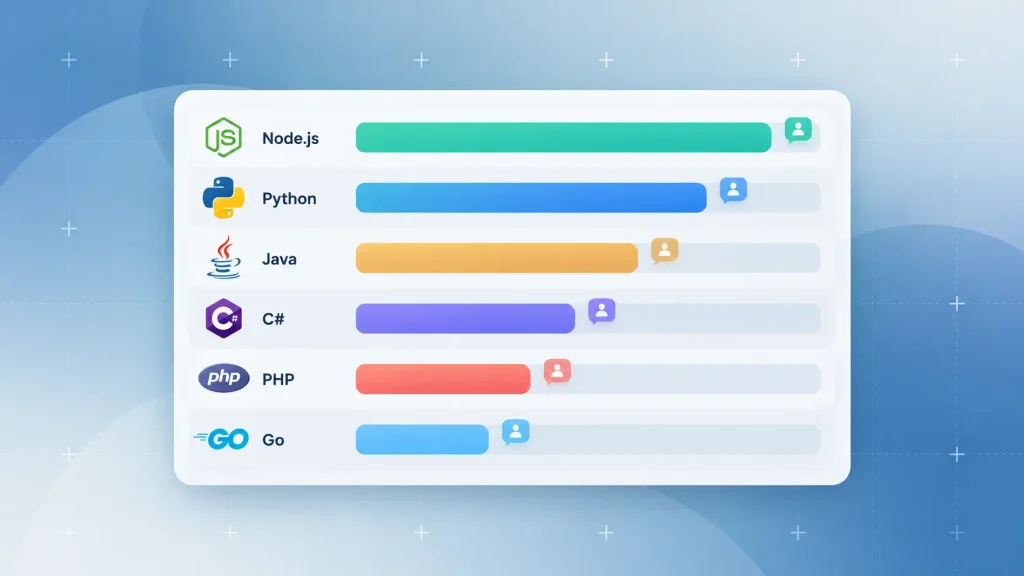
One caveat on the first row: the JavaScript figure includes frontend work, so it overstates backend use. Even so, the gap between the top three and the rest tells you where the hiring is easiest.
1. JavaScript and TypeScript (Node.js)
Node.js lets you run JavaScript on the server, so one language covers your browser code and your backend. That single-language setup is the main reason startups often call it the best backend language for a first product. A full-stack engineer can move between the two without switching mental models.
Node handles many simultaneous connections well, which suits chat, live dashboards, notifications, and REST API layers. It’s the most used web technology in the 2025 survey, with 48.7% of respondents working with it. Most serious teams now write it in TypeScript, which adds types and catches a class of bugs before they ship.
Here’s how it shakes out for you:
- Pick it if: your app is mostly APIs and database calls, you need real-time features, or your team already writes React.
- Skip it if: your backend does heavy number crunching, like video processing or large report generation, which blocks Node’s single main thread.
- Main frameworks: Express for simple APIs, NestJS for larger structured codebases, and Next.js when frontend and backend live together.
The real risk with Node is discipline, not capability. Its package ecosystem is huge, so you’ll want a team that audits dependencies instead of installing everything it finds.
2. Python
Python reads close to plain English, and its AI, machine learning, and data libraries are the deepest among the backend languages for web development on this list. If your web app includes recommendations, document processing, a chatbot, or anything model-driven, Python keeps that logic next to your application code.
Its momentum is real. Python usage jumped seven percentage points from 2024 to 2025 in the Stack Overflow survey, and the survey’s own write-up credits AI, data science, and backend work. FastAPI, a Python framework for building APIs, grew five points in the same year.
Your trade-offs look like this:
- Pick it if: AI or data sits at the center of your product, or you want the fastest route to a readable backend.
- Skip it if: you need maximum raw throughput on CPU-heavy work, where Python runs slower than Java or Go.
- Main frameworks: Django when you want admin panels and authentication built in, FastAPI for lean, high-speed APIs, and Flask for small services.
Python’s old concurrency limit is also loosening. Python 3.14 officially supports a free-threaded build as an opt-in option, although the default interpreter hasn’t changed yet. If you’re planning an AI-powered web app, AI product development with a Python backend is the usual starting point.
3. Java
Java is the language large companies trust with money, health records, and systems that need to run for a decade. For regulated, long-lived systems, it’s often the best language for backend development. Strong static typing catches errors early, and Spring Boot gives you a mature, well-documented structure for big codebases.
Spring Boot shows up in 15.6% of professional developers’ work in the 2025 survey. The language’s enterprise footprint means that when your buyer’s security team sends a long questionnaire, Java’s tooling and patterns already have answers.
Here’s where it fits:
- Pick it if: you’re building for banks, insurers, or large enterprises, or you expect the system to grow for years with many developers.
- Skip it if: you’re a small team racing to an MVP, because Java’s extra ceremony slows the first months.
- Main frameworks: Spring Boot for most web work, with Quarkus and Micronaut as lighter options.
If you’re torn between Java and Python specifically, our Python vs Java for web development comparison walks through that decision head to head.
4. C# (.NET)
C# runs on Microsoft’s .NET platform, and its web framework, ASP.NET Core, is cross-platform and fast. It’s the best backend language for web development when your company already lives in Azure, Microsoft 365, and SQL Server.
ASP.NET Core sits at 21.3% among professional developers in the 2025 survey, ahead of Spring Boot. Visual Studio and Rider give C# teams some of the best tooling in any ecosystem.
The trade-offs:
- Pick it if: your company runs on Microsoft infrastructure, or you’re building internal enterprise tools that plug into Active Directory and Azure.
- Skip it if: your team has no .NET background and you’re hiring in a market where C# developers are scarce.
- Main frameworks: ASP.NET Core for web apps and APIs, with Blazor when you want C# in the browser too.
A common point of confusion is whether .NET is frontend or backend. Our guide on whether .NET Core is backend or frontend clears that up in detail.
5. PHP
PHP still runs most of the web. W3Techs reports that PHP powers 69.4% of all websites whose server-side language it can detect, largely because WordPress, WooCommerce, and Magento are built on it.
That installed base keeps hosting cheap and developers easy to find. Modern PHP with Laravel is also far cleaner than the PHP many founders remember from 2010. Laravel shows up in 9.3% of professional developers’ work in 2025.
Your call depends on the project:
- Pick it if: you’re building a content-heavy site, an online store, or extending an existing WordPress or Laravel estate.
- Skip it if: you’re building an AI-native product or a real-time app from scratch, where Python or Node fit better.
- Main frameworks: Laravel for custom apps, Symfony for large structured projects, and WordPress when content management is the core.
So is PHP dying? No, and for content sites it’s still the best backend language in many cases. Its share does shrink among the biggest sites, which the usage section below shows clearly.
6. Go
Go, built at Google, compiles to small, fast programs that start instantly. Its built-in concurrency handles thousands of simultaneous requests without fuss. Teams reach for it when a service starts behaving like infrastructure: payment gateways, ingestion pipelines, and high-traffic APIs.
Go sits at 17.4% of professional developers in the 2025 survey, and the survey notes that Python developers are among those who aspire to use Rust and Go. It’s a smaller pool than Node or Python, but a well-regarded one.
Here’s the honest read:
- Pick it if: you need predictable performance under heavy load, or you’re splitting a growing system into microservices.
- Skip it if: you need lots of ready-made libraries for things like admin panels or AI, where Go’s ecosystem is thinner.
- Main frameworks: Gin and Echo, though many Go teams use the standard library alone.
Go is rarely the best backend language for an MVP. It often makes sense as your second, once one service needs the speed.
Worth a Look: Ruby, Rust, Kotlin and Elixir
A few more backend languages for web development earn a place in specific situations, even if they’re not the default pick for most web apps:
- Ruby (Rails): still a fast way to build a startup MVP, used by 6.9% of professional developers in 2025, though the talent pool is now much smaller than Node’s or Python’s.
- Rust: the most admired language in the 2025 survey at 72%, and excellent for one performance-critical service. As your whole backend, it slows hiring and early development.
- Kotlin: a modern alternative to Java that runs on the same JVM, a good fit if you already have Java systems.
- Elixir (Phoenix): Phoenix is the most admired web framework in the 2025 survey at 79%, and it shines for real-time apps. The talent pool is small, at 2.8% of professional developers.
You might also wonder about older systems languages. Our post on whether C can be used for web development covers why it rarely makes sense for a modern web backend.
What the Biggest Websites Actually Run
Overall usage hides a split that matters when you compare backend languages for web development. W3Techs breaks down server-side language use by how much traffic a site gets, and its latest data shows a clear shift as sites get bigger:
| Language | All websites | Top 1,000 websites |
| PHP | 69.4% | 59.3% |
| JavaScript | 8.1% | 31.7% |
| Ruby | 7.1% | 8.6% |
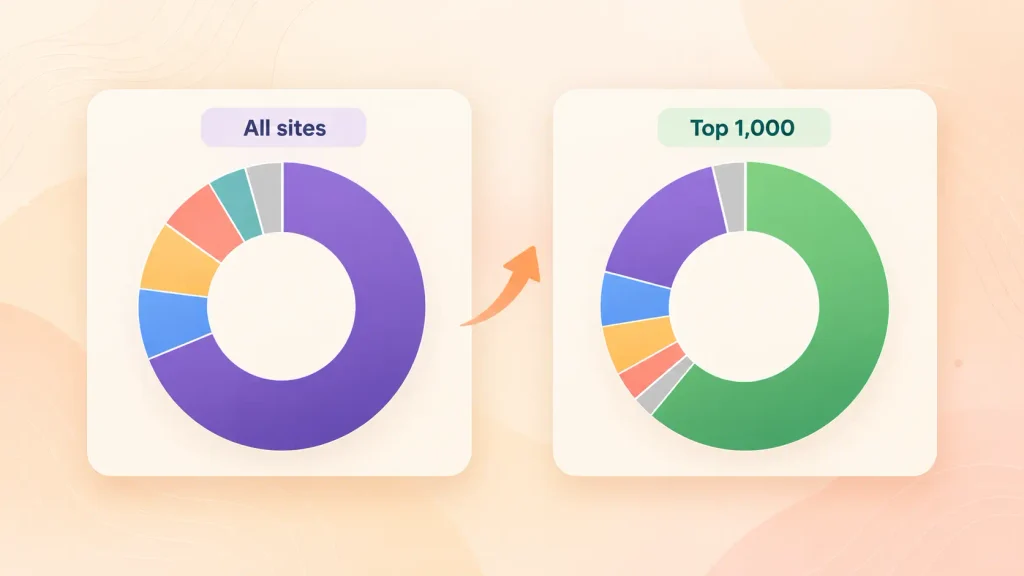
JavaScript’s share is nearly four times higher among the top 1,000 sites than across the whole web. W3Techs also reported in July 2026 that JavaScript overtook Ruby as the second-most popular server-side language overall.
What should you take from that? PHP dominates because of millions of small WordPress sites. High-traffic web apps, the kind you’re probably building, lean much harder on Node.js.
How to Choose the Best Backend Language for Your Web App
Your choice gets much easier once you stop asking which is the best backend language for web development in general and ask which one fits your product. Four questions do most of the work. For the wider picture, including databases and frontend frameworks, our guide on choosing the right tech stack for web apps covers the full stack.
Start With Your Workload
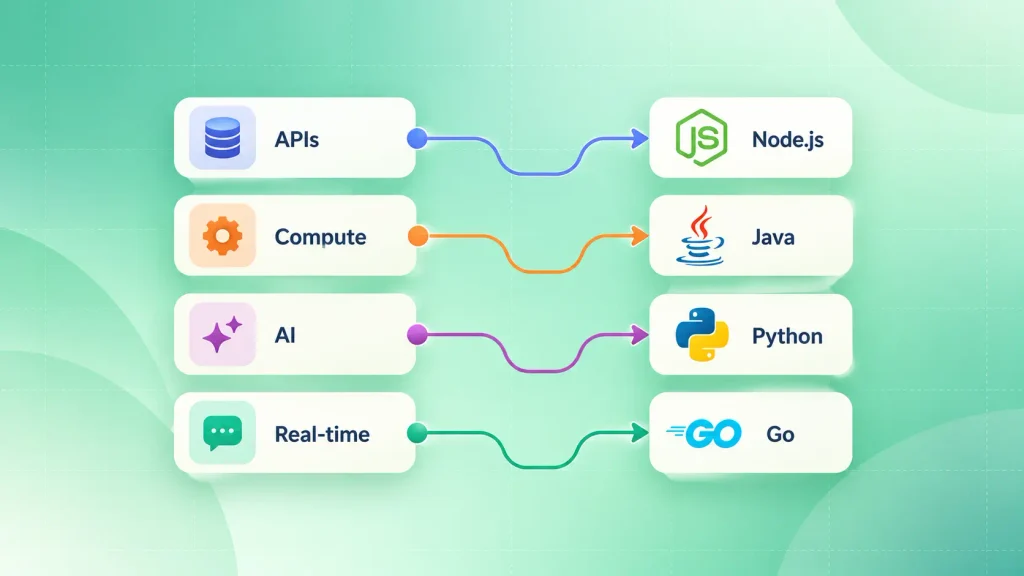
Your workload is what your backend spends its time doing. You can usually describe it in one sentence, and it points to a language family:
- Mostly API calls and database reads: Node.js, Python, PHP, and Go all handle this well.
- Heavy computation on the server: Java, Go, or C# outperform Node and Python here.
- AI models and data pipelines: Python, with little contest.
- Many live connections at once: Node.js, Go, or Elixir.
If you can’t describe your workload in a sentence yet, that’s a sign to scope the product before choosing anything.
Count Your Hiring Pool
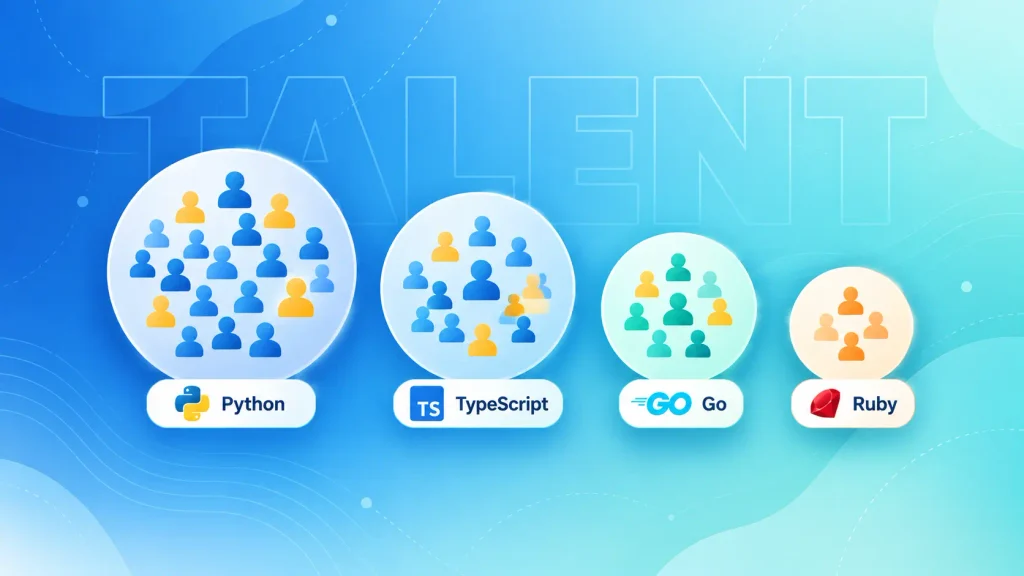
You’ll hire for this language for years, so the size of the talent pool matters more than any benchmark. A niche language can be a joy for your first engineer and a bottleneck for your fifth.
Among professional developers, Python sits at 54.8% and TypeScript at 48.8%, while Go is at 17.4% and Ruby at 6.9%. If you need to grow quickly without a long search, software developer staff augmentation can fill gaps in any of the mainstream stacks.
Check the Ecosystem for Your Must-Haves
Before you commit, it’s worth listing the integrations your product can’t launch without. Payments, authentication, email, AI model SDKs, and your cloud provider should all have well-maintained libraries in your chosen language. The same goes for your database: PostgreSQL, used by 58.2% of professional developers in 2025, has solid drivers in all six.
For the six languages above, this is rarely a problem. It becomes a real problem with smaller languages, where you may end up writing and maintaining your own integration code.
Match the Language to Your Scenario
Once you know your workload and your hiring market, the decision usually lands in one of these patterns:
| Scenario | Best pick | Runner-up | Why |
| SaaS MVP, small team | TypeScript (Node.js) | Python | One language, fast shipping |
| AI-powered product | Python | TypeScript (Node.js) | Model tooling lives in Python |
| Enterprise or regulated | Java | C# | Mature security and compliance patterns |
| Content site or store | PHP | Node.js | Cheap hosting, huge plugin ecosystem |
| High-traffic API | Go | Java | Speed with simple deploys |
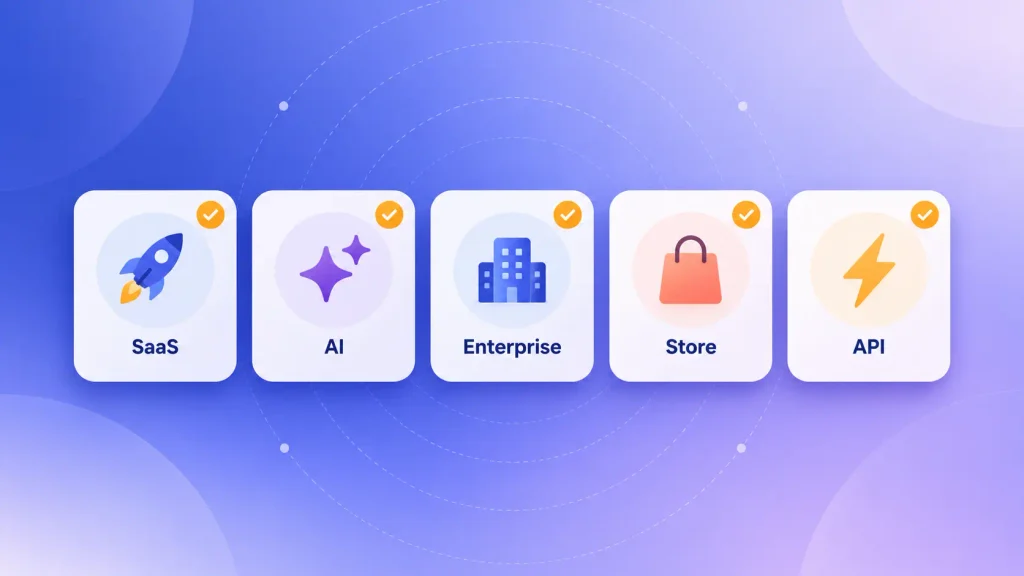
If you’re scoping an early product, the first two rows are where most SaaS MVP development work begins. If you’re stuck on Node.js vs Python for backend work, ask whether AI sits at the core of your product; that usually settles it. The table is a starting point, not a verdict, and your team’s existing skills are the tie-breaker.
Does the Backend Language Really Matter?
Less than most debates suggest. Your architecture, your database design, and your team’s experience usually decide whether an app is fast and stable. Switching from Python to Go won’t fix slow queries or a missing cache.
Where It Barely Matters
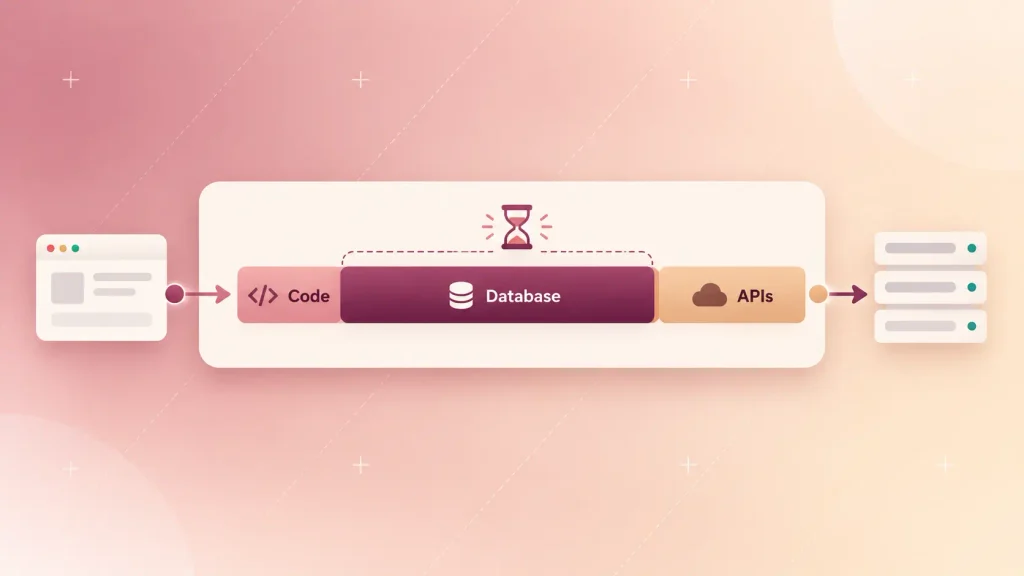
For a typical business web app, with user accounts, dashboards, forms, and a database, any of the six languages will do the job. In these apps, the server spends most of its time waiting on the database and outside APIs, not computing. Language speed rarely becomes your bottleneck.
Where It Really Does
The choice starts to matter at the edges. These are the situations where you’ll feel the difference:
- Heavy server-side computation: image or video processing, large calculations, and complex reports.
- Thousands of live connections: chat, multiplayer features, and live trading screens.
- Regulated industries: where auditors expect specific, proven frameworks.
- An existing codebase: where a new language means two stacks to hire for and maintain.
If none of these describe you, I’d suggest weighting hiring and speed of delivery above performance.
Can You Switch Languages Later?
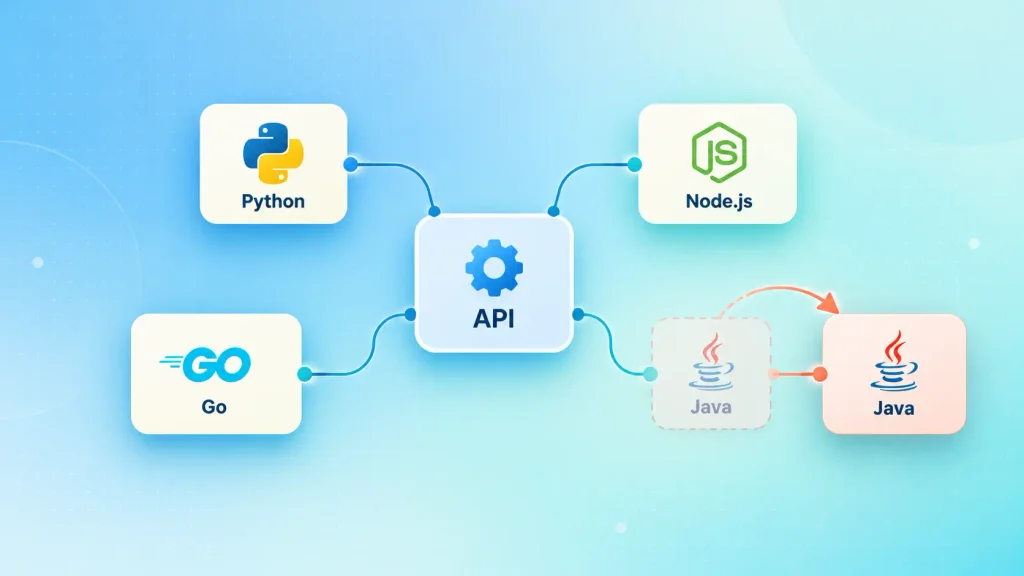
Yes, but a full rewrite is expensive and risky, and it pauses your roadmap. The safer route is gradual. You keep the original backend running and move one service at a time to the new language behind a shared API.
Many mature products end up mixing languages this way. A common pattern is Python for the AI features, Node.js for the real-time API, and Java or Go for the heavy core. That’s healthy, as long as each service has a clear boundary.
Questions to Ask Before Your Dev Partner Picks a Language
If you’re hiring an agency or development firm, you’ll often find that they recommend whatever their team already knows. That isn’t always wrong, but you deserve to hear the reasoning. These questions bring it out:
- Why this language for my product specifically, and what would you pick as the alternative?
- What does my workload look like, and how does this language handle it?
- How easy will it be for me to hire developers in this language if I bring the work in-house?
- Which frameworks and libraries will you use, and how actively are they maintained?
- What happens if we need to add AI features in year two?
- Have you shipped production apps in this language at my expected scale?
- Who owns the code and the infrastructure accounts?
A good partner answers all seven without getting defensive. If they can’t explain why they picked a language beyond “it’s what we use,” treat that as a warning sign.
How Boomdevs Chooses Your Backend Stack
Every Boomdevs custom web app development project starts by mapping your workload, your growth plans, and your future hiring market before anyone names a language. After 3.5K+ projects over 10+ years, we’ve learned that the right stack depends on the product, not on our habits.
You get a clear recommendation, a written reason for it, and an alternative you can weigh, so the choice stays scalable as your product grows. You can see how that fits into the wider build in our custom web app development process.
Frequently Asked Questions
Is Node.js or Python Better for Backend Development?
Neither wins outright, because they lead different workloads. Node.js is stronger for real-time features and APIs, especially when your frontend is already in JavaScript. Python is the better pick when AI, machine learning, or data processing sits at the center of your product.
Is PHP Still Worth Using in 2026?
Yes, for the right projects. PHP powers 69.4% of websites with a detectable server-side language, according to W3Techs, and Laravel makes it a solid choice for content sites and online stores. For AI-native or real-time products built from scratch, Python or Node.js usually fit better.
What Is the Fastest Backend Language for Web Apps?
For raw execution speed, compiled languages like Go, Rust, Java, and C# lead. In most business web apps, though, the database and outside APIs set the pace, so the language’s speed rarely limits you. Pick for speed only when your app does heavy computation or handles very high traffic.
What Is the Best Backend Language for Startups?
TypeScript on Node.js is a very common startup pick because one language covers frontend and backend, and the hiring pool is large. If your product depends on AI, Python is usually the better starting point. Both let a small team ship an MVP quickly.
What Is the Best Backend Language for Beginners?
Python is the usual recommendation because its syntax is readable and frameworks like Django and FastAPI have excellent documentation. JavaScript is a close second if you already know some frontend development, since you can use the same language on both sides.
Ready to Pick Your Stack With Confidence?
You don’t have to settle this debate alone. Tell us what you’re building, and we’ll recommend a backend language and stack for your workload, explain the trade-offs in plain language, and give you a project estimate.