


- 1. Key Takeaways
- 2. What Are the Key UI/UX Consulting Challenges?
- Defining the Real Problem Behind the Request
- Aligning Stakeholders With Different Definitions of Success
- Getting Trustworthy User Evidence Under Imperfect Conditions
- Balancing User Needs, Business Goals, and Technical Constraints
- Turning Research and Audits Into Priorities: A Core UI/UX Consulting Challenge
- Building Accessibility Into the Work Instead of Retrofitting It
- Maintaining Consistency as the Product Scales
- Preserving Design Intent Through Development and Release
- 3. How Can You Make a UI/UX Consulting Engagement More Effective?
- 4. When Does External UI/UX Consulting Make Sense?
- 5. Frequently Asked Questions
- 6. Final Thoughts
Summarize with
UI/UX consulting sounds simple from the outside: review the product, identify friction, and recommend a better experience. In practice, the interface is only one part of the problem. The harder work is understanding what is actually going wrong, aligning the people who own the product, and turning evidence into changes that can survive development and release.
That is why the most important UI/UX consulting challenges are rarely about choosing colors or rearranging screens. They sit between user behavior, business goals, technical constraints, accessibility, stakeholder expectations, and implementation. A useful consultant has to connect those pieces without letting one of them dominate the whole decision.
Key Takeaways
- Many UX problems are symptoms, so the first challenge is defining the real problem before proposing a redesign.
- Stakeholder alignment matters because product, engineering, marketing, and leadership can have different definitions of success.
- User research is most useful when the research question, participants, and method match the decision the team needs to make.
- Accessibility, technical feasibility, and implementation details need to influence design decisions early, not after approval.
- The value of consulting is not the number of findings in a report; it is whether the team can prioritize, implement, and measure the right changes.
What Are the Key UI/UX Consulting Challenges?
The key UI/UX consulting challenges are defining the right problem, aligning stakeholders, gathering trustworthy user evidence, balancing competing constraints, prioritizing findings, designing for accessibility, maintaining consistency, and carrying design intent into development. These challenges are connected. Weak problem framing can distort research, weak research can create stakeholder disagreement, and unclear implementation details can undo a strong design decision later.
Defining the Real Problem Behind the Request
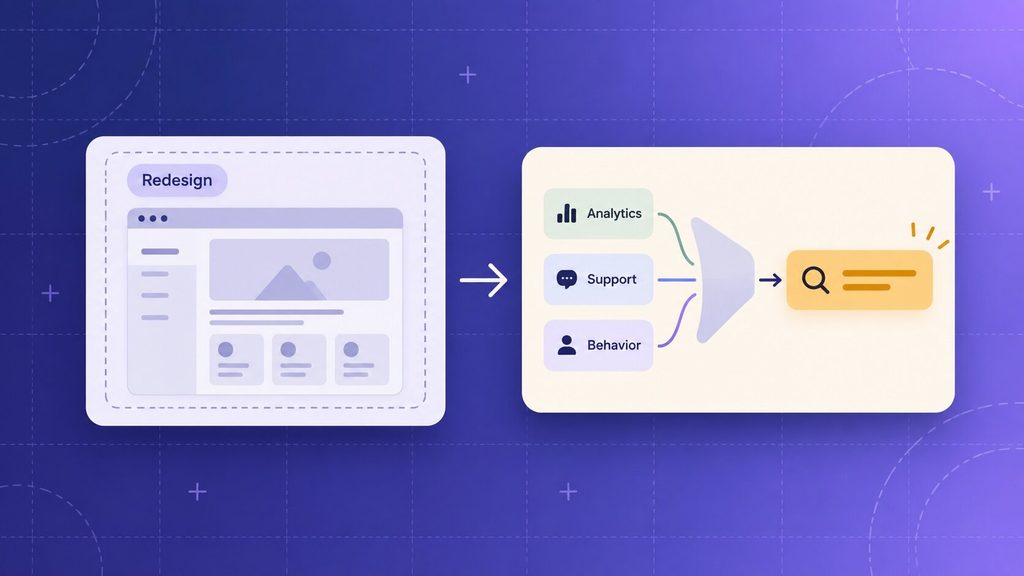
A client may ask for a cleaner dashboard, a modern onboarding flow, or a higher-converting checkout. Those are valid goals, but they do not yet explain why the current experience is underperforming. A visual redesign can easily solve the visible symptom while leaving the underlying problem untouched.
A consultant therefore needs to turn a broad request into a decision-ready problem. That usually means looking at available analytics, support patterns, stakeholder knowledge, user behavior, and product constraints before deciding what kind of design work is needed. GOV.UK’s user research guidance recommends turning unfounded assumptions and opinions into research questions, which is a useful discipline for this stage.
Consider a SaaS onboarding flow with poor completion. The cause could be an unclear value proposition, an unnecessary form, a confusing permission request, a technical error, or simply the wrong audience entering the flow. If the team assumes the problem is visual, a polished redesign may still miss the reason users stop.
The consulting question is not only, “What should this screen look like?” It is also, “What user behavior are we trying to change, and what evidence would show that the problem is improving?”
Aligning Stakeholders With Different Definitions of Success
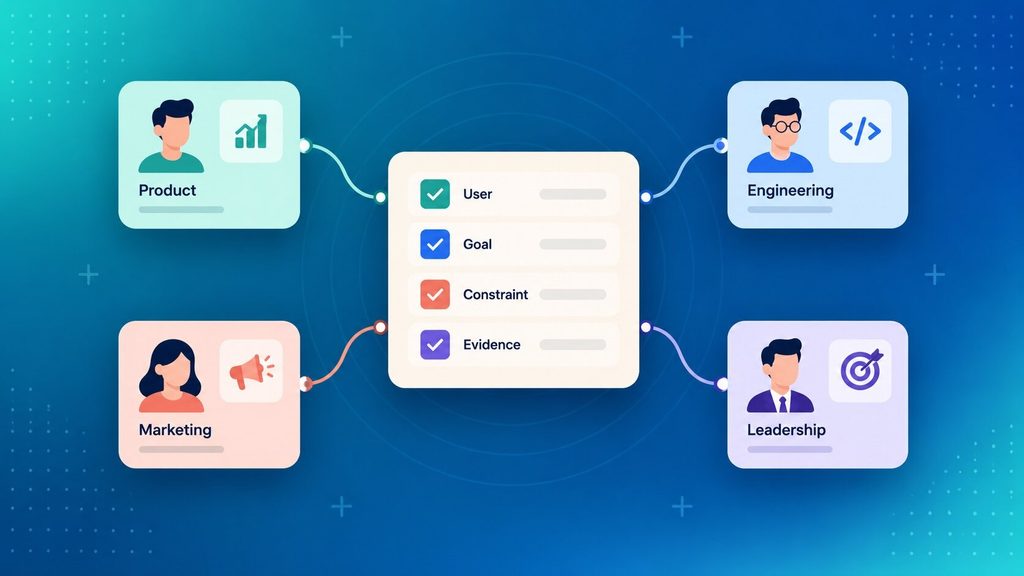
Stakeholder alignment is one of the recurring UI/UX consulting challenges because every team looks at the product through a different lens. Product may care about activation, marketing may want stronger messaging, engineering may be protecting technical stability, and leadership may be focused on a commercial target.
The consultant’s job is not to make every stakeholder equally happy. It is to create shared decision criteria, so the team can judge ideas against the same problem. That can include the target user, the business objective, known constraints, the evidence available, and the level of risk the team is willing to accept.
This is also where research can keep the conversation from becoming opinion-driven. When a disputed decision can be turned into a testable question, the team gains a path forward that does not depend only on seniority or preference.
A short decision log can help in complex engagements. It can record what was decided, which evidence supported it, which constraints shaped it, and what still needs validation. The goal is not documentation for its own sake; it is preserving context when the same decision reappears two sprints later.
Getting Trustworthy User Evidence Under Imperfect Conditions
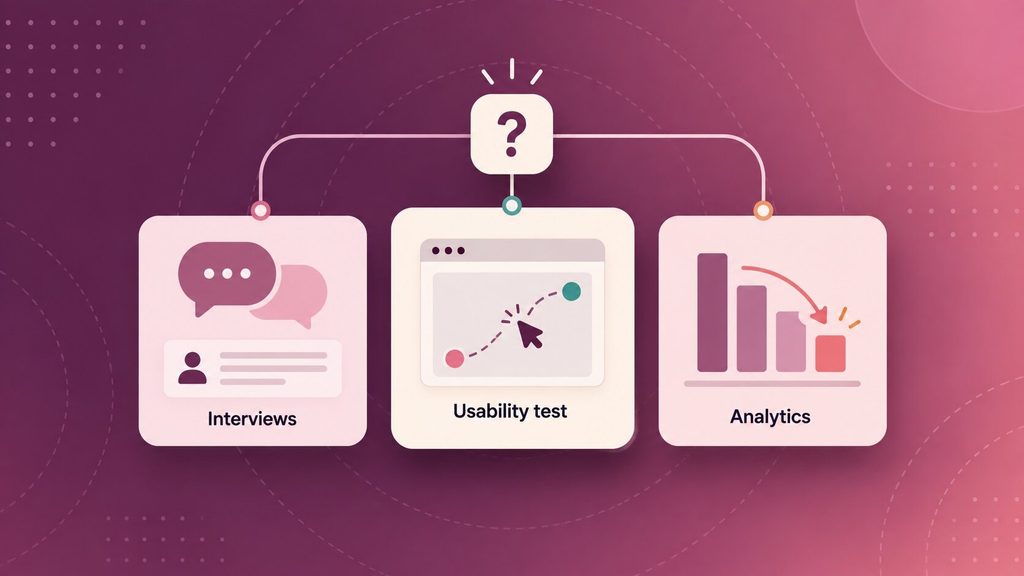
User research is one of the strongest inputs into UX work, but among the common UI/UX consulting challenges, gathering it under imperfect conditions stands out. Teams may have limited access to customers, short timelines, incomplete analytics, sensitive user groups, or a product that is still too early for meaningful behavioral data.
The response should not be to skip research or to use one method for every question. The method needs to match what the team is trying to learn. Interviews can help explore motivations and mental models, usability testing can expose friction in a specific flow, and behavioral data can show where users struggle at scale without explaining the reason by itself.
GOV.UK advises teams to define research objectives, prioritize research questions, involve the wider team, and update the research plan as they learn. That supports a practical consulting approach: start with the most consequential uncertainty, gather enough relevant evidence to make the next decision, and continue learning as the product changes.
Participant quality matters as much as method choice. Research with convenient but unrepresentative participants can create confidence without relevance. When the audience is narrow or specialized, recruitment criteria should reflect the users whose behavior the product actually needs to support.
For projects that need a deeper research layer, Boomdevs user research and market insights cover interviews, usability testing, behavioral analysis, journey mapping, and post-launch research. The useful connection here is not the number of methods available. It is choosing the smallest research approach that can answer the decision in front of the team.
Balancing User Needs, Business Goals, and Technical Constraints
A good UX recommendation has to work in the real product, not only in a prototype. That is where technical feasibility becomes part of the design problem.
A user may benefit from a simpler workflow, but the product may have role permissions, compliance rules, legacy data, or integration dependencies that cannot be ignored. A consultant who does not understand those constraints may create a concept that looks clear in Figma but becomes expensive, fragile, or incomplete in development.
The opposite mistake is letting technical limitations dictate the experience too early. Existing architecture can explain why something is difficult, but it should not automatically define the best long-term interaction. Consulting is valuable when it makes the tradeoff explicit: what the ideal experience is, what the current system can support, and what intermediate option creates meaningful improvement without unnecessary rebuild work.
This is why early collaboration with engineering matters. Technical input is most useful while options are still open, not after the design has been approved and handed over.
Turning Research and Audits Into Priorities: A Core UI/UX Consulting Challenge
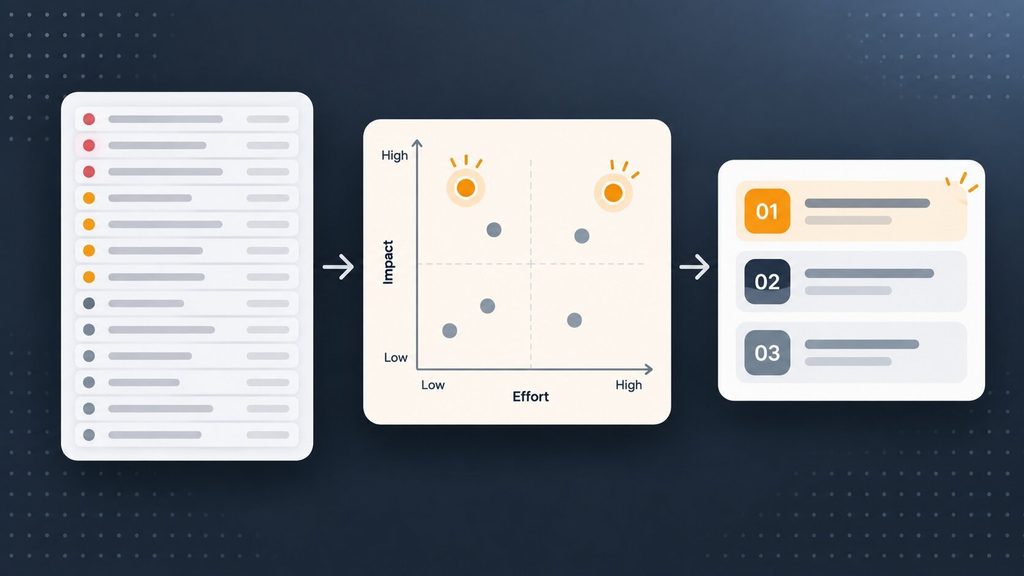
A UX audit can find dozens of issues. That does not mean a product team can or should fix all of them at once. Without prioritization, a detailed audit can become another backlog that nobody knows how to use.
Nielsen Norman Group describes heuristic evaluation as a method for finding usability problems by reviewing an interface against recognized usability principles. Finding problems, however, is only the diagnostic step. A consulting engagement still needs to translate those findings into decisions.
One practical approach is to weigh user impact, evidence confidence, business relevance, implementation effort, and dependencies. This does not need to become a complicated scoring formula. The purpose is to explain why one problem deserves attention before another.
Boomdevs UI/UX consulting service follows a similar direction by organizing findings into severity-ranked issues and actionable recommendations. A useful deliverable should let a product manager see what should happen next, let a designer understand what needs to change, and give engineering enough context to judge effort and risk.
The strongest recommendation is usually specific enough to act on but not so prescriptive that it ignores implementation discovery. “Improve navigation” is too vague. A better recommendation explains which users are struggling, where the breakdown occurs, what behavior should change, and which constraints the solution needs to respect.
Building Accessibility Into the Work Instead of Retrofitting It
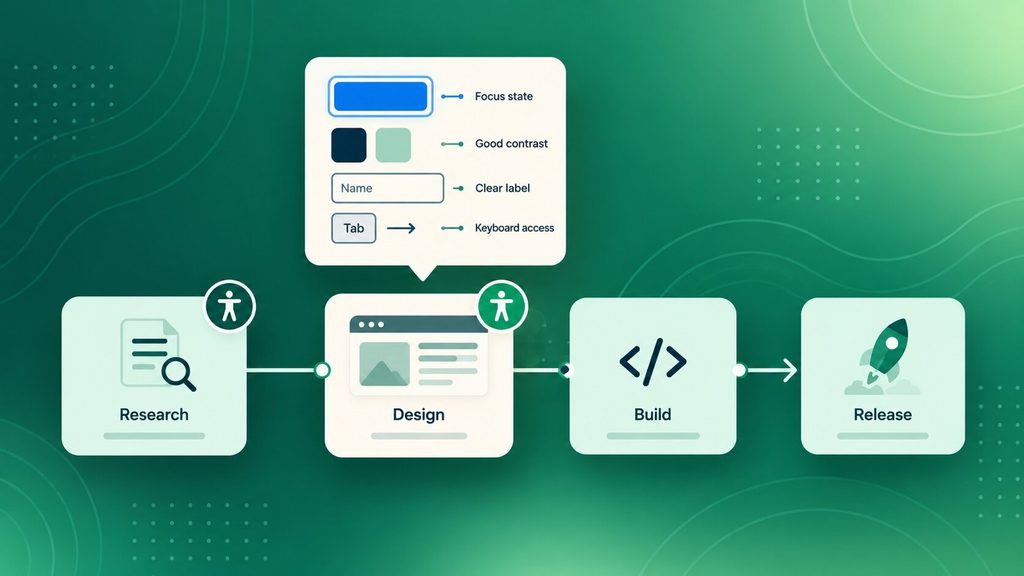
Accessibility is one of the UI/UX consulting challenges that is often treated as a final compliance check instead of a design input. It affects how users perceive information, move through interfaces, enter data, recover from errors, and interact with a product using different input and assistive technologies.
W3C’s accessibility, usability, and inclusion guidance explains that these areas overlap and are most effective when addressed together. W3C also recommends involving people with disabilities early and throughout design and evaluation, because standards alone cannot reveal every real-world accessibility issue.
For consultants, that changes when accessibility questions should appear. Color contrast, focus behavior, keyboard navigation, form labels, error feedback, content structure, zoom behavior, and screen-reader semantics are easier to shape while flows and components are still being designed.
Retrofitting later can also create design conflicts. A component may need different focus states, error messaging, target sizes, or interaction behavior than the visual concept originally assumed. When accessibility is part of the design criteria from the start, those requirements can influence the component rather than fight against it at the end.
Maintaining Consistency as the Product Scales
Consistency becomes harder when a product grows across features, platforms, and teams. Small variations accumulate: two buttons perform the same action with different labels, similar forms validate differently, spacing changes between modules, or the same component gets recreated several times.
Nielsen Norman Group’s usability heuristics include consistency and standards as a core principle. The guidance distinguishes internal consistency within a product from external consistency with platform and industry conventions. Both matter because users build expectations from what they have already learned.
A design system can help, but the challenge is not just creating a component library. Teams also need governance: who can change a pattern, how new variants are reviewed, how design and code stay synchronized, and how deprecated components are removed.
That is where design system consulting becomes operational rather than cosmetic. Boomdevs UI/UX design services include design-system work alongside product and interface design, which reflects the broader point: consistency has to be maintained across decisions, not only documented once.
Preserving Design Intent Through Development and Release
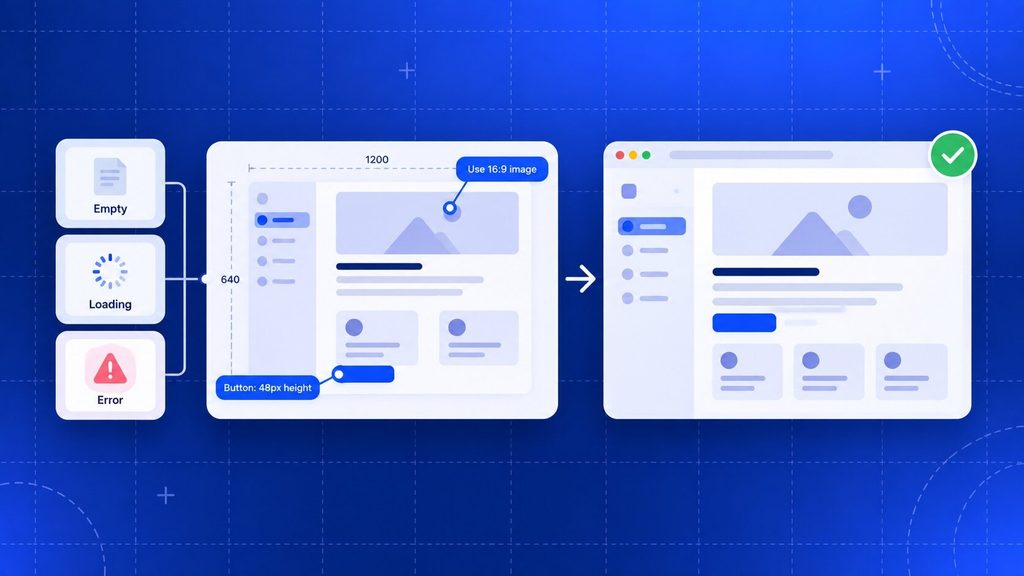
Design handoff is often treated as the moment the design team finishes. In complex products, it is better understood as the start of another collaboration phase.
A static screen cannot fully explain responsive behavior, empty states, loading states, validation, error recovery, permission differences, hover and focus behavior, animation, data limits, or edge cases. If those details are missing, developers have to infer them. The shipped experience can then drift even when everyone is working carefully.
A stronger handoff gives engineering the reasoning behind important decisions, not only the measurements. It also makes space for questions while implementation is underway. Design review during development can catch cases that were invisible in the prototype and refine decisions before they become production debt.
Boomdevs web app design services describe annotated design files, component libraries, interaction specifications, and post-handoff iteration as part of the delivery process. That approach is useful because it treats implementation quality as part of UX quality rather than a separate engineering concern.
The final check should not be, “Does production look like Figma?” It should be, “Does the implemented flow preserve the intended behavior for real users across the states that matter?”
How Can You Make a UI/UX Consulting Engagement More Effective?
A consulting engagement works better when the team creates clarity before producing a large volume of design work. The most useful setup connects the decision, evidence, constraints, ownership, and measurement from the beginning.
- Define the decision, not only the deliverable. “Redesign checkout” describes an output. “Reduce avoidable friction in checkout without changing the payment architecture” gives the team a decision boundary.
- Bring constraints into the room early. Engineering, compliance, content, analytics, and business constraints are easier to work with before a direction hardens.
- Agree on what counts as evidence. Analytics, interviews, usability tests, support data, and expert review answer different questions. The team should know what each input can and cannot prove.
- Prioritize decisions, not screens. The most important work may be fixing a flow, a policy, a content problem, or an information architecture issue rather than redesigning more UI.
- Keep validation connected to implementation. A recommendation should remain open to review when development reveals a constraint, edge case, or behavior the prototype did not capture.
It also helps to agree on UX metrics before the work is judged. The relevant measure depends on the problem: task completion, error frequency, time on task, onboarding completion, support demand, or another product-specific signal may be useful. A metric should be selected because it represents the intended change, not because it is easy to report.
When Does External UI/UX Consulting Make Sense?
External consulting is most useful when the team needs independent diagnosis, additional research capacity, specialist expertise, or a clearer way to resolve competing design decisions. It does not automatically mean the product needs a full redesign.
A focused engagement may be enough when:
- A live product has recurring usability problems, but the root cause is unclear.
- Stakeholders agree that something is wrong but cannot agree on what to fix first.
- The team is making high-impact product decisions with weak user evidence.
- A design system has become inconsistent across multiple teams or products.
- Accessibility issues are appearing late in QA or after release.
- Design and development repeatedly lose context during implementation.
- A major redesign is being considered, but the team wants evidence before committing to it.
In those cases, a UX audit, research sprint, heuristic evaluation, design-system assessment, or targeted flow review can create a more useful starting point than immediately redesigning the whole product.
Frequently Asked Questions
What is the biggest challenge in UI/UX consulting?
There is no single challenge that dominates every engagement. In many projects, problem definition is the most important early risk because research, design, and measurement can all drift when the team has not agreed on what it is trying to improve.
How is UI/UX consulting different from UI/UX design?
Among the UI/UX consulting challenges is this exact distinction: UI/UX design focuses on creating or refining the experience itself. UI/UX consulting focuses more heavily on diagnosis, research, prioritization, strategy, decision support, and guidance around what should change and why. An engagement can include both, but they are not the same job.
Can UI/UX consulting help without a full redesign?
Yes. A focused audit, usability study, information architecture review, accessibility review, or design-system assessment can identify targeted changes without replacing the entire interface. The right scope depends on the problem and the evidence available.
How should a team measure the success of UX consulting?
The measurement should connect to the original problem. If the engagement targets onboarding friction, onboarding behavior may matter. If it targets task errors or navigation, the team needs measures that reflect those outcomes instead. The useful metric is the one that can show whether the intended user or product behavior changed.
Final Thoughts
The hardest UI/UX consulting challenges are not isolated design problems. They are coordination problems between people, evidence, constraints, systems, and implementation.
When consulting works well, the team does not simply receive better-looking screens or a longer audit report. It gains a clearer view of the problem, stronger evidence for decisions, realistic priorities, and a path from recommendation to production.
If your team is facing these UI/UX consulting challenges and needs an independent review before committing to a redesign, Boomdevs UI/UX consulting can help you diagnose usability issues, prioritize the highest-value changes, and turn findings into a practical action plan.