


Summarize with
If your brand ships wholesale into Nordstrom, Macy’s, Bloomingdale’s, Saks, or Neiman Marcus, one Routing Guide violation can cost you 100% of that shipment’s cost, plus a $25 handling fee.
Not a percentage. Not a warning. The full shipment.
That’s not a hypothetical. It’s how Nordstrom’s expense offset program is actually built. Most finance teams at handbag and leather goods brands have never seen the fee schedule that determines it.
The Number Nobody Budgets For
Estimates vary by source, but they all point the same way. 5-15% of manufacturer invoices to retailers incur some kind of chargeback deduction. Vendor chargebacks typically account for a loss of 2-10% of a manufacturer’s total revenue.
The most commonly cited range, per SPS Commerce’s own published data, is 5-7% of gross revenue. Not gross margin, gross revenue.
At that rate, every $10 million shipped wholesale loses $500,000 to $700,000 a year.

The per-unit stakes are higher in this category than most. A compliance error on a $300 handbag carries more dollars per incident than the same error on a $30 accessory. (If you’d rather know your own number than the industry average, that’s a two-minute breakdown, not a research project)
Two Retailers, Two Completely Different Systems
Here’s something that surprises people who’ve only dealt with one department store: Nordstrom and Macy’s don’t run the same kind of deduction system at all, even though they look similar from the outside.
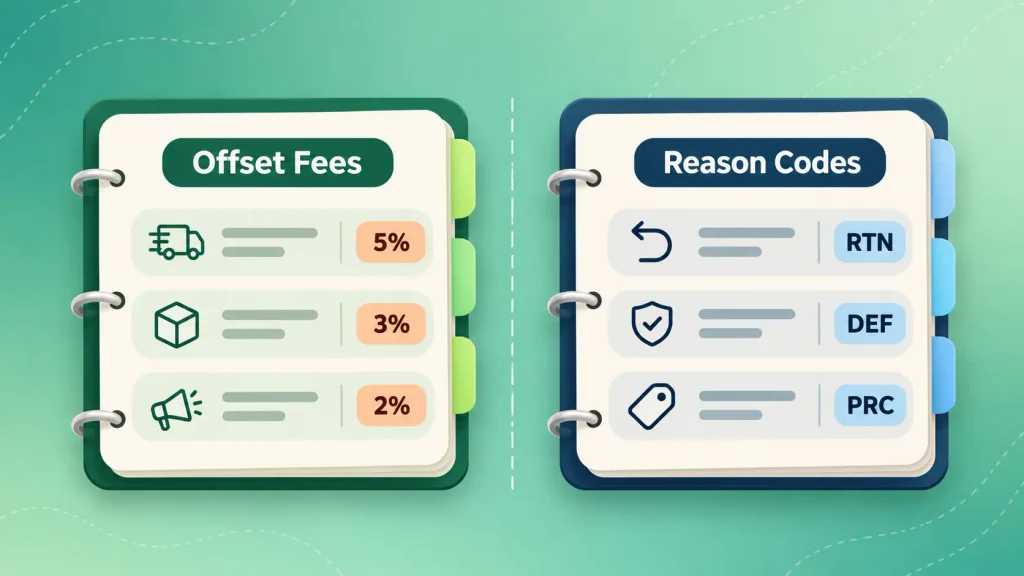
Nordstrom doesn’t use traditional chargeback codes. It runs what it calls expense offset fees, deducted directly from your invoice, categorized by type rather than by a numbered code list.
A paper invoice from an EDI-capable vendor costs $25. An erroneous EDI invoice costs $5. Labeling non-compliance carries a variable RTV or offset fee.
Routing Guide or PO violations, using the wrong carrier or ignoring Nordstrom’s shipping instructions, get charged at 100% of the shipment cost, plus a flat $25 handling fee on top.
EDI capability is required within 60 days of setting up as a vendor. Every carton needs a UCC-12 or EAN-13 barcode before it reaches a Nordstrom distribution center.
Here’s the part that catches brands off guard. Nordstrom’s dispute windows aren’t one number. Suppliers get 12 months from the invoice date to dispute an open invoice, and 12 months from the check date to dispute a claim or chargeback.
But for expense offset fees specifically, the ones tied to non-compliance, the window is only 60 days from the document date. A brand that assumes it has a year, because that’s true for other deduction types at the same retailer, can lose the right to dispute it in two months instead. This is exactly what a deduction audit catches: deductions that are still disputable before their window closes.

Macy’s runs on Reason Codes and Violation Codes, disputed through the Macy’s Net portal rather than a general accounts payable process. Every deduction comes with a specific code identifying exactly what went wrong, and the required documentation depends entirely on which code you’re looking at.
One real example: a deduction coded DM-POD REQ means Macy’s is asking for proof of delivery. Disputing it requires a specific form plus a copy of the invoice and the POD itself, including the street address.
Macy’s also draws a distinction most vendors never think about. A fine is a penalty for breaking an operational rule. A deduction for an audit or return happens when Macy’s decides the goods themselves were unacceptable, or an inspection flagged something. Same dollar impact on your remittance, completely different reason, and completely different documentation needed to fight it.
Two retailers, two different rulebooks, two different clocks. A brand selling into both isn’t running one compliance process, it’s running two, in parallel. Treating them as the same thing is usually where the money goes missing.
(Not sure which clock applies to which of your own deductions? That’s exactly what a retailer-by-retailer breakdown untangles)
The Off-Price Question
One thing worth being direct about, since it comes up constantly in this category: off-price isn’t a sign something went wrong.
TJX, Ross, and Burlington are a real, deliberate channel that established handbag brands run on purpose, not a place where liquidated stock accidentally ends up.
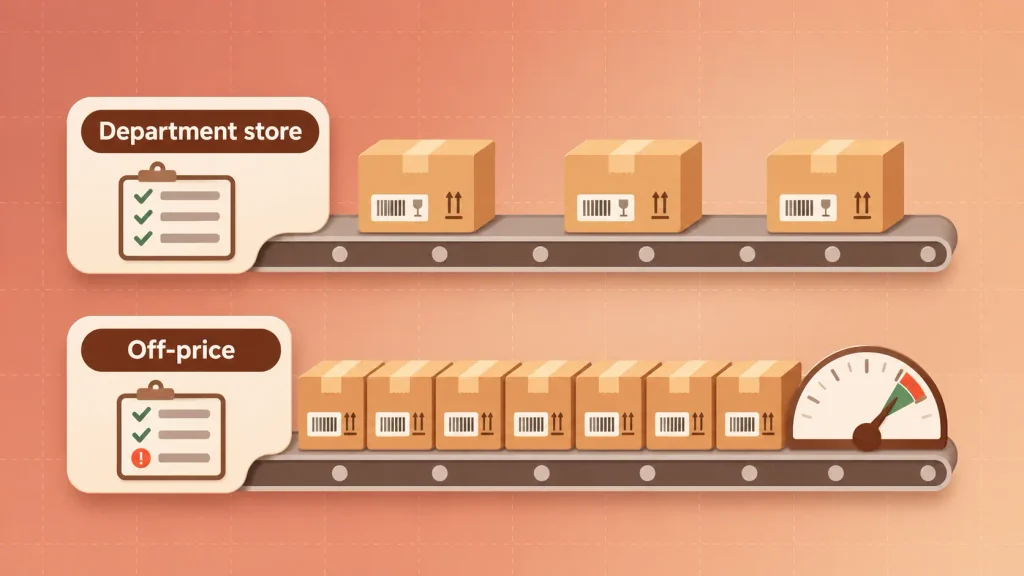
The compliance side works differently there too. Tighter tolerances, less relationship flexibility, more automated enforcement, since the entire off-price model depends on moving high volume through thin margins.
A brand running department stores and off-price at once needs genuinely different postures for each, not one process stretched across both.
Most Deductions Never Get Disputed
Deductions are a standard part of how department store retail works. The bigger problem is what happens after they arrive.
What’s less publicized is the accuracy problem underneath it. An estimated 10-20% of deductions are invalid, but go unchallenged anyway, because internal teams are stretched thin and dispute windows close fast, sometimes much faster than a vendor assumes.
Only 20-30% of deductions ever get disputed at all, industry-wide. Of what does get disputed, the win rate runs around 40% once real documentation exists, and suppliers with clean, automated compliance programs report win rates closer to 74% on well-documented first-time disputes.
The gap between 30% disputed and 100% disputable is, almost by definition, money that was never even argued for. A retail deduction audit shows which of those deductions are still inside their dispute window.

A Category With More Than One Peak
Unlike a category that concentrates its risk into one holiday season, handbags and leather goods see recurring demand spikes across the year, Valentine’s Day, Mother’s Day, graduation season, and the holidays.
Each one is a fresh SKU push, a fresh retail expansion, and a fresh chance for a first-time compliance mistake at a brand that’s growing. Four gifting peaks a year means four separate windows where new errors are most likely to get introduced, not one. Holiday is the largest of them, and its deductions arrive in December and January, when Nordstrom’s 60-day clock on expense offset fees is already running.

The Part That’s Actually Good News
None of this is inevitable. Compliance deductions are among the most preventable costs in a retail business. The invalid ones are, by definition, recoverable, if someone files the dispute in time with the right documentation for that specific code, at that specific retailer.
A few things worth checking, regardless of what you do next:
- Do you know your deduction rate as a percentage of wholesale revenue, broken out by retailer, not just the dollar total?
- Do you know Nordstrom’s 60-day window for expense offset fees specifically, separate from the 12-month window for everything else, and is anyone actually tracking that distinction?
- Do you have someone who knows Macy’s reason codes well enough to know which documentation a DM-POD REQ needs versus a fine versus an audit deduction?
Most finance teams can’t answer these without logging into two separate retailer portals and learning two separate rulebooks by hand. That’s usually exactly why nobody’s answered them yet.
If you want to see what catching this looks like across your specific mix of department stores, off-price, and Amazon accounts, get a free written teardown of what’s recoverable for your mix or just reply to the email that brought you here, whichever’s easier.
Sources referenced: industry chargeback and deduction rate estimates from retail compliance and supply-chain research, and directly from SPS Commerce’s own published deduction management data; Nordstrom’s expense offset fee structure and dispute windows, and Macy’s reason code and violation code system, as published in retailer-specific vendor compliance guides.