


- 1. 1. What Does AI SaaS Development Actually Look Like in 2026?
- 2. 2. How Do You Choose Between AI APIs, RAG, and Fine-Tuning?
- 3. 3. What Is the Best Tech Stack for an AI-Powered SaaS Platform?
- 4. 4. How Much Does AI SaaS Development Cost, and What Does It Cost to Run?
- 5. 5. How Do You Build Multi-Tenant AI SaaS Architecture Securely?
- 6. 6. Why Do Multi-Step AI Agents Fail? The Compounding Reliability Problem
- 7. 7. How Do You Optimize LLM Inference Costs Without Wrecking Quality?
- 8. 8. What Do the EU AI Act Rules Actually Require Now?
- 9. 9. How Do You Catch Model Drift and Regressions in Production?
- 10. 10. Should You Use Usage-Based Pricing for Your AI SaaS?
- 11. 11. Why Is Vertical AI SaaS the Stronger Bet for Founders?
- 12. 12. What Roadmap Gets an AI SaaS MVP to Production?
- 13. Frequently Asked Questions
- How Long Does It Take to Build an AI SaaS Product in 2026?
- What Is the Most Common Mistake in AI SaaS Development?
- How Do I Avoid Runaway API Bills?
- Is It Better to Build or Buy an AI Model?
- What Is the Model Context Protocol (MCP)?
- Is It Better to Build or Buy an AI Model?
- What EU AI Act Deadlines Apply to My SaaS Right Now?
- How Does RAG Differ From Ordinary Search in a SaaS Product?
- What Should AI SaaS Security Cover in 2026?
- 14. Where to Start
Summarize with
AI SaaS development in 2026 means shipping software where a model does part of the work, and where that part is non-deterministic, metered per token, and increasingly regulated. Building a prototype is no longer the hard part. A demo takes days.
Turning that demo into a product with tenant isolation, predictable gross margins, and a defensible compliance position takes months. That gap is where most projects quietly die.
This guide covers the 12 decisions that determine which side of the gap you land on. Every figure below links to its primary source, and the regulatory section reflects the timeline as it stood on 6 August 2026, not the one most articles are still repeating.
Key Takeaways
- The failure mode is operational, not technical. In a June 2025 forecast, Gartner predicted that more than 40% of agentic AI projects will be canceled by the end of 2027, citing escalating costs, unclear business value, and inadequate risk controls.
- The EU AI Act timeline changed in mid-2026. The Digital Omnibus moved high-risk obligations to December 2027 and August 2028, but Article 50 transparency rules took effect on 2 August 2026. Most articles still have this backwards.
- Inference cost is an architecture decision, not a billing one. Prompt caching and batch processing are multipliers you design for up front, and they change your unit economics by an order of magnitude.
- Prompt-level tenant isolation is not isolation. Enforce it in the database and the retrieval layer, then write tests that try to break it.
- Narrow beats broad. Markets and Markets projects vertical AI agents growing at a 62.7% CAGR through 2030, against 46.3% for the overall agent market.
1. What Does AI SaaS Development Actually Look Like in 2026?
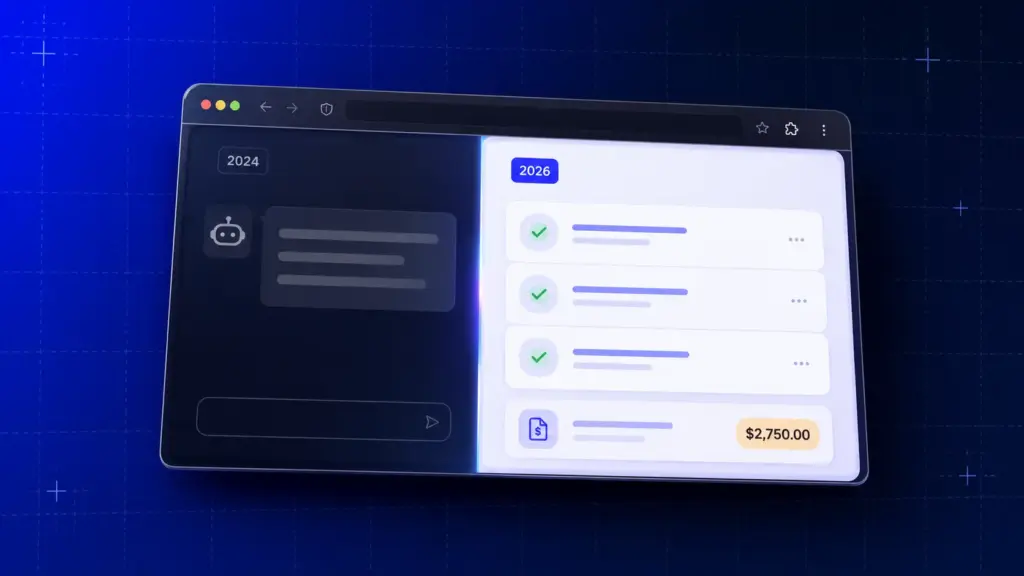
AI SaaS development in 2026 means shipping software that completes work rather than software that generates text. A 2024-era product summarized your tickets. A 2026-era product resolves them, then bills you for the resolution.
That shift is visible in what buyers pay for. On 15 June 2026, Salesforce signed a definitive agreement to acquire Fin, formerly Intercom, for approximately $3.6 billion. Fin’s core product is a support agent that closes tickets end to end across live chat, email, WhatsApp, SMS, phone, and Slack.
The money is following. MarketsandMarkets sizes the AI agents market at $7.84 billion in 2025, rising to $52.62 billion by 2030 at a 46.3% CAGR.
Growth that fast attracts noise. Gartner coined the useful term for it: agent washing, the rebranding of chatbots and RPA scripts as agents. In the same 2025 analysis, Gartner estimated that only about 130 of the thousands of agentic AI vendors are real.
Buyers have noticed. After two years of agent washing, enterprise procurement now asks for eval results, audit logs, and injection resistance data before it asks for a demo. Vague capability claims lose deals that a single reproducible benchmark would have won.
Worth being blunt here: if your product only produces text for a human to act on, you are competing in a commodity category against free features shipped by the model providers themselves.
2. How Do You Choose Between AI APIs, RAG, and Fine-Tuning?
Pick based on which problem you actually have. APIs give you general reasoning, retrieval gives you access to current private data, and fine-tuning gives you consistent behavior and house terminology.
| Dimension | Hosted API | RAG (Retrieval-Augmented Generation) | Fine-Tuning |
| Best at | General reasoning, summarizing, classifying | Answering from private or fast-changing documents | Locking in tone, format, and domain vocabulary |
| Data freshness | Fixed at the model’s training cutoff | Live, updates when your index updates | Fixed until you retrain |
| Upfront effort | Low, an API call | Moderate, ingestion and chunking pipelines | High, dataset curation and evaluation |
| Ongoing cost driver | Tokens per request | Tokens plus vector storage and re-indexing | Retraining plus serving |
| Fails when | The answer lives in your customer’s data | Retrieval returns the wrong chunks | The underlying task changes |
Most teams need two of the three, and almost nobody needs fine-tuning first. Start with an API plus retrieval, measure where quality actually breaks, and only then consider training.
There is a real exception, and it is instructive. Fin built its own post-trained support model, Apex, rather than continuing to rent general-purpose reasoning. Salesforce describes Apex as purpose-built for customer support, with resolution rates that outperform top commercially available frontier models.
Look at what made that build defensible: one narrow job, enormous proprietary conversation volume, and a measurable accuracy gap that prompting could not close. All three had to be true.
If you cannot describe your accuracy gap in a number, you are not ready to train a model.
3. What Is the Best Tech Stack for an AI-Powered SaaS Platform?
There is no single answer, but the 2026 default stack has stabilized enough to describe, and the only choice in it that deserves real debate is where you draw the service boundary.
Split your inference service from your CRUD API when any two of these are true: your model calls run longer than 30 seconds and hold connections open, your prompt changes ship more often than your application code, or your inference workload needs to scale independently of user traffic. Below that bar the split costs you more in operational overhead than it returns. Above it, you will make the split eventually, and doing it late means doing it under load.
Frontend: React with Next.js, primarily for streaming model output into the UI without hand-rolling a socket layer.
Backend: Node.js where concurrency dominates, Python where the AI libraries live, Go where per-request latency is a contract term.
Data and retrieval: Postgres with pgvector, using HNSW indexes for approximate nearest-neighbor search. Keeping embeddings next to your relational metadata avoids a second consistency problem you do not need.
Orchestration: LangGraph, Mastra, or Pydantic AI for agent state machines, retries, and human approval steps.
Tool connectivity: Model Context Protocol. On 9 December 2025, Anthropic donated MCP to the Agentic AI Foundation, a directed fund under the Linux Foundation, reporting more than 10,000 active public MCP servers and adoption across ChatGPT, Cursor, Gemini, Microsoft Copilot, and Visual Studio Code. The Linux Foundation announcement lists AWS, Anthropic, Block, Bloomberg, Cloudflare, Google, Microsoft, and OpenAI as platinum members.
Evals and observability: LangSmith, Braintrust, or Langfuse, instrumented through OpenTelemetry so you can switch vendors later.
The MCP governance change matters more than the download counts. A protocol owned by one vendor is a bet. A protocol governed by a cross-industry foundation is infrastructure, and enterprise buyers price that difference into procurement.
One caution: the MCP specification is versioned and still moving. Pin your version and read the changelog before upgrading, because tool definition changes have side effects that show up in section 7.
4. How Much Does AI SaaS Development Cost, and What Does It Cost to Run?
You will see quoted build ranges from roughly $5,000 for a proof of concept to $250,000 and up for an enterprise platform. Those figures describe scope, not cost, and they vary enormously by region and agency.
Here is the more useful way to think about the four tiers:
Proof of concept. One AI task, one happy path, no billing or multi-tenancy. The question it answers is whether the model can do the job at all.
MVP. A usable workflow with authentication, billing, and error handling. The question is whether anyone will pay.
Production. Tenant isolation, evals in CI, observability, incident runbooks, and a compliance position. The question is whether it survives real customers.
Platform. Multiple workflows, custom integrations, granular admin controls, audit logs.
The line item that sinks margins is not the build. It is inference, and almost nobody models it before signing a pricing page.
Working the Unit Economics
Take a support agent priced per resolution. The model below uses Anthropic’s published rates as of 6 August 2026.
Assumptions, stated so you can challenge them:
- 8,000 input tokens per model call (system prompt, retrieved documents, conversation history)
- 6,000 of those tokens cached, 2,000 fresh
- 600 output tokens per call
- 8 model calls per resolution (illustrative for a retrieval-plus-tools loop; substitute your own trace data, because this is the assumption most likely to be wrong for your workload)
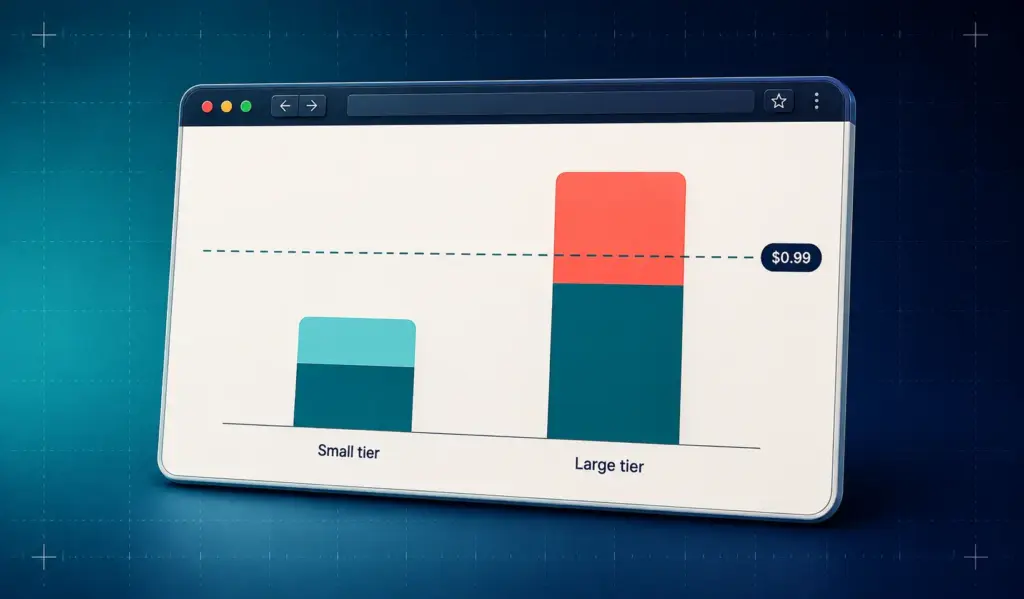
- $0.99 reference price per resolution, Fin’s published rate
| Model tier | Cost per call | Cost per resolution (8 calls) | As % of a $0.99 price |
| Small (Haiku 4.5) | $0.0056 | $0.045 | 4.5% |
| Large (Opus 5) | $0.028 | $0.224 | 22.6% |
Same architecture, same prompt, same output. The only variable is which model tier handles the step, and it moves inference from a rounding error to nearly a quarter of revenue.
Now add the resolutions you do not get paid for. Carry the small-tier figure and layer on the three costs nobody budgets:
| Line item | Assumption | Cost per billable resolution |
| Billed resolutions | Baseline | $0.045 |
| Escalations to humans | 18% of volume, model cost still incurred | $0.008 |
| Tool-failure retries | 12% of calls retried once | $0.005 |
| Eval runs in CI | 200 cases, 20 deploys/month, amortised at 10,000 resolutions/month | $0.004 |
| Effective cost | $0.062 |
At $0.99, that is 6.3% rather than 4.5%. Run the same three lines against the large-tier baseline and effective cost lands near $0.31, or 31% of revenue, which is how a 70% gross margin becomes a 40% one without a single line of the architecture changing.
Model this before you publish a price, not after.
5. How Do You Build Multi-Tenant AI SaaS Architecture Securely?
Enforce tenant scope in the database and the retrieval layer, never in the prompt. A vector similarity search does not respect organizational boundaries. It returns the nearest match, and if Tenant A’s pricing document is the nearest match to Tenant B’s question, that is what comes back.
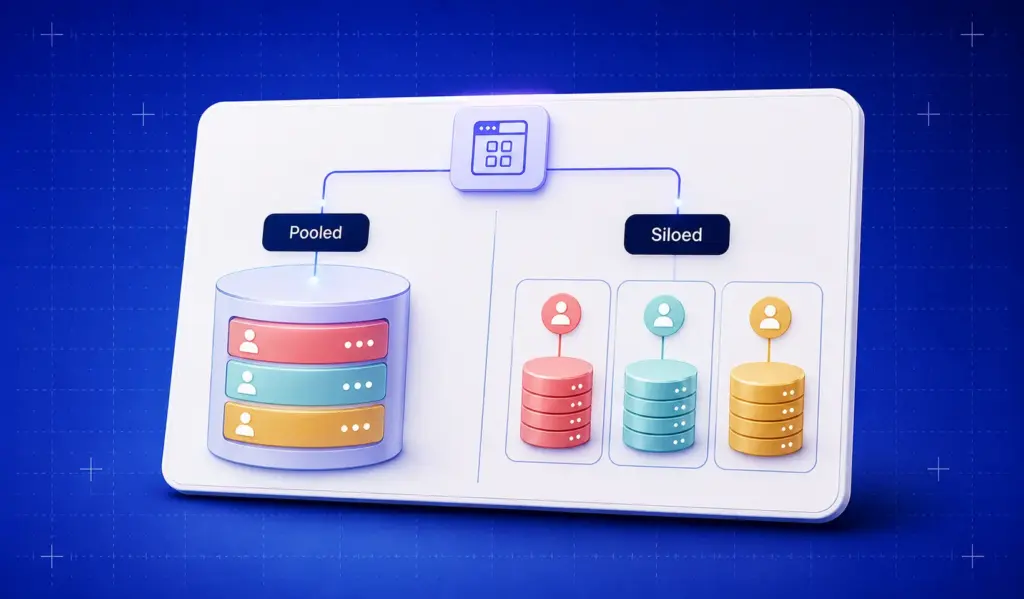
Two storage patterns, and the choice is mostly about scale and blast radius:
Silo: a database, schema, or collection per tenant. Strong isolation, higher operational cost, awkward past a few hundred tenants.
Pool: shared tables with a tenant_id on every row. Cheaper and simpler to operate, but isolation now depends entirely on discipline.
If you pool, the practical checklist looks like this:
- Put tenant_id on every table that holds tenant data, including embeddings and chat history.
- Turn on Postgres row-level security, and use FORCE ROW LEVEL SECURITY so even the table owner cannot bypass the policy. AWS publishes a detailed walkthrough of this pattern.
- Set the tenant context per connection through a session variable, and clear it when the connection returns to the pool. A leaked session variable in a pooled connection is a cross-tenant read.
- Resolve tenant identity from your session store on every tool call, not from anything the model produced.
- Write cross-tenant leakage tests and run them in CI. Isolation you have not tried to break is isolation you are assuming.
- Version your embeddings. Add a model_version column now, because the day you switch embedding models, old vectors stop being comparable to new queries.
Why Prompt-Level Guardrails Are Not Enough
There is hard data on this. Zou et al., “Security Challenges in AI Agent Deployment: Insights from a Large Scale Public Competition” (arXiv:2507.20526), ran the largest public red-teaming competition to date against 22 frontier AI agents across 44 realistic deployment scenarios. Participants submitted 1.8 million prompt-injection attacks, and more than 60,000 succeeded in eliciting policy violations including unauthorized data access, illicit financial actions, and regulatory noncompliance.
The paper reports an overall attack success rate of 27.1% for indirect prompt injection, against 5.7% for direct injection.
Indirect injection is precisely the shape of a RAG pipeline: the model reads a document, and the document contains instructions. Your retrieval layer is the attack surface.
The persistence finding is worse. The authors report that nearly all agents exhibited policy violations for most tested behaviors within 10 to 100 queries, with attacks transferring readily across models and tasks. A defense that holds on the first attempt is not a defense.
Anthropic’s own browser agent research benchmarks against an adaptive attacker given 100 attempts per environment, which tells you how the labs themselves think about this.
Read the OWASP Top 10 for LLM Applications and treat four entries as design requirements: prompt injection (LLM01), excessive agency (LLM06), system prompt leakage (LLM07), and unbounded consumption (LLM10). Excessive agency is the one that bites agentic products, and the fix is unglamorous: give each tool the narrowest possible permission, and require human approval for anything destructive or financial.
One subtle cache detail, since it sits at the intersection of cost and isolation. Anthropic isolates prompt caches between organizations and, on the Claude API, between workspaces. Within your own workspace, keep the shared static prefix in one cache segment and per-tenant context in another, so one tenant’s changing documents do not destroy every other tenant’s cache hit rate.
6. Why Do Multi-Step AI Agents Fail? The Compounding Reliability Problem
| Per-step reliability | 5 steps | 10 steps | 20 steps |
| 90% | 59% | 35% | 12% |
| 95% | 77% | 60% | 36% |
| 99% | 95% | 90% | 82% |
Three consequences follow, and they are the strongest argument in this entire guide for shorter agent loops.
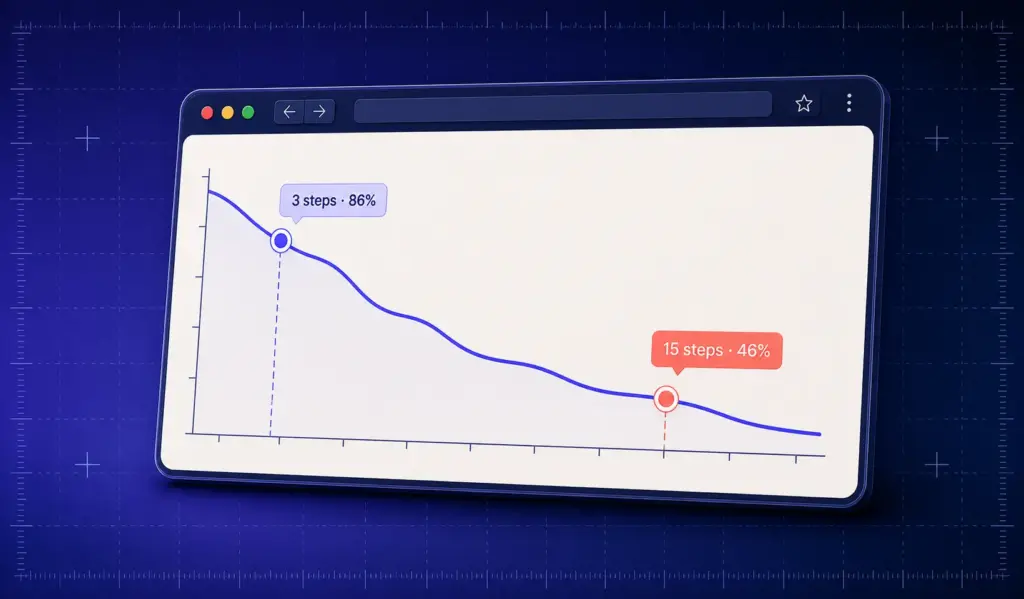
Your demo lied to you, and not on purpose. A three-step demo at 95% per-step reliability succeeds 86% of the time, which feels solid. The same reliability across a real 15-step workflow succeeds 46% of the time.
Reliability gains compound harder than capability gains. Moving one step from 95% to 99% is worth more across a 20-step chain than swapping in a smarter model for every step, and it usually costs less.
Checkpoints beat length. Break long chains into segments with validation between them, so a failure costs you one segment rather than the whole run.
The other structural challenges are covered where they belong: non-determinism and evals in section 9, token burn in section 7, and tenant isolation in section 5. This one gets its own section because the arithmetic is the part teams consistently fail to run.
7. How Do You Optimize LLM Inference Costs Without Wrecking Quality?
Three mechanisms do most of the work, and all three are architectural choices you make early.
Route by task difficulty. Most steps in a workflow are classification, extraction, or formatting, and a small model tier handles them fine. Reserve the large model for genuine reasoning. As section 4 shows, that single decision moves inference from a rounding error to nearly a quarter of revenue.
Cache aggressively, and cache correctly. Anthropic’s prompt caching documentation sets cache reads at 0.1 times the base input price, with writes at 1.25 times for a five-minute TTL or 2 times for one hour. A five-minute cache pays for itself after a single hit.
The catch is that cache hits require identical prompt segments. Three failure modes to avoid:
A timestamp, request ID, or per-request variable inside your cached prefix. Every request writes a new entry and never reads one, so you pay the write premium forever and see none of the discount.
Changing tool definitions. The cache follows a strict tools, then system, then messages hierarchy, so modifying a tool definition invalidates everything after it. For an agentic product adding MCP tools weekly, that is a real and recurring operational cost.
Falling below the minimum cacheable length, which runs from 1,024 to 4,096 tokens depending on the model. Below the threshold, caching silently does nothing and returns no error. Log cache_creation_input_tokens and cache_read_input_tokens on every production call, because a zero in that field is the only warning you get.
Move offline work to batch. Anthropic’s Message Batches API charges 50% of standard prices on input and output tokens. It stacks with caching, though cache hits become best-effort in batch, with documented hit rates ranging from 30% to 98% depending on traffic patterns.
Nightly enrichment, bulk classification, and your eval suite all belong in batch. Anything a user is waiting on does not.
One planning note: do not hard-code pricing assumptions. Published rates change, and the multipliers have been far more stable than the absolute prices. Build your cost model on ratios, and set a calendar reminder to re-verify the absolute numbers against the pricing page each quarter.
8. What Do the EU AI Act Rules Actually Require Now?
This is where most 2026 content is simply wrong, so it is worth getting right.
For over a year, 2 August 2026 was the date everyone planned around, because that was when high-risk obligations were due to apply. Then the Digital Omnibus moved it.
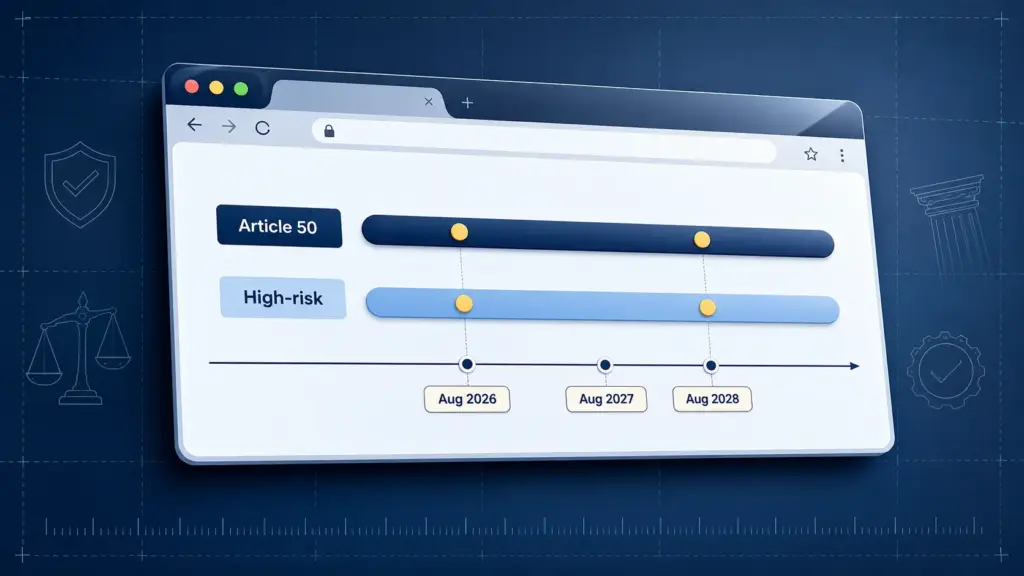
The European Parliament endorsed the final text on 16 June 2026 and the Council adopted it on 29 June 2026. The regulation entered into force on 27 July 2026, deferring stand-alone high-risk obligations under Annex III to 2 December 2027, and embedded high-risk systems under Annex I to 2 August 2028.
What did not move is the part that applies to almost every AI SaaS product.
| Date | What applies |
| 2 August 2026 | Article 50 transparency obligations, and enforcement begins |
| 2 December 2026 | Article 50(2) machine-readable marking for generative systems placed on the market before 2 August 2026, plus new prohibitions |
| 2 August 2027 | Member States to establish national AI regulatory sandboxes |
| 2 December 2027 | High-risk obligations, Annex III stand-alone systems |
| 2 August 2028 | High-risk obligations, Annex I embedded systems |
Article 50 applies from 2 August 2026 regardless of whether your system is high-risk. The Commission adopted its final interpretive guidelines on 20 July 2026.
The obligation covers four distinct situations: telling people when they are interacting with an AI system, marking AI-generated content in machine-readable form, disclosing emotion recognition or biometric categorization, and labelling deepfakes and AI-generated text on matters of public interest.
Penalties are not symbolic. Article 50 breaches carry fines of up to 15 million euros or 3% of worldwide annual turnover.
There is also a voluntary route. The Commission’s Code of Practice on Transparency of AI-Generated Content gives signatories an EU-wide recognised framework for demonstrating compliance, and roughly 190 organisations had signed by the end of July 2026. For signatories, the Commission has said enforcement will focus on monitoring adherence to the code rather than case-by-case assessment.
Practical read for a founder: if you serve EU users, your chatbot needs a disclosure and your generated content needs marking, and both obligations have applied since 2 August 2026. The high-risk deferral bought you time on conformity assessments and technical documentation, not on transparency. Treat the extra 16 months as runway for the work rather than permission to stop.
9. How Do You Catch Model Drift and Regressions in Production?
Run three layers, because each catches a different class of failure:
Unit evals on individual steps. Did retrieval return the right chunk? Did the extractor produce valid JSON? These are fast, cheap, and belong in every pull request.
Regression suites using an LLM as judge for subjective quality, gating merges against a quality threshold.
Production trace sampling, scoring live traffic and promoting real failures back into the eval set.
That third loop is the one teams skip and later regret. Your eval suite should grow out of production failures, not stay frozen as the synthetic cases you wrote in month one.
Understand the limitation of the tooling too. Offline, sampled, judge-based evals surface a regression in the next batch, not on the turn it happened.
A response citing the wrong refund policy returns a normal status code, normal latency, and a normal token count. Nothing in your APM will flag it.
Drift comes from four places, in rough order of how often it surprises people: a provider updates a model behind the same endpoint, someone edits a prompt, your document corpus changes under the retriever, or an embedding model swap silently invalidates old vectors.
For tooling, LangSmith fits LangChain and LangGraph stacks natively, Braintrust is built around gating releases on eval results, and Langfuse is the self-hosted option when data residency is a constraint. Arize and Phoenix make sense if you already run classical ML monitoring. Instrument through OpenTelemetry’s generative AI semantic conventions regardless, so the decision stays reversible.
10. Should You Use Usage-Based Pricing for Your AI SaaS?
Some usage or outcome component is close to mandatory in 2026, because your cost of goods scales with consumption rather than with seats. A pure per-seat price on a product whose costs rise with adoption is a margin trap.
The cleanest public example is Fin, which prices its AI agent at $0.99 per outcome and charges once per conversation regardless of how many questions it answers. Salesforce, announcing the acquisition, said the agent resolves about 76% of support volume without a human.
Three lessons worth stealing:
Define the billable event precisely, in public. Fin’s definition includes conversations where the customer confirmed the answer helped and conversations where they simply left without asking again. Whatever you choose, publish it, because ambiguity here reads as a trick.
Not every outcome is worth the same. Fin bills different outcome types at different rates rather than flattening everything into one price. If a lead qualification is worth 10 times a routine answer to your customer, price it that way.
Set a floor. Fin’s standalone plan carries a 50-outcome monthly minimum. Consumption pricing with no floor means your smallest customers cost more to serve than they pay.
The honest trade-off: usage pricing aligns your revenue with delivered value, and it makes your customer’s budget unpredictable. Finance teams raise that objection for good reason, which is why hybrid models exist. Base seats for access plus credits for consumption is now the common compromise.
One caution on forecasting. Vendor-reported resolution rates are averages across a customer base that self-selected into the product. Model your own economics on a conservative rate, and check what happens to margin if it lands 20 points lower.
11. Why Is Vertical AI SaaS the Stronger Bet for Founders?
Compare two products. A horizontal writing assistant competes with a feature the model providers ship for free, updated weekly, at no marginal cost to them. A prior-authorization agent that knows one specialty’s payer rules, integrates with a specific EHR, and carries the audit trail a compliance officer demands competes with a spreadsheet and a temp.
Replicating that second product requires domain data, regulatory work, and integrations nobody builds speculatively. That is the moat, and it sits in the data and the workflow rather than in the model.
The market agrees. MarketsandMarkets projects vertical AI agents as the fastest-growing segment at a 62.7% CAGR through 2030, roughly 16 percentage points ahead of the overall agent market. The same forecast puts coding and software development agents at 52.4% and multi-agent systems at 48.5%.
Two honest counterpoints. Vertical markets have ceilings, and a total addressable market that fits inside one industry can cap your outcome even when execution is excellent.
The good verticals are also crowding fast, with ambient clinical scribes already commoditized. Narrower and less obvious usually beats bigger and fashionable.
12. What Roadmap Gets an AI SaaS MVP to Production?
Climb the ladder instead of jumping to the top of it. The three-rung framing below adapts the concierge-MVP pattern long used in service design, applied to workflows where a model does the work.
Done for them. Deliver the outcome manually, as a service, for five to 10 customers. You will learn the workflow’s real edge cases, and you will build a labeled dataset as a byproduct. Painful, unscalable, and the highest-information stage there is.
Done with them. Automate the repetitive middle, keep a human on approvals. This is where you discover which steps actually need the large model and which do not.
Done by them. Ship self-service, with your evals as the safety net and human escalation as the fallback.
Three gates before you climb from one rung to the next:
- Can you measure quality with an eval suite rather than an opinion?
- Do you know your cost per billable event at the model tier you actually use?
- Can you prove tenant isolation with a test that tries to break it?
Teams that skip stage one build products that demo beautifully and collapse on contact with real data. That pattern is a large part of what sits behind Gartner’s cancellation forecast, and the causes it names, escalating costs and unclear business value, are exactly what stages one and two are designed to expose while they are still cheap to fix.
Frequently Asked Questions
How Long Does It Take to Build an AI SaaS Product in 2026?
A working prototype takes days with modern tooling. A production MVP with authentication, billing, tenant isolation, and an eval suite typically takes a few months. The prototype timeline is what gets quoted, and the production timeline is what gets budgeted. Confusing the two is the most common planning error in AI SaaS development.
What Is the Most Common Mistake in AI SaaS Development?
Shipping a chatbot and calling it an agent. Gartner named this “agent washing” and estimated only around 130 of thousands of agentic AI vendors were genuine. A real agent takes actions in external systems through connected tools and is accountable for an outcome, not just a response.
How Do I Avoid Runaway API Bills?
Route simple steps to a small model tier and reserve the large tier for real reasoning, which alone moves inference from under 5% of revenue to over 20% at the same call volume. Then cache your static prefix, where reads cost 0.1 times base input, and push offline work to the Batch API at 50% of standard rates.
Is It Better to Build or Buy an AI Model?
Buy, unless you can state your accuracy gap as a number that prompting and retrieval demonstrably cannot close. Fin is the exception that proves the rule: it built its own post-trained support model only after reaching serious scale on one narrow job with enormous proprietary conversation volume.
What Is the Model Context Protocol (MCP)?
MCP is an open standard for connecting AI applications to external tools and data sources. Anthropic introduced it in November 2024 and donated it to the Linux Foundation’s Agentic AI Foundation on 9 December 2025, reporting more than 10,000 active public MCP servers and adoption across ChatGPT, Cursor, Gemini, Microsoft Copilot, and Visual Studio Code.
Is It Better to Build or Buy an AI Model?
Buy, unless you can state your accuracy gap as a number that prompting and retrieval demonstrably cannot close. Fin is the exception that proves the rule: it built its own post-trained support model only after reaching serious scale on one narrow job with enormous proprietary conversation volume.
What EU AI Act Deadlines Apply to My SaaS Right Now?
Article 50 transparency obligations applied from 2 August 2026, covering AI interaction disclosure, marking of AI-generated content, emotion recognition notices, and deepfake labelling. The Digital Omnibus deferred high-risk obligations to 2 December 2027 for Annex III systems and 2 August 2028 for Annex I. Article 50 breaches carry fines up to 15 million euros or 3% of worldwide annual turnover.
How Does RAG Differ From Ordinary Search in a SaaS Product?
Search returns documents for a person to read. RAG retrieves relevant passages and feeds them to a model as grounding context, so the answer draws on your customer’s own data. The security implication is significant: retrieved content can carry injected instructions, and large-scale red-team testing found indirect injection succeeded at 27.1% against 5.7% for direct attempts.
What Should AI SaaS Security Cover in 2026?
Start with the OWASP Top 10 for LLM Applications, prioritizing prompt injection, excessive agency, system prompt leakage, and unbounded consumption. Enforce tenant isolation in the database with row-level security rather than in prompts, scope every tool to least privilege, require human approval for destructive or financial actions, and test cross-tenant leakage in CI.
Where to Start
If you are pre-build, do three things this month: write the eval suite for your core task before writing the feature, calculate cost per billable event at both model tiers, and confirm whether Article 50 applies to you.
If you are already in production and margins are thinner than the model promised, the answer is usually routing and caching rather than a rewrite.
Want the margin math and architecture reviewed before you commit?
Book a 30-minute technical scoping call with Boomdevs and leave with a costed build plan, a tenant-isolation checklist, and a compliance timeline mapped to your markets.