


- 1. Key Takeaways
- 2. What Is Generative AI?
- 3. What Are the Main Challenges of Generative AI?
- 4. Generative AI Challenges at a Glance
- 5. How to Overcome the Technical Barriers to AI Adoption?
- 6. Navigating the Risks of AI in Business
- 7. Key Stats at a Glance
- 8. Frequently Asked Questions
- What Is the Biggest Challenge in Generative AI?
- Is AI Dangerous for the Environment?
- What Are the Four Types of AI Risk?
- Is RAG Better Than Fine-Tuning?
- What Is Gartner’s “50% Rule” for GenAI Projects?
- How Can a Small Team Start Fixing These Problems Without a Big Budget?
- What Are the Most Common Generative AI Challenges?
Summarize with
Generative AI challenges rarely show up in the demo. They show up six months later, when the pilot that looked brilliant in a boardroom quietly stalls in production.
Gartner’s own numbers make the pattern hard to ignore. Companies abandoned at least half of their generative AI (GenAI) projects after proof of concept, sunk by unclear business value, data that wasn’t ready, and costs nobody budgeted for. That doesn’t mean GenAI is a bad bet. It means most teams are solving the wrong problem first.
This guide walks through the failure points doing the most damage right now, plus the fixes worth trying before your next budget review.
Quick Answer
The most common generative AI challenges are unclear business value that leadership won’t keep funding past a pilot, data that isn’t clean enough to support the model, and hallucinations that erode trust once real users start poking at the output. Gartner’s own research names poor use-case selection and unclear value as the most consistent cause of abandonment, with data readiness a close second. Retrieval-augmented generation (RAG), structured data validation, and tracking cost avoidance instead of raw revenue fix most of the damage.
Regulatory exposure is also rising though the EU AI Act’s toughest deadlines were just pushed back (more on that below), IP and copyright risk are already producing real settlement figures, so both belong on the same risk register as hallucinations and bad data.
Key Takeaways
- Companies abandoned at least 50% of GenAI projects after proof of concept, mostly over unclear value, unready data, and runaway cost.
- Hallucinations come from how models predict text, not from a bug you can patch. Retrieval-augmented generation (RAG) limits the damage.
- “Workslop,” AI content that looks finished but isn’t, costs a 10,000-person organization an estimated $9 million a year in lost productivity.
- The EU’s high-risk AI obligations, originally due August 2, 2026, were formally postponed in June 2026 to December 2, 2027 (standalone systems) and August 2, 2028 (product-embedded systems) but transparency and watermarking rules still apply from August 2026.
- Anthropic’s $1.5 billion authors’ settlement shows AI copyright exposure is no longer theoretical.
- Cost avoidance and time saved, not direct revenue, are the metrics that actually keep GenAI budgets alive.
What Is Generative AI?
Ask a chatbot to draft an email, and ask an image tool to paint a mountain at sunset, and you’re watching the same underlying trick at work. Neither is retrieving a stored answer. Both are predicting, piece by piece, what a plausible answer would look like, based on patterns pulled from an enormous training set.
That’s generative AI: machine learning that creates something new (text, images, audio, code) instead of just sorting or scoring what already exists. Tools like GPT-4, Llama, and DALL-E all work this way, and the output can feel uncannily creative. Underneath, it’s still pattern completion at scale, which is exactly why the challenges below keep showing up, project after project. (If you’re weighing where GenAI could actually fit into your own workflows rather than just how it works in theory, our generative AI development services page walks through the same use-case-first approach.)
What Are the Main Challenges of Generative AI?
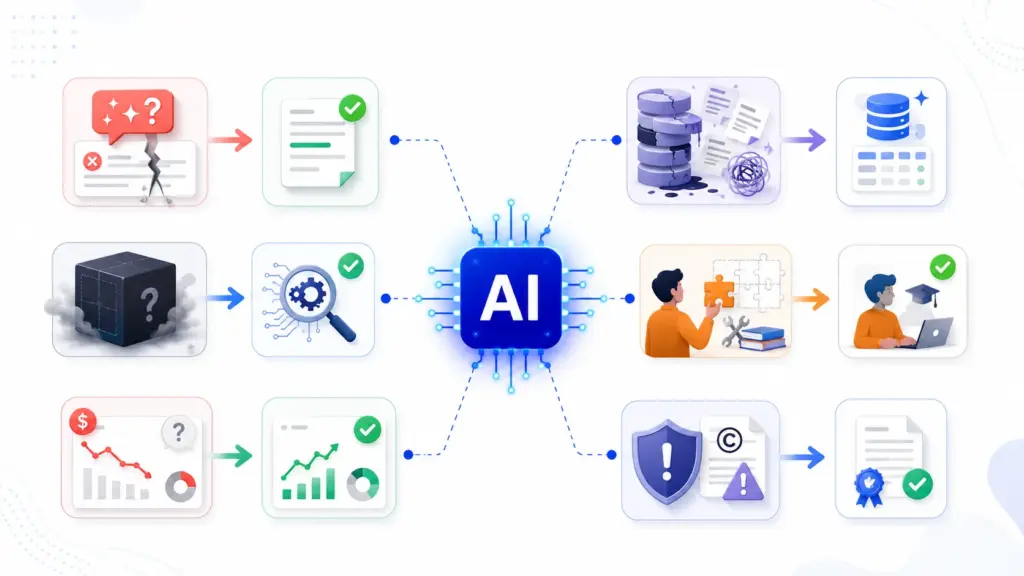
Most of the trouble traces back to three root causes: models that guess instead of verify, data that isn’t ready for the job, and systems nobody can fully explain.
Why Do AI Models Hallucinate?
A language model doesn’t check facts. It predicts the next likely word based on everything it’s seen before, and sometimes the statistically likely answer is simply wrong.
That gap between plausible and true is what the industry calls a hallucination. It’s baked into how these models work, not a bug someone forgot to fix. Ask a model about a court ruling, a drug interaction, or a niche API, and it will often answer with total confidence, whether or not that answer is real.
How Does Poor Data Quality Derail Projects?
“Garbage in, garbage out” isn’t just a cliché here. Gartner ranks it alongside inadequate risk controls and escalating costs as one of the leading causes of GenAI abandonment just behind unclear business value.
Gartner’s review of hundreds of GenAI implementations found that data which isn’t ready doesn’t just slow one department down; it produces unreliable outputs and broken retrieval-augmented generation setups across the board. Legacy systems rarely agree on date formats, units, or naming conventions, so a model trained on that mess inherits the mess. Real AI data quality standards fix the pipeline, not just the prompt.
What Is the “Black Box” Problem?
Even the engineers who build large models often can’t fully explain why a specific output came out the way it did. That opacity makes audits difficult, and it makes bias hard to catch before it reaches a customer.
Bias mitigation depends on being able to see inside that box, and black-box models resist exactly that kind of inspection. Algorithmic fairness audits are becoming a compliance expectation in several jurisdictions, not just a nice-to-have.
Generative AI Challenges at a Glance
| Challenge | Root Cause | Primary Fix | Who Should Own It |
| Hallucination | Models predict plausible text, not verified fact | Retrieval-augmented generation (RAG) + human review of high-stakes output | AI/ML engineering |
| Poor data quality | Inconsistent formats, legacy systems, no validation | Automated validation (e.g., Great Expectations) + continuous monitoring | Data engineering |
| Black-box opacity | Even builders can’t fully explain specific outputs | Fairness audits, explainability tooling, named risk owners | Governance/compliance |
| Skills gap | Few staff can evaluate output or own a RAG pipeline | Structured upskilling paired with targeted hiring | People/L&D + engineering leads |
| Unclear ROI | Leadership expects revenue, not efficiency | Track cost avoidance and time saved, not just new revenue | Finance + business sponsor |
| Workslop | AI output treated as finished instead of a draft | Protect review time; treat AI output as a first draft | Team leads/managers |
| Regulatory exposure | Shifting deadlines and unresolved copyright case law | Track EU AI Act timeline; confirm commercial rights before publishing AI output | Legal/compliance |
How to Overcome the Technical Barriers to AI Adoption?
Most technical fixes come down to three moves: get the data in shape, ground the model in something real before it answers, and close the skills gap that’s quietly slowing both. Most of this work sits closer to disciplined custom software development than to prompt engineering which is often why it stalls when it’s treated as a side project instead of an engineering one.
A Four-Step Data Validation Framework
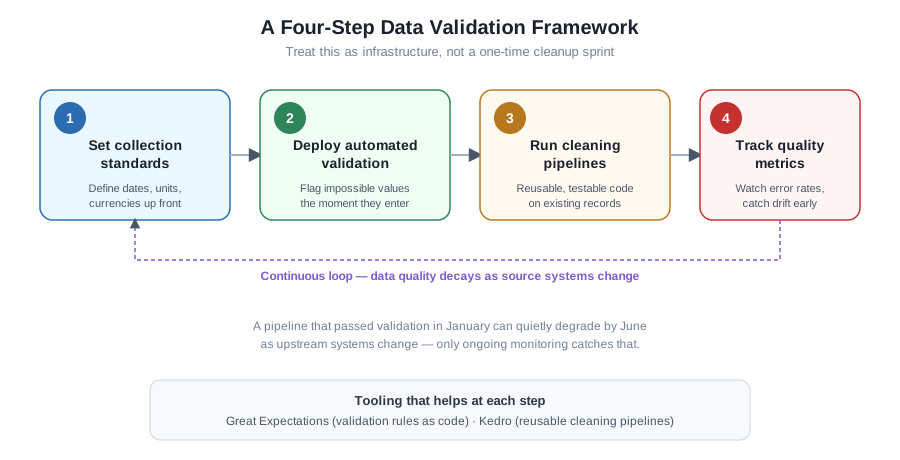
Bad data doesn’t announce itself. It hides in a spreadsheet until a model trained on it starts giving confident, wrong answers, and by then the fix costs far more than it would have upfront. A structured pipeline catches the mess earlier and cheaper.
- Set collection standards first. Define dates, units, currencies, and required fields before anyone touches a spreadsheet. Most “AI data quality” problems are really unresolved arguments about formatting that nobody settled years ago.
- Deploy automated validation. Flag impossible values (a birth year of 1890, negative revenue, a phone number with nine digits) the moment they enter the system, not during a quarterly audit. Open-source frameworks like Great Expectations let teams write these checks as code, so a rule caught once gets enforced everywhere, automatically, going forward.
- Run cleaning pipelines on existing records. Frameworks like Kedro turn one-off cleanup scripts into reusable, testable code that survives staff turnover instead of living in one analyst’s laptop.
- Track quality metrics continuously. Watch error rates and missing-value percentages so drift gets caught before it reaches a model, not after. A pipeline that passed validation in January can quietly degrade by June as upstream systems change; only ongoing monitoring catches that.
Treat this as infrastructure, not a one-time cleanup sprint. Data quality decays continuously as source systems change, so the validation layer needs to run continuously too.
Can Retrieval-Augmented Generation (RAG) Fix Hallucinations?
Retrieval-augmented generation, RAG for short, cuts hallucinations by making a model check its answer against a real source before it responds, instead of relying only on what it memorized during training. Picture a support bot: rather than guessing at a return policy from training data that might be a year stale, RAG pulls the current policy document and grounds the answer in it.
Under the hood, a RAG pipeline runs in two phases. Offline, documents get split into chunks (commonly 512 to 1,024 tokens each), converted into numerical “embeddings” that capture meaning rather than just keywords, and stored in a vector database like Pinecone, Milvus, or the open-source FAISS. At query time, the system embeds the question, pulls the closest-matching chunks, and hands them to the model as grounding before it generates an answer.
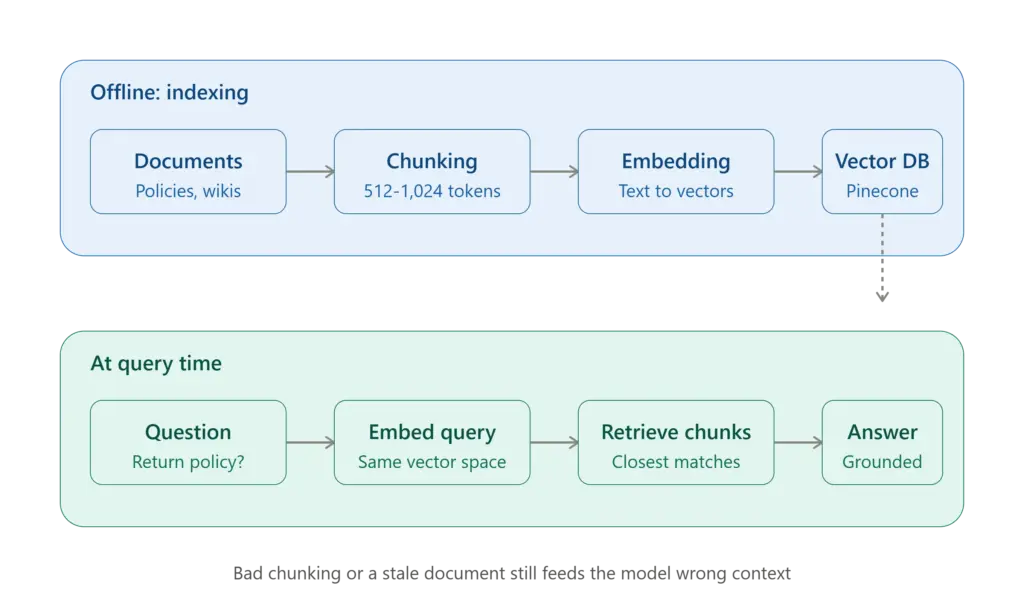
That said, RAG is not a cure-all. Poor chunking, stale documents, or a retriever that surfaces the wrong passage can still feed the model bad context, and a confident answer built on bad context is still a hallucination, just one wearing a citation. Treat RAG as a way to shrink the error rate, not eliminate it, and keep a human reviewing high-stakes outputs regardless.
RAG also isn’t a replacement for fine-tuning. It’s usually cheaper and faster to update, since swapping a document is easier than retraining a model, while fine-tuning still wins when you need to reshape how a model reasons or writes, not just what it knows.
Closing the AI Skills Gap
Even a perfect pipeline stalls if nobody on staff knows how to run it. IDC projects that more than 90% of global enterprises will face a critical AI skills shortage by 2026, with the resulting delays, quality problems, and missed revenue costing the global economy up to $5.5 trillion.
The gap isn’t really about prompt-writing anymore. It’s about people who can evaluate an AI output critically, spot a hallucination before it ships, and own a RAG pipeline end to end. Hiring alone won’t close a shortage this size fast enough; pairing new hires with structured, ongoing upskilling for the team you already have tends to move faster and cost less. and for teams deciding whether to build that capability in-house or bring in outside help, our breakdown of what a good AI consultant actually adds covers that trade-off in more depth.
Reusable engineering closes part of the same gap. One enterprise team restructured a roughly 100,000-line monolithic AI project into six use cases built from 35 shared components, cutting mean time to recovery by up to 500% in the process. Reuse, not just raw model quality or headcount, often separates a GenAI program that scales from one that collapses under its own maintenance load.
Navigating the Risks of AI in Business
Regulators are moving fast, and the ground has shifted even in the last few months. The EU AI Act’s high-risk obligations were originally set to apply from August 2, 2026. In June 2026, the EU formally adopted a “Digital Omnibus” package that pushes those deadlines back: obligations for standalone high-risk systems (Annex III employment, credit scoring, education, and similar use cases) now apply from December 2, 2027, and obligations for AI embedded in regulated products (Annex I) apply from August 2, 2028. Transparency and AI-content labeling requirements under Article 50, however, still take effect on the original August 2026 timeline, with a grace period on some watermarking duties running to December 2026.
The practical takeaway for a 2026 pitch deck: don’t cite August 2026 as the date “core obligations” bite for high-risk systems that risk has moved out. Do keep watching for the labeling and transparency requirements, which haven’t moved, and keep an eye on further developments, since regulatory timelines in this space have shifted more than once already.
Protecting Data Privacy and Security
Employees paste client contracts and source code into public chat tools more often than most security teams would like to admit, and every one of those prompts is a potential leak. Prompt injection attacks add another layer of risk: a hidden instruction buried in a document or webpage can quietly hijack an AI agent’s next action.
The stakes shift by industry. In healthcare, any AI vendor that touches patient records needs a signed business associate agreement (BAA) under HIPAA before it goes anywhere near real data. In finance, fraud-detection models face the opposite pressure: they need to be transparent enough for an auditor to trust the flag, not just accurate enough to catch it. Which is a big part of why fintech-specific development work treats explainability as a requirement from day one, not an afterthought bolted on before an audit.
Zero Trust architecture, plus encryption at rest and in transit, closes some of that gap. LLM security still comes down to something simpler, though: a written policy telling employees exactly which tools are approved for sensitive data does more day-to-day work than any firewall.
Intellectual Property (IP) and Copyright
Who owns what an AI creates, and did the model even have the right to train on the material it learned from? Courts are still working that out in real time, and the numbers involved are no longer theoretical.
Anthropic agreed to pay $1.5 billion to settle Bartz v. Anthropic, a class-action lawsuit brought by book authors over the use of pirated copies of their works in AI training reported by NPR, Reuters, and the Copyright Alliance in September 2025, with the settlement moving toward final court approval through mid-2026. The deal works out to roughly $3,000 per book across an estimated 500,000 titles covered by the class, and legal commentators have described it as the largest copyright class-action recovery on record.
A separate ruling against Ross Intelligence in a related case has also shaped how courts are approaching fair use in AI training. Until case law settles further, treat AI-generated output the way you’d treat any unlicensed content: confirm you actually have the right to use it commercially before it ships.
One thing worth flagging for any team citing this figure in a proposal or deck: it’s a settlement, not a court ruling on damages, and the exact payout mechanics are still working through final approval. Cite it as “a $1.5 billion settlement Anthropic agreed to,” not as a legal precedent on what any other company would owe.
Solving the ROI Gap
Leaders grow impatient fast when a GenAI line item shows no revenue next to it, and Gartner lists unclear business value as the single most common reason projects get killed. Smart GenAI adoption strategies don’t wait for a bigger number. They measure a different one.
Track cost avoidance (support tickets a chatbot resolved before they became escalations) and time savings (hours a drafting tool cut from a report cycle), instead of insisting on a straight revenue line. Escalating GPU infrastructure costs make this discipline more urgent every quarter: a setup that looks affordable in a small pilot can balloon once thousands of employees start running the same prompts every day. (If you’re still scoping what a pilot should cost before you can even measure its ROI, our 2026 AI consulting pricing guide breaks down realistic ranges by engagement type.)
Managing Workforce Disruption and “Workslop”
Workslop is the term researchers at BetterUp Labs and Stanford’s Social Media Lab coined for AI-generated work that looks finished but isn’t: memos, decks, and reports that pass a glance and fail a real read. Their survey of 1,150 U.S. desk workers found roughly 40% had received workslop in the past month.
Each instance costs close to two hours of cleanup, which the researchers calculate works out to about $186 per affected employee per month — or roughly $9 million a year in lost productivity for a 10,000-person organization. That’s the exact opposite of what the tool was bought to deliver.
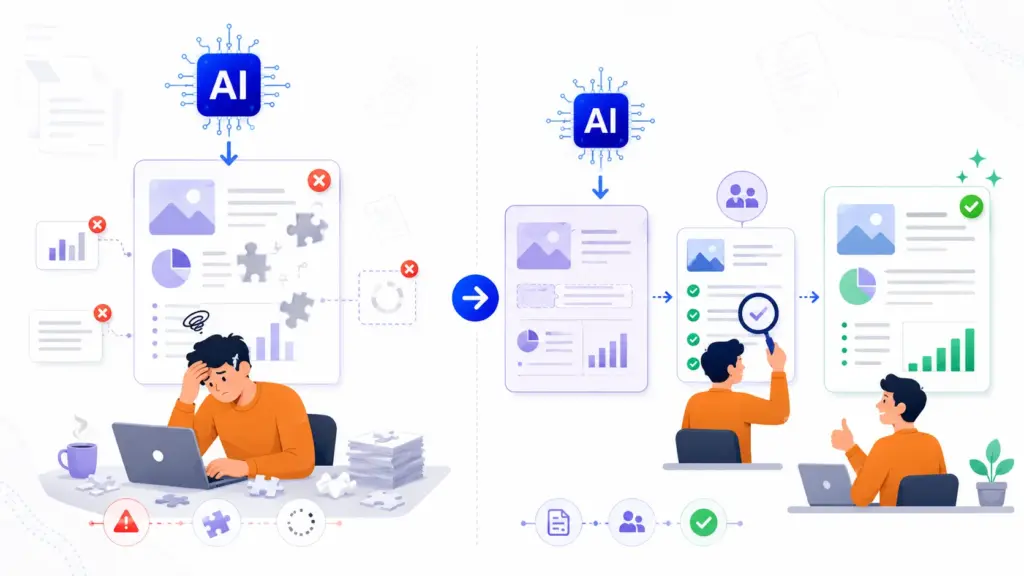
The fix isn’t banning AI. It’s changing what gets rewarded. Teams that treat AI output as a first draft rather than a finished product, and that protect review time instead of skipping it under deadline pressure, see far less workslop reach a colleague’s inbox.
Training matters here too, but not the one-off kind. Ongoing reskilling that teaches people what a model is genuinely good at (drafting, summarizing, and brainstorming) and where it still needs a human (judgment calls, novel analysis, and anything client-facing) cuts workslop off at the source, before it ever gets sent.
Key Stats at a Glance
| Metric | Figure | Source |
| GenAI projects abandoned after proof of concept | At least 50% | Gartner |
| Workslop incidence among U.S. desk workers (past month) | ~40% | BetterUp Labs / Stanford Social Media Lab |
| Average time to resolve one workslop incident | ~1 hour 56 minutes | BetterUp Labs / Stanford Social Media Lab |
| Annual workslop cost, 10,000-person organization | ~$9 million | BetterUp Labs / Stanford Social Media Lab |
| Anthropic authors’ copyright settlement | $1.5 billion (~$3,000/book, ~500,000 books) | Reported settlement filing, Sept. 2025 |
| EU AI Act high-risk obligations (standalone, Annex III) | Deferred from Aug 2, 2026 → Dec 2, 2027 | Digital Omnibus on AI, adopted June 2026 |
| EU AI Act high-risk obligations (product-embedded, Annex I) | Deferred from Aug 2, 2027 → Aug 2, 2028 | Digital Omnibus on AI, adopted June 2026 |
| Global data center share of electricity demand (2024) | ~1% | International Energy Agency |
Not sure where your own team stands against these patterns? Grab our free Generative AI Data-Readiness Checklist and score your next use case against the same failure points Gartner tracks, before you pitch it to leadership. If you’d rather walk through it with someone, our AI and generative AI consulting team runs this exact kind of readiness assessment before scoping any engagement.
Frequently Asked Questions
What Is the Biggest Challenge in Generative AI?
Proving clear business value fast enough to keep executive patience intact. Gartner’s analysis of hundreds of GenAI rollouts found unclear ROI tops the list of reasons projects get abandoned after proof of concept, ahead of both cost and data problems.
Is AI Dangerous for the Environment?
Training and running large models carries a real environmental cost, though it’s smaller today than the headlines suggest. Data centers accounted for just over 1% of global electricity demand in 2024, and the International Energy Agency projected that share could approach 3% by 2030 as AI workloads scale. In electricity-dense hubs like Ireland, data centers already draw around a fifth of the national grid, a figure the IEA expected to climb toward 32% by 2026.
What Are the Four Types of AI Risk?
Most frameworks group generative AI risk into four buckets: model reliability (hallucinations and inconsistent outputs), data protection (privacy and security), intellectual property (training data and output ownership), and societal or ethical impact (bias, misinformation, and job disruption). A mature GenAI program assigns a named owner to each bucket, not just to IT.
Is RAG Better Than Fine-Tuning?
Neither wins outright. They solve different problems. RAG is faster to update and cheaper to maintain, which makes it the better fit when a model just needs current facts, while fine-tuning still wins when the goal is reshaping how a model reasons or writes.
What Is Gartner’s “50% Rule” for GenAI Projects?
It refers to Gartner’s finding that companies abandoned at least half of their generative AI projects after proof of concept, largely because of unclear business value, data that wasn’t ready, and total cost of ownership that spiraled past what the pilot budget assumed. For teams scoping a new pilot, it’s a strong argument for solving the boring problems (data, cost tracking, a named business metric) before the ambitious ones.
How Can a Small Team Start Fixing These Problems Without a Big Budget?
Start with the cheapest fix that addresses the most common failure: define a single success metric before the pilot begins, so “unclear ROI” can’t be the reason it gets killed later. Pair that with basic input validation on whatever data feeds the model even a handful of automated checks catches a surprising share of “garbage in” problems before they reach a customer.
What Are the Most Common Generative AI Challenges?
The most common generative AI challenges are unclear business value, poor data quality, hallucinations, black-box opacity, a widening skills gap, workforce disruption from low-quality AI output (“workslop”), and rising regulatory and copyright exposure. Most of them trace back to the same two root issues: models that predict plausible answers instead of verified ones, and data or business cases that weren’t ready before the project started.