


- 1. Key Takeaways
- 2. What Does an AI Consultant Actually Do?
- 3. Top Benefits of Hiring AI Consultant for Business Growth
- How Does an AI Consultant Speed Up Deployment?
- Is Hiring an AI Consultant Actually Cheaper Than Hiring In-House?
- Do You Get Deeper Expertise From a Consultant Than an In-House Hire?
- What Risk and Compliance Value Does an AI Consultant Add?
- Does an Outside Perspective Actually Help, or Is That Just a Sales Pitch?
- 4. Common Mistakes Businesses Make When Hiring an AI Consultant
- 5. In-House AI Team vs. AI Consultant: Which Fits Your Business?
- 6. Are You Actually Ready for an AI Consultant? A Readiness Self-Check
- 7. How to Hire the Right AI Consultant, Step by Step
- 8. How to Measure ROI From Hiring an AI Consultant
- 9. Real-World Results: AI Consulting in Action
- 10. How Much Does It Cost to Hire an AI Consultant?
- 11. Green Flags and Red Flags When Evaluating Candidates
- 12. Frequently Asked Questions
Summarize with
Hiring AI consultant gets you a working AI system faster, usually for less than a full-time data scientist’s salary. You get strategy, technical build, and compliance help from someone who has already solved these problems elsewhere. This guide covers when that’s worth it, what it actually costs, and how to spot a good consultant from a bad one.
An AI consultant is worth hiring when you need working AI faster than an in-house hire timeline allows, lack specialized expertise internally, or want to test a use case without committing to permanent headcount. Expect to pay $100–$500+ per hour, or $5,000–$500,000+ per project depending on scope, and budget an extra 15–25% annually for post-launch maintenance.
Key Takeaways
- An AI consultant plugs the gap between what AI can technically do and what your business actually needs it to do, usually cheaper than hiring a full in-house team.
- Rates in 2026 run from roughly $100 to $500+ per hour, or $10,000 to $500,000+ per project, depending on scope and seniority.
- More than 80% of enterprise AI projects still fail to deliver business value, mostly for organizational reasons a good consultant is trained to catch early.
- Run a readiness check (data quality, budget, internal alignment) before you sign anyone, not after.
- The strongest hires bring a documented framework and case studies, not just a portfolio of buzzwords.
What Does an AI Consultant Actually Do?
Most articles on this topic list benefits before explaining the job itself. That’s backwards, so let’s fix it.
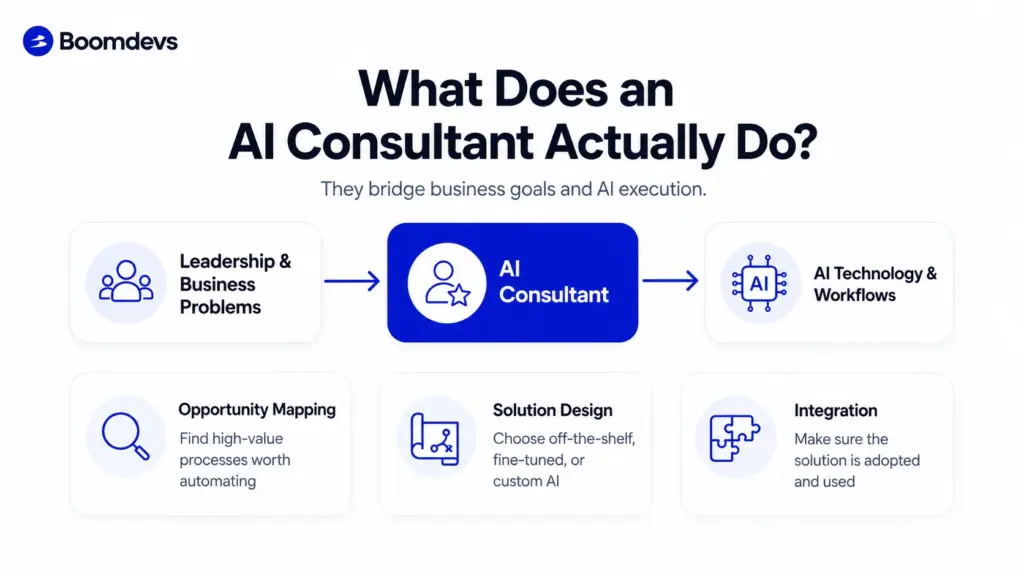
An AI consultant spends their day translating between two groups that rarely speak the same language: your leadership team, who know the business problem, and the technology, which doesn’t care about quarterly targets. In practice, that means auditing your data, prototyping a model against a real workflow, and then sitting in the room when a VP asks “but will this actually save us money?” A good one has done this five or ten times already in your industry. A bad one is learning on your budget.
Day to day, the role usually covers three things. First, opportunity mapping: figuring out which of your processes are actually worth automating, since most aren’t. Second, solution design: choosing between an off-the-shelf model, a fine-tuned one, or something built from scratch. Third, integration: making sure the thing actually gets used instead of dying in a pilot, which is where most AI projects quietly go to die.
Top Benefits of Hiring AI Consultant for Business Growth
The case for hiring an AI consultant usually comes down to five things: speed, cost efficiency, expertise you don’t have in-house, risk reduction, and a perspective that isn’t tied to your team’s past decisions. Each one matters differently depending on the size of your project and how much AI experience your organization already has, here’s what each actually looks like in practice.
How Does an AI Consultant Speed Up Deployment?
A consultant has already built the thing you’re about to build, or something close enough. Instead of your team spending three months rediscovering the same dead ends, they bring templates, pre-vetted architectures, and a rough map of where the project usually breaks.
That compresses timelines hard. What takes an inexperienced in-house team six months of trial and error often takes an experienced consultant six to eight weeks, because they’re not guessing at which approach works. They’re reusing one that already has.
Key Insight: Speed comes from pattern matching on past failures, not from working faster in the abstract. A consultant who has shipped five similar projects has already burned through the dead ends your team hasn’t found yet.
Is Hiring an AI Consultant Actually Cheaper Than Hiring In-House?
Here’s the part most companies get wrong: they compare a consultant’s hourly rate to a salary and assume the salary wins. It usually doesn’t, once you count everything.
A full-time data scientist in the US earns around $130,000 a year on average, and that’s before benefits, before the DevOps engineer you’ll also need, and before the six months it takes to hire and onboard them. A consulting engagement, by contrast, gets you a small team, data scientist, an ML engineer, sometimes a domain specialist, for a defined project window. 2026 market rates for AI consultants run roughly $150 to $500 per hour, or $5,000 to $50,000 for a fixed-scope project, scaling up toward $500,000+ for full enterprise builds.
The math changes again for a short pilot. If you only need six weeks of expert time, paying a premium hourly rate still beats a $130,000 salary for someone who sits idle in month two.
Key Insight: The comparison that matters isn’t rate-per-hour versus salary-per-year; it’s total cost of a defined outcome versus total cost of a permanent headcount you may not need in twelve months.
Do You Get Deeper Expertise From a Consultant Than an In-House Hire?
Your in-house team is probably good at one or two things. AI consultants, especially ones who’ve bounced between industries, have usually shipped work across natural language processing, computer vision, and the unglamorous grind of data cleansing that eats most of a project’s timeline.
That range matters more than it sounds. A healthcare AI problem and a retail AI problem look nothing alike under the hood, and a generalist in-house team often reinvents the wheel a specialist would recognize on sight.
What Risk and Compliance Value Does an AI Consultant Add?
This is the benefit nobody wants to think about until it’s too late. AI systems degrade. A model trained on last year’s customer behavior starts making worse predictions as that behavior shifts, a problem practitioners call model drift, and it needs active monitoring to catch.
Add regulation on top of that. GDPR, HIPAA, and a growing pile of AI-specific rules mean a wrong move on data handling isn’t just a technical bug, it’s a legal one. Consultants who specialize in regulated industries have already built the compliance guardrails you’d otherwise learn the hard way.
The stakes are real: more than 80% of enterprise AI projects still fail to deliver their intended business value, and the causes are overwhelmingly organizational rather than technical. An experienced consultant has seen those failure patterns up close and knows which ones to head off early.
Key Insight: The 80% failure figure isn’t a knock on AI technology itself. RAND and follow-up research consistently trace failure back to organizational gaps (ownership, data readiness, sponsorship) rather than model quality, which is exactly the territory a good consultant is trained to audit first.
Does an Outside Perspective Actually Help, or Is That Just a Sales Pitch?
There’s a particular kind of stuck that only happens internally: a team has spent four months tweaking an algorithm, and nobody wants to admit the real problem is the training data. An outsider walks in, asks an obvious question, and the project unsticks in a week.
That’s not because consultants are smarter. It’s because they weren’t in the room when the original decisions got made, so they have nothing to defend.
Common Mistakes Businesses Make When Hiring an AI Consultant
Even companies that get the “why hire a consultant” part right often trip on execution. The recurring patterns:
- Skipping the readiness check. Hiring before you know your own data quality or budget ceiling means the consultant spends billable hours discovering problems you could have flagged for free.
- Anchoring only on the hourly rate. A $150/hr “blended rate” quote can hide a team that’s 50% junior analysts, billing at a marked-up average rate. Always ask for a rate card broken down by role and seniority.
- No defined success metric. A contract without a measurable outcome (hours saved, error rate reduced, revenue unlocked) makes it impossible to tell later whether the engagement actually worked.
- Treating the engagement as strategy-only. Consultants who deliver a roadmap document and walk away leave you with no one who can execute it, a pattern industry analysts call the “consulting dependency trap,” where capability never transfers to the client team.
- No maintenance plan. Skipping the conversation about drift monitoring and retraining costs means budgeting for a system, not for the ongoing 15–25% annual upkeep it will actually require.
- Choosing brand over fit. A Big Four name buys credibility in the boardroom, but a boutique firm’s senior practitioners often deliver comparable technical work at a lower rate for most SMB projects, fit matters more than logo recognition.
In-House AI Team vs. AI Consultant: Which Fits Your Business?
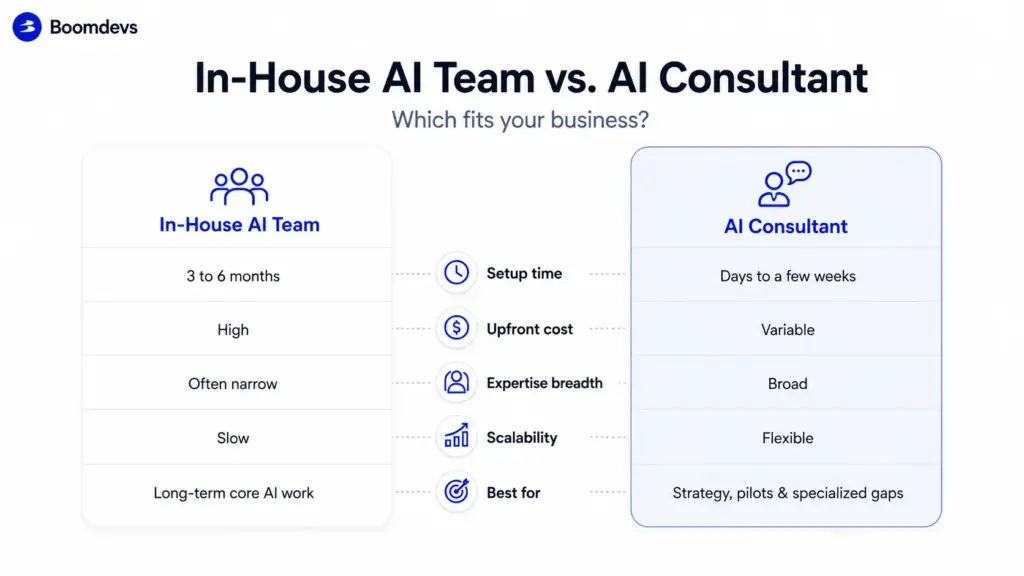
Neither option is universally right. It depends on how long you’ll need the capability and how fast you need results.
| Factor | In-House AI Team | AI Consultant |
| Setup time | 3 to 6 months to hire and onboard | Days to a few weeks |
| Upfront cost | High (salaries, benefits, tooling) | Variable, scoped to the project |
| Expertise breadth | Often narrow, tied to who you hired | Broad, cross-industry |
| Scalability | Slow, requires more hiring | Flexible, scale the engagement up or down |
| Best for | Long-term, core AI product work | Strategy, pilots, and specialized gaps |
If AI is going to be a permanent, central part of your product, you’ll eventually want an internal team regardless. Many companies split the difference: bring in a consultant to get the first version live, then hire internally to run and extend it.
Are You Actually Ready for an AI Consultant? A Readiness Self-Check
Most guides skip this part entirely, which is strange, because a consultant can’t fix a company that isn’t ready to use one. Before you hire anyone, be honest about where you stand:
- Data quality: Is your data centralized, reasonably clean, and accessible, or scattered across five spreadsheets and someone’s inbox?
- Budget clarity: Do you have a defined range, or are you hoping a consultant will tell you what to spend?
- Business goal: Can you state the problem in one sentence without the word “AI” in it? (“Reduce support ticket resolution time” is a goal. “We need AI” is not.)
- Internal buy-in: Does leadership actually want this, or is it one executive’s pet project that will lose funding at the first setback?
- Tech infrastructure: Can your current systems talk to a new model, or does everything live in a decade-old legacy platform?
If you answered “not really” to three or more of these, that’s not a disqualifier. It’s just useful information, and worth telling a prospective consultant upfront so they can scope accordingly.
How to Hire the Right AI Consultant, Step by Step
- Define the business problem before the technology. Start from an outcome, like cutting response time or reducing returns, not from “we need AI” as a goal in itself.
- Run the readiness check above. Know your data, budget, and infrastructure gaps before the first sales call, so you’re not finding out about them mid-project.
- Evaluate industry-specific experience. Ask for a case study in your exact domain, not an adjacent one. A consultant who’s never touched HIPAA shouldn’t be designing your patient data pipeline.
- Discuss post-launch support up front. Models need retraining as data shifts. Get the maintenance plan in writing before you sign, not after the model starts drifting.
How to Measure ROI From Hiring an AI Consultant
ROI on a consulting engagement is easy to promise and hard to prove after the fact, unless you set up the measurement before the project starts.
Set a baseline before work begins. Whatever the target metric is, support ticket resolution time, forecast error rate, or hours spent on manual data entry measure it for at least two to four weeks before the consultant starts. Without a “before” number, any “after” number is unverifiable.
Separate leading indicators from lagging ones. Adoption rate, model accuracy, and processing time are leading indicators you can track within weeks of launch. Revenue impact, cost savings, and headcount reallocation are lagging indicators that typically take a full quarter or more to show up cleanly in the numbers. Judging a project a failure at week three because revenue hasn’t moved yet is a common, avoidable mistake.
Track total cost, not just the invoice. Total cost of ownership includes the consulting fee, internal staff time spent in discovery and review meetings, any new tooling or licensing, and the 15–25% annual maintenance budget mentioned above. Comparing a consulting fee against savings while ignoring maintenance overstates ROI.
Use payback period as your primary yardstick. Well-scoped engagements in operationally intensive functions like claims processing, demand forecasting, and healthcare revenue cycle work typically recover their cost within 12 to 18 months through reduced labor hours and error rates, according to industry benchmarking. If a proposal’s projected payback period stretches well beyond that without a clear justification, treat it as a scope or pricing red flag rather than an outlier worth accepting at face value.
Revisit the number the readiness check gave you. If your original business goal was “reduce support ticket resolution time,” your ROI conversation six months later should still be about that number, not a moving target the consultant redefined mid-engagement.
Real-World Results: AI Consulting in Action
Numbers convince better than promises. A few documented examples:
Healthcare. Manipal Hospitals worked with Google Cloud to rebuild its nurse handoff process using generative AI and cut the handover time from 90 minutes down to just 20, a 78% reduction in one of the most error-prone moments in patient care.
Retail. In one demand-forecasting engagement for a healthcare products manufacturer, an AI-driven forecasting overhaul delivered a 30% reduction in stockouts alongside a 25% drop in overstock and 15% lower holding costs.
Manufacturing. McKinsey research on predictive maintenance points to a 20% to 40% cut in unplanned equipment downtime once sensor data feeds into a failure-prediction model instead of a fixed maintenance calendar.
None of these outcomes came from deploying AI software alone. Each required careful planning, implementation, integration, and ongoing optimization. Each involved someone who understood both the AI and the specific operational bottleneck it needed to solve.
How Much Does It Cost to Hire an AI Consultant?
It depends heavily on scope, but the ranges are consistent enough across the market to budget against.
Independent consultants and boutique firms typically charge $150 to $500 per hour in 2026, with junior talent starting closer to $100 and senior specialists or Big Four firms running $400 to $1,000+. Fixed-scope projects, like an AI readiness assessment or a single-use-case proof of concept, generally land between $5,000 and $50,000. Full enterprise implementations, the kind that touch multiple systems and require ongoing governance, can run $100,000 to $500,000 or more.
Whatever number you land on, budget for maintenance separately. Post-launch monitoring, retraining, and drift correction typically add another 15% to 25% of the build cost every year, and it’s the line item most proposals conveniently leave out.
Green Flags and Red Flags When Evaluating Candidates
Green flags: They ask about your data before pitching a solution. They can name a project that failed and what they learned from it. They talk about maintenance and retraining without being asked. They give you a realistic timeline instead of the one you want to hear.
Red flags: Every answer is “yes, we can do that” with no follow-up questions. The proposal has no mention of ongoing support. They can’t explain their past work without leaning on jargon. The contract has no defined success metric, just a vague promise of transformation.
Frequently Asked Questions
Is hiring an AI consultant worth it?
Yes, for most businesses testing a well-defined use case provided you’ve run a readiness check first. A consultant beats a full-time hire for anything shorter than an ongoing need: senior expertise for a defined window, not a six-figure salary. It stops being worth it if the goal is vague or there’s no maintenance plan.
How much does it cost to hire an AI consultant?
Rates typically run $150 to $500 per hour depending on experience, or $5,000 to $50,000 for a fixed-scope project like a readiness assessment. Full enterprise implementations can exceed $500,000, and most engagements also carry an annual maintenance cost of 15% to 25% of the original build.
When should a business hire an AI consultant?
Bring one in when you lack internal data science expertise, need to move faster than an in-house hire timeline allows, or want to test an AI use case without committing to permanent headcount. It also makes sense when a project has stalled and needs an outside diagnosis.
What does an AI readiness assessment involve?
It’s an evaluation of your data quality, existing tech infrastructure, internal alignment on the goal, and whether you have a clearly defined business outcome in mind. Consultants run this before scoping a project because skipping it is the single biggest reason AI initiatives quietly fail after launch.
Can a small business afford an AI consultant?
Yes, when the engagement is scoped to a single use case. A focused readiness assessment paired with one pilot project is generally the most cost-effective entry point, typically landing in the $5,000–$25,000 range rather than a full transformation engagement.