


- 1. Key Takeaways
- 2. In-House vs Outsourced AI Development: Head-to-Head
- 3. What In-House AI Development Really Takes
- 4. What Outsourcing AI Development Looks Like
- 5. The Hidden Costs Neither Side Puts in the Proposal
- 6. Why Foundation Models Changed the Build-vs-Outsource Math
- 7. The Hybrid Model: Outsource the Build, Own the Brain
- 8. Which Should You Choose? A Decision Framework
- 9. What to Put in an AI Outsourcing Contract
- 10. How Boomdevs Solves the AI Build-vs-Outsource Problem
- 11. Frequently Asked Questions
- 12. Ready to Scope Your AI Build?
Summarize with
You’re weighing in-house vs outsourced AI development, and your board wants AI progress this quarter. Hiring your own team feels safer, and bringing in a partner feels faster. Both camps have real wins and real scars.
The honest answer depends on your situation, not on which model is better on paper. It comes down to how central AI is to your product and how much runway you can commit.
Here’s a framework to find your side of that line in the in-house vs outsourced AI development debate.
Key Takeaways
- Outsource: when you need a working AI feature in weeks, not quarters, or when AI supports your product rather than being the product.
- Build in-house: when the model’s behavior is what customers pay for, your data is heavily regulated, or you can fund a team for two years past launch.
- Choose a hybrid AI development model in most other cases: a partner builds, and one internal owner holds the roadmap, the evaluation set, and the keys.
- Plan the exit on day one: The choice isn’t permanent, and a planned handover lets you move from outsourced to in-house without a rewrite.
In-House vs Outsourced AI Development: Head-to-Head
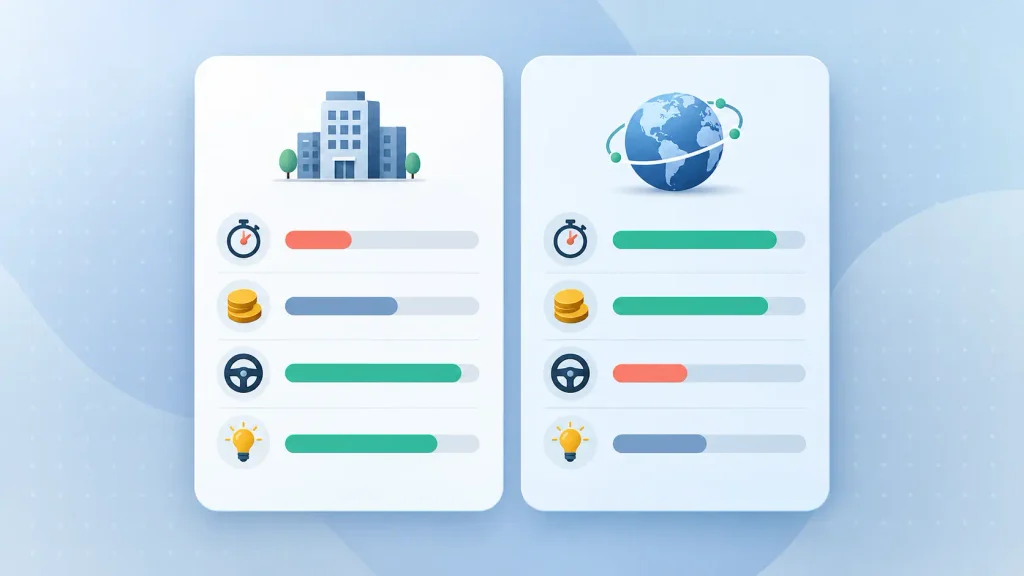
If you only read one section, make it this one. In-house wins on control and long-term knowledge. Outsourcing wins on speed, talent access, and flexible cost.
Here’s how in-house vs outsourced AI development compares on the criteria that actually decide the outcome:
| Criterion | In-House | Outsourced |
| Upfront cost | High: salaries, recruiting, tooling | Lower: scoped project or monthly team |
| Time to first release | Slow: hire first, then build | Fast: team starts in weeks |
| Day-to-day control | Full | Shared, set by contract and cadence |
| IP ownership | Yours by default | Only as strong as the contract |
| Data security | Stays inside your walls | Needs access rules and audit rights |
| Talent access | Limited to who you can hire | Specialists on demand |
| Scaling up or down | Slow and costly | Adjust team size by phase |
| Knowledge retention | Compounds internally | Leaves unless handover is planned |
Read the table by column, and a pattern shows up. Outsourcing’s weak rows (control, IP, knowledge) are fixable with process and contract terms.
In-house’s weak rows (cost, speed, talent) are fixable mostly with money and time, which are exactly what most growing companies lack.
What In-House AI Development Really Takes
Building in-house means you hire the people, own the infrastructure, and carry the payroll whether the first model ships or not. The upside is a team that lives inside your data every single day.
The Roles You Actually Need
A working AI team is rarely one brilliant hire. You need several kinds of ownership, or critical work falls into the gaps between people:
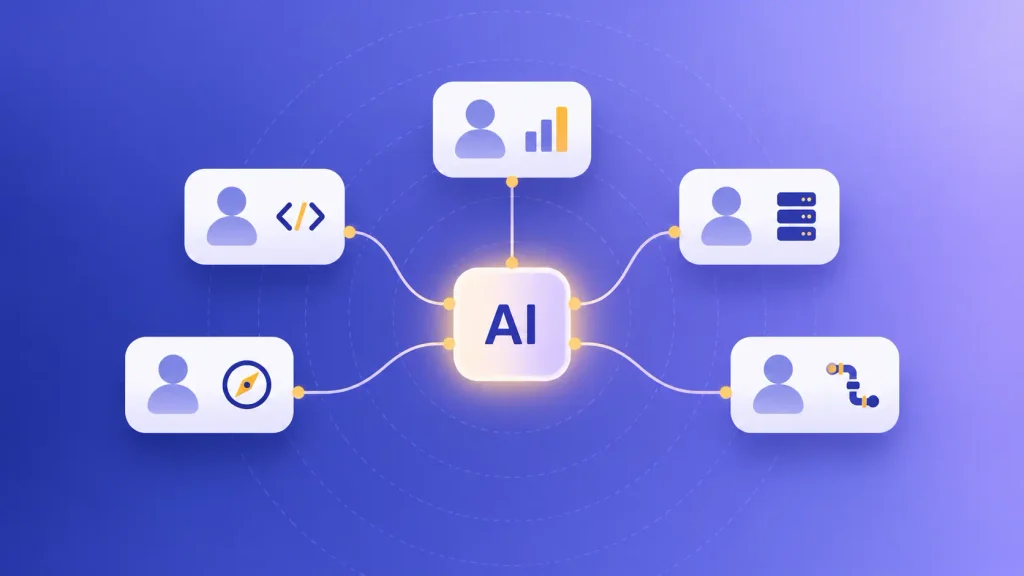
- AI/ML engineer: builds model-powered features, wires up LLM APIs, and turns model output into software your users touch.
- Data scientist: defines what “good” looks like, builds baselines and evaluation sets, and checks whether the model moves a real business metric.
- MLOps engineer: owns deployment, monitoring, versioning, and cost tracking once the system is live.
- Technical lead: translates business goals into architecture and makes the final calls on models, frameworks, and trade-offs.
- Data engineer: the role founders forget. Plenty of AI projects stall on messy pipelines long before they stall on models.
Depending on your product, you may also need a product manager, a security reviewer, or a domain expert. Small teams often ask one person to cover two roles. That works right up until that person leaves.
What It Costs Before You Ship Anything
Salaries are the most visible part of in-house AI team cost. U.S. Bureau of Labor Statistics medians give you a realistic floor to plan from:
| Role | U.S. Median Pay | BLS Category |
| AI/ML or MLOps engineer | $135,980 (May 2025) | Software developers |
| Data scientist | $120,230 (May 2025) | Data scientists |
| Technical lead | $171,200 (May 2024) | Computer and information systems managers |
Staff a lean team of two engineers, two data scientists, one MLOps engineer, and one lead at those medians. That puts your in-house AI team cost at roughly $820,000 a year in base wages alone, before benefits, recruiting fees, cloud compute, model API usage, and tooling.
Those medians also cover every employer in the country, from regional banks to government agencies. The AI specialists you’ll compete for at funded startups will often ask for more.
Where In-House Wins
In-house pays off when AI capability has to compound inside your company for years. Three situations make the case strongest:
- The model is the product: if customers pay for how your AI behaves, the feedback loops and evaluation logic are your core IP.
- Your data can’t leave: in healthcare, fintech, or insurance, every extra party with access adds audit and compliance work.
- You’re building a moat: proprietary pricing logic, fraud detection, or domain models shouldn’t depend on outside people who also serve your competitors.
Notice what’s missing from that list: saving money. In-house rarely wins on cost in year one. It wins on what you own in year three.
Where In-House Hurts
The slowest part of building in-house is the part before anyone writes code. ManpowerGroup’s 2026 Talent Shortage Survey found that AI skills are now the hardest skills for employers to find globally. That’s the first time they’ve overtaken engineering and IT, and 72% of the 39,000 employers surveyed reported hiring difficulty.
Then comes ramp-up. Even a strong hire needs weeks to learn your data, your systems, and why staging behaves the way it does.
Key-person risk is the quieter problem. On a three-person team, one resignation can freeze your roadmap while you rehire, and that person’s knowledge goes with them.
What Outsourcing AI Development Looks Like
Outsourcing AI development means you bring in an external team that already has the specialists, the delivery process, and the tooling. You pay for output and capacity, not headcount.
Four Engagement Models
“Outsourcing” covers very different arrangements, and the one you pick changes how much control you keep. Here are the four you’ll run into most:
| Model | What You Get | Best For | Watch Out For |
| Project-based | Fixed scope, defined outcome | PoC, MVP, one defined feature | Scope creep on change requests |
| Dedicated team | A full team on your product only | Ongoing roadmap without hiring | Needs strong product ownership from you |
| Staff augmentation | Specialists inside your team | Filling one skill gap fast | You still manage them daily |
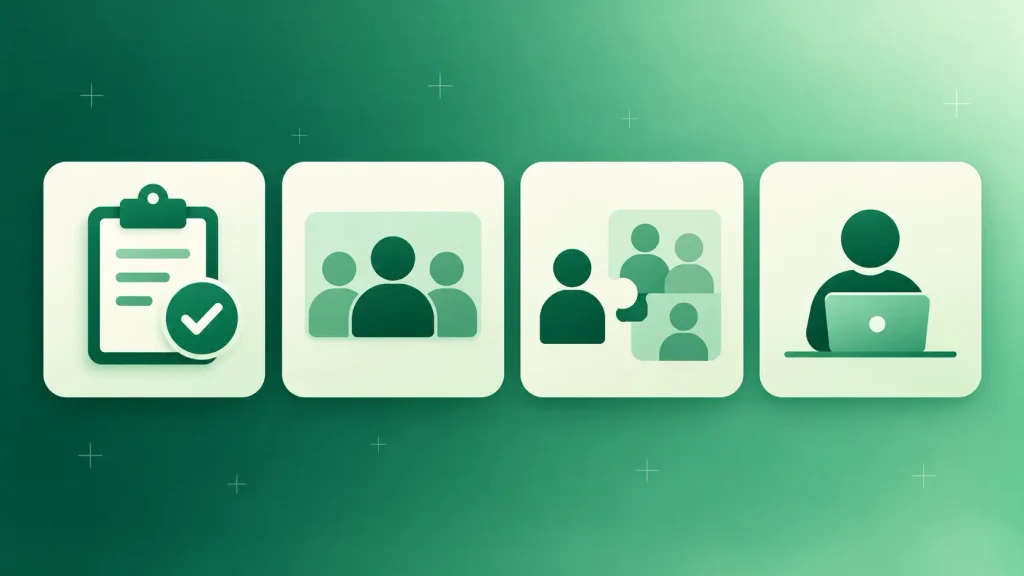
| Freelancers | Individual contractors | Small, isolated tasks | Continuity and security on big builds |
If you already have engineers and only lack AI depth, staff augmentation for software teams keeps your process intact. If you have no technical team at all, a dedicated team or a project engagement is the safer starting point.
Where Outsourcing Wins
Speed is the headline advantage. An experienced team starts with patterns it has already shipped, so your first sprint goes to your problem instead of setting up infrastructure.
It also changes the shape of your risk. Instead of committing to six salaries around an untested idea, you can fund a scoped pilot and decide with real results in hand:
- Proof before commitment: validate the use case and the data, then decide whether hiring makes sense.
- Niche skills on demand: computer vision, voice agents, or retrieval systems for one project, without a permanent hire.
- Flexible capacity: scale the team up for launch and back down for maintenance.
The catch is that speed only helps if you’re building the right thing. RAND’s study of failed AI projects found that misunderstanding or miscommunicating the problem is the most common root cause. A fast partner who never questions your brief can just fail you faster.
Where Outsourcing Hurts
The risks of outsourcing AI development are real, but they’re mostly about structure, not talent. Engagements usually go wrong in one of these four ways:
- Knowledge walks out: undocumented architecture means only the partner can maintain what you paid for.
- Lock-in by design: code in their repositories, infrastructure in their cloud accounts, prompts nobody on your side has seen.
- Thin product context: a skilled team without access to your users builds features that demo well and then get ignored.
- Diluted priority: your project competes with other clients for the same senior people.
Every item on that list has a contract or process fix. The contract section further down covers each one.
The Hidden Costs Neither Side Puts in the Proposal
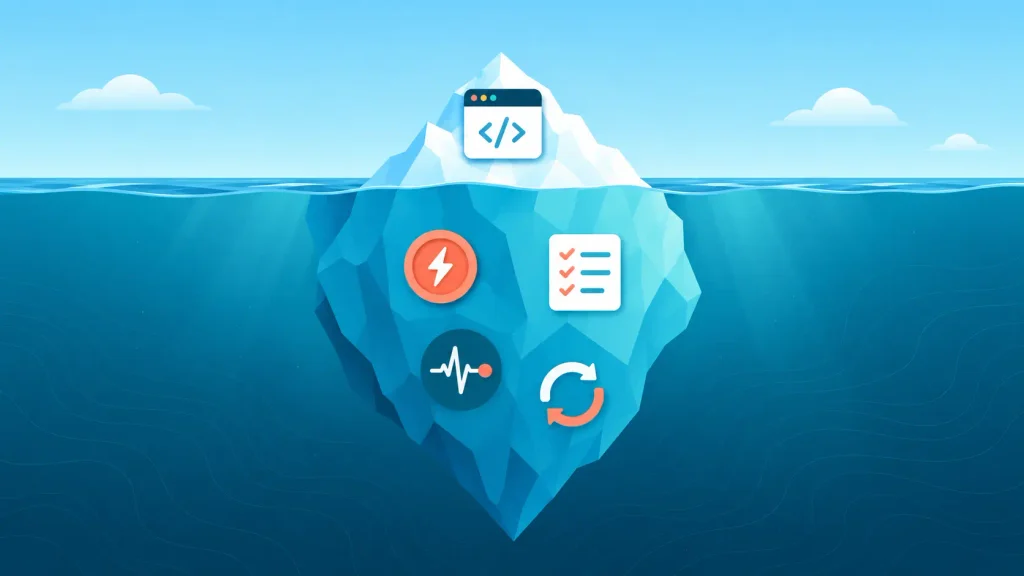
Whichever way you go, the build is only part of what you’ll pay. AI systems keep costing money after launch in ways traditional software doesn’t:
- Inference bills: every LLM call costs money, and usage grows as the product succeeds. Someone has to own model choice and cost per request.
- Evaluation sets: the test cases that tell you whether a model or prompt change made things better or worse. Without them, every update is a guess.
- Monitoring and drift: model behavior shifts as your data, your users, and your inputs change over time.
- Upstream model changes: AI providers update and retire models on their own schedule, and each change needs retesting on your side.
- Rehiring and handover: the cost of replacing a key engineer or onboarding a new partner mid-project.
I’d suggest asking any team you’re considering, internal or external, who owns each of these in month 13. If the answer is vague, the price on the proposal isn’t the real price. For how advisory fees fit into the total, our breakdown of what AI consulting really costs goes deeper.
Why Foundation Models Changed the Build-vs-Outsource Math
A few years ago, building AI often meant training models from scratch with research-grade talent. Today, most business AI products sit on top of foundation models from providers like OpenAI, Anthropic, or Google, or on open-weight models like Llama.
That shifts where the hard work sits in any build vs outsource AI decision. The tough parts now are integration, retrieval over your own data, evaluation, guardrails, and cost control. Those are engineering problems more than research problems.
For your in-house vs outsourced AI development decision, this shift cuts in a few directions at once:
- Good news for in-house: you may need a smaller team of strong product engineers rather than PhD researchers.
- Good news for outsourcing: integration patterns repeat across projects, so an experienced partner reuses far more than it could on a from-scratch model.
- A new risk for both: shipping a demo on a foundation model is easy. Making it reliable in production is not, and our guide to common generative AI challenges covers where those builds usually break.
The practical takeaway? Before you hire a research team, check whether your use case actually needs custom model training. Many don’t, and that changes both the team you need and the budget you’ll burn.
The Hybrid Model: Outsource the Build, Own the Brain
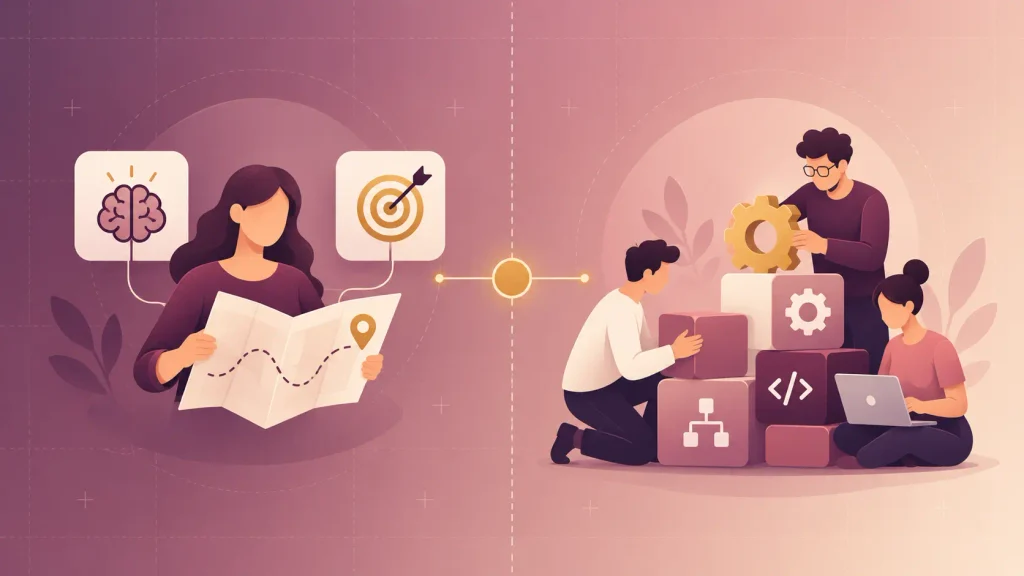
For most growing companies, the strongest answer is a hybrid AI development model. A partner supplies the engineering capacity, and you keep ownership of the decisions that make the product yours.
The split holds up best when both sides know exactly where the line sits:
| Keep In-House | Can Be Outsourced |
| AI roadmap and priorities | Feature builds and integrations |
| Evaluation criteria and test sets | Infrastructure setup and MLOps |
| Data access decisions | Specialized builds (voice, vision, agents) |
| Final say on model and cost trade-offs | Extra capacity for launches |
This is the structure that keeps AI product development engagements healthy over the long run. The partner moves fast, and you never lose the thread.
The One Role You Should Never Outsource
Even if everything else is external, you need one internal owner for AI. Call it an AI product lead or a technical owner. The title matters far less than the job.
This person decides what problem the AI solves, signs off on the evaluation set, and reads architecture decisions well enough to push back. Without them, you’re not managing a partner. You’re hoping.
That role doesn’t need to be a senior full-time hire on day one. A technical cofounder, a CTO, or a product lead with some AI literacy can hold it early, especially with an experienced AI consultant helping them ask the right questions.
A Phased Handover Plan
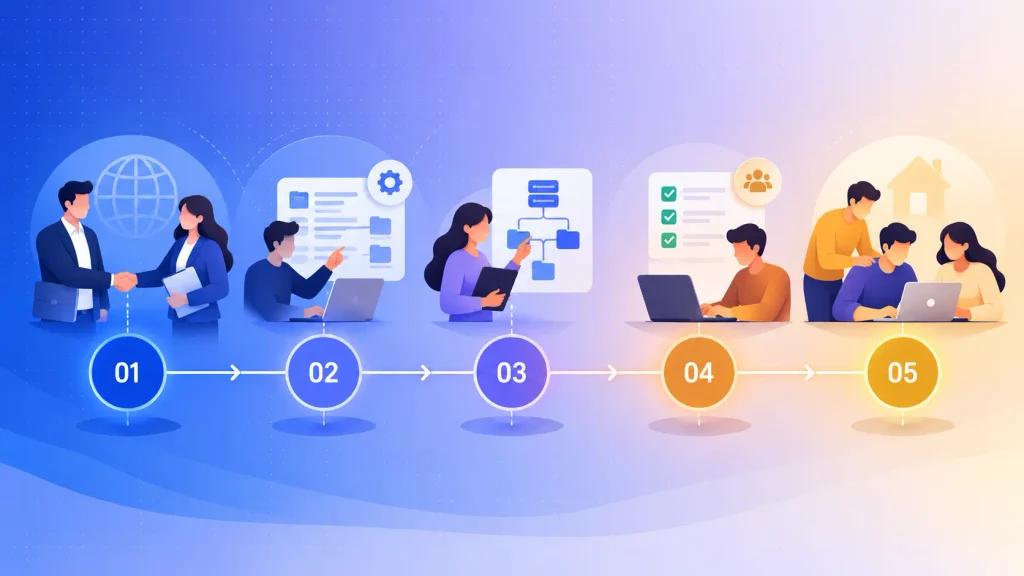
If you start with a hybrid AI development model and plan to bring AI in-house eventually, build the exit into the start. Here’s a sequence that avoids the painful rewrite:
- Pilot (outsourced): the partner validates the use case and the data, and you agree on success metrics together.
- First release (outsourced, in your accounts): code, cloud accounts, and model API keys sit under your company from the first commit.
- First internal hire: your AI owner joins code reviews and architecture decisions while the partner keeps building.
- Shared maintenance: your team handles fixes and small features, and the partner handles new builds and specialist work.
- In-house led: your team owns the roadmap, and the partner stays available for capacity or niche skills.
The timing depends on your funding and hiring pace, not a fixed calendar. What matters is that documentation, runbooks, and decision records arrive throughout, never crammed into a rushed final week. The same discipline runs through a well-structured AI product development process.
Which Should You Choose? A Decision Framework
No single rule settles in-house vs outsourced AI development for every company, but your stage narrows the answer quickly. Start with where you are, then pressure-test it with the questions below.
Decide by Company Stage
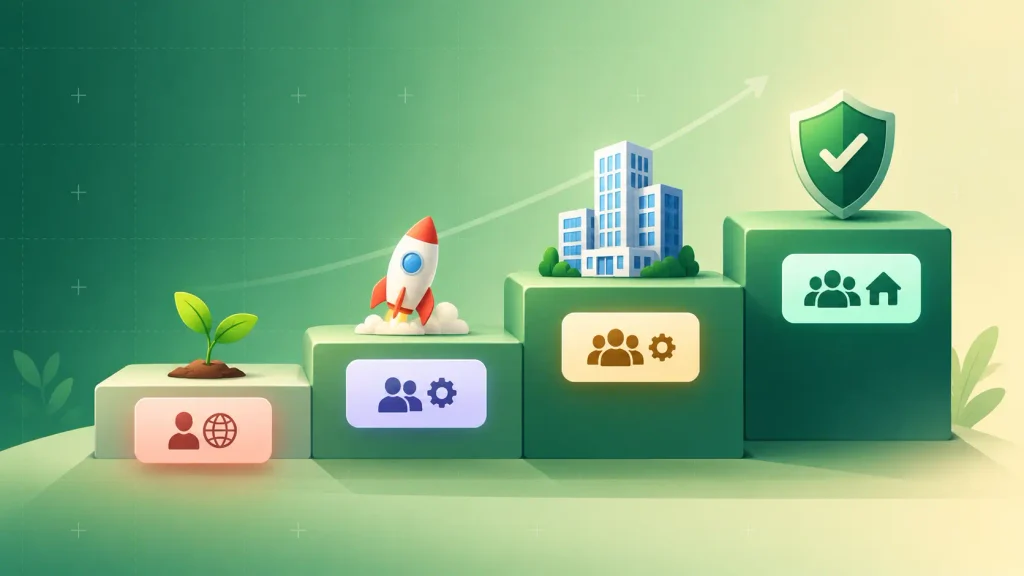
Your funding stage and how central AI is to your product do most of the deciding. Here’s where each situation usually lands:
| Stage | Best Fit | Why |
| Pre-seed or idea stage | Outsourced pilot | Prove the use case before fixed payroll |
| Seed to Series A | Hybrid | Partner builds, one internal owner steers |
| Series B+, AI is the product | In-house core, partner for capacity | The moat has to compound inside |
| Established company, AI supports operations | Outsourced or hybrid | AI is a tool, not what customers buy |
| Regulated data at any stage | In-house or tightly scoped hybrid | Every outside party adds audit work |
If you sit between two rows, lean toward the one that keeps your options open. Moving from outsourced to in-house is far easier than unwinding six hires.
Questions to Answer Before You Hire or Sign
Before you commit budget, it’s worth getting honest answers to these, ideally with your cofounders or leadership team in the room:
- Is AI the reason customers pick you, or a feature that helps?
- Can you fund an AI team for two years, not just until launch?
- Do you have someone who can judge an AI engineer’s or a partner’s work?
- What result do you need to show in the next six months?
- Is your data ready, or does it need cleanup first?
- How much would a six-month hiring delay cost you?
- Must anyone outside your company touch regulated data?
- Who owns the system in month 13?
If you answered “no” or “not sure” to questions two and three, a pure in-house build is a risky bet right now. A short AI consulting engagement can help you work through the rest before you spend on either path.
What to Put in an AI Outsourcing Contract
If you outsource, the contract is where control actually lives. A verbal promise about ownership isn’t worth much on the day you need to switch partners.
At minimum, you’ll want each of these in writing:
- IP assignment: custom code, prompts, model configurations, fine-tuned weights, evaluation sets, and documentation all belong to you.
- Client-owned infrastructure: repositories, cloud accounts, and model API keys sit under your company from day one.
- Data handling terms: where data is processed, who can access it, how long logs are kept, and what gets deleted at the end.
- Reusable components: clarity on which accelerators stay with the partner and whether any of their code ships inside your product.
- Documentation cadence: architecture notes, runbooks, and decision records delivered as you go.
- Exit and transition: a defined handover period and support if you bring the work in-house or move to another team.
If IP ownership isn’t addressed explicitly, walk away. For the wider selection process, including red flags in proposals, our guide on how to choose an AI consultancy walks through it step by step.
How Boomdevs Solves the AI Build-vs-Outsource Problem
Most founders who come to Boomdevs aren’t choosing between two pure models. They want to move fast now without losing control later.
That’s how our AI development services are set up by default. The team builds in your repositories and cloud accounts, documents as it goes, and works alongside your internal owner instead of around them.
Depending on where you are, that can look like one of these:
- An outsourced pilot to validate an AI use case before you commit to hiring.
- A dedicated AI team for chatbots, AI agents, copilots, voice agents, or a full AI SaaS product.
- Staff augmentation when you already have engineers and need to add AI depth to your team.
With 10+ years in the business, 3.5K+ projects delivered, and 50+ full-time specialists, Boomdevs has seen which handovers work and which don’t. You get that pattern library from your first sprint.
Frequently Asked Questions
Is Outsourcing AI Development Cheaper Than Building In-House?
Usually, in year one. A scoped outsourced project avoids fixed salaries, recruiting, and ramp-up time. Over several years of continuous development, the gap narrows, so compare total cost of ownership rather than the first invoice.
Can a Startup Outsource AI and Still Own the IP?
Yes, if the contract says so. Assign custom code, prompts, model configurations, and evaluation sets to you. Repositories and cloud accounts should sit under your company from the start.
How Long Does It Take to Build an In-House AI Team?
Longer than most roadmaps allow. You’re recruiting for the hardest-to-fill skills in the global market, then waiting for each hire to ramp up on your data and systems. Many companies run an outsourced pilot in parallel so the product doesn’t wait on hiring.
What’s the Difference Between Staff Augmentation and Outsourcing?
With staff augmentation, external specialists join your team and follow your process, and you manage them. With project or dedicated-team outsourcing, the partner manages delivery, and you manage outcomes. Augmentation fits when you have engineering leadership; full outsourcing fits when you don’t.
When Should You Bring AI Development In-House?
When AI becomes central to why customers choose you, when you can fund a team well past launch, and when you have an internal owner who already understands the system. A planned handover turns that move into a transition instead of a rewrite.
Ready to Scope Your AI Build?
You don’t have to settle the in-house vs outsourced AI development question on gut feel. A short scoping conversation about your use case, your data, and your runway usually makes the right model obvious.
Book your free AI scoping call with Boomdevs and get an honest recommendation, even if the answer is to hire your own team.