



- 1. Key Takeaways
- 2. What Are the Biggest AI Product Development Challenges?
- 3. Why Do AI Projects Fail More Often Than Traditional Software?
- 4. Is AI Riskier to Build Than Traditional Software?
- 5. How Do You Fix Data Quality Issues in AI Development?
- 6. How Do You Solve the AI Talent Shortage?
- 7. What Are the Best Practices for AI Model Deployment?
- 8. What Is the Best Way to Scale an AI Product?
- 9. How Do You Keep Compute and Energy Costs Under Control?
- 10. How Do You Build an AI MVP That Survives Production?
- 11. How Do You Handle AI Compliance, Privacy, and Explainability?
- 12. How Do You Evaluate an AI Development Partner?
- 13. Common Questions About AI Product Development
- How Long Does It Take to Develop an AI Product?
- Is It Cheaper to Use a Pre-Trained API or Build a Custom Model?
- How Much Does AI Development Actually Cost?
- How Do I Know If My Business Problem Needs AI?
- What Is the Biggest Risk for an AI Startup?
- What Is Black Box AI?
- Can AI Automate Every Business Process?
- How Do I Prove the ROI of an AI Initiative?
- Does AI Replace Jobs in Product Development?
- 14. The Short Version
Summarize with
Most AI product development challenges have nothing to do with the model. They are data problems, ownership problems, and production problems, and they surface months after the demo impressed everyone in the room.
The numbers are blunt. RAND’s study of 65 working data scientists and ML engineers, published as The Root Causes of Failure for Artificial Intelligence Projects and How They Can Succeed, found that more than 80% of AI projects fail, roughly twice the failure rate of IT projects that don’t involve AI. Their most common root cause was not compute or algorithms. It was teams misunderstanding, or miscommunicating, which problem they were solving.
That’s the encouraging part. The failure modes repeat, six or seven of them, across industries and company sizes and model choices. You can design around repeatable failures.
Key Takeaways
- The odds are bad, and they are documented. Over 80% of AI projects fail (RAND, 2024), 42% of companies scrapped most of their AI initiatives in a single year (S&P Global Market Intelligence, 2025), and Gartner expects 60% of projects without AI-ready data to be abandoned through 2026.
- Data readiness, not model choice, is the deciding factor. In Gartner’s survey of 248 data management leaders, 63% either lack the right data management practices for AI or aren’t sure they have them.
- Talent scarcity has shifted shape. AI skills are now the hardest of all skills to hire globally, ahead of engineering and traditional IT (ManpowerGroup, 2026).
- Models decay quietly after launch. Peer-reviewed testing found temporal degradation in 91% of model and dataset pairs (Vela et al., Scientific Reports, 2022), so monitoring and retraining are running costs, not optional extras.
- Compliance moved in 2026. EU AI Act Article 50 transparency duties took effect on August 2, 2026, while most high-risk obligations slid to December 2, 2027.
What Are the Biggest AI Product Development Challenges?
The recurring blockers are messy data, unclear problem ownership, scarce senior AI talent, brittle integration with older systems, models that can’t explain themselves, silent post-launch decay, and compute costs that grow with usage rather than staying fixed.
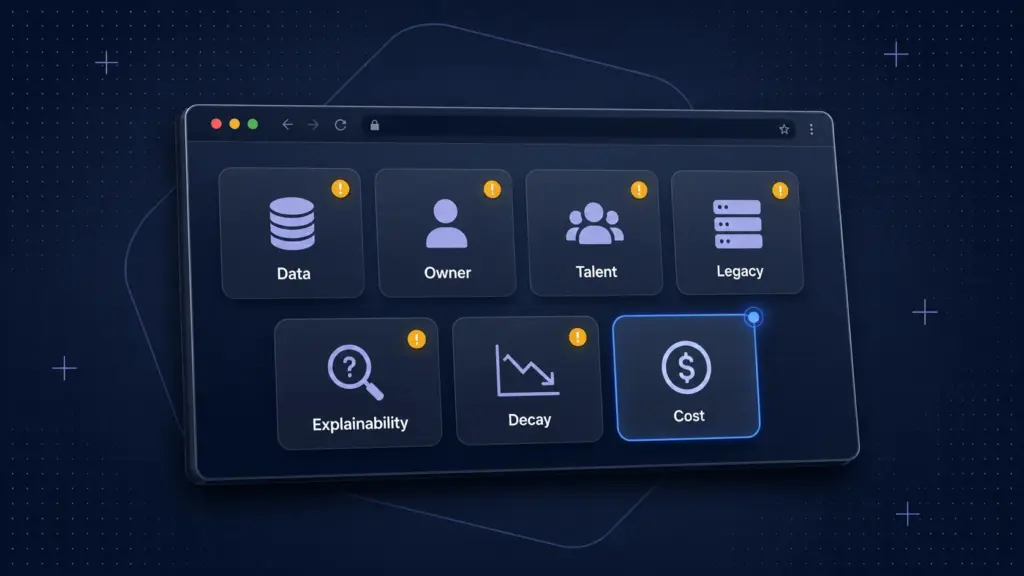
Here is what each one actually looks like in a build:
Data that isn’t AI-ready. Gartner’s survey of 248 data management leaders found 63% either lack or are unsure of the right data practices for AI, and predicts organizations will abandon 60% of projects unsupported by AI-ready data through 2026.
AI-ready is a stricter standard than report-ready: it needs lineage, active metadata, and quality checks at the cadence the model consumes data, not the cadence finance closes the books. If your pipeline is the bottleneck, that is a data engineering problem before it is a modeling problem.
No owner, no metric. RAND’s interviews put miscommunication about the problem at the top of the failure list. If nobody can state the target number before the build starts, there is nothing to hold the project to at month five.
Talent you can’t hire fast. ManpowerGroup’s 2026 Talent Shortage Survey of 39,063 employers across 41 countries found AI skills are now the hardest to find globally, overtaking engineering and IT for the first time, with 72% of employers reporting hiring difficulty.
Legacy integration. Older architectures often lack the APIs, event streams, or throughput a model needs. In Cisco’s 2025 AI Readiness Index, only 15% of organizations said their networks were fully ready for AI, and 54% said their networks could not scale for current complexity or data volume. Modular architectures and phased rollouts are the practical way through, because they let you replace one interface at a time instead of one platform at a time.
Explainability gaps. A model that can’t justify a decision is hard to defend to a risk committee, an auditor, or a rejected customer. In regulated use cases that’s a launch blocker, not a nice-to-have, and it belongs in your AI governance plan from the first sprint.
Silent decay after launch. Nothing in the code changes, yet accuracy drops. More on that below, with the peer-reviewed research behind it.
Costs that scale with success. Compute, inference, retraining, and monitoring all grow with usage. Vendors quote the build. The build is rarely the expensive part.
Notice how few of these are model problems. That pattern holds across the primary research, and it’s why swapping foundation models almost never rescues a stalled project.
Why Do AI Projects Fail More Often Than Traditional Software?
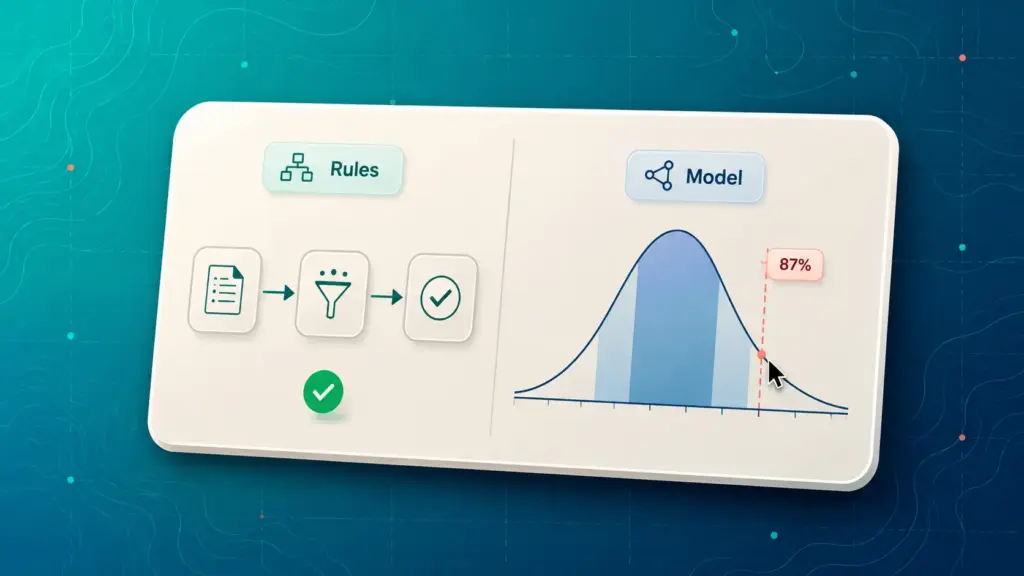
Traditional software is deterministic: the same input returns the same output, and correctness is something you can finish testing. AI systems are probabilistic, learned from data rather than specified in code, so behavior is a distribution and “correct” is a threshold you agree on.
That difference reshapes the whole plan. Requirements evolve as the data reveals what’s possible. Timelines depend on experiments that may not work, and testing gives you confidence intervals instead of green checkmarks.
The evidence keeps landing in the same place. S&P Global Market Intelligence found 42% of companies abandoned most of their AI initiatives in 2025, up from 17% a year earlier, with the average organization scrapping 46% of proofs of concept before production. Cost and data privacy topped their list of obstacles.
Scaling is where the wheels come off. McKinsey’s State of AI survey found 88% of organizations regularly use AI in at least one function, yet only 39% report any enterprise EBIT impact, and about 6% qualify as high performers attributing 5% or more of EBIT to AI. The strongest differentiator was not the model. It was redesigning the workflow around it.
Generative pilots show the sharpest version of this gap. MIT Project NANDA’s The GenAI Divide: State of AI in Business 2025 reported that roughly 95% of enterprise GenAI pilots produced no measurable P&L return despite an estimated $30 to $40 billion in spending, and attributed the divide to integration and learning gaps rather than model quality.
Treat that 95% as directional, not definitive. The study rests on a review of about 300 publicly disclosed initiatives, 52 structured interviews, and 153 survey responses gathered at industry conferences between January and June 2025, and the authors describe it as a snapshot rather than a market census. Critics have fairly pointed out that a conference-recruited sample and a strict definition of “measurable P&L return” will both push the failure figure upward.
Agents are repeating the cycle faster. In a June 2025 forecast, Gartner predicted that over 40% of agentic AI projects will be canceled by the end of 2027 on escalating costs, unclear business value, and weak risk controls. Senior director analyst Anushree Verma described most current agentic projects as “early stage experiments or proof of concepts.”
Gartner also flags agent washing, where existing chatbots and automation get rebranded as agents. The firm estimates only about 130 of the thousands of self-described agentic vendors are building something real. When you evaluate an agent vendor, that ratio is the context to hold in mind.
Is AI Riskier to Build Than Traditional Software?
Yes, and the risk is structurally different rather than simply larger. An AI product can degrade in production without a single code change, which means the work does not end at launch.
| Risk Area | Traditional Software | AI Product Development | What It Changes in Your Plan |
| Requirements | Specified up front | Discovered through experiments | Budget a discovery phase before committing scope |
| Data | Flows through the logic | Defines the behavior | Data work becomes the critical path, not a prerequisite task |
| Timelines | Estimable from known methods | Depend on experiments that may fail | Fund in stages with kill criteria at each gate |
| Testing | Can be judged complete | Statistical, never exhaustive | Ship against accuracy and safety thresholds, plus human review |
| Post-launch | Stable until you change it | Degrades as the world shifts | Staff monitoring and retraining as ongoing operations |
| Cost curve | Mostly fixed after build | Scales with usage and retraining | Track cost per outcome, not just the build invoice |
| Failure rate | About half the AI rate, per RAND’s comparison | Over 80% of projects fail | Approve fewer projects and resource them properly |
The plan-level implication is the one teams skip: production infrastructure for an AI feature can take as long as building the AI feature. Give it one month in a six-month plan and you will discover the mistake at month five, which is exactly when confidence and budget run out.
Before you commit the full budget, run a short feasibility review on your data, your success metric, and your integration path. Get the AI Feasibility Checklist, 13 questions you can work through with your own team, no email required.
How Do You Fix Data Quality Issues in AI Development?
Fixing data quality means auditing where data actually lives, assigning ownership with measurable quality targets, automating cleaning and validation in the pipeline, and closing gaps with augmentation or synthetic data before training begins.
Four steps, in this order:
Audit before you architect. Map every source the use case touches. Note what’s structured, what’s siloed, who controls access, and how far back reliable history goes.
Assign ownership, then define “good.” Governance fails as a policy document and works as a name plus a number. One accountable owner per domain, with agreed thresholds for completeness, freshness, and accuracy. Gartner’s own framing treats AI-ready data as a practice needing continued investment, not a checklist you clear once.
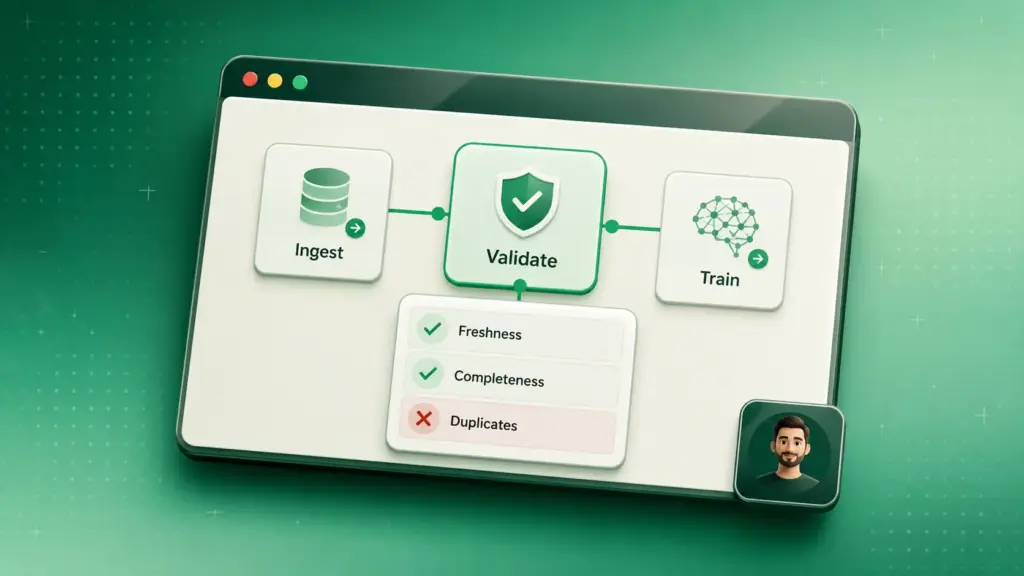
Automate validation inside the pipeline. Put quality checks in the ETL or ELT path so duplicates, drifting schemas, and null spikes fail loudly at ingestion. A model trained on silently broken input produces confident nonsense, which is far more expensive than an obvious crash.
Close gaps deliberately. Augmentation and synthetic data can fill thin classes and rare edge cases. Both need validation against real distributions, or you have taught the model your assumptions rather than reality.
One trade-off worth naming: waiting for perfect data is its own failure mode. Scope the data work to the single use case in front of you, ship, then widen. Enterprise-wide cleanup projects tend to outlive the business case that funded them.
How Do You Solve the AI Talent Shortage?
The realistic answer combines three moves: upskill engineers you already have, use augmentation or a specialist partner for the scarce senior roles, and hire for trajectory rather than competing for the market’s most expensive résumés.
Upskill from inside. Your senior backend engineers already understand your data, your domain, and your deployment constraints. That context is harder to buy than PyTorch familiarity. ManpowerGroup found reskilling existing staff is now a leading employer response to structural scarcity.
Buy the scarce parts. MLOps, evaluation design, and applied research are the roles teams wait longest to fill. Staff augmentation or an embedded delivery partner gets you moving now, and moves knowledge in-house if you write that into the engagement.
Hire for slope, using signals that actually predict. Three hold up better than a keyword-matched CV: the candidate has taken a model to production and can describe what broke, they can read a recent paper and reimplement the core idea, and they have debugged a training run that converged to a wrong answer without erroring. Ask for the story behind each one in the interview, because all three are hard to fake in detail.
Cover the literacy layer too. ManpowerGroup’s ranking puts AI model and application development first among hard-to-find skills at 20%, with AI literacy close behind at 19%. Product managers, analysts, and support leads who understand what a model can and cannot promise prevent a lot of expensive rework.
Worth saying plainly: hiring alone will not close this gap at current supply. Design your roadmap around a small senior core plus upskilled generalists, not around a hiring plan that assumes you’ll win every offer.
What Are the Best Practices for AI Model Deployment?
Deployment goes wrong when teams treat launch as the finish line. Manage it with an MLOps foundation: versioned data and models, automated validation, staged rollouts, live performance monitoring, and retraining triggered by evidence rather than by calendar.
Version everything, including the data. Reproducibility is the difference between debugging a regression in a day and guessing for a week. Model registry, data snapshots, feature definitions, evaluation sets.
Containerize for the failures specific to ML. Pin CUDA and driver versions explicitly, because a host driver upgrade can change numerical results without changing your code. Keep model artifacts out of image layers and mount them at runtime, or every retrain rebuilds a multi-gigabyte image. Reserve GPUs at the scheduler level so an inference pod and a training job never contend for the same device.
Roll out gradually. Canary or shadow deployments on a small traffic slice surface latency, cost, and quality surprises while the blast radius is small. Keep the previous version warm.
Monitor inputs and outcomes, not just uptime. Track input distribution shift, prediction distribution, and the business metric the model exists to move. Dashboards that only show 200s will happily report a healthy service making worse decisions every week.

Trigger retraining on evidence. Retraining on every drift alert wastes compute and can hurt calibration. A workable rule: act when a distribution shift coincides with a measurable drop on a freshly labeled evaluation slice.
The decay is real and well documented. Vela, Sharp, Zhang, Nguyen, Hoang, and Pianykh tested four standard model types against 32 real-world datasets across healthcare, finance, transportation, and weather, giving 128 model and dataset pairs, and found temporal degradation in 91% of cases (Temporal quality degradation in AI models, Scientific Reports, 2022).
They named the phenomenon AI aging. Different model types aged at different rates on identical data, which is a useful argument for choosing stable architectures in slow-feedback domains.
For LLM and agent systems the same discipline applies with a twist: you usually aren’t training the weights. Providers ship updates, retrieval indexes get re-embedded, prompts get edited, tool schemas change. Any of those can shift end-to-end behavior, so version your prompts and retrieval configs with the same seriousness you’d version a model.
What Is the Best Way to Scale an AI Product?
Scaling works when compute is elastic, components scale independently, and cost is measured per outcome. It fails when a prototype meets production traffic on infrastructure that was never sized for it.
The infrastructure gap is measurable. Cisco’s 2025 AI Readiness Index, a double-blind survey of 8,000 senior leaders across 30 markets and 26 industries, found only 13% of organizations qualify as fully ready Pacesetters, a share that has held steady for three years. Those firms are four times more likely to move pilots into production. Of that group, 98% design their networks for the growth and complexity of AI, against 46% overall.
Practical moves that hold up under load:
- Separate inference, retrieval, training, and orchestration into services that scale on their own curves. Inference spikes with users; training doesn’t.
- Cut model cost before you buy more capacity. Distillation, quantization, caching, and routing easy requests to smaller models usually beat a bigger instance.
- Put usage caps and budget alerts on every agent or workflow that can call a model in a loop. Runaway loops are the most common surprise on an AI cloud bill.
How Do You Keep Compute and Energy Costs Under Control?
Price your GPUs per completed job, not per hour. Rental rates for identical silicon vary widely by provider, and as of mid-2026 CloudZero’s pricing comparison puts A100 cloud rental at roughly $1.29 to $2.50 an hour against a much wider $1.40 to $8.00-plus spread for H100, while H100 class hardware delivers roughly three to five times the transformer throughput. A faster, pricier GPU is often the cheaper training run. Verify current rates at deployment time, because this market reprices in weeks rather than quarters.
Three habits that save real money:
Match hardware to workload. Memory-bound inference, modest-throughput training, and frontier-scale jobs want different chips. Defaulting the whole team to the newest accelerator is how budgets disappear.
Use spot or preemptible capacity for anything interruption-tolerant. Fault-tolerant training and batch inference are natural fits, often at a fraction of on-demand rates.
Attribute spend to teams and features. Untracked GPU spend gets discovered at renewal, when the negotiating position is weakest.

Energy is now part of this conversation, and increasingly part of ESG reporting. The IEA’s Key Questions on Energy and AI reports that global data center electricity demand grew 17% in 2025, with AI-focused data centers surging 50%, against 3% growth in overall global electricity demand. Two implications for product teams: efficiency work has a carbon story as well as a cost story, and enterprise buyers in Europe are starting to ask for both.
How Do You Build an AI MVP That Survives Production?
A working AI MVP solves one measurable business problem, proves data feasibility before the full budget is committed, and reaches production on pre-trained models wherever a custom model isn’t the point.
Pick one bottleneck with a number attached. Turnaround time, error rate, manual review hours, escalation volume. If you can’t name the metric and its current value, you can’t prove the win later.
Validate feasibility first. A short discovery phase answers three questions: does the data exist, is it usable, and can the workflow absorb the output? This is the cheapest place to find out the answer is no.
Scope with must-have discipline. MoSCoW or any similar model works, as long as somebody has authority to say no. Every extra must-have delays the moment you learn whether the core hypothesis holds.
Start with pre-trained or open-weight models. APIs and open models like the Llama or Mistral families get you to a real user test faster and cheaper. Fine-tune when generic performance provably caps your outcome, not because custom sounds more defensible.
Plan the production path on day one. Where it runs, who owns it, how it’s monitored, what triggers rollback. This is the step whose absence shows up in the 46% of proofs of concept that get scrapped.
An MVP is not a proof of concept. A PoC answers “can this work?” An MVP answers “will people use it, and does the number move?” Confusing the two is how teams end up with an impressive notebook and no product.
How Do You Handle AI Compliance, Privacy, and Explainability?
Build for privacy and auditability from the first sprint: minimize and anonymize personal data, log provenance and human overrides, and use explainability tooling so any individual decision can be reconstructed and defended.
The EU timeline shifted materially this year, so calendars built in 2025 are wrong. Under the Digital Omnibus on AI, endorsed by the European Parliament on June 16, 2026 and given final approval by the Council on June 29, 2026, standalone high-risk obligations under Annex III moved to December 2, 2027, and to August 2, 2028 for AI embedded in regulated products under Annex I (Gibson Dunn summary). The amending regulation was published in the Official Journal on July 24, 2026 and entered into force on July 27, 2026.
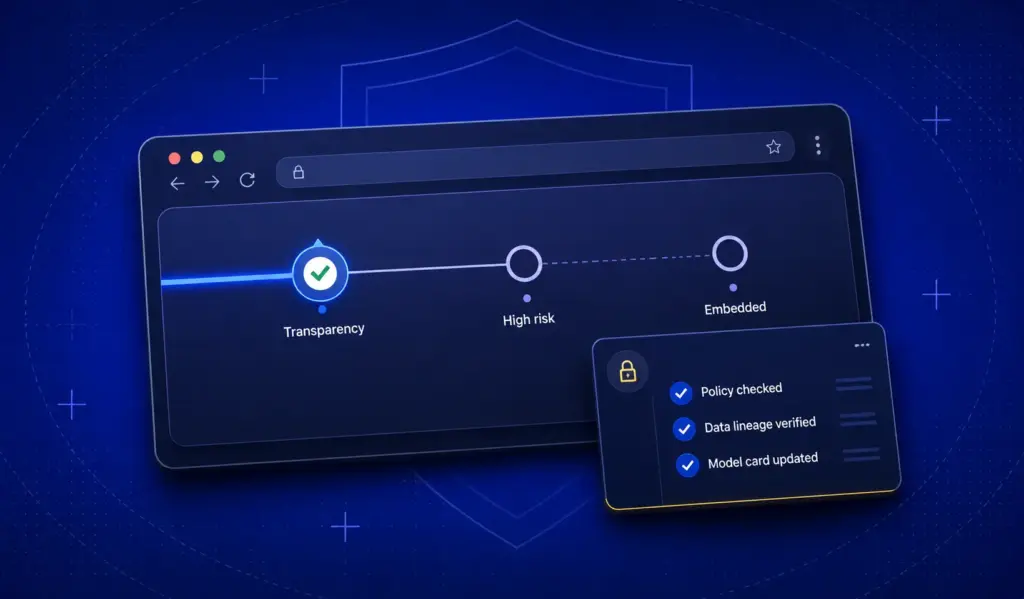
Article 50 transparency duties were left out of that deferral. Telling people they are dealing with an AI system, disclosing emotion recognition and biometric categorization, and labeling deepfakes all applied from August 2, 2026 as originally scheduled. One narrow carve-out exists: generative systems already on the EEA market before that date have until December 2, 2026 to meet the machine-readable marking and detection requirement in Article 50(2).
Read the high-risk delay as a runway, not a reprieve. The underlying requirements around risk management, data governance, human oversight, logging, and post-market monitoring did not change, and systems already on the market get treated differently from ones you substantially modify later.
What to put in the build:
Minimize, and plan for deletion you cannot do with a DELETE. Strip or tokenize personal identifiers before training, and keep a documented lawful basis for every field you retain. The harder problem is that data absorbed into model weights cannot be removed by dropping a database row, so decide up front whether your answer to an erasure request is a scheduled retrain, a holdout architecture that keeps personal data out of the weights entirely, or a retrieval layer you can purge independently.
Log provenance and overrides. Dataset lineage, model versions, human corrections, and the reason for each retrain. Reconstructing this after an audit request costs multiples of maintaining it.
Add explainability where decisions affect people. SHAP and LIME give per-decision attributions for tabular models; for generative systems, cite sources, log retrieved context, and keep prompts under version control.
Watch the training-data question. In June 2025 two judges in the Northern District of California ruled two days apart on whether training on copyrighted books is fair use. In Bartz v. Anthropic Judge Alsup held the training use was fair but that building a permanent library from pirated copies was not, while in Kadrey v. Meta Judge Chhabria reached a fair-use result by treating acquisition and training as one integrated process.
Both rulings were narrow and fact-specific, both judges signaled that better evidence of market harm could flip the outcome, and Anthropic later settled the piracy claims. Meanwhile EU rules put weight on machine-readable rights reservations and training-content summaries, so if you fine-tune on scraped or user-generated data, document the source of every corpus now.
Audit the model, not just the pipeline. Test for biased inference across segments on a schedule, and treat prompt injection and data exfiltration as security requirements rather than research curiosities.
How Do You Evaluate an AI Development Partner?
Portfolios show what a team shipped. They rarely show whether it survived. Ask for the operational evidence instead:
Production track record with monitoring. How many models are live, for how long, and who watches them? Ask to see a drift dashboard and a real retraining decision, redacted if needed.
Data readiness process. Do they run a feasibility gate before quoting a build, or do they quote first and discover the data later?
Named success metric in the contract. Strong partners insist on a measurable target. Weak ones accept “improve efficiency.”
Cost transparency past launch. Ask for a three-year view including inference, retraining, monitoring, and support, not just the build fee.
Knowledge transfer terms. Documentation, code ownership, and a plan for your team to take over. Anything else creates a dependency you’ll pay for annually.
Governance fluency. Can they speak precisely about the EU AI Act phases, audit logging, and explainability options for your risk profile?
If a prospective partner can’t answer the monitoring and metric questions, they build demos. That’s a different service, and it should carry a different price.
We answer all six of these questions on the first call.
Book a 30-Minute AI Feasibility Review and bring your use case plus whatever data documentation you have.
Common Questions About AI Product Development
How Long Does It Take to Develop an AI Product?
Plan on six to 12 months for a governed production build, with a focused MVP landing sooner. The variable is rarely modeling time. Data preparation, integration, and production hardening dominate the schedule, which is why so many projects die in the gap between proof of concept and deployment.
Is It Cheaper to Use a Pre-Trained API or Build a Custom Model?
Pre-trained APIs win on speed and upfront cost for common tasks, and they let you validate demand before committing capital. Custom or fine-tuned models earn their cost when you have proprietary data, domain language the generic model gets wrong, or unit economics that break at API prices. Start with the API, measure, then decide.
How Much Does AI Development Actually Cost?
Budgets range from tens of thousands for an API-first feature to seven figures for a custom-trained enterprise system. The lines teams underestimate are data preparation, inference at scale, and ongoing monitoring and retraining, which can rival the original build over three years. Budget total cost of ownership, not the build quote, and see our full AI development cost breakdown for the line items.
How Do I Know If My Business Problem Needs AI?
If deterministic rules solve it, use rules. They’re cheaper, testable, and explainable. AI earns its keep on probabilistic problems: prediction, ranking, extraction from unstructured input, and classification at a volume humans can’t sustain. A rules engine that solves 80% of your cases is often the better product decision.
What Is the Biggest Risk for an AI Startup?
Data readiness. Gartner expects organizations to abandon 60% of AI projects unsupported by AI-ready data through 2026, and 63% of surveyed data leaders either lacked the right practices or weren’t sure they had them. Without trustworthy inputs, model sophistication buys you nothing.
What Is Black Box AI?
Black box AI describes models, typically deep neural networks and large language models, whose internal reasoning can’t be inspected directly by a human. You see inputs and outputs, not the path between them. Explainability tools reconstruct approximate reasons, which is usually enough for review boards but is not the same as reading the logic.
Can AI Automate Every Business Process?
No. Processes that turn on subjective judgment, carry legal accountability, or generate too few examples to learn from are poor candidates. Automate the high-volume, well-instrumented parts, and route the ambiguous cases to people with the model’s confidence score attached.
How Do I Prove the ROI of an AI Initiative?
Define the KPI and its baseline during discovery, then review it quarterly against the original business case. McKinsey found only 39% of organizations report any enterprise-level EBIT impact from AI, and the high performers are the ones that redesigned the workflow rather than bolting a model onto it. Measure the workflow outcome, not model accuracy.
Does AI Replace Jobs in Product Development?
Mostly it shifts the work. McKinsey’s survey found 32% of respondents expect headcount decreases in the coming year, 43% expect no change, and 13% expect increases. In practice, manual coding and testing shrink while demand grows for evaluation, oversight, data engineering, and product judgment about what should be automated at all.
The Short Version
AI product development challenges are predictable, which makes them manageable. Get the data foundation right for one use case, name an owner and a number before the build starts, plan production infrastructure as real work, and treat monitoring and retraining as operations rather than overhead.
Then do the hardest part: approve fewer projects and resource them properly. That single decision separates the teams reporting EBIT impact from the ones filing another postmortem.
Sitting on an AI idea and unsure whether the data supports it?
Book a 30-Minute AI Feasibility Review. Bring your use case and whatever data documentation you have, and you’ll leave with a go, a no-go, or a specific fix-first list, plus the metric to hold the build to.