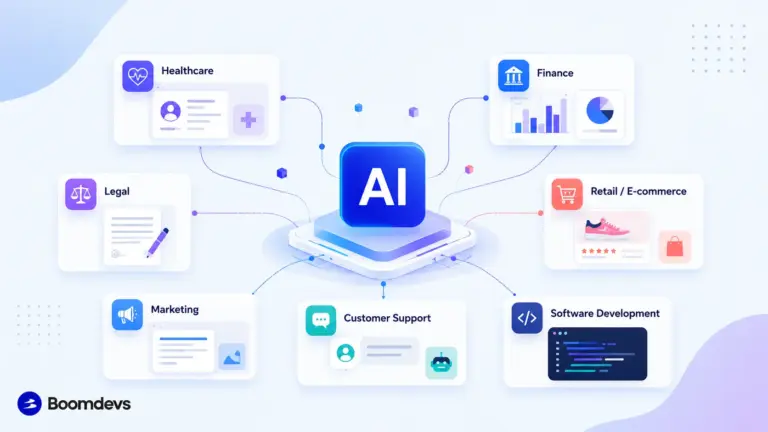



- 1. What Is Generative AI?
- 2. How Is Generative AI Different from Traditional AI?
- 3. How Does Generative AI Actually Work?
- 4. What Are the Top Generative AI Tools in 2026?
- 5. Where Is Generative AI Already Being Used in Business?
- 6. How to Start Using Generative AI (Step by Step)
- 7. What Are the Risks and Limitations of Generative AI?
- 8. What’s Next: Agentic AI and Multimodal AI in 2026
- 9. Frequently Asked Questions
Summarize with
Generative AI is technology that learns patterns from huge amounts of text, images, and audio, then creates something new, a paragraph, a picture, a snippet of code, rather than simply retrieving existing content. Tools like Claude, ChatGPT, and Gemini put this behind a simple chat window.
You have almost certainly used generative AI this week, whether it was a chatbot drafting an email, an app suggesting a caption, or a coworker pasting in an AI-written report. But what is generative AI, exactly, and why has it taken over so much of daily work in 2026? This guide breaks it down in plain language: what it is, how it actually works, which tools matter right now, and how to start using it without getting burned by its biggest risks.
Key Takeaways
- Generative AI creates new content (text, images, video, audio, code) instead of just analyzing data that already exists.
- Large language models like Claude and GPT-5.6 predict the most likely next word, while diffusion models turn random noise into a finished image.
- As of McKinsey’s most recent published survey (November 2025), 71% of organizations regularly use generative AI in at least one business function, up from 65% in early 2024.
- The biggest shift in 2026 is agentic AI: systems that plan and carry out multi-step tasks with little human oversight.
- Hallucinations, data privacy, and copyright remain the risks worth understanding before you hand real work to any tool.
What Is Generative AI?
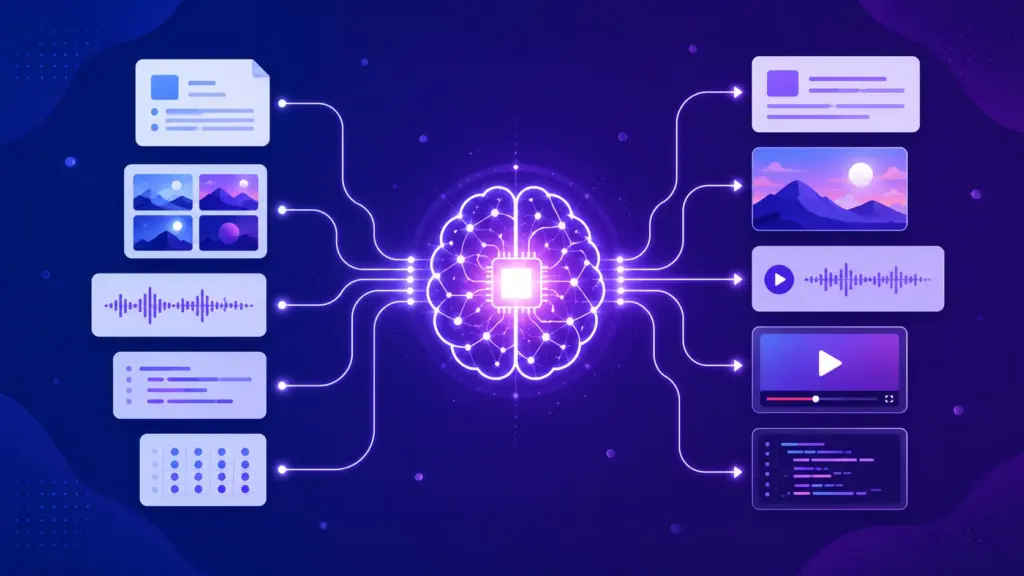
Generative AI is technology that studies patterns across vast datasets, images, and audio, then uses what it learned to produce something new. Ask it for a marketing email or a photo of a mountain at sunset, and it builds an original answer from nothing, rather than pulling up something that already exists online.
That distinction, creating versus retrieving, is the whole story. A spam filter looks at an email and decides: junk or not junk. A generative tool looks at a blank page and decides: what goes here. Nobody wrote the sentence before you asked for it.
Tools like Claude, ChatGPT, and Gemini put this technology behind a simple chat window. You type a plain-language request, no code required, and the model writes, draws, or builds in response. That accessibility is why generative AI moved from research labs to everyday work faster than almost any technology before it.
How Is Generative AI Different from Traditional AI?
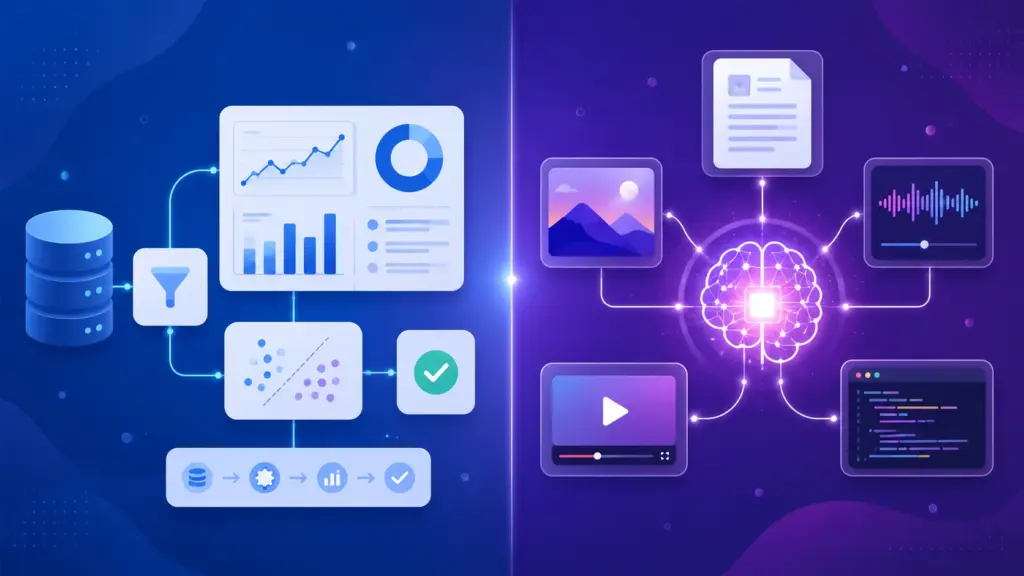
Traditional AI sorts, scores, and predicts. Generative AI produces. The table below breaks down where each one actually gets used.
| Traditional AI | Generative AI | |
| Function | Analyzes, classifies, or predicts existing data | Creates original text, images, audio, video, or code |
| Common uses | Spam filters, fraud alerts, product recommendations | Chatbots, image generators, coding assistants |
| Output | A label, a score, or a decision | A new piece of content |
| Example | Flags a transaction as likely fraud | Drafts the fraud alert email itself |
Neither type replaces the other. Most companies now run both side by side. A recommendation engine decides what a customer might want, and a generative model writes the email that pitches it to them.
How Does Generative AI Actually Work?
Under the hood, three ideas do most of the heavy lifting: training data, transformers, and diffusion. None of them require a math degree to understand once you have the right picture in your head.
Large Language Models and Training Data
A large language model learns by reading billions of sentences and tracking which words tend to follow which. Think of each word, or word fragment, as a puzzle piece the model has seen fit to put together millions of times before. When you type a prompt, the model is not looking anything up. It is predicting, one puzzle piece at a time, which piece most likely comes next, and it keeps going until the sentence, paragraph, or code block is done.
This is also why models occasionally get facts wrong. They are optimized to produce a plausible-sounding next piece, not to check a database. Keep that distinction in mind. It explains a lot of what generative AI is good at and what it is not.
Transformers and the Attention Mechanism
The transformer is the architecture that made modern generative AI possible, and its key trick is called attention. Attention lets the model weigh which earlier words in a sentence matter most for predicting the next one.
In the sentence “The trophy did not fit in the suitcase because it was too big,” attention is what lets the model figure out that “it” refers to the trophy, not the suitcase. Older architectures struggled with exactly this kind of long-range connection. Transformers handle it well, which is a big part of why today’s models write coherent, multi-paragraph answers instead of disconnected sentences.
Diffusion Models for Images
Image generators like Midjourney work differently from text models. A diffusion model starts with a canvas of pure random noise, static, with no shape to it, and removes a little bit of that noise at each step. After enough steps, guided by your text prompt, the noise resolves into a coherent picture.
It is a strange process to picture the first time you hear it: sculpting an image out of static rather than drawing it stroke by stroke. But it is why AI image tools can generate a genuinely new photo of “a red fox reading a newspaper in a coffee shop” even though no such photo ever existed to copy from.
What Are the Top Generative AI Tools in 2026?
The tool landscape moves fast, and every entry below is worth double-checking against the vendor’s own release notes before you build a workflow around it. Here is where things stand as of mid-July 2026, organized by what each category is actually for.
Text and chat
Anthropic made Claude Sonnet 5 the default model for Free and Pro plans on June 30, 2026, positioned as its most agentic Sonnet yet, with Claude Opus 4.8 remaining the stronger choice for the hardest accuracy-sensitive work. OpenAI released the GPT-5.6 family (Sol, Terra, and Luna) on July 9, 2026; note that GPT-5.5 Instant, not GPT-5.6, remains the default for everyday ChatGPT conversations, with GPT-5.6 Sol available to paid plans through reasoning settings. Google’s Gemini 3.1 Pro leads on graduate-level reasoning benchmarks like GPQA Diamond, and xAI’s Grok 4.5 is a common pick for tasks that lean on real-time web and social context, per running third-party model comparisons.
Image and design
Midjourney and Adobe Firefly remain the design-team favorites, joined in 2026 by Google’s Nano Banana Pro and OpenAI’s ChatGPT Images 2.0, both built for accurate text rendering inside generated images.
Video
Google’s Veo 3.1 is now the leading generative video model. OpenAI officially retired the Sora 2 consumer app on April 26, 2026, which left Veo, Runway, and Pika as the main players for AI-generated clips.
Code
GitHub Copilot and Cursor remain the standard AI pair-programming tools, with Claude Code increasingly used for multi-file, multi-agent coding tasks that go beyond simple autocomplete.
Pick based on the job, not the headline. A tool that tops a coding benchmark is not necessarily the best choice for writing a client email.
Where Is Generative AI Already Being Used in Business?
Skip the future-gazing for a second. Here is where generative AI is already doing real, measurable work inside businesses today, organized by function. The same starting point our AI and generative AI consulting team uses when scoping a client’s first project.
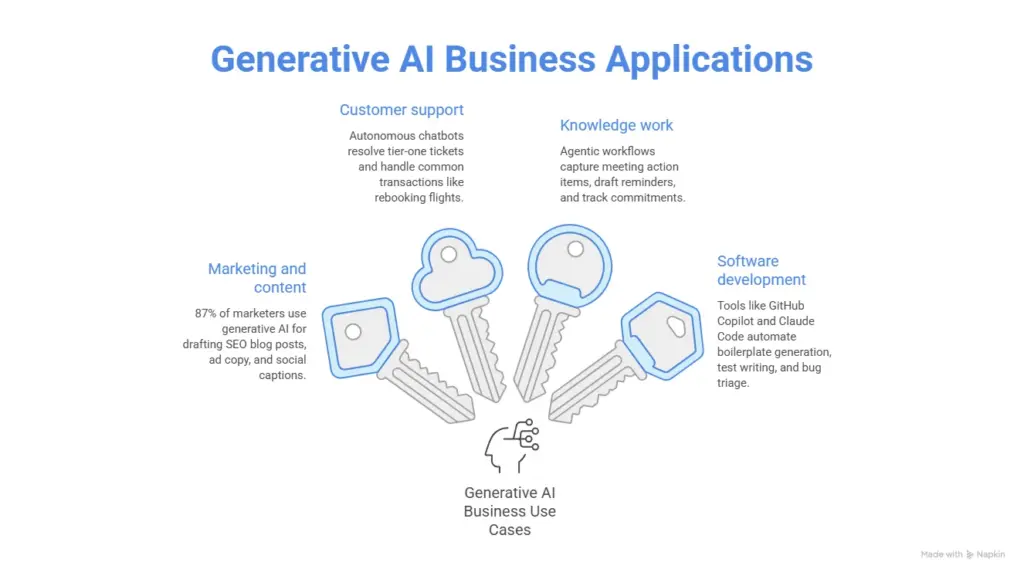
Marketing and content
Drafting SEO blog posts, ad copy, and social captions is the most mature use case by adoption. 87% of marketers now use generative AI in at least one recurring workflow, up from 51% in 2024, according to Salesforce’s State of Marketing 2026 report. The jump is steep enough that non-adoption, not adoption, is now the outlier.
Customer support
Autonomous chatbots resolve tier-one tickets around the clock, freeing human agents for the messier cases that actually need judgment. Deloitte’s 2026 State of AI in the Enterprise report cites an airline using AI agents to handle common transactions like rebooking a flight or rerouting bags, freeing staff for more complex cases.
Knowledge work and operations
The same Deloitte report describes a financial services firm using agentic workflows to automatically capture meeting action items from video calls, draft follow-up reminders, and track whether people actually did what they committed to. This kind of internal-knowledge-management use case rarely makes headlines but tends to deliver some of the fastest, least glamorous ROI.
Software development
Boilerplate generation, test writing, and bug triage are now routine parts of the coding workflow, driven by tools like GitHub Copilot and Claude Code.
Notice the pattern. In every case, the tool handles the repetitive first draft, and a person still reviews the result before it ships.
How to Start Using Generative AI (Step by Step)
You do not need a technical background to start. You need a tool, a decent prompt, and a habit of checking the output.
Pick the right tool for the task
Use a text model like Claude for long documents and analysis, an image tool like Midjourney for visuals, and a code assistant like Cursor for programming work. Matching the tool to the job matters more than picking whichever one is trending. It’s the first thing our team checks before recommending anything to a client.
Write a strong prompt
A reliable structure is Context, Task, Persona, and Format: tell the model what it is working with, what you need done, who it should sound like, and what shape the answer should take. “Summarize this contract like a cautious lawyer, in five bullet points” beats “summarize this” almost every time.
Review and refine
Treat every output as a first draft, never a finished product. This is the golden rule, and it is the single habit that separates people who get real value from generative AI from people who get burned by it.
What Are the Risks and Limitations of Generative AI?
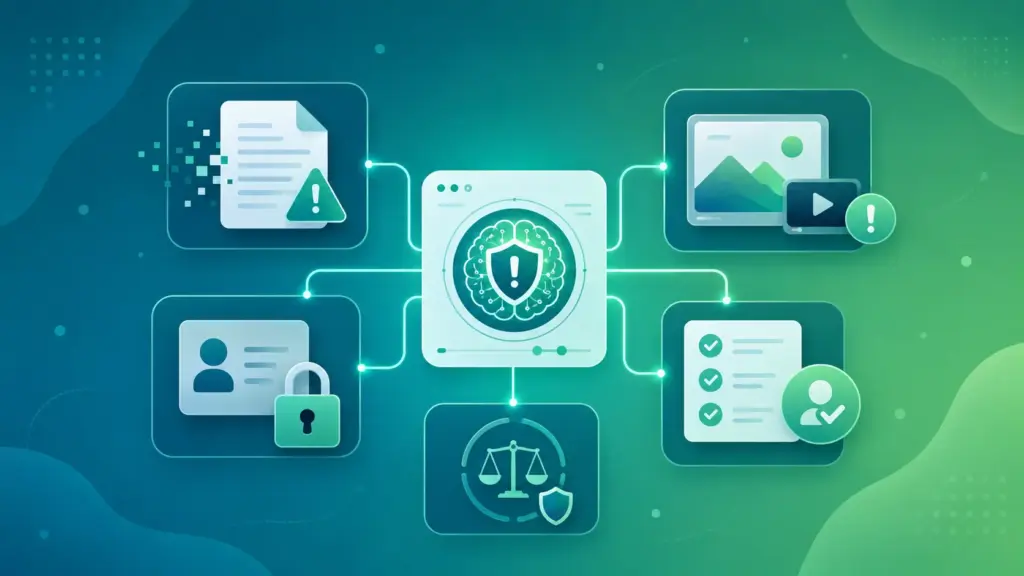
Every one of these is manageable. None of them should be a surprise once you know to look for it.
AI hallucinations
Generative models can state false information with complete confidence, because they are built to produce plausible text, not verified fact. Always check names, numbers, dates, and citations before you use anything a model gives you in a real document.
Data privacy
Never paste sensitive company data, client records, or personal information into a public AI tool unless your organization has an enterprise agreement that guarantees the data will not be used for training. What feels like a private chat window is often anything but.
Copyright and deepfakes
The legal and ethical lines here are still being drawn in real time. California’s AI Transparency Act (SB 942) originally took effect January 1, 2026, but a 2025 amendment (AB 853) pushed the operative date to August 2, 2026, specifically to align with the EU AI Act’s Article 50 provenance-labeling timeline. Both require large AI providers to label AI-generated image, video, and audio content. If your business publishes AI-generated media, that deadline is closer than it looks.
What’s Next: Agentic AI and Multimodal AI in 2026
Two trends define where generative AI is headed next, and both move it past simple content creation.
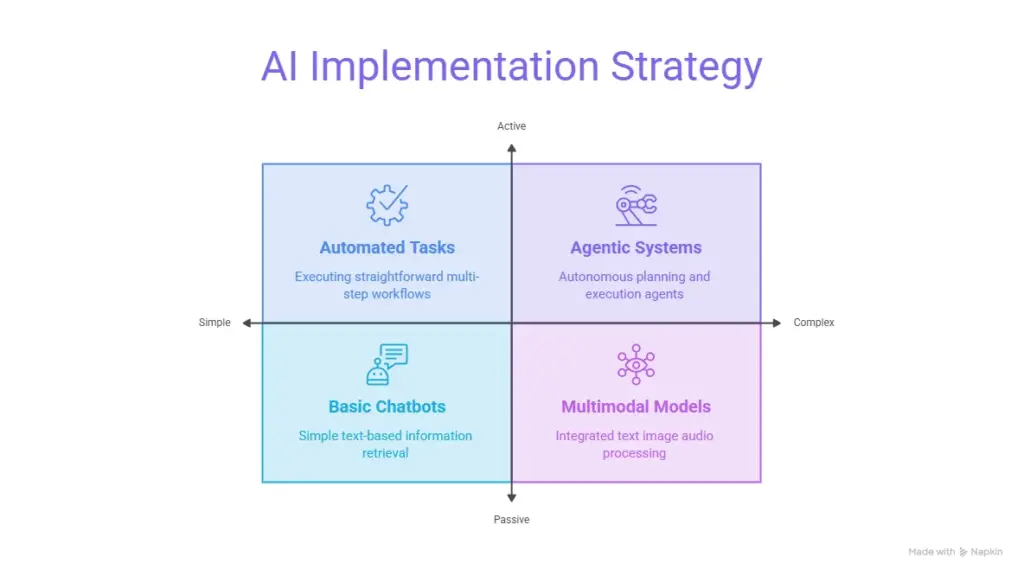
Agentic AI describes systems that do not just answer a question but plan and execute a multi-step task on their own, booking a flight change, drafting and sending a follow-up email, or restocking inventory across a supply chain without a human clicking through each step. Gartner expects 40% of enterprise applications to embed task-specific AI agents by the end of 2026, up from under five percent in 2025, according to enterprise agent adoption data. Deloitte’s research already shows this in production: one financial services firm uses agentic workflows to capture meeting action items and chase follow-through automatically, while an airline lets agents rebook flights and reroute bags without a human agent involved.
Multimodal AI means a single model that handles text, images, audio, and video together instead of needing a separate tool for each. That is the direction every major lab is racing toward, and it is why the line between “a chatbot” and “an assistant that can see, hear, and act” keeps getting blurrier by the month. Wiring a multimodal model into an actual product, rather than just chatting with it, is custom software development work in practice. The model is one component, not the whole build.
Ready to put one of these tools to work in your business rather than just read about them? Talk to Boomdevs’ AI and generative AI consulting team and we’ll help you pick a starting point.
Frequently Asked Questions
Is ChatGPT the Same as Generative AI?
No. ChatGPT is one specific application built on top of generative AI technology. Generative AI is the broader category that also includes image generators like Midjourney, video tools like Veo, and coding assistants like Cursor.
What Is an Example of Generative AI?
A tool that writes a first draft of a blog post from a one-line prompt is a generative AI example, and so is an image generator that turns a text description into a photo, or a code assistant that writes a function based on a plain-English request.
How Is Generative AI Different from AI?
Generative AI is a subset of the broader field of artificial intelligence. All generative AI is AI, but not all AI is generative. Traditional AI includes systems built purely to classify, predict, or optimize, with no content creation involved.
What Are the Risks of Generative AI?
The main risks are hallucinated or false information presented confidently, data privacy exposure when sensitive information is pasted into public tools, and unresolved copyright and deepfake concerns that regulators are actively working through in 2026.
Will Generative AI Replace Human Jobs?
Most evidence points to augmentation rather than wholesale replacement. Generative AI removes the repetitive first-draft work, but human judgment, review, and accountability still decide what actually ships.
Is Generative AI Safe for Businesses to Use?
Yes, provided the business uses enterprise-tier tools with clear data protection terms and keeps a human reviewing anything before it goes out the door. The risk is not the technology itself. It is skipping the review step.