


Summarize with
Here is the math most activewear finance teams have never run.
Across suppliers, only 20-30% of retailer deductions are ever disputed, and about 40% of disputed deductions are won back (SPS Commerce). Put those together: for every $100 your retailers deduct, a typical brand fights for about $25 and recovers about $10. The other $90 is written off, whether the retailer was right or not.
That would be a footnote if deductions were small. They aren’t. And for activewear brands right now, they’re about to get bigger.
The category is growing fast. Grand View Research values the global athleisure market at $422 billion in 2025, rising to an estimated $459.8 billion in 2026, and growing at 9.9% a year through 2033 (Grand View Research). Demand is being reshaped too: Circana found that 80% of U.S. households using GLP-1 weight-loss medications expect to need new clothes because their size changed, and 55% have already bought some (Retail Dive).
Growth means new SKUs, new size curves, new retailers, and new rulebooks nobody on your team has learned yet. That is when compliance mistakes, and the deductions that follow, are most likely.
The Number Nobody Budgets For
SPS Commerce, which sells deduction recovery software, puts the loss at 5-7% of annual revenue (SPS Commerce). Independent research reported by Supply Chain Dive puts it lower, at 1-5% of revenue, rising to 4% in Q4 (Flxpoint). Either way, it is a revenue-sized number, not a rounding error.
Now look at what it does to profit. A deduction comes off the top of an invoice, but it lands at the bottom of the P&L, because none of your costs go down when a retailer short-pays you.
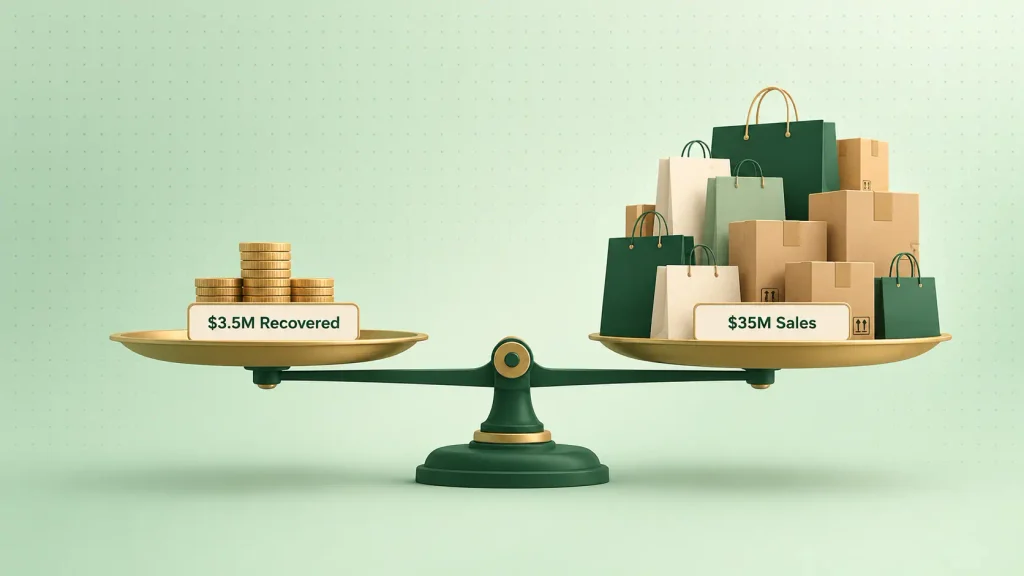
Take a $70M brand at a 5% deduction rate. That’s $3.5M a year. If the brand runs a 10% operating margin, earning that $3.5M back through sales would take $35M of extra revenue. Recovering it would take no extra sales at all.
Put simply: a 10% operating margin means the brand keeps $10 of profit from every $100 it sells. Deductions take money straight out of profit. So to make up $3.5M of lost profit by selling more, the brand would need to sell ten times that amount, $35M, because only a tenth of each new sale is profit. Winning back a wrongly taken deduction puts the full amount back in one step.
| Revenue | Deductions at 3% | Deductions at 5% | Deductions at 7% |
| $40M | $1.2M | $2.0M | $2.8M |
| $70M | $2.1M | $3.5M | $4.9M |
| $100M | $3.0M | $5.0M | $7.0M |
| $150M | $4.5M | $7.5M | $10.5M |
Most finance teams know the dollar total of their deductions. Far fewer know it as a rate, by retailer. The rate is what tells you whether you’re inside the normal range or well above it.
(If you’d rather know your own number than the industry average, that’s a two-minute request, not a research project.)
The Part That Should Bother You
Not every deduction is wrong. Some are fair: a shipment really was late, a label really was off. The problem is the ones that aren’t fair, and how few of them get fought.
Practitioners estimate that 10-20% of deductions are invalid but go unchallenged, because the team is buried in everything else (Talk Business & Politics). Invalid means the retailer took money it wasn’t owed. On a $3.5M deduction bill, that’s $350K to $700K a year you could have kept.
Three things make that money hard to get back.
Every retailer runs its own clock. Dispute windows typically run 30 to 90 days, depending on the retailer and the type of deduction (3PL Center). Amazon is among the shortest: SPS Commerce reports the best window for disputing Amazon shortages is about 30 days, and that disputes filed after 40 days succeed an estimated 0-5% of the time (SPS Commerce). Even within one retailer, the clocks differ: a Walmart compliance chargeback and a Walmart invoice deduction are handled and disputed differently (5G Sales). Once a window closes, the money is gone, valid claim or not.

Every dispute is manual. Filing an Amazon Vendor Central dispute by hand usually takes 15 to 30 minutes per deduction (iNymbus). Multiply that by every line item, across every portal, and it’s easy to see why most never get filed.
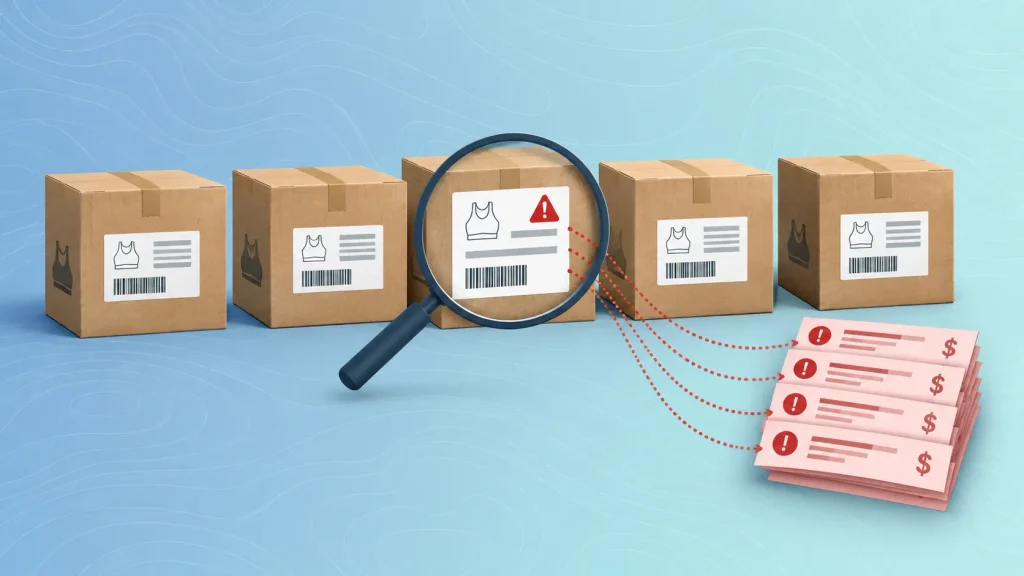
The proof lives somewhere else. The deduction shows up in a retailer portal. The evidence that beats it (the proof of delivery, the ASN record, the carton label) sits in your ERP, your EDI logs, and your 3PL’s system. Someone has to stitch those together, one claim at a time, before the clock runs out.
Why Activewear Gets Hit Harder
Few categories sell through as many different kinds of retailers as activewear does. A growing brand often ends up in several of these at once:
| Channel | Examples | What it adds |
| Sporting goods | Dick’s, Academy | Its own routing guide, label specs and delivery rules |
| Department stores | Nordstrom, Macy’s, Kohl’s | A different compliance rulebook again |
| Mass | Walmart, Target | Walmart fines 3% of the cost of goods on non-compliant cases when a supplier misses its monthly on-time, in-full goal (SPS Commerce) |
| Amazon 1P | Vendor Central | 40+ chargeback types; chargebacks average about 1.5% of invoice value in Q1 to Q3 and about 4% in Q4 (SPS Commerce, citing Carbon6) |
| Off-price | TJX, Ross, Burlington | Another set of vendor requirements |
| Specialty run, yoga and studio | Independent and regional stores | Smaller accounts, each with its own terms |
Each of these is a separate system: separate rules, a separate portal, and a separate dispute clock. A brand selling into four of them isn’t managing one deduction problem. It’s running four compliance operations in parallel, usually with the same one or two people.
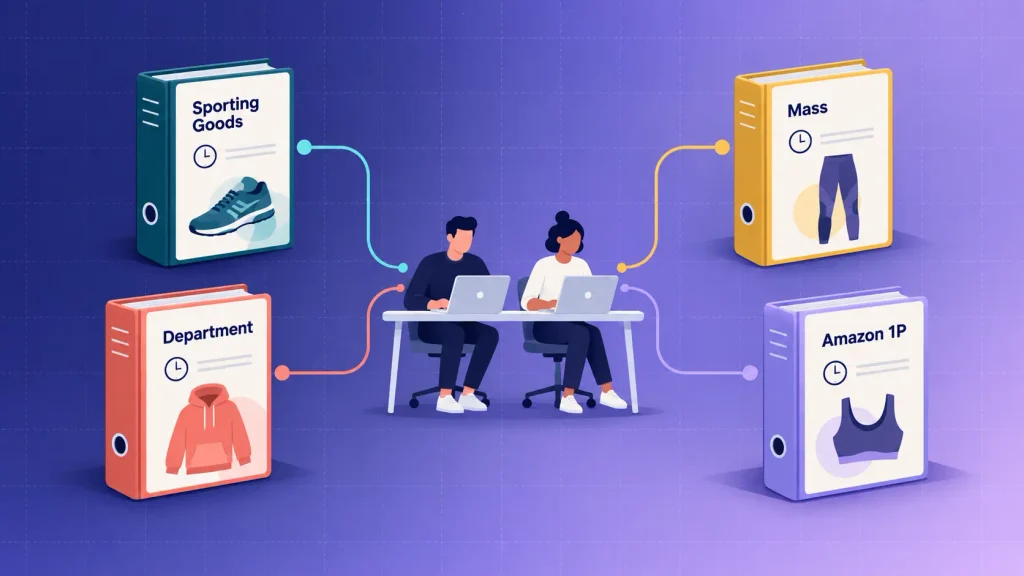
That’s also why growth cuts both ways. A running brand adding golf, a studio label adding kids’ sizes, a new account at Academy: each one is a fresh rulebook. The Amazon numbers show the pattern in miniature. If Q4 is your biggest Amazon quarter, it’s also the quarter where each order is most likely to be docked.
What It Adds Up To
Here is one illustrative brand: $70M in revenue, selling through Dick’s, Nordstrom and Amazon, with a 10% operating margin. The figures use the published ranges above, not any real company’s numbers.
| Amount | How it’s worked out | |
| Deducted each year | $3.5M | $70M × 5% |
| Likely invalid | $350K to $700K | 10-20% of $3.5M |
| Sales needed to replace that profit | $3.5M to $7M | Invalid amount ÷ 10% margin |
| Time to dispute by hand | 15 to 30 minutes per line item | Per deduction, before anyone finds the proof |
Read the third row again. Every invalid deduction that expires unchallenged costs as much profit as a sale ten times its size. And unlike new sales, this money is already yours. It was earned, shipped, and invoiced. It only needs to be claimed in time.
The invalid share is also the part you can shrink for good. When the same label error, the same carrier, or the same distribution center keeps triggering deductions, fixing that one root cause stops next quarter’s deductions before they happen.
Five Questions to Ask Your Team This Week
You don’t need software to start. You need answers to these:
- What is our deduction rate as a percentage of wholesale revenue, by retailer? If one account’s deductions are rising faster than its sales, that’s where to look first.
- What share of deductions did we dispute last quarter, and what share of those did we win?
- How much expired last quarter without anyone looking at it?
- What are our top three deduction reason codes, and do they keep coming from the same carrier, label or distribution center?
- When we add a new retailer, does our process scale, or does someone start from scratch?
Most teams can’t answer the first question without logging into every retailer portal by hand. That’s usually the reason nobody has answered it yet.
A retailer-by-retailer breakdown is a faster way to a first answer than pulling every portal yourself.
Get Your Own Number
The ranges in this article are industry averages. Your number depends on your revenue, your retailers, and how many separate systems you sell into.
Share those three things, and we’ll send you a written breakdown by email: an estimate of what your mix is likely losing to deductions, how much of it is likely invalid, and which of your retailers carries the most risk. It takes two minutes to request, and no call is required.
Or just reply to the email that brought you here.