
Your retailers are short-paying you. We build the system that Gets it back.
Footwear brands lose an estimated 5–7% of revenue to retailer deductions, and dispute only 20–30% of it before the window closes.
We build custom, Al-assisted deduction software tuned to your exact retailer mix. You recover more, keep 100% of it, and own the system outright.
Share your retailers and revenue. We send back a written teardown. No call required.
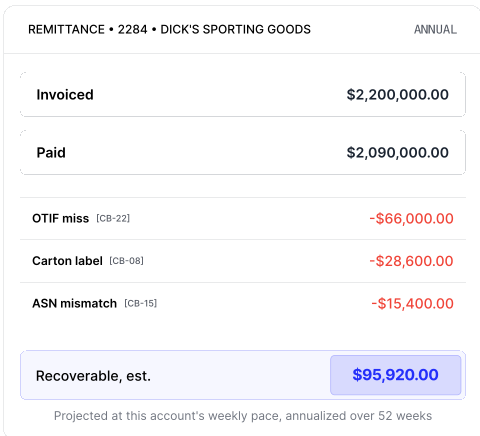
The leak
It’s not one big bill.
It’s a thousand small ones.
Deductions never show up as a single alarming invoice. They land as hundreds of sub-$500 line items — an OTIF miss here, a carton-label chargeback there, an ASN mismatch next week. Each one is easy to wave off, easy to write off as the cost of doing business. Add them up, and the story changes fast.
$4M a year, gone. That’s what a 5% deduction rate quietly costs an $80M wholesale book — every single year. Columbia Sportswear’s U.S. segment — a comparable multi-channel active/outdoor apparel business — ran a 15.0% operating margin in 2025; apply that to an $80M book and operating profit lands around $12M — so a $4M leak isn’t a rounding error. It’s roughly a third of the profit the business actually made.
Stacked up, deductions and chargebacks run 3% to 8% of annual sales for most brands, and around 5–7% per SPS Commerce’s own published data — before trade and shortage deductions are even added on top. And it compounds every year it goes unmanaged: the deductions that expire unchallenged this quarter don’t reset the leak — they just make next quarter’s baseline a little worse.
So most of that $4M must just be invalid claims you’ll never win back — right?
THE REAL INSULT
Most of it is still winnable.
Almost none of it gets fought.
You don’t need most deductions to be invalid to make this worth fixing. You need a fraction of them disputed properly, consistently, before the window closes — and right now almost nobody does that.
20–30%
of deductions ever get disputed at all. The rest expire quietly inside the window. (SPS Commerce)
~40%
average win rate once documentation exists — and 74% at Walmart on well-documented first-time disputes. (SPS Commerce)
Recovery on the same $4M leak
Disputing like most brands do today
~$400K/yr
Disputing closer to everything winnable
~$1.6M/yr
A 4× swing — 25% disputed at a 40% win rate, versus disputing closer to everything winnable. Same leak, same $4M.
You already own an ERP, EDI, a 3PL — so why doesn’t a normal tool just catch these? Because no two of your retailers play by the same rules.
Why generic tools fail you
Every retailer is its own rulebook
You’re running sporting goods, department stores, specialty run and yoga retailers, off-price, mass, and Amazon 1P at once — each grading you differently, each with its own routing guide, label spec, and ASN format.
Walmart
~3% of COGS
on OTIF misses
Target
~5%
on non-compliance
Amazon 1P
$2.60–$250
15+ chargeback types, per unit to per incident
Most retailers
1–20%
of gross invoice, by severity
And it’s worst exactly when activewear ships the most: Amazon 1P chargebacks average ~1.5% of invoice value Jan–Sep, then climb to ~4% in Q4 — the New Year fitness surge and holiday gifting, activewear’s two heaviest volume windows, sit right at the edges of that spike. (Carbon6)
A tool built for the average brand flags the wrong things and misses real claims across a mix like yours. That accuracy gap is real money, every quarter.
The system
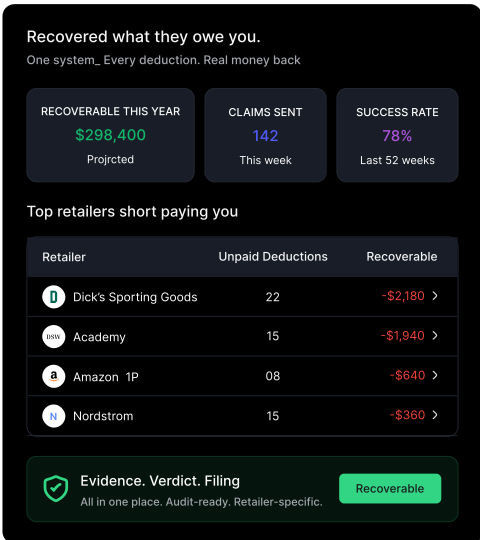
One screen. Every deduction. Proof already attached.
A single queue pulls every deduction across all your retailers, sorted by what’s actually worth recovering. Beside each one, the proof is already there — PO, POD, label, ASN — with a plain verdict: worth disputing, here’s the filing, send it.

The 15-minute claim becomes a 30-second one
Invalid charges stop expiring inside the dispute window
Repeating deduction codes surface, so root causes get fixed
AI-assisted, living inside your ERP, EDI, and 3PL stack, not another portal
Tuned to your retailers, not a one-size template
HOW IT WORKS
From leak to recovery in three moves
01
We map your leak
Tell us your retailers and revenue. We map where you’re losing money and estimate what’s recoverable, in writing.
02
We build it around your shelf
A system tuned to your exact retailer mix, plugged into your stack. One queue, auto-assembled proof, dispute-ready. First release in weeks, starting with your highest-volume retailers.
03
You recover, and own it
Every recovered dollar stays with you. No per-dispute fee, no cut. The system is yours — code, data, and roadmap.
Build vs rent
Own the system. Keep all of the recovery.
We’ll say it plainly: renting a platform is the right move for small, simple brands. Owning wins once your volume and channel complexity are real — which, if you’re here, they probably are.
Rent a platform / recovery firm

Cost shape
A 25–30% cut of every dollar recovered, forever (published rates from firms in this space)
Build once. It’s yours
What you keep
Recovery minus 25–30%
100% of what you recover
Fit
Built for the average brand
Built for your exact retailer mix
Accuracy
Generic matching, more false flags and missed claims
Tuned to your shelf, more real claims caught
Ownership
Subscription, lock-in, your data in their cloud
You own the code, data, and roadmap
Where it lives
Another portal to log into
Inside your existing stack
On $1M recovered in a year, a 25–30% contingency fee is $250K–$300K, every year, for as long as you keep using them. Own the system instead, and that $250K–$300K stays with you.
We’ve automated messes like this before
Complex operations, made simple
Deductions are a cross-system, manual, money-slipping-through-the-cracks problem. That’s exactly the kind of thing we build AI systems to fix. Our closest proof: a multi-warehouse fulfillment platform we automated end to end.
“They helped us automate our entire fulfillment workflow and made a really complex platform feel simple and solid. Couldn’t have launched without them.”

Alex Newell
Co-Founder & CFO, Fulfillit.io
Fulfillit.io is a BoomDevs-built 3PL platform for Amazon FBA sellers. Different problem, same shape: many disconnected systems, heavy manual work, and a finance leader who needed it to just work.
Is this you?
Built for mid-market footwear brands
This tends to pay for itself inside the first year for brands that look like this:

$40M to $150M in wholesale revenue
Selling into two or more major retailer systems — sporting goods, department, specialty run/yoga, off-price, mass, or Amazon 1P
A finance or AR team losing real hours to retailer portals
Not already locked happily into a recovery platform
Sound like you? Get the number in writing.
Questions finance teams ask
The honest answers
How much are activewear brands really losing?
Industry estimates put deductions at 3% to 8% of annual sales, with SPS Commerce’s own data around 5% to 7%, before trade and shortage deductions. The bigger issue isn’t how much is invalid, it’s how little gets challenged: only 20% to 30% of deductions are ever disputed, even though disputes with solid documentation win about 40% of the time on average, and closer to 74% at retailers like Walmart when the paperwork is clean.
We already have an ERP and a 3PL. Why isn’t that enough?
Deductions live in retailer portals, while the proof that beats them — PODs, ASN logs, label evidence — is scattered across your ERP, EDI, and 3PL. Nothing connects them by default. That’s the gap we close.
Isn’t a tool like SupplyPike or SPS simpler than building?
Sometimes, and we’ll tell you when. Building wins when your retailer mix is unusual, when per-dispute or percentage fees are eating your recovery, or when you want the system inside your own stack and roadmap.
How long until it’s working?
We start with your highest-volume retailers, usually a usable first release in weeks, then expand to the rest, prioritizing wherever you’re bleeding most.
Does it prevent deductions or just recover them?
Both. Recovery gets this quarter’s money back. The root-cause view stops the same label, carrier, or DC error from repeating next quarter.
Do we really keep 100% of recovery?
Yes. No per-dispute fee and no cut. You paid to build it, so the dollars it claws back are entirely yours.
See what’s recoverable
Get a written teardown before you commit to anything
Tell us your retailers and revenue. We’ll send back where you’re likely leaking and what’s recoverable across your mix. Read it in two minutes. If you want to go further, we talk. If not, you’ve still got a clearer number than you had this morning.
No call required · No cut of your recovery, ever
We’ll only use this to build your teardown. No spam.